Skip to content
DevMeme
795 of 7435
Programmers as Human Compilers
DevCommunities Post #899, on Dec 9, 2019 in TG

Programmers as Human Compilers

Why is this DevCommunities meme funny?

Level 1: Stop Reading, Start Complaining

Imagine you're listening to a story, and as soon as the storyteller says one thing you don't like, you instantly put your hands over your ears and yell, "This story is silly!" to everyone around. You didn't wait to hear the rest of the story or find out the ending — you just stopped at the first thing that bothered you and started complaining right away. This meme is joking that programmers do the same thing when they read something. The moment they see one line in an article that they think is wrong, they quit reading the article and immediately go online to complain about that line. It's a funny comparison because it's such an over-the-top reaction. It’s like a robot that encounters a tiny error and freezes up, refusing to continue. In real life, if we act like that, it’s obviously a bit silly — you might miss out on important stuff that comes later. The humor here is pointing out, in a playful way, that sometimes people (especially tech folks) behave a little like robots or machines: hitting a “stop” button as soon as something isn’t exactly how they want, and then making noise about it. We can laugh at it because we know, yes, sometimes we do that, and it’s as absurd as a movie character who storms out of the room after hearing one disagreeable word. The meme basically says: “See how goofy that is? Don’t be like a machine that stops at the first error. Hear the whole story!” But it says it with a wink and a laugh, comparing us to a compiler (a very strict computer program) to get the point across.

Level 2: Compiler vs Reader

Let’s break down what this meme is saying in simpler terms, especially if you’re not deeply familiar with compilers. A compiler is a program that takes source code written by developers (say in C++ or Java) and translates it into a form that computers can execute (like machine code or bytecode). It’s very strict about the code being correct. Think of a compiler as an ultra-picky editor or teacher for your code: if you make a mistake in the code’s syntax (like forgetting a ; at the end of a statement, or having parentheses that don’t match), the compiler raises a syntax error. It usually won’t continue beyond that point until you fix the error. For instance, if on line 10 of your code you misspelled a keyword or used a variable that wasn’t defined, the compiler will stop right at line 10 and complain, “Error – something’s wrong here.” It won’t go on to line 11 or 12 at all, because it considers the code broken from that error onward. This behavior is by design: it’s like if you’re reading instructions and you hit a step that makes no sense, you might pause there rather than blindly follow the rest. In coding, that pause is the compiler refusing to compile further. Every programmer is familiar with seeing a compiler error and having to go back to edit the code. You can’t run the program until that error is resolved – the compiler is essentially saying “I refuse to build this; there’s a problem you need to address first.”

Now, what does that have to do with reading essays and tweeting? The meme is making an analogy (a comparison). It suggests that programmers reading an essay can behave like a compiler reading code. An “essay” here could be a long blog post, article, or any written piece, often about a tech topic or opinion. When we say “tweet about it”, we mean the person goes on Twitter (a social media platform popular in tech circles) and posts a short message for everyone to see, usually expressing their opinion or reaction. So imagine a programmer starts reading a tech essay. They’re going through it line by line (or paragraph by paragraph). According to the meme, the moment they encounter the first line that they disagree with – maybe a statement or claim in the essay that doesn’t match their own view or experience – they stop reading any further. Immediately, they switch over to Twitter and fire off a tweet complaining about that line. In effect, they’ve read up to “the first disagreeable line” and then bailed out, exactly like a compiler that stops at the first error in code and spits out an error message. The tweet is the equivalent of that error message: it’s the person broadcasting “I found something wrong here!” to the world, without seeing what comes next.

Let’s use a concrete example to make this crystal clear. Suppose there’s an essay titled “10 Reasons Why Framework X is the Future of Web Development.” A curious programmer starts reading it. They get to reason #1, which says, “Framework X is faster than all its competitors because of feature Y.” Now, imagine this programmer has had a different experience and strongly believes that claim is false – perhaps they’ve benchmarked and found Framework X is actually slower in some cases. This is the first line they disagree with. According to the pattern in the meme, at this point our programmer will stop reading the other 9 reasons. They’ll jump straight onto Twitter and post something like: “Ugh, this article lost me at ‘X is faster than everything’. What a joke.”

What happened there? The programmer treated that first controversial line as if it were a fatal error in the text. Instead of continuing to read reason #2, #3, and so on (which might contain important context or even counterpoints), they abandoned the “compilation” of the essay in their mind. And their tweet is effectively an error report – announcing the flaw they found. This mirrors a CompilerError scenario: the compiler would see something it considers invalid at that point in code and immediately output an error like “Compilation failed: unexpected token” or “undefined reference encountered,” then stop without analyzing the rest of the code. The person did the same but in a discussion sense: “I saw something I think is wrong, so I’ll announce ‘this essay is wrong here’ and not examine the rest.”

Why is this funny or noteworthy? Well, among programmers, it’s an almost comic exaggeration of a RelatableDeveloperExperience. We know how compilers can be abrupt and unforgiving – one tiny mistake and you get a wall of red text or at least a stern error line. And we also know (perhaps sheepishly) that in heated online debates, some of us have that same abrupt reflex. It’s humorous because it highlights a flaw in how we sometimes communicate. We’re basically being called out for not fully reading or considering an argument, in a joking way. The use of the compiler analogy is perfect for a dev audience because compilers are something we deal with regularly. It’s much more clever (and lighthearted) to say “haha, I function like a compiler here” than to say “I tend to be impatient and reactive when reading things I disagree with.” The former makes us chuckle and nod; the latter might feel like a personal critique. By couching it in fun tech terms, it becomes a shared joke.

To put it simply: The tweet is comparing code compilation to reading comprehension (or lack thereof). Reading until something doesn’t fit your expectations, then reacting immediately, is like a program that runs until it hits an error, then crashes. In an ideal world, a person would read the whole essay like running a full program, maybe take notes of disagreements, and then respond thoughtfully (just like some compilers can collect multiple errors before stopping). But many of us don’t do that, especially not on fast-paced social media. We short-circuit. The meme shines a light on this habit in a playful manner. It’s saying, “Hey developers, you know how your compiler stops at the first error? Sometimes you do that too when you argue on the internet!” And it’s funny because, well, it’s kinda true and it’s a quirky comparison. It’s TwitterHumor meets programming culture. Even the structure of the original joke (being a tweet itself) underscores the point: it’s a quick broadcasted reaction about people who react too quickly on broadcasts. 😄

Here’s a side-by-side comparison to drive the point home:

What a compiler does 🖥️ What a programmer does 😅
Reads code line by line Reads an essay or article line by line
If it finds a mistake, it stops immediately and flags an error 🙅‍♂️ If they find a statement they disagree with, they stop reading and flag it on Twitter 🛑
Shows an error message (e.g., “Syntax error at line 5”) 📝 Posts a tweet about the “wrong” line (essentially an error complaint) 💬
Doesn’t produce output until code is fixed (no complete program generated) 🚫 Doesn’t see the rest of the essay’s argument (no complete understanding reached) 🤷

In both columns, something is getting “compiled,” and in both cases the process halts at the first sign of trouble. For the compiler, the trouble is a code bug; for the programmer-reader, the trouble is an idea they don’t agree with. The table highlights the parallel in a straightforward way.

So, in summary, the meme is a light-hearted critique of a common habit in tech discussions: not fully reading before reacting. By using the compiler metaphor, it communicates that idea in a fun, geeky way that programmers can instantly relate to. After all, we deal with compilers complaining about our mistakes every day — it’s ironically fitting to realize we sometimes behave just like them when confronted with ideas we think are mistakes. It’s a joke at our own expense, and that’s why it’s both funny and a little insightful. Next time you catch yourself about to rage-tweet at an article after one paragraph, you might remember this meme and decide to read a bit more... effectively telling your inner compiler, “Hey, try a bit of error recovery and continue parsing the input!” 😉

Level 3: Compile-Time Critique

For any experienced programmer active in online dev communities, this meme hits close to home. It’s funny because it’s true: we’ve all either seen or been the person who reacts to an article way too fast. The tweet text says, “programmers tend to read essays until they get to the first line they disagree with and then tweet about it, like a compiler.” Instantly, a seasoned developer will recall how a compiler stops cold at the first error in code, and likely also recall countless flame wars or Twitter threads that started because someone couldn’t get past one provocative statement in a blog post. The humor comes from recognizing that quirky parallel between how our tools behave and how we sometimes behave. It’s a form of self-aware DeveloperHumor that makes you smirk and think, “Yep, I’ve seen that compiler error... and I’ve seen that guy on Twitter.”

Why this combination of elements creates humor: It’s the juxtaposition of a rigid machine behavior with human behavior. Compilers are deterministic and emotionless – they do exactly what they’re programmed to do, halting on the first error because that’s the logical thing when input violates the rules. Humans, on the other hand, should be capable of nuance and patience. Seeing developers (who pride themselves on logical thinking) act just as rigidly as a program is ironically hilarious. The phrase “like a compiler” is the punchline that ties it all together. It’s classic TechHumor: you need to know a bit about compilers and a bit about developer online culture to fully appreciate it. When those two knowledge areas connect, it produces that “aha, I see what you did there” kind of laughter. The meme essentially calls out an engineer’s knee-jerk reaction in a language engineers understand. It’s an inside joke that lovingly mocks our own tendency to be pedantic or impatient in discussions. We’ve turned a mirror on ourselves and coded the reflection in C++ error messages.

Industry patterns being satirized: This meme is lampooning a common communication anti-pattern in tech circles: fail-fast feedback. Just as some systems are designed to fail fast on errors, some conversations in the developer world seem to fail at the first sign of disagreement. It’s pointing at the habit of giving a first_error_reaction rather than fully engaging with content. Think about times you’ve seen a long technical proposal or a detailed blog post shared in a community. Often, the discussion focuses disproportionately on one line or an out-of-context excerpt that someone took issue with. For instance, maybe an essay on cloud architecture has a throwaway line like “Monoliths are inherently inferior to microservices.” A reader who disagrees might zero in on that, tweet “This author is clueless – monoliths can be great!” and not read another word. The whole essay could be full of good points or even clarify the nuances of that statement later, but the discussion is already derailed to just that line. It’s an analog of how a compiler won’t look at later lines of code if an early line breaks the rules. The meme exaggerates it a bit for comedic effect, but not by much! We really do see that kind of one-and-done reading behavior a lot.

The unspoken shared experience: Every developer with a Twitter account or who follows tech discussions has likely witnessed this. Maybe a prominent figure tweets a link to an article about a new programming paradigm. Scroll the replies, and you’ll find someone quoting a single sentence from the article with a snarky comment, clearly indicating that was as far as they got. It’s almost a running joke — did you even read past the first paragraph? Often the answer is “nope.” This shared experience is what makes the meme so relatable. It’s a gentle poke at our collective impatience. And let’s be honest, many of us have been guilty of it too: reading an opinionated essay, hitting a claim that rubs us the wrong way, and immediately Alt-Tabbing to social media to set the record straight. The meme makes us laugh at that impulse by comparing it to something as mechanical as a compile error. It’s basically saying, “Look, we’re acting like our own programs here!” — which is both funny and a tiny bit embarrassing.

Real-world scenarios where this happens: You don’t have to look far. Hacker News and Reddit threads are rife with this pattern. Someone will submit a long technical article, and the top comment might be “> I stopped reading when the author said we should all use Kubernetes for everything.” The replies to that comment might include, “Well, if you had read the next sentence, you’d see they caveated it.” This is literally the meme in action: programmer sees one disagreeable statement, stops reading, jumps straight to commenting. On Twitter, the effect is amplified by the platform’s design. People post hot takes quoting a fragment of an essay, essentially broadcasting a tweet about that first disagreeable line to all their followers. It’s like a build log being publicly dumped after a failed compile. By the time (or if) they ever read the rest, the discourse has already run away on that tangent. If you’ve ever authored content, you might’ve experienced this from the other side: you publish an essay and suddenly someone is arguing with a point you addressed later in the text. You think, “If only they had read the whole thing!” — a sentiment akin to “if only the compiler would have seen the closing brace later in the file.”

Why this keeps happening (and is hard to fix): Developers are trained to be laser-focused problem solvers. We fixate on correctness. So when a statement in an essay appears incorrect (to our perspective or experience), it triggers the same reflex as seeing a bug in code. We want to call it out immediately. There’s also an element of ego and public performative knowledge: by tweeting a quick rebuttal, a person might feel they’re demonstrating expertise or keen insight (just as a compiler proudly prints an error it caught). Unfortunately, this means skipping the due diligence of reading thoroughly. Culturally, the fast-paced nature of social media encourages quick reactions; if you don’t chime in now, the conversation (and clout) might pass you by. In a way, it incentivizes a “single-pass” reading – kind of a Just-In-Time Outrage 😜. Just as JIT compilation compiles code on the fly at runtime, devs generate outrage on the fly at read time. Waiting to form a considered opinion is like doing extra passes; it feels slow when the social conversation is moving fast. So we get this endemic behavior where even very smart people will react hastily. The meme shines a light on it, but fixing it would require changes in how we consume information (and maybe a personal setting to run our mental compiler in a more lenient mode!).

The systemic effect and culture: The comparison to a compiler failing fast hints that this might not be entirely positive. In software, failing fast is often good – better to catch an error early than let it persist. But in human communication, failing fast can short-circuit understanding and nuance. When everyone does this, discussions become a series of fragmented hot takes. The DevCommunities on Twitter and elsewhere can devolve into cycles of quick judgments, rather than collaborative problem-solving. It’s a known quirk of tech Twitter that sometimes it feels like an infinite loop of people reacting to half-read content. The meme resonates because everyone who’s been in those discussions recognizes the pattern and can laugh, nodding, “yep, seen that thread before.” It’s almost cathartic to call it out. And doing so in the language of CompilerErrors and code is perfect, because that’s the common tongue of software engineers. It softens the critique with humor: we’re basically gently roasting ourselves for behaving like rigid Pascal compilers from the 80s, throwing a tantrum at the first sign of an unexpected token.

To summarize the cultural insight with a sprinkle of humor: this meme is pointing out that in developer culture, reading an argument often gets treated like compiling code. We perform a compile-time critique – evaluating the text in real time and stopping at the first “error” we perceive. It’s a relatable flaw turned into a joke. Everyone from junior devs to battle-scarred architects can see a bit of truth in it. That combination of truth and irony fuels the meme’s popularity. After all, recognizing our own follies is easier when we frame it as a nerdy joke. So the next time you catch yourself about to tweet “This article is stupid, I disagree with line 3,” you might remember this meme and chuckle — perhaps you’ll think, “Oops, I’m acting like a compiler. Maybe I should read the whole thing (run the whole program) before throwing an error.” And that self-awareness (sprinkled with laughter) is exactly what this kind of DeveloperHumor is meant to spark. It’s an inside joke with a gentle lesson: humans > compilers, so maybe we can afford to not crash on the first error. 😅

Level 4: Compilation Terminated

This meme leverages a deep understanding of how compilers process code to humorously comment on developer behavior. In a compiler pipeline, source code goes through multiple stages (lexical analysis, parsing, semantic analysis, optimization, code generation) that enforce strict formal rules at each step. The moment the compiler encounters something that violates the language’s grammar or type rules, it typically raises a compiler error and stops right there. This is the classic fail-fast approach in compilation: no further lines are evaluated once a fatal flaw is found. For example, consider a snippet of C++ code with a tiny mistake:

#include <iostream>

int main() {
    int x = 42  // Missing semicolon triggers immediate error
    int y = x * 2;
    std::cout << "Result: " << x + y << std::endl;
    return 0;
}

When you try to compile this, the compiler will complain at the line with the missing semicolon and refuse to proceed to the next lines or produce an executable:

error: expected ';' before 'int'

The compilation process halts at that first error. The compiler doesn’t attempt to interpret the rest of the code once it hits a show-stopping issue – it effectively says, “I can’t continue until you fix this.” This behavior ensures that no meaningless output is generated when the program is invalid. It’s a design choice to prevent cascades of false errors: one structural problem can confuse the parser so much that continuing might produce a flood of spurious errors. Stopping at the first real error often makes the programmer’s job easier, since you fix issues one at a time. The key point is that a compiler is an unforgiving, literal machine: as soon as it detects a rule violation, compilation is terminated.

Now, the meme’s joke is an elegant compiler_analogy: it compares a programmer reading an essay to a compiler compiling code. The “first line they disagree with” in the essay is analogous to the first line of code that a compiler finds erroneous. At that point, like a strict compiler, the programmer’s brain halts processing any further input. They effectively stop “parsing” the essay and immediately produce output – in this case, a tweet voicing their disagreement. The tweet is humorously equated to a compiler’s error message. It’s as if the person’s mind, acting as a human compiler, encountered an “invalid statement” in the essay and reacted by dumping an error to the console (Twitter). The meme highlights how the programmer doesn’t continue reading the rest of the essay (just as a compiler doesn’t continue compiling the rest of the source file after a fatal error). This one-to-one mapping of behavior forms the core of the joke.

We can even map compiler concepts to this scenario in a tongue-in-cheek way: When reading an argument or an opinion piece, developers often have an internal set of expected rules and definitions (their mental “language specification”). A statement that contradicts their expectations triggers a failure in understanding – a bit like encountering a token that doesn’t fit the grammar. In compiler terms, the reader hits a parse error. Real compilers implement strategies for error recovery – for instance, a compiler might skip some tokens or assume a missing symbol and try to continue, in order to report multiple errors in one go. But not all compilers do this, and even those that do often can’t get very far after a serious error. Similarly, the meme is poking fun at the idea that many programmers do no error recovery at all when reading: the first disagreeable idea is treated as a critical failure, and they don’t attempt to parse anything that comes after. They’re operating in a strictly fail-fast mode socially.

To make the analogy even more precise, think about the distinction between syntax and semantics in code. A syntax error is when the code structure is invalid (e.g., a missing curly brace or misordered keywords), and it will immediately prevent the compiler from building an Abstract Syntax Tree (AST). A semantic error is when the code is syntactically correct but doesn’t make sense in context (like using an undefined variable or a type mismatch) – the compiler will also error out on that once detected. In the essay scenario, it’s not a literal syntax issue with English; it’s more like a semantic disagreement – the programmer thinks the content of that line is wrong or illogical. But the reaction is as non-negotiable as a syntax error: one violation of expected logic and boom, compilation (reading) stops. The brain’s internal type-checker has thrown an exception 😅. The humor is that we developers, who design and use these rigid compilers, sometimes behave with the same rigidity in discussions. We treat an unexpected idea in a longform argument as if it were a stray semicolon or an invalid type conversion, and we abort processing the rest.

This comparison resonates strongly in DevCommunities because it’s both exquisitely nerdy and accurate. It’s bridging a computer science concept with human behavior. In fact, it’s a bit of self-mockery from programmers: we trust compilers for their precision, but when we act like compilers in conversations, it’s clearly a tongue-in-cheek critique of our impatience. The meme format (a tweet) even doubles down on the idea – Twitter is essentially a real-time stream of outputs (tweets) reacting to inputs (things people read). The meme calls out a pattern many recognize: a long essay is published in the community, and almost immediately your timeline shows someone ranting about one sentence from it. The analogy paints those reactions as the “error messages” of an overzealous code compiler. In other words, programmers compile essays the way a compiler compiles code: they scan until something “does not compute” and then throw an error (tweet) without looking further. This blend of social commentary and computer science insight is what makes the humor click for an audience immersed in TechHumor. It’s a joke that requires knowing how a compiler works, so when you get it, you feel like part of the in-crowd of developers who can chuckle at this shared quirk.

Description

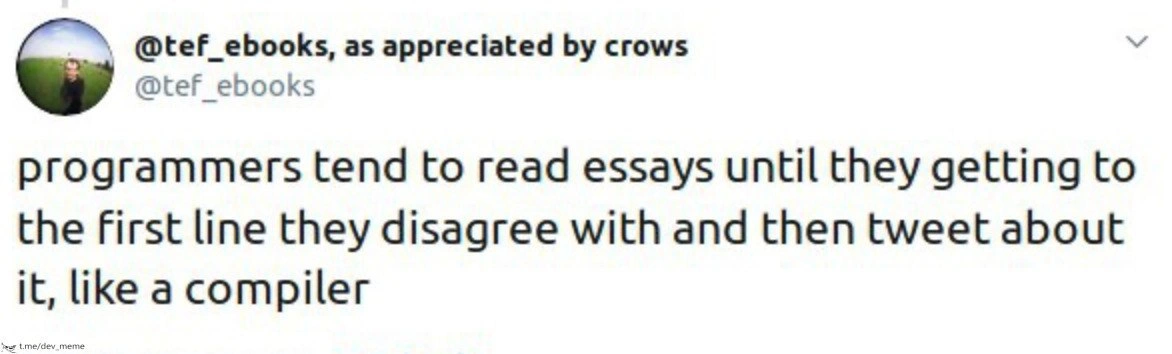
A screenshot of a tweet from the user '@tef_ebooks, as appreciated by crows' (@tef_ebooks). The tweet reads: "programmers tend to read essays until they getting to the first line they disagree with and then tweet about it, like a compiler". The humor comes from the sharp analogy between a common developer behavior and the functionality of a compiler. A compiler processes code and halts at the very first error it finds, refusing to go further. The tweet satirizes the tendency within developer communities for individuals to seize upon a single perceived flaw or point of disagreement in an article or argument, immediately broadcasting their objection without necessarily engaging with the piece as a whole. It's a commentary on the culture of pedantry and argumentative discourse prevalent in online tech circles
Comments

7
Anonymous ★ Top Pick A programmer's 'Well, actually...' is just a human-readable compiler error, halting execution of the conversation until the perceived syntax error is addressed
  1. Anonymous ★ Top Pick

    A programmer's 'Well, actually...' is just a human-readable compiler error, halting execution of the conversation until the perceived syntax error is addressed

  2. Anonymous

    I read tech blogs the way Clang parses code: hit one “monoliths are dead” token, emit 200 lines of colorful diagnostics to Twitter, abort all optimizations, done

  3. Anonymous

    We've optimized our brains for O(1) disagreement detection but somehow still run our code reviews at O(n²) complexity

  4. Anonymous

    Ah yes, the classic fail-fast pattern applied to reading comprehension - except instead of gracefully handling the exception and continuing execution, we immediately dump the stack trace to Twitter and exit(1) the entire discussion. At least compilers have the courtesy to show you *where* the error occurred; we just quote-tweet with 'this is wrong' and call it code review

  5. Anonymous

    My reading algorithm has early-exit on disagree(line) that throws TweetException; with -Werror enabled, I never reach paragraph two

  6. Anonymous

    Programmers read essays like `grep -m1 'disagree'`: halt at first hit, pipe outrage straight to Twitter

  7. Anonymous

    I read essays with -Werror enabled; the first shaky premise triggers abort(1) and emits a 280-char stacktrace to prod

Use J and K for navigation