Skip to content
DevMeme
4694 of 7435
From Stack Overflow to ChatGPT: debugging tool generation gap in 2023
AI ML Post #5144, on Apr 21, 2023 in TG

From Stack Overflow to ChatGPT: debugging tool generation gap in 2023

Why is this AI ML meme funny?

Level 1: Human Help vs Robot Help

Imagine your grandma says, “When I had a problem with my homework, I used to go ask all my neighbors or look it up in big books.” And you, a kid of today, smile and say, “Sure, grandma, that’s nice, but now we have a little robot in the house that can answer any question!” The meme is just like that, but for computer programmers.

In the “old days” (not even that long ago, but before 2023), if a person writing code got stuck or had an error, they would ask other people on the internet for help. It’s like asking a bunch of friends or experts, “Hey, have you seen this problem before?” They would use special websites (forums) where people help each other by posting answers. That was the normal way to get help.

Now, in 2023, there’s a new way: you can ask an AI helper (kind of like a super-smart talking computer). This AI, called ChatGPT, has learned a lot from the internet and can give you answers almost like it’s an expert itself. So it’s as if instead of calling a friend for advice, you just talk to a smart computer program and it tells you what it thinks the solution is.

The funny part of the picture is that the younger person is treating the older person very gently, almost like you’d treat a sweet grandma who is stuck in her old habits. When the grandma character says “we used forums like Stack Overflow to debug,” that’s her talking about the old way (asking people on a forum for help with code problems). The young helper responds “Sure grandma, let’s get you to bed. ChatGPT can help you,” which is a playful way of saying, “Okay, that was then, but now let’s use the new way – the AI can help.” It’s like if your grandma talked about using a typewriter and you said, “Sure, grandma, let’s get you to bed; I’ll just use my computer to write it for you.” You’re not literally putting grandma to bed; it’s an expression meaning “Alright, that’s old info, time to move on.”

So in simple terms: the meme compares old-fashioned help (asking humans on a forum) with modern help (using an AI bot). It makes us laugh because it shows the older method as if it’s something only a very old person would insist on, and the new method as obvious and easier. It exaggerates just how fast technology changes in a funny way. Even though Stack Overflow (the forum) is actually still used by many, in this joke it’s treated like ancient history. The essence is: people used to help me debug my code, but now a computer can help me debug my code. And the young person is humorously patting the old way on the head, saying “that’s enough, let’s rely on the new tool now.” It’s a lighthearted way to show how new generations do things differently from the old, even in programming.

Level 2: Posting vs Prompting

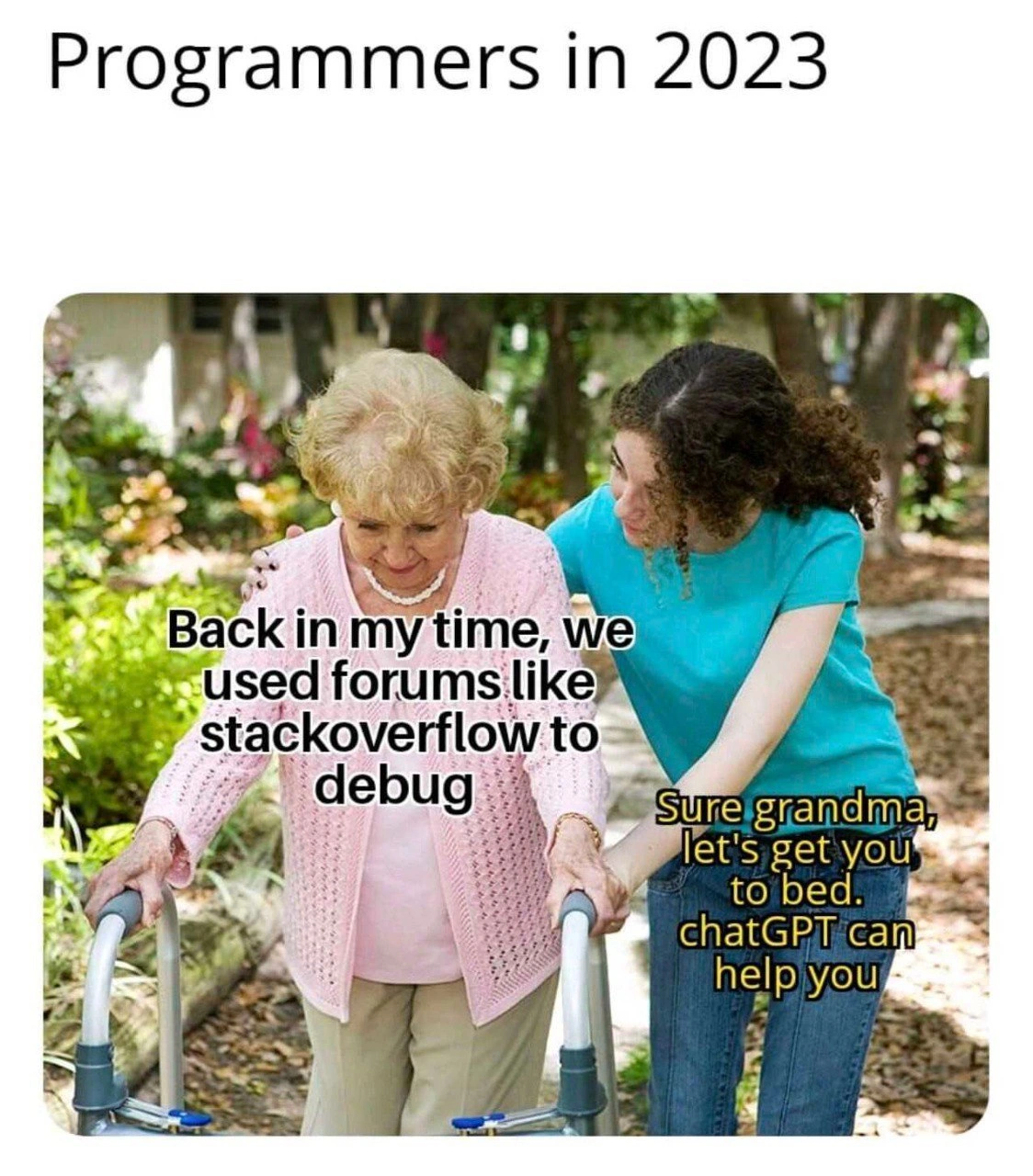
Let’s break this meme down in simpler terms. The image labeled “Programmers in 2023” shows an older woman (the “grandma”) being helped by a younger woman. The text over the grandma reads: “Back in my time, we used forums like StackOverflow to debug.” The text over the helpful younger person says: “Sure grandma, let’s get you to bed. ChatGPT can help you.” This is a humorous portrayal of a generation gap in how programmers solve problems (specifically, how they debug code).

Stack Overflow is an online Q&A site (a forum specifically for developers) where you can post programming questions and get answers from other programmers. When the grandma character says “we used forums like Stack Overflow to debug,” it means that in her time (not actually a long time ago, but before AI helpers were common), programmers would troubleshoot errors by searching the web or posting on community forums. For example, if you hit an error message, you might copy that error into Google, find a Stack Overflow thread where someone had the same issue, and then use the solution mentioned there. “Debugging via forums” was basically asking other humans for help on the internet and benefiting from their expertise. Debugging itself means finding and fixing errors or bugs in your code. So she’s describing the old-school way a lot of developers did that: by collectively sharing knowledge on sites like Stack Overflow (or similar forums).

Now enter ChatGPT – an AI assistant. ChatGPT is a type of AI (Artificial Intelligence) tool known as a language model, which can answer questions and have a conversation. By 2023, ChatGPT became famous for being able to help with all sorts of questions, including coding problems. Instead of searching a forum, a programmer can now directly ask ChatGPT something like, “Hey, why am I getting this NullPointerException in my Java code?” and ChatGPT will try to explain the cause and how to fix it. It’s like having a very knowledgeable (though sometimes imperfect) robot friend who’s read all the programming manuals and forum posts out there. This is a big change in developer communities and tools. Rather than reaching out to other people online, many devs in 2023 started reaching out to an AI for quick help – we call these AI assistants or LLMs (Large Language Models). It’s a new way to do debugging/troubleshooting: ask the AI for guidance, maybe even have it write a bit of code as a hint.

The line “Sure grandma, let’s get you to bed. ChatGPT can help you.” is a reference to a popular meme format. People online often use “Sure, grandma, let’s get you to bed” as a joking response when someone says something that seems outdated, confused, or just silly. It’s like treating the person as an elderly grandparent who’s talking about the old days or maybe hallucinating a bit, and you gently say “okay, time to rest now” as if to humor them. In this meme, the younger developer is basically teasing the older one for suggesting Stack Overflow, implying that Stack Overflow is an old-fashioned way to do things – so old-fashioned that only a grandma would talk about it! She then says “ChatGPT can help you,” meaning let’s use the new tool instead. This contrast is the joke: StackOverflow vs ChatGPT, or old vs new.

To give more context, Stack Overflow (founded in 2008) was the place where developers got help for a long time. You’d earn reputation points there by answering questions, and those points were a proud achievement in the developer community. It’s part of what we call Dev Communities – programmers helping programmers. On the other hand, ChatGPT became widely available in late 2022, and by 2023 it felt almost magical. You could type a question and get a pretty decent answer or an explanation in plain English, without waiting for someone to respond. This felt like a new generation of debugging tool. It doesn’t mean forums like Stack Overflow disappeared overnight (far from it), but suddenly there was this shiny new helper.

The meme is highlighting an evolution in debugging tools. It’s as if one generation of developers is telling a story: “When I had a bug, I posted on a forum or searched and found someone’s answer,” and the next generation laughs and says, “Ha, that’s so yesterday – now we just ask the AI chatbot for help.” It’s exaggerated for comedic effect, because realistically many programmers still use both methods. But it’s true that there’s a feeling of a generation gap. If you started coding recently, you might be more inclined to use these AI helpers that weren’t around before. If you’ve been coding for a longer time, you remember the days before such AI, when you had to rely on human-generated answers on sites like Stack Overflow, Reddit, or other forums.

Another detail: notice that in the image the younger person is gently guiding the grandmother with a walker. This visual reinforces the joke. It’s like the younger dev is carefully escorting the older dev away from the “old” way and towards the “new” way, as if taking grandma to bed and saying “there, there, don’t worry about those old forums; the new tech will take care of it.” The faces are blurred (as the description says), which is common in memes when using stock photos – it’s not about specific people, just generic “grandma dev” and “young dev” characters.

So in summary: the meme contrasts two eras of debugging:

  • The “grandma” era: Using forums (like Stack Overflow) and community knowledge to solve programming issues. This was very common through the 2010s and is still used, but is here labeled humorously as the old way.
  • The modern era: Using ChatGPT or similar AI assistants to get quick answers or help with code. This is presented as the 2023 way, which the young dev considers obviously superior or at least the new normal.

It’s funny to developers because Stack Overflow is something we all used (and still use), so calling it something from grandma’s time is an amusing exaggeration. And “Sure, grandma” as a response is an internet in-joke to playfully dismiss someone’s out-of-date comment. This meme is basically saying, “Haha, look how fast things change – yesterday’s essential tool is today’s boomer tech!” It’s AI humor mixed with developer humor, drawing on the shared experience of anyone who’s struggled with a bug and either scoured Stack Overflow or, more recently, chatted with an AI for help. If you’re a new dev, it gives a giggle that you have sci-fi-like tools that older devs didn’t. If you’re an older dev, you laugh (perhaps a bit ruefully) that you’re now being cast as the old-timer who remembers the Stack Overflow days.

Level 3: From RTFM to LLM

For seasoned developers, this meme hits on a “I’ve seen this movie before” feeling, packaged with humor. It captures the way tools and norms change so fast in tech that one day you’re the cool kid using Stack Overflow, and seemingly the next day you’re the “grandma” for not immediately turning to an AI assistant. Let’s break down why this scenario is so relatable (and funny) from a senior engineer’s perspective:

First, there’s the generational gap trope being used ironically. In everyday life, a grandma might reminisce about how things were done in her time (like using a rotary phone or writing letters), and a grandchild might lovingly tease her with “Sure, grandma, times have changed.” Here, the elder is an experienced programmer saying “Back in my time, we used forums like Stack Overflow to debug.” To any developer who’s been around for more than a few years, that line is both true and comically hyperbolic. True, because not long ago Stack Overflow was the go-to solution for debugging help – many of us literally built our careers with a browser tab open to Stack Overflow. Hyperbolic, because calling 2010-era methods “back in my time” as if it’s ancient history is an exaggeration… yet it feels accurate in 2023. The industry moved so quickly from one paradigm to another that it feels like a generation apart. Experienced devs chuckle at this because we remember when Stack Overflow itself was the revolutionary new tool supplanting earlier practices (mailing lists, IRC chats, or that hefty O’Reilly reference book on your desk). Now Stack Overflow is portrayed as outdated as a floppy disk, and it’s a bit of self-deprecating humor for those of us who still have it in our bookmarks.

Now consider the contrast in attitudes between the two “characters” in the meme. The older programmer (Grandma) trusts the collective wisdom of developer communities: she implies that when stuck on a bug, you go search forums, read through Q&A threads, and find a solution that someone in the world has already shared. This approach has been a pillar of Developer Experience (DX) for years – so much so that “just Google the error and click the Stack Overflow link” became a standard troubleshooting method. Many senior devs have muscle memory for that routine. The younger programmer in the meme, however, represents the new wave in 2023 who says, why trawl through forum pages when I can get an instant answer? She quips, “ChatGPT can help you” – essentially, there’s a faster, AI-powered way to debug now. The humor here also carries a tiny sting of truth: junior developers entering the field now might genuinely lean more on tools like ChatGPT or Github’s Copilot for help, whereas folks who learned before these tools existed had no choice but to search manuals or forums. It’s a classic Developer Experience evolution: from RTFM (“Read The Fine Manual,” a phrase old-timers used when newbies asked obvious questions) to “Ask the LLM.” The meme jokingly portrays the veteran as out-of-touch for still doing things the “old” way, while the newbie casually trusts a cutting-edge AI. Seasoned devs find this funny because in many cases we are the “grandma” still copying error messages into Google while our juniors are asking an AI. It’s poking fun at ourselves for being slightly behind the latest trend.

Digging a bit deeper, there’s an undercurrent of cultural shift in dev communities. Stack Overflow isn’t just a tool; it’s a community with its own norms and dynamics. Long-time users recall that asking a good question on Stack Overflow required careful wording, providing details, and sometimes bracing yourself for snarky comments or downvotes if you didn’t do enough homework. We remember seeing newbies told curtly to “search before asking” or “RTFM”. In other words, getting help from humans often came with a side of human judgment. A lot of us have a story of being humbled on Stack Overflow, or finally earning enough reputation to comment or upvote – it was (and is) a bit of a rite of passage in the dev world. Now enter ChatGPT and other AI assistants: they don’t demand that you format your question perfectly or that you show your attempt first. An AI won’t sigh and say “duplicate question, closing it.” It will happily explain for the 1000th time what a NullPointerException is, no complaints, 24/7. From a senior perspective, this is a double-edged sword. On one hand, it’s wonderful for newcomers: a friendly assistant that never judges and never sleeps, improving the on-boarding Developer Experience. On the other hand, we know that old-school forums often taught us to think critically. You had to compare multiple answers, read the comments debating them, maybe try a few things and ultimately understand the solution. The worry (voiced by some veteran devs) is that an over-reliance on ChatGPT might make it easier to get answers without truly understanding them or without learning the skill of troubleshooting through documentation and community discussion. The meme captures this worry in a lighthearted way – the young dev is essentially saying “why bother with that process, the AI will just tell you.”

Another subtle context that senior developers immediately recognize is the Stack Overflow vs ChatGPT rivalry that actually unfolded. In late 2022, when ChatGPT burst onto the scene, many users started asking it programming questions. Some then went to Stack Overflow and began posting ChatGPT-generated answers. The Stack Overflow community and moderators quickly noticed an influx of answers that sounded very confident and elaborate (as ChatGPT’s style is) but were often slightly off or outright incorrect. The community response was swift: Stack Overflow temporarily banned answers generated by ChatGPT, citing that the volume of dubious answers was too high to reliably vet and they could pollute the site with misinformation. This is delicious irony from an experienced perspective. The “grandma” platform (Stack Overflow) basically said “that newfangled AI helper is not trustworthy here.” Meanwhile, many individual developers were privately thinking, “Hmm, this ChatGPT is pretty handy, even if we can’t use its answers verbatim on the forum.” So there was a bit of a push-pull: the established knowledge base skeptical about the AI, while the hype for the AI was surging because it did often give useful guidance. The meme’s scenario exaggerates it to comedic effect: the younger dev doesn’t even want to hear about Stack Overflow (“let’s get you to bed”) because she’s fully team AI now. Veteran devs chuckle at this because they recall those discussions and perhaps their own initial skepticism. It’s a humorous reflection of how quickly the tables turned: one day we dismiss AI’s answers as low-quality, and the next, we find ourselves casually asking ChatGPT for help before we even open a browser.

From an industry and historical perspective, this also mirrors previous shifts. A senior developer might reminisce how, back in their early days, the solutions to coding problems were found in thick reference books or scattered blog posts. Then came centralized Q&A sites (Stack Overflow and its progenitors) which drastically cut down problem-solving time. We anthropomorphize Stack Overflow as that wise crowd of gurus who have already solved any bug you’ll ever run into. Now in 2023, the new kid on the block is an AI that acts like a single guru who somehow knows everything (or at least pretends to). It’s funny because we’ve essentially collapsed the “many human experts” down into one artificial expert. The meme shows exactly that: the passage of the torch (or walker) from the collective human forum to the singular AI assistant. And the walker in the image, by the way, is a cheeky touch – implying Stack Overflow is like an old lady needing help walking in the park. For those of us who have high regard for the platform, seeing it depicted as a grandma with a walker is comical and a tad bittersweet.

Why is this so “too real” for developers? Because we’ve all been in a situation where a new tool or framework emerges and suddenly the older ways feel antiquated. It might be cloud vs on-prem servers, or React vs jQuery, etc. Here it’s debugging tools. Many senior engineers have already experienced junior colleagues asking ChatGPT for code solutions or boilerplate, which can feel as paradigm-shifting as when stackoverflow itself became ubiquitous. We also know that, despite new tools, the old methods don’t vanish overnight. A lot of us still use Google and Stack Overflow daily, in parallel with AI assistants. But the zeitgeist has shifted enough that jokes about Stack Overflow being “your grandma’s tool” resonate. There’s also a layer of self-irony: experienced devs might realize “Am I the grandma here? Am I behind the times?” and that self-awareness is both humorous and a little uncomfortable.

One more angle: knowledge validation and trust. In a team setting, a senior dev might insist on finding authoritative documentation or community-verified answers to ensure a solution is correct. A junior dev, having grown up with more advanced AI, might trust the AI’s answer readily. The meme dramatizes this as a kind of “Ok sure, whatever you say, let’s just do it the new way” dismissal of the old approach. It highlights a real challenge: we have to figure out when to trust the AI and when to double-check. Seasoned developers know the pain of a copy-paste from Stack Overflow that didn’t quite fit the situation, and they’ve learned to be cautious. Similarly, we’re learning how to be cautious with AI outputs. But to someone new, the AI can feel like magic that’s right by default. So when grandma dev says “we used forums to debug,” the underlying subtext could be “we made sure our answers were peer-reviewed by other devs,” and the young dev saying “ChatGPT can help” might imply “who needs peer review, the AI sounds confident.” The humor for the experienced audience is in that tension — we recognize the convenience, but also the potential folly, in assuming the new tool is infallible.

In daily practice, this generational divide shows up in small ways. Some senior engineers may still start debugging by doing a web search and clicking that Stack Overflow link (out of habit or trust in tried-and-true solutions). Meanwhile, juniors might hit Ctrl+K in their IDE to consult an AI plugin or go to the ChatGPT website first. Each might poke fun at the other: “Ok Grandpa Google, I’ll be over here with my robot friend.” and the rebuttal: “Alright AI-whippersnapper, don’t come crying when the robot hallucinated your bug fix.” It’s all in good humor, and this meme encapsulates it with the exaggerated scenario of literally guiding grandma to bed for suggesting a forum.

Finally, let’s acknowledge the speed of change which is a bit mind-boggling. Stack Overflow went from being the hot new thing in developer support to being meme-ified as an old-person habit in just a decade and a half. Many of us senior devs don’t actually feel “old” (we might be in our 30s or 40s, not literally grandparents!), but in tech chronology, we have seen multiple generations of toolchains. This meme lets us laugh at that whiplash-inducing pace. It says: Remember how you used to copy code from Stack Overflow? Cute. Now the AI will write code for you. It’s a form of developer humor that’s both poking fun at the hype (the idea that ChatGPT is the new solution to everything) and at the same time acknowledging that, yeah, this is happening – there is a bit of a tooling generation gap. The “Sure grandma” format is the perfect punchline because it’s normally reserved for lovingly dismissing something archaic or outlandish. Applying it to Stack Overflow – which we all still use – gives a nice absurd twist that senior devs appreciate. It’s as if the meme is winking at us, saying “Don’t worry, we know Stack Overflow isn’t really that old… but doesn’t it suddenly feel old now?” and we can’t help but grin and nod knowingly.

Level 4: Attention vs Reputation

At the core of this meme is a shift in knowledge retrieval for debugging: from community-curated forums to AI-generated assistance. This represents a fundamental change in how programming wisdom is stored and accessed. On one side, we have Stack Overflow – essentially a massive, searchable FAQ maintained by humans. On the other, ChatGPT – a product of a Large Language Model (LLM) that has learned from vast swaths of the internet (including many a Stack Overflow thread) and can generate answers on the fly. To a computer science theorist, this is a move from explicit, crowd-sourced knowledge to implicit, model-encoded knowledge. Let’s unpack that in technical terms:

Stack Overflow’s approach is akin to a robust information retrieval system augmented by human moderation. Every question and answer is a discrete chunk of knowledge. When you debug using Stack Overflow, you’re effectively performing a search (either via the site or through Google) to retrieve a relevant piece of that knowledge base. The quality of answers is governed by a reputation system – users earn points for good answers, so high-scoring responses (and the people posting them) tend to be more trustworthy. The content is organized by tags and subject matter, somewhat like a relational database of problems and solutions. Importantly, the knowledge remains explicit: an answer about a NullPointerException is written out in plain text, ready to be read, critiqued, or improved by others. Mistakes get corrected by comments or edits, and updates can be made when new information emerges. In essence, the “memory” of the system is the collection of Q&A pages, and you retrieve knowledge by searching and reading. It’s a bit like an open-book exam: the answers are out there, provided you know how to look or whom to ask.

ChatGPT’s approach, meanwhile, is rooted in the power of the Transformer architecture – the model behind ChatGPT is a neural network with billions of parameters that has been pre-trained on text from the internet (code, documentation, forum discussions, you name it). A key component of Transformers is the attention mechanism, which (in simple terms) lets the model weight the relevance of different words in the input to understand context. This was famously described in the research paper “Attention Is All You Need” (Vaswani et al., 2017) – a title that has become prophetic for AI. When you ask ChatGPT a debugging question, it’s not performing a database lookup of stored answers. Instead, it’s generating a brand new answer word-by-word, based on patterns it learned during training. It has effectively absorbed a huge portion of programming knowledge into its model weights. The result is that ChatGPT can synthesize a solution even for novel combinations of problems, by drawing analogies from what it has seen in training data. You might think of it as a closed-book exam with a student who has memorized textbook passages and Stack Overflow discussions – the answer comes from what’s encoded in their brain, rather than flipping to a specific page of a book.

This difference has deep theoretical implications. Explicit vs implicit knowledge representation is a classic problem in AI and knowledge management. Stack Overflow’s explicit knowledge base is easy to update (just add or edit a post) and transparent – you can see who said what and cite the source. ChatGPT’s knowledge is parametric, baked into millions of numerical weights via a training process. Updating that (to learn a new API or fix a misconception) is non-trivial and requires retraining or fine-tuning the model on new data. There’s also the issue of verification: a Stack Overflow answer often comes with discussion, perhaps multiple solutions, and user comments that can validate or refute it. In contrast, an LLM like ChatGPT presents its answer in a single authoritative tone. It doesn’t cite sources by default, and it has no built-in mechanism to assure you that “I’ve seen this error 20 times in real forum threads and this fix always worked”. In fact, an LLM can hallucinate – a fancy term meaning it might concoct an answer that sounds plausible but is entirely made-up or incorrect, because it’s optimizing for a coherent continuation of text, not for ground-truth accuracy.

The meme humorously pits “attention” against “reputation” as the governing principles of these two systems. In Transformer-based AI, the attention mechanism governs what pieces of context the model focuses on when generating each token of the answer (for example, paying attention to the function name and error message you provided to stay relevant). In human forums, reputation governs whose answers gain visibility – developers pay attention to the highest-voted answer or the reply from that famous user with 100k reputation. Both are strategies to elevate relevant, likely-correct information out of a sea of data. One is algorithmic attention over text; the other is social attention (via upvotes) to experts. Each system has feedback loops, too. Stack Overflow’s feedback loop is people upvoting good answers (and downvoting or correcting bad ones). ChatGPT’s feedback loop happened during training with techniques like RLHF (Reinforcement Learning from Human Feedback), where human evaluators rated the AI’s answers and guided it to favor answers that humans deem high-quality. In a sense, ChatGPT internalized a generalized form of the code community’s preferences by training on their writings and being fine-tuned with their feedback. It doesn’t explicitly know what an upvote is, but it has a statistical sense of what an upvote-worthy answer looks like.

From a DevOps/architecture perspective, this also reflects a shift in tooling infrastructure. Debugging via Stack Overflow involves an internet connection, a search engine, and your brain’s ability to parse and integrate information from multiple pages. Debugging via ChatGPT involves querying a cloud-hosted AI model that consumes your prompt and produces an answer from its internal state. Under the hood, that query uses lots of compute for the AI to churn through trillions of calculations (transformer models do heavy matrix multiplications and attention operations) to produce a few hundred tokens of answer. It’s a marvel of distributed computing and optimization: the latency of getting an answer from ChatGPT is perhaps a few seconds, which is astonishing given the complexity – but to a developer, it feels instantaneous compared to scrolling through forum hits and skimming long threads.

Finally, as a historical note, consider how quickly this change occurred. Stack Overflow was launched in 2008 and became the de-facto collective knowledge base for developers in the 2010s – a cornerstone of the programming world. By contrast, ChatGPT (based on GPT-3.5) became widely available in late 2022, and within a few months (by 2023) it started challenging Stack Overflow as the first stop for help. That’s less than 15 years between one paradigm and the next – a blink of an eye in generational terms. The meme magnifies this contrast by jokingly casting the Stack Overflow era as something only a tech “grandma” would reminisce about. It’s tongue-in-cheek, of course – 2008 wasn’t that long ago – but in software development culture, it truly can feel like ages. This rapid tooling evolution from forums to AI assistance underscores a key theme in computing history: abstraction and automation keep advancing. We went from searching for answers manually, to having them curated by a community, to now having them generated on-demand by an AI trained on the sum of that community’s knowledge. The tools for debugging have leaped from a human-driven Q&A process to an AI-driven conversational interface.

To summarize some of the key differences in a more structured way:

Debugging via Stack Overflow (Forums) Debugging via ChatGPT (AI Assistant)
Knowledge Storage: Explicit Q&A entries curated by users (a human knowledge base). Knowledge Storage: Implicitly contained in model weights learned from training data (a neural knowledge base).
Trust Mechanism: Community voting and user reputation indicate which answers are reliable. Each answer can be discussed or improved by others. Trust Mechanism: The model’s training (including RLHF) biases it towards answers that sound correct. No immediate community verification; requires the user’s judgment to verify correctness.
Update Cycle: Continuously updated – new questions and answers appear daily. Solutions can be edited or added as technology evolves. Update Cycle: Static after training. The model’s knowledge has a cutoff (e.g. ChatGPT’s knowledge might be up to 2021 data). Needs retraining or fine-tuning to include new information.
Accessing Info: Requires formulating a good search query or question post. Often involves reading multiple answers or threads to piece together a solution. Accessing Info: Involves phrasing a prompt. The AI synthesizes an answer in one go. Interactive: you can ask follow-up questions in a conversational loop.
Answer Format: Often a code snippet or explanation from a person with references or personal experience. May include links to documentation. Answer Format: A generated explanation or code that looks cohesive. If not prompted, it usually doesn’t cite sources, even if it drew from them. The style is like a friendly tutor explaining.
Error Correction: If an answer is wrong, the community downvotes or comments. Erroneous info tends to get corrected over time (crowd self-policing). Error Correction: If the AI’s answer is wrong, it won’t know unless the user tells it or asks again. It can correct itself if prompted further, but it won’t proactively announce mistakes.
Examples and Edge Cases: Often, multiple answers mean you see different approaches, edge-case discussions, and warnings from various users. Examples and Edge Cases: The AI might provide one solution path. It can give examples if asked, but it might not cover every edge case unless you specifically inquire.

In short, the meme’s “Programmers in 2023” comparison highlights a paradigm shift. We’ve gone from using the collective wisdom of developer communities (browsing forums, reading Q&As) to leveraging artificial intelligence assistants that learned from that wisdom and beyond. It’s a fascinating technical and cultural generation gap, squeezed into just a decade or so. The humor hits home for those of us marveling at how we now casually troubleshoot via an AI model that would have seemed sci-fi not long ago, treating yesterday’s cutting-edge forum as if it’s the stuff of elderly nostalgia.

Description

The meme shows a stock photo of a younger woman helping an elderly woman with a walker through a park path. Top caption reads: “Programmers in 2023.” Text over the grandmother says, “Back in my time, we used forums like stackoverflow to debug.” Text over the younger helper responds, “Sure grandma, let’s get you to bed. chatGPT can help you.” Faces are blurred for anonymity, and the humor contrasts legacy developer habits (forum-based collective wisdom) with modern reliance on large-language-model assistants for troubleshooting code, illustrating the rapid tooling shift experienced by engineers

Comments

13
Anonymous ★ Top Pick We’ve evolved from copy-pasting code of dubious license from Stack Overflow to copy-pasting code of unknowable provenance from an LLM trained on that very snippet - undeniable progress
  1. Anonymous ★ Top Pick

    We’ve evolved from copy-pasting code of dubious license from Stack Overflow to copy-pasting code of unknowable provenance from an LLM trained on that very snippet - undeniable progress

  2. Anonymous

    Remember when we thought Stack Overflow would kill documentation? Now we're watching ChatGPT hallucinate solutions while Stack Overflow becomes the training data for the very AI that's replacing it. The real irony is senior devs still debugging the AI-generated code with... you guessed it, Stack Overflow

  3. Anonymous

    The irony is palpable: Stack Overflow spent years training developers to RTFM and mark questions as duplicates, only to have their entire knowledge base become the training data for the AI that's now replacing them. Turns out the real 'accepted answer' was teaching a language model to gaslight you into thinking your approach might work, instead of 17 people telling you why you're fundamentally wrong before closing your question

  4. Anonymous

    Stack Overflow: solutions with 10-year-old edge cases. ChatGPT: edge cases in every line

  5. Anonymous

    StackOverflow enforced “minimal reproducible example”; ChatGPT enforces “maximal context window” - we didn’t fix debugging, we just changed the billing metric

  6. Anonymous

    We replaced SO’s green checkmarks with sampling temperature - code reviews now list model, version, and seed alongside the diff

  7. Deleted Account 3y

    That's sad and not funny

  8. @s2504s 3y

    True story

  9. @Araalith 3y

    ChatGPT can help with comments or style but it can't do even a simple task without dozens of mistakes of all sorts. So, we have to wait a few more years.

    1. @ZgGPuo8dZef58K6hxxGVj3Z2 3y

      I don’t know it gave me pretty much the right answer every time unless I asked specifically about Win32 API then it likes o add Ptr or drop the Ex from the end of function names even tho it talks about those versions

      1. @Araalith 3y

        Sometimes. But sometimes it gives wrong answers and you have to ask again and again with the same result just to find out that chatGPT has no idea how to do it right. It's like a junior - full of enthusiasm and lack of experience. Stackoverflow has human reviews after all. It guarantees that the code works (or at least it was). I mean that ChatGPT is a different tool, not a replacement.

        1. @ZgGPuo8dZef58K6hxxGVj3Z2 3y

          Did you tried to make a new thread? If it gets some info that is not true it will believe its true for the duration of the thread

  10. @SamsonovAnton 3y

    Well, back in my time, we used FidoNet conferences and Usenet newsgroups, and even BBS message boards for programming-related questions. 👨‍🦳

Use J and K for navigation