Gender Reveal: It's a Daemon!
Why is this DevCommunities meme funny?
Level 1: Surprise Goes Up in Smoke
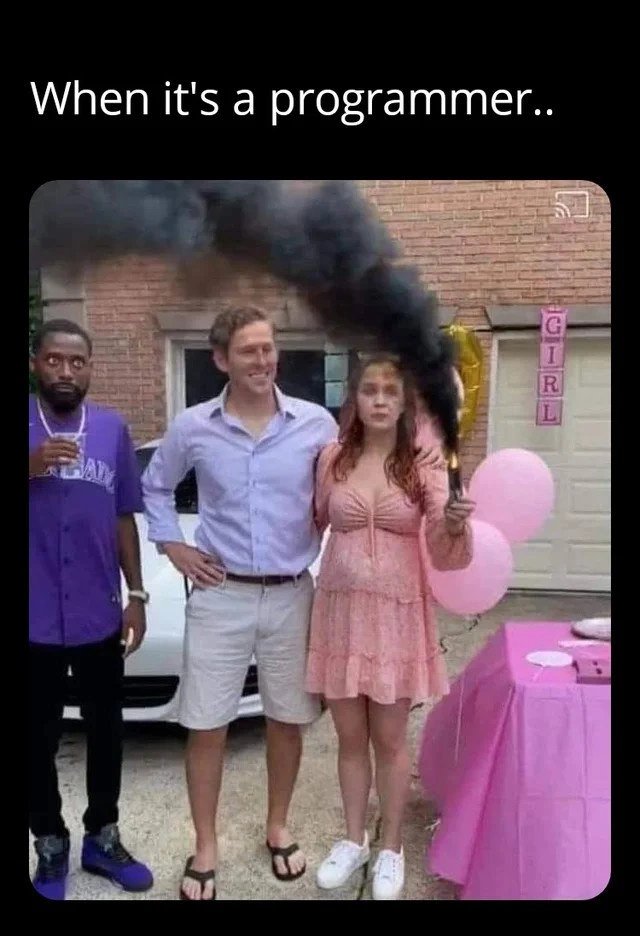
Imagine you’re at a party where your friends are going to reveal a surprise – like whether their new baby will be a boy or a girl. They have a special firework stick that’s supposed to puff out blue smoke for a boy or pink smoke for a girl. Everyone is excited, watching closely. The mom-to-be sets off the stick… but instead of blue or pink, a big black cloud of smoke comes out! It covers their faces in soot and confusion. That’s not supposed to happen at all! It’s as if you opened a jack-in-the-box expecting a fun clown pop-out, but a puff of dark dust burst out instead.
This is funny because it was such a simple goal – show pink or blue – and it went terribly wrong in the silliest way. It’s like asking someone a yes-or-no question, and instead of yes or no, they just groan like a monster. The phrase “returns undefined” in the caption is a techie way to say “we got no real answer.” So the joke is that when a programmer (someone who writes computer code) is involved, even a basic party trick can fail spectacularly like a computer error. In everyday terms: they tried to do a special colorful surprise, and it literally went up in smoke. Everyone expecting a happy reveal instead got a goofy disaster moment. It makes people laugh because we don’t expect a cute gender reveal to look like a car engine blowing up. It’s a playful reminder that sometimes when you’re really hoping for one of two perfect outcomes, life might hand you a completely unexpected, funny mistake instead.
Level 2: Undefined is Not a Gender
Let’s break down the joke for those newer to coding. In programming, when something is undefined, it means the program doesn’t have a value for it. Think of a variable as a box where you store a number or text. If you never put anything in the box (never initialize it), and someone asks “what’s in the box?”, the programming language essentially shrugs and says “undefined” (or “I don’t know what this is”). A very common beginner mistake is to call a function or use a variable that doesn’t have a valid value, leading to unexpected output or errors. For instance, in JavaScript if you try to use a variable that was never set, its value is literally undefined. In other languages you might get a null or even a runtime error like a NullPointerException.
Now, imagine a gender reveal device as part of a program. It’s supposed to output blue smoke for a boy or pink smoke for a girl. In a simple world, that’s like a binary true/false or an if/else choice. But in this meme, something went wrong in that “program.” The caption jokes that the device “returns undefined black smoke instead of blue or pink.” This is phrased like a code joke: in coding we might say a function “returns undefined” when it doesn’t give a proper result. So, the meme is saying the gender reveal behaved like a buggy function call. The black smoke is like getting an error value. Black isn’t one of the expected outcomes (just like an error or undefined isn’t an expected valid answer from a function). It’s as if the programmer who set this up had a code error such as:
- Not assigning the color properly (so it defaulted to nothing or a null state)
- Using the wrong variable or a typo, so the device never got the “pink” signal
- Or perhaps treating this event like a live test rather than a rehearsed run, in true “it’ll work in production” fashion
The term “smoke test” is actually a real testing term in software: it’s a quick check to see if the basic stuff works – named after the idea of turning on some hardware and making sure it doesn’t start smoking. Here, we got actual smoke, which is ironic and funny. Normally, a smoke test in a software project might be something like launching the application to see if it runs without immediately crashing. If it does crash (figuratively goes up in smoke), you know something’s fundamentally wrong. In the party, lighting the flare was the smoke test – and oh boy, it literally went up in smoke of the wrong color, telling everyone “there’s a bug!”
Also, bugs in software are mistakes or problems in the code that lead to wrong or unexpected results. This situation is presented as if the gender reveal had a bug. The decorations clearly showed the expectation (pink theme indicates it’s supposed to announce a girl), but the outcome didn’t match – much like when a program’s output doesn’t match the user’s expectations or the requirements. To new developers, this meme is showing a very relatable scenario in a playful way: even outside the computer, when a programmer is involved, sometimes things break in spectacular fashion because of a tiny overlooked detail (like not plugging in the correct value for the smoke color). It’s combining everyday life with coding humor. If you’ve just started coding, think of all those times your code compiled or ran but gave the wrong answer because you forgot to set a variable or mis-ordered some logic. Now imagine that happening in front of all your friends at a party – that’s the cringe-and-laugh vibe here.
In short, the meme uses tech terms to explain a party fail: “undefined” (no value / error) black smoke comes out when we expected a clear pink or blue result. It’s a fun way to say: when a programmer sets up something, if they mess up even a little, you might not get a normal outcome – you might get a weird glitch, even in real life. And indeed, the thick black smoke covering everyone’s faces is basically a big glitch in this celebration. The props (balloons, “GIRL” banner, pink tablecloth) are like the program’s intended config, and that black cloud is the bug saying “Nope, I’m not doing what you expected.” If you’re a junior dev, you can definitely chuckle at how literal this bug turned out – it’s an undefined behavior joke made visible without needing to read a single line of code.
Level 3: Works in Dev, Burns in Prod
For seasoned developers, this image triggers the same mix of amusement and anxiety as a production bug surfacing during a live demo. The caption “Programmer gender reveal returns undefined” immediately reads like a code error message – undefined, in programmer lingo, means “no value assigned”. It’s as if the script responsible for the smoke color had a bug: perhaps an if condition that never set the color, or a variable that defaulted to null. The result? The system fell back to a default state – and apparently the default was black smoke (the equivalent of the program throwing up its hands and producing a gibberish output). This is darkly funny to developers because we’ve all seen something like this before: an application expected to output one of two valid values but instead yields a blank, an error, or some bizarre third option because someone forgot to initialize a variable or handle a corner case. In coder terms, the function revealGender() might have hit an else clause that wasn’t supposed to run:
function revealGender(expectedColor) {
// expectedColor should be "blue" or "pink"
if (expectedColor === "blue") {
emitSmoke("blue");
} else if (expectedColor === "pink") {
emitSmoke("pink");
} else {
emitSmoke("black"); // Oops: unexpected default path
}
}
// Somewhere else in the code, a programmer calls it without a valid color:
revealGender(undefined); // The color variable was never set, triggers black smoke
In the snippet above, the programmer either forgot to pass a proper argument or the variable expectedColor was undefined due to a logic bug. The flare’s black smoke is the IRL equivalent of a program hitting that erroneous else branch. It’s the kind of mistake a junior dev might catch with unit tests – but of course, this was a ceremony, not a QA environment. Testing? Who had time for that? The result is a comedic smoke test fail: the very thing meant to celebrate the baby’s gender turned into a debugging session. You can practically hear the sighs and see the mental stack trace: “Did we even run this once before deploying it at the party?”
This scenario also taps into well-worn developer humor about things breaking at the worst possible moment. Deploy on Friday and watch the servers catch fire – or throw a gender reveal party with a programmer’s DIY gadget and watch it spew chemicals like a crashed server catching fire. The presence of black smoke is hilariously over-the-top, almost like a visual stack trace for everyone present: something clearly went very wrong internally. Seasoned engineers have a saying, “It worked in staging, but in production it went up in smoke,” and here we see that adage made literal. The pink decorations are all set, the banner literally says “GIRL”, meaning the expected state was known – yet the system (our flaring device) ignored the spec and delivered a completely off-spec output. This reminds experienced devs of times they thought their software was configured correctly for prod, only to have some misconfiguration or missing environment variable make it behave like it’s possessed.
The humor cuts deep into the Developer Experience (DX) pain: something meant to be straightforward turned complicated because of a bug. In practical terms, maybe the programmer over-engineered the reveal with some IOT device or homemade contraption. And as any cynical veteran knows, the more complex the system, the more likely it is to break in new and spectacular ways. There’s an unwritten rule: if anything can go wrong, it will – especially when a coder is trying to show off. We’re laughing (perhaps a bit nervously) because this gender reveal fiasco is a perfect metaphor for deploying code without adequate testing – the kind of stunt that leads to an emergency rollback, or in this case, awkward coughing and a sooty driveway. Relatable pain? Absolutely. We’ve all had a feature that returned “undefined” or null in front of an audience (be it an app demo crashing or a live site error) and wished we could disappear in a puff of smoke ourselves.
Level 4: Undefined Behavior Blowback
At the most granular level, this meme is a case of undefined behavior escaping the confines of code and manifesting literally in smoke. In programming languages like C/C++, using an uninitialized variable (e.g., a color value that was never set) can lead to unpredictable results – famously, the outcome could be anything from random numbers to metaphorical “nasal demons” flying out. Here our hapless programmer’s gender reveal behaves like a rogue program: it was supposed to output either BLUE or PINK smoke (two well-defined states), but due to a "bug" it returns an undefined result – an opaque black smoke plume. This is essentially a real-world instance of a function returning a value outside its expected domain. In theoretical terms, if we modeled the reveal as a function revealGender(): Color, with Color defined as {blue, pink}, the presence of black indicates a value not in the type’s range – a type safety violation! Such an outcome is analogous to a null reference error or reading from an invalid memory address: the program (or in this case, the flare) enters an unspecified state.
From a testing theory perspective, the event doubles as a failed smoke test – literally. The term “smoke test” in engineering originally meant powering up hardware to see if it smokes (a quick way to catch catastrophic failures). In software, a smoke test is a brief run-through to ensure basic functionality doesn’t go up in flames. If a system “smokes,” you stop right there. Our meme’s scene is a perfect parody of this principle: the very first check – “does the flare produce a clear result?” – spectacularly fails. The smoke test not only failed, it produced actual smoke! On a deeper level, this highlights why robust error handling and initialization are crucial. Formal methods or stricter languages could have prevented an “undefined” output: e.g., a statically typed or formally verified system might treat the absence of a valid color as a compile-time error rather than letting it explode at runtime (or at party time). But in the chaotic world of real life (and loosely-typed scripting, perhaps), you get this error state visualized in the form of a sooty cloud. In summary, the meme operates on the sophisticated joke that a programmer’s oversight – akin to a null pointer dereference or an unchecked error – yielded an out-of-spec outcome, turning a joyful ceremony into an unintended integration test failure for everyone to see. It's a humorous nod to the deep truth that when code (or flares) have undefined behavior, all bets are off – sometimes you literally get smoke.
Description
A photo from a gender reveal party with the caption 'When it's a programmer..'. The scene features a smiling couple and a shocked bystander. The expectant mother holds a smoke flare that is emitting thick black smoke, despite pink decorations and a 'GIRL' sign in the background. The humor comes from reinterpreting the unexpected black smoke through a programmer's lens. Instead of a simple failure, the black smoke is jokingly identified with developer-centric concepts like 'dark mode', a critical system error, a failed compilation, or, more cleverly, the birth of a 'daemon' process. The shocked look on the bystander's face perfectly captures the reaction to this catastrophic, yet nerdy, outcome
Comments
33Comment deleted
It's not a boy or a girl, it's a daemon process. Now we just have to hope it doesn't get orphaned and become a zombie
Someone added ‘NonBinary’ to the Gender enum but forgot to update the switch - so the smoke test hit default: emitBlackSmoke();
The smoke is just the Kubernetes cluster auto-scaling to handle the gender reveal microservice that somehow required 47 dependencies and a Redis cache
Ah yes, the classic programmer gender reveal: they were expecting a simple boolean output (pink = true), but someone deployed to production without testing and now we're dealing with a critical incident generating massive error logs. The smoke isn't pink or blue - it's the color of a failed deployment at 3 AM. Clearly someone forgot to handle the edge case where the reveal() function throws an UnexpectedExplosionException. This is what happens when you skip the staging environment and your CI/CD pipeline has zero rollback strategy
Shipping the gender reveal through CI seemed fine - staging had COLOR=pink, prod missed the env var and defaulted to #000; congratulations, it’s a postmortem
Dev took 'smoke test' post-deployment too literally - now it's a full-on incident
Only a programmer’s gender reveal doubles as a deploy: black smoke = failed build - someone took “smoke test” literally and left the Terraform module pointed at prod
? Comment deleted
somehow in USA gender reveal is a party event on which fuckton of cringe is produced and gender is signalled in some dumb way on this photo the colour of the smoke was supposed to rrveal gender Comment deleted
I don't get all that anyway - over here in Austria, we don't have anything like this. No gender reveal party, no 'baby shower' as it seems to be called, and no party after the birth either. Sure, we do congratulate the mother & give her gifts, but there's no separate party for that. It seems pretentious to me that the simple act of fucking deserves a party to be thrown. rant over lol Comment deleted
had to get that out though, it just seems so bizarre to me. Comment deleted
Okey,and? Comment deleted
Fire on a prod :D Comment deleted
At friday Comment deleted
? Comment deleted
No no, she did not cheat with me. Black color is accidental Comment deleted
Loooool Comment deleted
OHHHHHHHHHHHHHHHHHHHHHHHH I get it now! Comment deleted
is that stick running Android Studio? Comment deleted
obvious brigade please Comment deleted
did you mean explanation squad (Пояснительная бригада)? Comment deleted
A brigade is a major tactical military formation that is typically composed of three to six battalions plus supporting elements. Not squad definitely. Comment deleted
it's a phrase, it doesn't have to be literally correct to convey the same meaning. Comment deleted
The original phrase sounds exactly, so, if you please, repeat it accordingly to original Comment deleted
not sure what you mean by that Comment deleted
In that case you're wrong breaking into this discussion . Comment deleted
you translate meaning, and not words Comment deleted
Me? Comment deleted
You were just trying to translate a popular expression Comment deleted
You're wrong. It's s t a b l e expression. Comment deleted
This is something from biology according to the first google's page Comment deleted
sad to hear Comment deleted
google what that means Comment deleted