School plagiarism rules vs open-source programmers shrug over MIT/WTFPL code reuse
Why is this OpenSource meme funny?
Level 1: Sharing Instead of Cheating
Imagine you’re in school and you spend hours doing a homework project. If a classmate just copies your work and hands it in, you’d probably be upset – that’s cheating, right? That’s why teachers say “don’t plagiarize” – everyone needs to do their own assignments so it’s fair and you learn your lesson. But now picture the world of programming like a big kitchen where everyone’s sharing recipes. One cook says, “Hey, I have this great cookie recipe. Anyone can use it!” If you take that recipe and bake cookies, it’s not cheating at all – your friend wanted you to use it and enjoy. Coding in real life is more like sharing cookie recipes: a programmer might put their code out there and say “Go ahead, use this in your own program, it’s okay!” The meme is joking that in school copying was bad, but among programmers, copying with permission is totally fine. Instead of getting in trouble, the original coder smiles and says, “Sure, do what you want with it!” It’s the difference between sneaking a peek at someone’s test (not okay) and a friend handing you a free pass to use their idea (awesome!). That’s why this is funny: it shows how sharing replaces cheating when it comes to programming code.
Level 2: From Plagiarism to Permission
This meme contrasts academic rules with open-source coding practices. Let’s break down the key terms and ideas so it all makes sense:
Plagiarism (in school) – Plagiarism means taking someone else’s work (like an essay or program) and presenting it as your own without credit. Schools and universities treat this very seriously. If you copy a friend’s code on a class assignment or lift code from the internet and submit it as yours, that’s considered cheating. The reason is that in an educational setting, the goal is for you to learn and demonstrate your understanding. Using someone else’s answers defeats that purpose. So teachers say “plagiarism is unacceptable” at every grade level. They want individual effort and proper citation of any sources or references. There’s often an honor code or academic integrity policy: do your own work, cite any help or references, and don’t copy others.
Open-Source Code – Now, contrast that with open-source software. Open source means the code is published publicly and intended to be shared and reused. Developers put their source code on platforms like GitHub under an open-source license so that others can read it, download it, use it, and even modify it freely. It’s a collaborative approach: people around the world can contribute improvements or use the code in their own projects. Open-source culture actually encourages code reuse because it prevents everyone from having to reinvent solutions that already exist. As a new programmer, you’re probably already benefiting from tons of open-source components (like libraries, frameworks, or tools) in your projects. Using them isn’t considered stealing at all – it’s typically allowed and even recommended, as long as you obey the license terms. This is often summed up as “standing on the shoulders of giants” – we build new software on top of foundations others have shared.
Software Licenses – In software, a license is basically a legal permission slip that the author attaches to their code. By default, code is copyrighted (meaning you cannot use it without permission). But authors can choose to release it under an open-source license that explicitly gives you permission to use, copy, change, and share their code. Different licenses have different rules, but they all aim to let others work with the code in some way. Some are more restrictive (for example, they might require you to share changes or give credit), and some are very permissive. Two examples appear in the meme:
MIT License – This is one of the most common permissive licenses. “Permissive” means it’s very allowing. The MIT License basically says: you can use this code in almost any way you want, including in your own products or projects, as long as you keep my name and license text somewhere and don’t sue me. It doesn’t require you to open-source your own project if you include the code – you can even use MIT-licensed code in a commercial, closed-source application. It’s popular because it’s simple and business-friendly. So when the meme’s character says “It’s MIT licensed,” he means “You’re not actually stealing – I already gave everyone permission to copy this code under the MIT terms.” In real development, if you find code on GitHub under an MIT License, you can legally copy-paste it or include it in your project. It’s not plagiarism because the original author granted permission in advance (though usually you do keep a copy of the license text or attribution as required).
WTFPL License – This one is more of a joke license, but it’s real and some projects use it. WTFPL stands for “Do What The Fk You Want To Public License**” (excuse the language, but that’s the official name!). This license is as free as it sounds: it basically says do whatever you want with this code, no conditions. It’s even more permissive (and less formal) than MIT. The WTFPL is not as widely used in professional settings (because its language is a bit unprofessional and some lawyers prefer licenses that are more explicit), but it perfectly symbolizes an “I don’t care, just copy it” attitude. In the meme, when the programmer says “I don’t care, it’s WTFPL licensed (do what you want),” he’s expressing the ultimate laissez-faire stance on code reuse. He’s effectively saying “You can literally steal my code and I’m totally fine with it – in fact, I told you and the world you can do anything with it.” That’s the opposite of school rules!
“Copying code” vs “stealing code” – In professional development, copying code with permission (under the right license) isn’t called stealing; it’s usually called code reuse or using a library. There’s even a friendly term “copy-paste coding” that we joke about – like when you grab a solution from Stack Overflow to fix a bug. Every junior developer does it, and senior developers do it too (they’ve just amassed a bigger personal library of snippets over time). The key difference from academic plagiarism is that in open source and work environments, the original author wants you to use their code and usually you’re expected to acknowledge the source (often by including the license or a comment). So it’s more like citing a source than plagiarizing. In fact, many companies have policies for using open-source: they’re okay with it as long as the license is compatible with their project. They might only forbid copying code that has no license or a restrictive one, because that would be unpermitted copying.
Why the meme is funny to devs: Practically every programmer remembers being new and worried about “not copying” code because of school. Then you enter the real world and find out sharing code is standard practice in the OpenSource community. The meme exaggerates this by using the extreme example of the WTFPL license to show just how far this goes – not only is copying tolerable, it might be explicitly allowed with a shrug. It’s comedic because the two cartoon programmers are unbothered by something that would be a huge scandal in class. For a junior developer, it highlights an important lesson: context matters. Copying code can be bad (cheating) or good (collaboration) depending on whether you have permission. In open source, thanks to licenses, you usually do have permission. So, developers can freely exchange code like ideas, which is a cornerstone of modern software development. Essentially, the meme says “Relax, you’re not going to get detention for using someone’s MIT licensed code. That’s how coding works in the real world!”.
Level 3: Honor Code vs Source Code
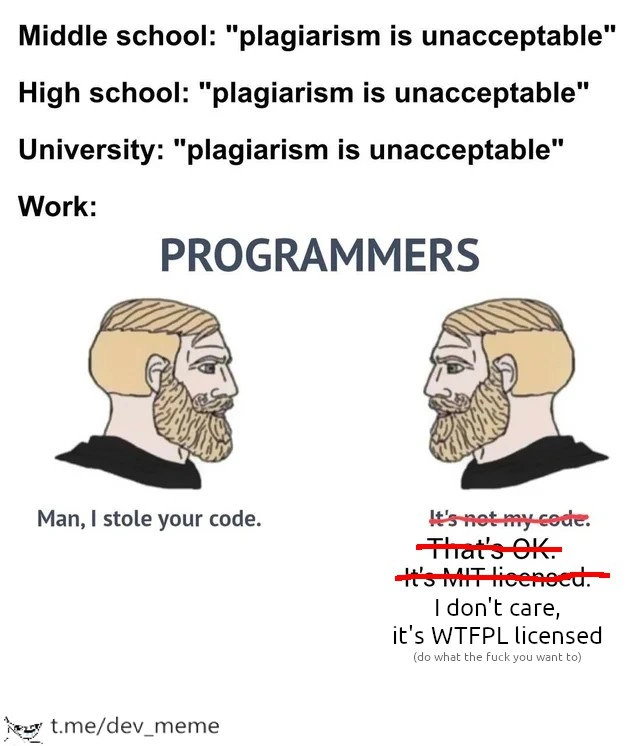
At first glance, this meme highlights a hilarious contradiction every developer who went through school recognizes. In education, from middle school to university, you're drilled with strict anti-plagiarism rules: never copy someone else’s work or you’re in big trouble. Yet in the software industry, the attitude flips completely. The meme’s setup lists “plagiarism is unacceptable” three times (for middle school, high school, university) to hammer in that copying = bad. Then comes “Work: PROGRAMMERS” with two developer caricatures casually talking about stolen code. This sudden reversal is the punchline: in the real world of coding, reusing someone’s code can be perfectly fine, even encouraged. It’s a classic bait-and-switch joke structure—by the time we see “Work:”, we expect another “plagiarism is unacceptable,” but instead we get programmers basically saying “Meh, go ahead and copy.” 😄 That extreme contrast makes developers laugh and nod knowingly.
The technical core of the humor lies in open-source culture and software licensing. In academia, copying code without permission is considered a sin because the goal is to assess individual learning. But working developers live by a different ethos: “Don’t reinvent the wheel.” Writing everything from scratch is inefficient; instead, we reuse code from libraries, frameworks, and examples. The only catch is permission. That’s where licenses like MIT and WTFPL come in. The meme’s dialogue showcases an escalating level of “I really don’t mind” from the original coder:
- “Man, I stole your code.” – One programmer admits outright that he copied code written by the other. In a school setting this would be a bombshell confession. But here it sets up the expectation that the other dev might shrug it off.
“It’s not my code.”– First potential response (crossed out) implies “hey, I don’t even claim ownership; maybe I borrowed it from elsewhere too!” Many projects are built on someone else’s work. This hints that code is often a collective effort in open source.“That’s OK.”– Second try (also struck through) simplifies the sentiment: the original author doesn’t mind at all. In developer terms, this nonchalance is laughably relatable. We copy Stack Overflow snippets daily – it’s practically a running gag in DeveloperHumor circles.“It’s MIT licensed.”– Third attempt (also struck out) gives a specific reason why it’s okay: the code was released under the MIT License, a super-permissive open-source license. This means the author already allowed anyone to use their code freely (with only minimal conditions like including the license text). A seasoned dev sees this and goes, “Of course it’s fine, that’s the point of MIT licensed code!”- “I don’t care, it’s WTFPL licensed (do what the fuck you want to).” – Finally the real response (not crossed out) one-ups even MIT. WTFPL is an actual license called “Do What The F**k You Want To Public License.” It literally says anyone can do whatever they want with the code. By replying with this, the coder is saying, “You didn’t just have permission, I explicitly wanted people to copy it!” This over-the-top license name nails the absurdity: the original dev does not care at all about so-called plagiarism – he intended his code to be a free-for-all. It’s like the ultimate open-source mic drop. 🎤
Why is this so true-to-life for developers? In practice, programmers constantly stand on each other’s shoulders. Companies and open-source projects prefer using well-tested existing code (via libraries or examples) over writing new code from scratch, because it’s safer and faster. Reusing code isn’t seen as “cheating” – it’s being efficient and pragmatic. The only time copying code is a problem at work is when you violate a license or use someone’s proprietary code without permission (that will get you in legal trouble). But if the code is under a permissive license like MIT, Apache, or even the ultra-free WTFPL, then it’s explicitly not plagiarism – you have the author’s blessing. In fact, open-source developers want others to copy and build on their code; it’s a compliment and a sign their project is useful. This is the open-source culture: knowledge and code are shared openly, as long as rules (licenses) are respected. It’s the opposite of an exam scenario with hidden answers. Experienced devs remember the academic honor codes from school, and can’t help but laugh when comparing it to the copy-paste coding reality of their jobs. The meme perfectly captures that “plagiarism vs open source” paradox. The final “WTFPL licensed” line even adds a bit of edgy humor – only in programmer culture would there be a legit license with that name, basically a legal way of saying “I don’t give a damn, use this however you want.” 😅
At a deeper level, this speaks to how incentives and goals differ between school and software development. In school, originality is valued to ensure you learn; using someone else’s work is “stealing credit” and defeats the purpose of the assignment. In professional coding, however, the goal is to solve problems and ship products. If someone already solved a piece of the puzzle and made their solution open-source, using it isn’t stealing – it’s collaborating across time and space. The MIT License for instance is popular exactly because it encourages code to spread and be used everywhere with almost no restrictions. Senior engineers know that almost every project is built on countless open-source components (from the OS kernel to libraries). We’d never finish anything if we had to write it all ourselves. So the industry teaches the opposite of school: “Find good code and reuse it, as long as it’s legal.” This meme gets a knowing chuckle because it pokes fun at that reversal we all experienced. The moment a CS student becomes a professional developer, it’s like entering a world where the rules got flipped upside down. Copying code? Suddenly totally normal – even a smart move – as long as you follow license rules. Talk about a culture shock! And the meme distills that shock into a simple, funny exchange between two identical programmer dudes essentially shrugging over code reuse. In short, what was “unacceptable plagiarism” in class becomes “awesome, you saved time!” in the open-source workplace, and that dramatic shift is what every coder eventually learns to embrace.
Description
White background meme. Top text, left-aligned: “Middle school: "plagiarism is unacceptable"”, “High school: "plagiarism is unacceptable"”, “University: "plagiarism is unacceptable"”, and finally “Work:”. Beneath, large centered heading “PROGRAMMERS”. Below the heading are two mirrored cartoon side-view heads (generic Wojak/‘Nordic’ style with blond undercut, faces blurred) facing each other. The left head has a caption underneath that reads “Man, I stole your code.” The right-side reply shows several statements, each progressively crossed out in red strike-through: “It's not my code.”, “That's OK.”, “It's MIT licensed.” Under the red marks, the final uncrossed text reads: “I don't care, it's WTFPL licensed (do what the fuck you want to)”. Bottom left corner watermark: “t.me/dev_meme”. Visually simple black text and minimal line art. Technically, the joke contrasts strict academic anti-plagiarism culture with permissive open-source norms - highlighting MIT and WTFPL licenses that explicitly allow copying, epitomizing developer attitudes toward code reuse and OSS licensing
Comments
6Comment deleted
Graduating as a dev is realizing copy-pasting under MIT/WTFPL is fine - real plagiarism is when you accidentally smuggle a single GPL file into prod and Legal copies you on every email chain till end-of-support
The real plot twist is when you find your own code from 2015 on Stack Overflow, upvote it, then realize it's actually better documented than your current implementation
The real irony is that in academia they'll fail you for not citing Stack Overflow, but in production they'll promote you for successfully copying from it. The WTFPL is basically the honest version of every 'I definitely wrote this myself' commit message - at least it's upfront about the fact that half your codebase is a Frankenstein's monster of MIT-licensed repos, that one brilliant algorithm you 'adapted' from a 2009 blog post, and three different implementations of the same utility function because nobody bothered to check if it already existed in the codebase
Academia calls it plagiarism; in enterprise it’s a “third‑party component” - right up until OSPO spots WTFPL in the SPDX header and turns your merge into a compliance incident
School: Cite or fail. Code review: 'MIT? LGTM, ship it.'
“I stole your code.” “Cool, it’s WTFPL.” Three days later: SCA false positives, a red CI gate, and Legal asking what “public-domain-ish” means