The Natural Enemies of Programmers, Including Themselves
Why is this DevCommunities meme funny?
Level 1: Sibling Rivalry
Imagine you and a few friends are trying to build a big LEGO castle together. Each friend has a different job:
- One friend has the idea of what the castle should look like and keeps saying “Let’s add a dragon! No, now let’s add a tower!” (That’s like the product owner, always coming up with new requests.)
- Another friend is in charge of time, saying “We only have one hour, hurry up!” and making sure everyone is doing something (that’s like the project manager watching the schedule).
- Another friend is writing down the plan on paper — drawing what the castle should be and making lists of pieces (like an analyst who writes down requirements).
- And you’re the one actually snapping the LEGO bricks together to build it (that’s the programmer, the builder).
Now, building the castle should be fun teamwork, but it can easily turn into a little fight:
- The idea friend keeps changing their mind about the design, which makes you frustrated because you have to rebuild parts (“Make up your mind!” you say).
- The timekeeper friend (schedule watcher) keeps saying “Hurry, hurry!” which stresses everyone out.
- The planner friend with the paper might draw something that’s hard to build with the bricks you have, or they erase and redraw the plan a lot.
- You, the builder, get annoyed because it feels like the others don’t understand how hard it is to actually make the castle. Maybe you even snap at another builder friend who’s helping, like “No, you’re putting that wall in the wrong place!”
In the end, everyone is upset, and the castle isn’t finished. You might even throw up your hands and yell, “Ugh, you guys ruined everything!” This is like the meme’s joke: all the different people (friends or team roles) end up blaming each other. It’s funny in the comic because it’s so exaggerated – the character yells “Damn programmers! They ruined programming!” which sounds silly. But it’s showing a real feeling: when people don’t work together well, everyone feels like someone else messed things up.
So the simple idea is: working on a team is hard when everyone sees things differently. Just like brothers and sisters (or best friends) can fight even though they actually love each other, the people in a software team can argue even though they all want the project to succeed. The meme makes us laugh because it’s a big, cartoonish way of saying, “Teams sometimes fight like siblings, even though they’re on the same side.”
Level 2: Cross-Functional Friction
In an Agile software team, there are several distinct roles meant to collaborate, but they often bump heads:
Product Owner (PO): In Scrum (an Agile framework), the product owner is like the project’s "visionary" from the business side. They decide what the team should build to deliver value to users or stakeholders. They prioritize the backlog (the to-do list of features). The friction comes because a PO is often pushing for more features ASAP (they have stakeholders demanding results). For a junior developer, imagine the PO as the person who always wants new changes and features yesterday. If you’ve ever heard, “Could we just add this one little thing by Friday?” — that’s the product owner talking. Developers can feel pressured by POs because technical work isn’t as quick or simple as non-coders think. MisalignedExpectations arise when the PO thinks a feature is a “small tweak” but it’s actually a huge effort in code. This mismatch sets the stage for conflict: the PO might think devs are slow or resistant, while devs think the PO is out of touch with technical reality.
Project Manager (PM): A project manager is responsible for timelines, resources, and delivery. In an Agile context, sometimes this role overlaps with Scrum Master or just doesn’t exist formally, but many companies still have PMs. Think of the PM as the one with the schedule and checklists. They care about when things get done and coordinating all the moving parts. If you’re new to a dev team, the PM is the person asking for status updates and if you’re “on track.” The classic conflict is that the PM promises a delivery date to upper management or clients, and then turns around and presses the devs to meet that date no matter what. If requirements change or something takes longer, developers feel the squeeze while the PM worries about slipping deadlines. This leads to the feeling that PMs and devs are on opposing sides: one side says “we must hit the date!” and the other side says “but this is harder than you think!” It’s a CommunicationGap where each side doesn’t fully grasp the other’s challenges. A junior dev might experience this as, “Why does management set deadlines without understanding the actual work?”
Analyst (Business Analyst or Systems Analyst): This role focuses on what needs to be done from a requirements standpoint. Analysts gather information, write requirements documents or user stories, and clarify details so developers know what to build. They’re essentially translators between the business and tech. However, analysts might not have a coding background, so sometimes they propose things that are technologically tricky without realizing it. From a developer’s perspective, requirements can feel like they’re handed down from an ivory tower. If you joined a project where there’s a big specification doc, an analyst probably wrote it. The conflict comes when those specs are ambiguous or keep changing. Developers might complain, “These requirements make no sense” or “The spec changed again?!” Meanwhile, analysts might be frustrated that the solution the dev built isn’t exactly what they described. It’s easy for each to blame the other: developers might say the analyst doesn’t understand technical limits, analysts might say the dev didn’t follow the requirements. This is another form of CollaborationChallenges – both roles actually want a good product, but they communicate past each other.
Programmers (Developers) vs other Programmers: You’d think developers would be united, but even within dev teams there can be internal rivalries and conflicts. For someone early in their career, this could be as simple as a disagreement in a code review (for example, one developer critiques another’s code style or approach). Developers can be very passionate about their craft, which sometimes leads to programmer_infighting over things that outsiders might find trivial. Perhaps you’ve seen debates on whether to use one framework vs another, or arguments about naming conventions in code. These disagreements can get surprisingly heated. There’s also the scenario of blame: if a bug reaches production (the live environment), developers might end up pointing fingers at whoever wrote the offending code (“It’s John’s fault, he wrote that module!”). In healthy teams, people collaborate and learn from each other; in dysfunctional moments, teammates act like adversaries competing or criticizing without empathy. The meme’s final joke — a programmer saying “They ruined programming!” about other programmers — captures that exasperation. It’s like an admission that if anyone’s going to wreck this project or codebase, it’s probably someone on the dev team itself. This is role_conflict_humor turned inward.
The overall theme here is the Communication and role conflict problems that can happen even though all these people are supposed to be on the same team. In an ideal Agile team, everyone collaborates: POs explain the “why” clearly, devs explain technical constraints, PMs adjust timelines realistically, analysts clarify details, and programmers work together smoothly. But in real life, pressures and misunderstandings create a mini “civil war” inside the project. Each role has different priorities:
- The product owner’s priority is keeping stakeholders happy with features and improvements (often leading to StakeholderPressure on the team).
- The project manager’s priority is delivering on time and within scope.
- The analyst’s priority is making sure the solution meets the business requirements and rules.
- The programmer’s priority is building the thing correctly, with good code, stability, and maintainability.
When these priorities aren’t aligned, it feels like everyone is pulling in different directions. For example, a junior dev might notice during a sprint planning meeting: the PO keeps adding new “high-priority” tasks, the PM worries that “we’re already over capacity for this sprint,” the analyst insists on revising the acceptance criteria for a story, and the dev lead sighs that the codebase can’t handle another half-baked feature without refactoring. The meeting might get tense – exactly the kind of scenario this meme exaggerates for humor. It highlights a common Agile pain point: collaboration can devolve into chaos if not carefully managed.
Another thing a new developer might glean from this meme: it’s normal to feel frustration when working with different roles. The joke is basically, “No matter who you interact with, it can feel like they’re against you.” Of course, that’s an exaggeration; in good teams, these roles actually support each other. But the reason this meme makes tech folks nod (or laugh) is because many have experienced at least one situation where it really did feel adversarial. Maybe you’ve had a product owner override your estimate, or a project manager commit you to a deadline without asking, or an analyst give confusing specs, or a teammate merge code that broke your work. It’s all part of learning how to navigate CollaborationChallenges in the workplace.
Finally, note the self-irony: developers themselves are included as enemies of programming. It’s a little reminder not to get a big ego. Even within the dev community, we joke about how we sometimes create our own mess (like introducing bugs or arguing over trivial things). It’s a form of DeveloperHumor that keeps us humble. So while the meme humorously says “Damn programmers, they ruined programming,” the truth is we all have to work together to not ruin it. A junior dev can take away that effective software development isn’t just about coding – it’s also about communicating with all these different roles and finding a way to turn potential conflicts into cooperation.
Level 3: Agile Civil War
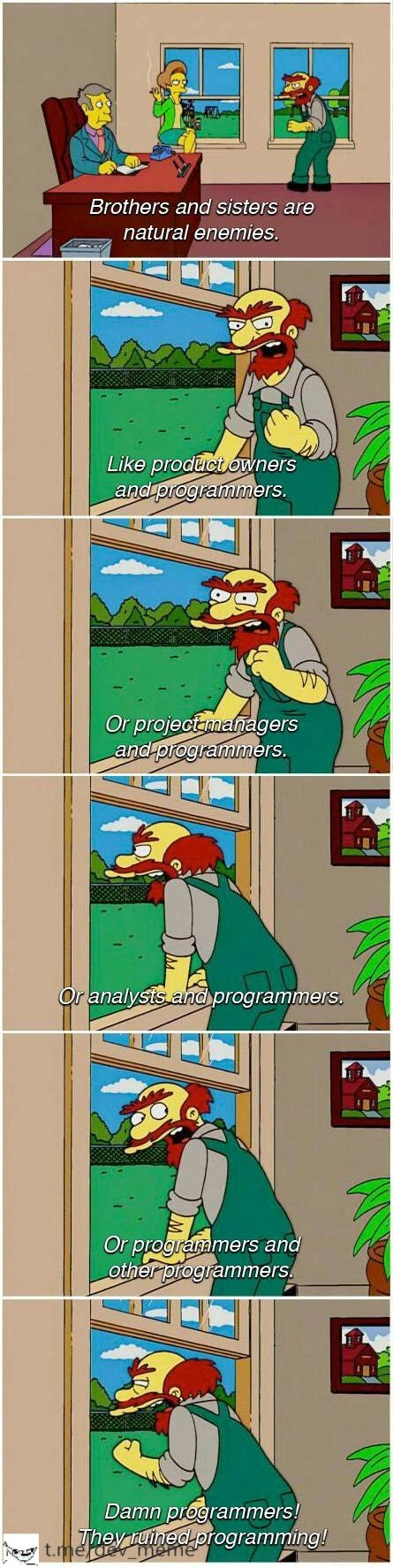
Software teams are supposed to be cross-functional allies, but this meme reveals the darkly comic reality: sometimes it feels like everyone in the development process is at war. The image riffs on a classic Simpsons scene with Groundskeeper Willie declaring various pairs as "natural enemies." Here each pairing is a tech-world battle:
- Product owners vs. programmers: The product owner (often the voice of business or the customer in Agile) pushes for features and urgent changes to deliver quick value. Programmers push back, worried about code quality, technical debt, and impossible timelines. The result? Misaligned expectations and a constant tug-of-war over scope and deadlines. It's a textbook AgilePainPoints scenario: business wants it now, engineers want it right.
- Project managers vs. programmers: Project managers care about schedules, budgets, and keeping upper management happy. To developers, though, it can feel like PMs just create status meetings and Gantt charts that ignore real coding challenges. Ever had a PM cheerfully announce a "tiny change" that actually derails two weeks of work? 😒 That CommunicationGap leads to resentment. Developers joke that PMs and devs are natural enemies because one speaks the language of timelines and task trackers, while the other speaks in code and commits. Both think the other "doesn't get it."
- Analysts vs. programmers: Business analysts (or system analysts) write requirements and specifications. In theory, they translate business needs into clear tasks. In practice, specs can be vague, ever-changing, or detached from technical reality. Developers end up implementing fuzzy requirements, then getting blamed when it doesn't meet the business's imagination. Analysts get frustrated when devs ignore the fine print. It's a classic CollaborationChallenge: each side thinks, "Why are they making my life harder?"
- Programmers vs. programmers: Ah, the internal holy wars. Tabs vs spaces, Vim vs Emacs, which JavaScript framework to rewrite the app in this month... Developers often clash with each other over architecture or coding style. Code reviews can turn into battlegrounds of ego. Junior devs might introduce bugs; senior devs might cling to old patterns. Feature teams sometimes blame the platform team, front-end devs argue with back-end devs. By the end, even engineers agree other engineers are the worst! The meme’s punchline “Damn programmers! They ruined programming!” is dripping with self-deprecating sarcasm. It’s the cynical acknowledgment that sometimes we developers shoot ourselves in the foot — over-engineering things or not communicating — and then gripe that programming isn’t fun anymore. It's an ultimate irony: programmers become their own worst enemy.
This meme nails a painful truth about CorporateCulture in tech: these roles should be partners working toward a shared goal, but poor communication and competing priorities turn them into adversaries. Everyone is under StakeholderPressure (from the CEO, from customers, from the market), so the blame rolls downhill. The product owner blames the devs for slow delivery, the devs blame the PM for unrealistic planning, the PM blames changing requirements or the analysts, and developers even blame each other in heated stand-ups. It’s a vicious cycle of ManagementVsEngineering strife. Seasoned engineers have lived through this “Agile civil war” across many retrospectives and burned-out sprints. We’ve seen stories of endless feature creep, last-minute “simple” requests, and production incidents where every department points fingers. This shared trauma is exactly why this meme is popular on developer forums — it’s TechHumor that rings hilariously true. The exaggerated hostility from a cartoon Scotsman captures how devs feel on bad days: that they’re fighting everyone just to get quality code out the door.
Ironically, Agile methodology was supposed to break down these walls by promoting collaboration, feedback, and shared understanding. In healthy teams, product owners, PMs, analysts, and devs are more like siblings working together than “natural enemies.” But as the joke highlights, achieving that harmony is harder than it looks on a Scrum training poster. When Agile processes are just for show (cargo-cult Agile), you get all the ceremonies (daily stand-ups, sprint planning, etc.) but still suffer old-school communication gaps and territorial behavior. Each role speaks a different language and optimizes for different things, creating friction. The result is exactly what the meme depicts: every role perceives the others as obstacles. Developers especially, being on the implementation front line, often feel surrounded by enemies — until they remember that, wait, the code came from our own kind. Damn programmers. 🙂
Ultimately, this meme is poking fun at the CollaborationChallenges in software development. It’s a comedic exaggeration of real Agile team dysfunctions: miscommunication, misaligned goals, and a dash of finger-pointing. Any experienced dev reading it will chuckle (or groan) in recognition. After all, as Groundskeeper Willie might say in a stand-up meeting: “Agile teams and peaceful cooperation are natural enemies!”
Description
A six-panel meme using a scene from the animated TV show 'The Simpsons' featuring the character Groundskeeper Willie. The first panel shows Principal Skinner at his desk, with the subtitled dialogue 'Brothers and sisters are natural enemies.' The subsequent panels show Groundskeeper Willie at the window, angrily listing off other 'natural enemies' in the context of software development: 'Like product owners and programmers.', 'Or project managers and programmers.', 'Or analysts and programmers.', 'Or programmers and other programmers.' The final panel delivers the punchline with Willie shaking his fist and exclaiming, 'Damn programmers! They ruined programming!'. The meme humorously captures the common frictions between developers and other roles in a tech organization, but its core joke is the self-deprecating twist that programmers' own culture, habits, and disagreements are often the biggest source of problems. This resonates deeply with senior engineers who have witnessed everything from framework wars to bikeshedding on trivial issues
Comments
7Comment deleted
The only thing two developers can agree on is that the third developer's code is garbage. And that they're using the wrong JavaScript framework
After two decades, I’ve realized the org chart is just a live-action merge conflict: Product insists on --theirs, PMs push --ours, analysts call for a rebase, and devs are left staging resentment one hunk at a time
After 20 years in tech, I've learned the real CAP theorem: you can have Consensus, Alignment, or Progress - pick two, and even then only if Mercury isn't in retrograde and the PM hasn't discovered Jira's custom fields yet
This perfectly captures the paradox of software engineering: we've built elaborate frameworks for collaboration (Agile, Scrum, DevOps) yet somehow still manage to recreate the Balkans in every sprint planning meeting. The real architectural pattern here isn't microservices - it's micro-grievances, where every role boundary becomes a demilitarized zone and programmers achieve the remarkable feat of being simultaneously victims of everyone else AND their own worst enemy. It's Conway's Law taken to its logical extreme: organizations design systems that mirror their communication structures, which apparently means 'mutually assured dysfunction.'
Agile at scale is a distributed system: POs, PMs, BAs, and devs attempting 2-phase commit until the coordinator times out and blames the participants
Siblings ping sporadically; prod bugs CAP your weekend with unavailability, partition, and zero tolerance for logout
Product, PM, Analyst, and Dev: distributed consensus without quorum - aka sprint planning; Dev vs Dev is the split-brain failover