New Release vs. Production: An Explosive Story
Why is this Production meme funny?
Level 1: Block Tower Collapse
Imagine you and your friend spent all day building a big tower out of blocks. It’s standing tall and sturdy, like a little castle you’re both proud of. Now you excitedly place one last fancy block on top as a final touch. But the moment you do, the entire tower starts to wobble and then crash! – the whole thing collapses into a heap of pieces. That “fancy block” was meant to make the tower even better, but instead it brought everything down. You both freeze, eyes wide, looking at the wreckage of your once-beautiful tower. It’s a bit like, “uh-oh, that wasn’t supposed to happen!” It’s the same idea the meme jokes about: you add something new to a perfectly good setup, and suddenly the whole castle (or tower) is ruined in an instant. It’s kind of funny afterwards, even though at the time it was a big “uh-oh!” moment, because you never expected that one small change would break everything.
Level 2: Production on Fire
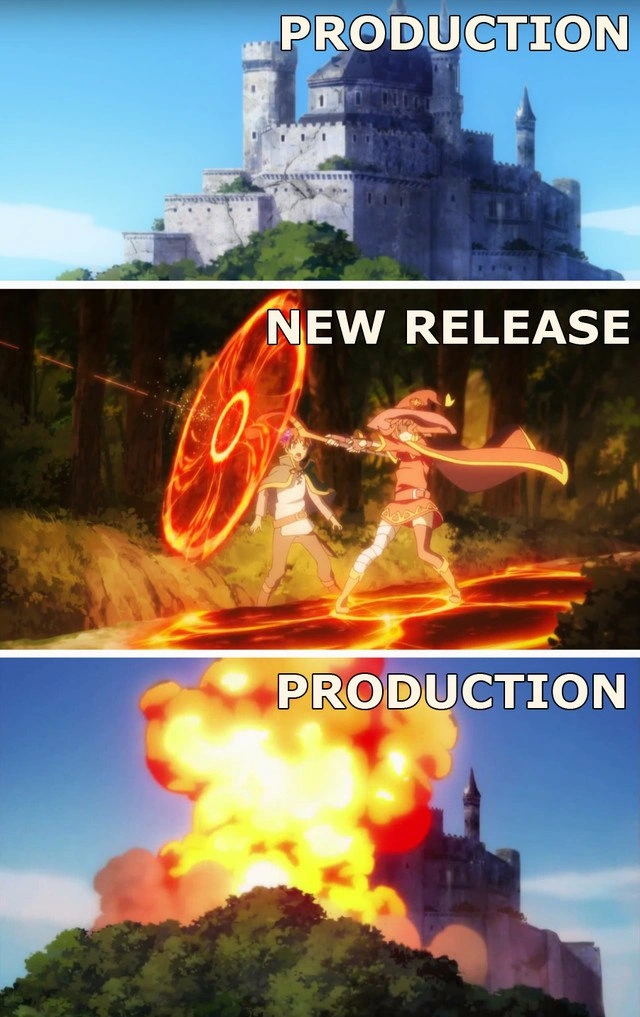
In this meme, the word “PRODUCTION” is written over a picture of a beautiful stone castle. In tech jargon, Production (often just “prod”) means the live, real-world environment where your software runs for actual users. It’s supposed to be sturdy and well-guarded – much like that castle. Next, we see the second panel labeled “NEW RELEASE”: a mage in a red cloak is casting a gigantic fiery spell at someone. This represents deploying a new release of code (the latest version of the software) into production. Finally, the third panel shows the same castle but now it’s engulfed in a massive explosion, captioned “PRODUCTION” again. This dramatic before-and-after sequence means the production environment, which was fine before, has been essentially destroyed by the new release. In simpler terms: the software update went terribly wrong and caused the system (prod) to go up in flames (not literally, but as a metaphor for a major failure).
Why is this scenario so familiar to developers? Because a bad bug in new code can indeed take down a production system. A bug is a mistake or error in the code. For example, a bug might cause an app to crash, use up all the server’s memory and freeze, or accidentally delete important data. When we deploy a new version of an application, we always hope it will improve things or add cool features. But if that version has a serious bug that we didn’t catch in testing, it can lead to downtime or an outage – which is exactly like that castle blowing up in the meme. The meme is showing an exaggerated “worst-case scenario” of a deployment: everything is literally on fire. This captures a feeling common in development teams called deployment anxiety or release anxiety – people get nervous before pushing changes to production, because they know even a small mistake can cause a huge problem on the live site.
Let’s break down the environments and outcomes in a simple way:
| Environment | Before the Release | After the Release |
|---|---|---|
| Testing (QA) | Castle intact (everything OK) | Castle still intact (no issues) |
| Production | Castle intact (stable) | Castle on fire (major failure) 💥 |
In a typical software workflow, changes are tried out in a QA or staging environment (like a dress rehearsal for prod) before going live. Usually, everything looks fine there – the castle stays standing during tests. But sometimes, when the code is released to production, new problems show up. Production might have many more users, different data, or slightly different server settings that weren’t present in testing. So something that didn’t break in QA suddenly triggers a crash in the real environment. That’s why you’ll hear developers exclaim, “But it worked in staging!” while staring in horror at errors in production.
When production breaks like this, we call it a production issue or an outage. It’s a big deal: real users can’t use the service properly, and the company might be losing money or data until it’s fixed. Developers and operations engineers have to jump into “firefighting” mode to repair the issue as fast as possible. Many teams have an on-call rotation: a designated engineer (often someone from the DevOps or SRE team — SRE means Site Reliability Engineer) is available at any time to respond if something goes wrong unexpectedly. If production goes down, the on-call engineer’s phone will blow up with alerts (monitoring tools send urgent notifications — imagine a loud alarm or phone buzzing at 3 AM saying "Server down!"). Having to wake up and deal with a broken production system because a new release failed is basically every on-call engineer’s worst nightmare. This kind of situation leads to a lot of joking in the DevOps community — a form of on-call humor. People who keep the systems running (devs, DevOps, SREs) often make light of “server fires” to cope with the stress. The meme we have here is exactly that kind of humor – it’s poking fun at how a deployment can turn into a disaster, something anyone who’s been on support duty can relate to.
It’s worth noting the origin of these images: they come from a comedy anime (Japanese cartoon) called KonoSuba. The character in the red outfit (named Megumin) is a wizard who loves casting an extremely powerful explosion spell. In that anime scene, she literally blows up a castle (for comedic effect). Tech meme-makers found it perfect to illustrate a “release gone wrong.” Even if you don’t know the show, the sequence of pictures is easy to understand: first the castle is fine, then a huge magical blast (the new code being released), and then BOOM – the castle is in flames. It’s a visual way to say “our deployment destroyed production.”
To put it all together plainly: the software was working fine in production (the castle was standing), then we rolled out an update (new release cast by our developer “wizard”), and suddenly everything broke and went down (the castle exploded in a fireball). It’s funny in hindsight because it exaggerates a real risk in software development. It reminds everyone that deploying new code needs to be done carefully, because even though we test changes, there’s always a chance we missed something — and the result can be a real production fire that everyone has to rush to put out.
Level 3: Release of Mass Destruction
One minute, your production environment stands tall and stable like a fortified castle; the next minute, your brilliant new deploy has turned it into a giant fireball visible from space. This meme nails that nightmare scenario with dark DevOps humor. The top panel’s peaceful castle labeled “PRODUCTION” represents a system happily running in production—everything is finally quiet on-call, users are content, and the uptime graph looks pristine. Enter the “NEW RELEASE” in the middle panel: a red-cloaked mage charging up a massive explosion spell. That mage is basically the development team introducing a new code release into production. It’s supposed to be a magical improvement or a much-awaited feature, but instead it conjures a catastrophic production incident. The bottom panel says it all: the production castle is now engulfed in a massive explosion. In other words, the system that was working moments ago has just spectacularly crashed and burned because of the new release.
To experienced engineers, this scenario is painfully relatable. It’s the classic “deployment from hell” story we swap on late-night calls. You hit deploy thinking “what’s the worst that could happen?” — and then you watch as everything that could go wrong does, in spectacular fashion. The humor here comes from just how extreme and instantaneous the destruction is depicted. We often joke about “blowing up prod” whenever a release introduces a severe bug, but here the meme visualizes it literally: production isn’t just down; it’s a mushroom cloud. The mage in the image has a gleeful look akin to a developer confident in their code, while the sidekick’s nervous face is like the one sensible engineer thinking “Uh, guys, maybe we should double-check this?” But it's too late — the code has been unleashed, and now everyone's scrambling to handle the fallout.
This meme resonates strongly with anyone in DevOps or an SRE role, because it’s basically on-call nightmare fuel. We’ve all received that 2 AM page saying “Service XYZ is down, major outage in progress” after a deployment, and it truly feels like someone launched a fireball at your nice, calm production system. In outage postmortems (the investigation after everything’s extinguished), it inevitably turns out that the new release had a critical bug or misconfiguration. Often it's something that seemed harmless – say, a database migration script with a subtle mistake, a memory leak that wasn’t obvious in testing, or that one-line hotfix merged late Friday that “surely couldn’t break anything” (famous last words). In the best case, you can quickly rollback to the previous version (yank the mage’s staff away, so to speak), but often by the time you react, the damage is done – production is on fire and you're in full firefighting mode trying to save what's left of the castle. The on-call engineer probably spills their coffee as they jump online, Slack channels light up with frantic messages, and the team begins triaging the wreckage.
What makes this dark scenario funny (in a laugh-to-keep-from-crying way) is how common it is despite all our best practices. It highlights release anxiety: that knot in your stomach before rolling out new code, because you know even a tiny mistake can have a massive blast radius in a complex system. The castle didn’t get destroyed by an external hacker or a natural disaster – it was friendly fire from our own deployment, which is a bitter truth in many production failures. The meme pokes fun at that irony. In theory, we have CI/CD pipelines, automated tests, code reviews, and staging environments to catch problems early. But in reality, some bugs only rear their head in the live production environment under real conditions (like real user data or high traffic) – turning a routine release into an instant disaster. The phrase “Works on my machine” becomes meaningless when that same code decides to segfault or throw crazy exceptions in prod and take everything down with it.
Historically, seasoned engineers develop almost a superstitious caution around deployments because of experiences exactly like this. There's the unofficial rule: “Never deploy on a Friday”, precisely to avoid spending your weekend watching the production castle burn. If a release goes out end-of-day Friday and triggers a meltdown, guess who’s spending Saturday sifting through logs and ashes? (Been there, done that, got the soot stains on my shirt.) Teams implement safeguards — automated rollbacks, canary releases (deploying to a small subset of servers/users first), feature flags to turn off new code quickly — all to limit the blast radius of a bad release. Those practices basically say "Instead of blowing up the whole castle, let’s test the fireball on a tiny shed first." But not every team has these in place, and sometimes the safeguards fail too, and you still get the full castle explosion.
The shared understanding among veteran developers is what makes us chuckle at this meme. We’ve all uttered terms like “deployment failure,” “production bug,” or “incident bridge call” with that mix of dread and resignation. The image of a medieval fortress exploding due to a wizard’s spell is just a dramatization of what a high-severity production outage feels like. It might even remind some of real infamous tech goofs — like the time one bad software update took down a huge chunk of the internet, or when a simple configuration error knocked out an entire data center. The castle is our supposedly robust infrastructure; the giant fireball is that one unforeseen bug that cuts through all our defenses. When someone jokes “we deployed and the castle blew up,” it’s cathartic because it’s both absurd and plausible. It’s a wry commentary on the realities of Production and OnCall life: even the mightiest system can be brought down by a single bad deploy. We laugh because if we didn’t, we might just cry. This meme is a tongue-in-cheek reminder to respect the release process — or else risk ending up with a smoking crater where your prod used to be.
Description
A three-panel meme using screenshots from the anime series KonoSuba to illustrate a catastrophic software deployment. In the first panel, a large, stable-looking castle is shown under a clear blue sky, with the label 'PRODUCTION' in bold white text. This represents the stable, running production environment. The second panel features the character Megumin, known for her explosion magic, casting a powerful, fiery spell in a forest, with the label 'NEW RELEASE'. This symbolizes the deployment of a new, impactful feature. The third panel returns to the castle, now being consumed by a massive, fiery explosion, again labeled 'PRODUCTION'. This humorously and painfully depicts how a new release, despite its intended purpose, can introduce critical bugs or breaking changes that completely destroy the production environment. The joke is deeply relatable to any developer, SRE, or DevOps engineer who has witnessed or been responsible for a deployment that resulted in a major production outage
Comments
10Comment deleted
The feature was described as 'explosively popular' in the release notes. We just didn't realize that was a literal description of its effect on the production database
Good news: the new pipeline cut lead time to change to 5 minutes - bad news: mean time to crater is still 7
The feature worked perfectly in staging because staging doesn't have 10 years of edge cases, 47 different API versions, and that one customer still using IE11 with a custom proxy that somehow generates negative timestamps
The three stages of deployment: 'It works in staging' (pristine castle), 'Deploying to prod' (epic battle with feature flags and circuit breakers), and 'Checking monitoring dashboards' (everything's on fire and the PagerDuty alerts are melting your phone). This is why we have canary deployments, blue-green strategies, and a 'no deploys on Friday' policy - though somehow that castle still ends up exploding on a Tuesday at 4:47 PM, right when you were about to leave
New release: “just a migration”; production: “just a crater” - turns out “idempotent” was a staging-only feature
Nothing like a big-bang deploy - no canary, no toggles, minimal smoke tests - to take DORA's change-failure rate to 100% and the blast radius to SEV-1
Deploying that 'quick hotfix' to prod: because nothing says 'stable architecture' like turning your monolith into a fireball
Ecusu... Comment deleted
...proson!!! Comment deleted
ЭКСОПЕРОЩО Comment deleted