The fragile joy of deployment before the inevitable pager alert
Why is this Deployment meme funny?
Level 1: Celebrated Too Soon
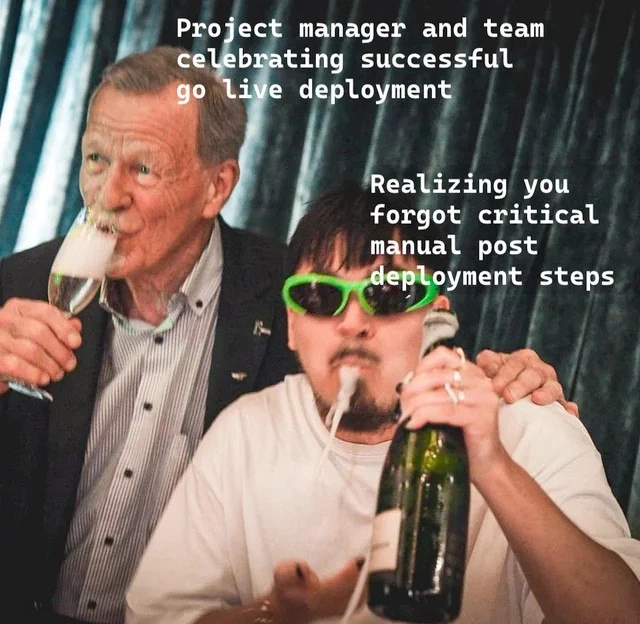
Imagine you just finished a big school project with your friend. You both are so happy that it’s done, and you even throw a little party to celebrate. 🎉 But then, right in the middle of your celebration, one of you suddenly realizes, “Oh no, we forgot to do the last part of the project!” That feeling is exactly what’s happening in this meme. The people thought they were completely done – they were cheering, drinking fancy bubbly drinks, having a great time – and then boom, someone remembers an important task that didn’t get done. It’s like throwing a birthday party and then remembering you left the cake in the oven burning.
In the picture, the older gentleman (like a boss or manager) is happily sipping his drink because he thinks everything is perfect. The younger guy next to him was celebrating too, but he just figured out they missed something huge, and he’s so shocked that he spits out his champagne! It’s a funny way to show the mood going from super happy to 😱 “uh-oh!” in a split second. We find it funny because we can all relate to that sinking feeling when you realize you celebrated too early. Whether it’s thinking you aced a test and then recalling you skipped a question, or doing a victory dance and then noticing you still have work left – it’s that oops moment. So, the meme is basically an “oops, not done after all” story. It reminds us humorously: don’t party until you’re absolutely sure you didn’t forget anything important!
Level 2: Manual Step Misstep
Let’s break down what’s happening in this meme in simpler terms. On the left side, you have the project manager and team members “celebrating a successful go-live deployment.” “Go live” means they’ve just released their software to the real world (the production environment where actual users use it). Everyone’s happy because deploying new code or features, especially if it’s a big project, is a big deal. They’re raising glasses, literally having a little party to congratulate each other.
Now, the right side: “Realizing you forgot critical manual post deployment steps.” This is the oh no part. A post-deployment step is something you’re supposed to do right after you deploy the code. “Manual” means it isn’t done by the computer automatically; a human has to do it. “Critical” implies if you skip it, bad things can happen. In a perfect world, when you deploy new software, everything should be handled by scripts or the deployment process: build the code, run tests, deploy to servers, update databases, etc. That automated process is often managed by what’s called a CI/CD pipeline (Continuous Integration/Continuous Deployment pipeline). Popular tools for this include Jenkins, GitHub Actions, and others, which let you define every step.
However, in many real teams, some tasks don’t get automated and remain manual. Common examples of manual post-deploy steps could be:
- Running a database migration script to update the database structure (so it matches the new code).
- Clearing a cache or CDN so users get the latest files.
- Updating a setting or configuration (like switching an environment variable or feature flag from “off” to “on” for the new feature).
- Kicking off a one-time data backfill or sending a notification email that the new version is live.
For instance, imagine you just deployed a new version of your app that uses a new database table. If you forget to run the script that creates that table, the app will try to use it and then start erroring out or crashing. Oops! That’s a critical step one might forget. In the meme, the guy in the white T-shirt with the champagne bottle probably represents a developer or DevOps engineer. He suddenly remembers, “Oh no, we forgot to do [the important thing] after deploying!” You can see the alarm on his face (even through the pixelation and cool green shades) and champagne foam coming out of his mouth because he’s literally spitting out his drink in shock. The celebration turns sour immediately.
This meme is highlighting DeploymentAnxiety and a classic DevOpsPainPoints lesson: don’t celebrate a deployment until you’ve checked everything. It’s common for less experienced developers or teams without strict processes to think “deploy done = we’re all good!” and overlook a step that wasn’t in the deploy script. That oversight can lead to a ProductionIncident (an issue in the live system). Suddenly, users may face problems, and the team has to rush to fix things. They might need to do a quick hotfix (a fast emergency fix on production), or even rollback the deployment (which means reverting to the previous version of the software that was working fine).
To a junior developer or someone new to deployments, the key points to take away are:
- Always have a checklist or automate all steps: If there’s something you need to do after deploying, try to include it in your deployment pipeline or have a clearly written checklist. For example, if step 10 in your list is “Run
update_schema.sqlon the prod database”, don’t rely on memory — automate it or at least mark it off every time. - Double-check before celebrating: It’s okay to be happy when a deploy goes through, but make sure you verify that the app is actually working in production as expected. Many teams do a “smoke test” right after deploying – a quick test of basic features – to ensure nothing critical was missed.
- Learn from the scare: If you do forget a step and catch it (hopefully before things go really bad), treat that as a lesson. It’s a signal that this step should be scripted or documented better. As they say in DevOps, “Automate all the things!” so that next time, the computer does it and won’t forget, unlike a human might.
In simpler terms: this meme is a funny reminder that in software releases, it’s easy to forget stuff if it’s not automated. The consequences range from mild stress (quickly doing the step after you realize) to major issues (system downtime, users screaming, managers freaking out). The guy spitting out champagne is basically a comedic exaggeration of that “Oh no, what did we miss?!” feeling in your gut when you suddenly remember a missed deployment step. It’s a feeling many in tech know, and it’s why DevOps culture puts such an emphasis on thorough automation and process. After all, computers don’t forget to do steps, but people celebrating a big win just might!
# Example of a CI/CD pipeline snippet (hypothetical)
steps:
- name: Build and Test
run: ./ci_build_and_test.sh
- name: Deploy to Production
run: ./deploy_to_prod.sh
# TODO: Run database migrations (oops, this was missed and left as a TODO)
# - name: Migrate Database
# run: ./migrate_db.sh
(Above, the pipeline had a commented-out step for migrating the database. If such a TODO was forgotten, the new code might break because the DB wasn’t updated. This is exactly the kind of slip-up the meme jokes about.)
Level 3: Not-So-Continuous Delivery
This meme perfectly captures a DevOpsHumor scenario that seasoned engineers know all too well: premature celebration of a deployment followed by the “oh no” moment when you realize something critical was left out. The left side shows a project manager and team happily raising a toast to a “successful” go-live. In reality, the deployment wasn’t fully successful — it just seemed so, until someone remembered the forgotten_post_deployment_tasks. The abrupt shift from triumph to panic (as seen in the guy sputtering out champagne) is funny precisely because it’s painfully common. The humor has that “laugh so you don’t cry” quality. Every veteran developer has a war story of a ReleaseAnxiety dream turning into a nightmare hotfix scramble.
Why is this combination of elements so funny and familiar? It’s pointing at an anti-pattern in software releases: declaring victory before verifying all the boxes are ticked. People are cheering, the project manager is already congratulating the team on meeting the deadline, but then someone from DevOps/engineering realizes, “Wait, we didn’t run the data migration script!” In an instant, the mood flips. It’s deployment whiplash. One second you’re clinking glasses, the next you’re frantically SSH-ing into a server to run a script or create a missing resource. The text on the meme labels it clearly: “Realizing you forgot critical manual post deployment steps.” Few things unite IT folks like the shared trauma of DeploymentPainPoints where a tiny oversight can send you from hero to zero.
This scenario underscores process gaps in what should be a continuous deployment. A true CI/CD pipeline means all steps are automated—from code merge, to testing, to deployment, and any post-deploy configuration. Here, clearly, the pipeline wasn’t complete. Perhaps the team has a runbook (a set of manual instructions) that says “After deploying, run X, Y, Z manually”. Maybe it’s updating a database schema, purging a cache, flipping a feature flag, or restarting a background worker. These things were known, but not integrated into the script. Why not? Common reasons senior devs will recognize:
- Technical debt or legacy process: “We never got around to automating that step.”
- Fear of automation: “That step is risky to run automatically, so we do it by hand.”
- Siloed knowledge: Only Steve in ops knew about it, and Steve was on vacation during the deploy.
- Timeline pressure: “Ship it now, we’ll automate later” – famous last words before a ProductionIncident.
The meme’s comedy also lies in organizational dynamics: the project manager (and likely stakeholders) think everything is done and great – they’re not technically hands-on, so if the CI/CD pipeline says green, they assume all is well. The engineers know there’s more nuance. In this picture, the PM with the suit is sipping bubbly, oblivious, while the dev with the champagne bottle just had an “oh 💩” realization. We can almost hear him choking out, “Hold on, something’s wrong!” It’s relatable to senior devs as a facepalm moment. You can bet the next thing that happens is someone saying, “Everyone, hold off on the celebration… we might need to roll back.”
Real-world scenarios echo this meme often. For example, a team deploys a new version of an app expecting users to flood in, but nobody can log in because someone forgot to set the new OAuth callback URL in production (a manual config step). Cue the rollback_rush or a quick config fix. Another classic: code was deployed that requires a new message queue to be running, but ops didn’t create it beforehand – now the app is throwing errors and the on-call engineer is racing to deploy that missing infrastructure as a hotfix_incoming. These stories are so prevalent that terms like DeploymentAnxiety exist and why post-deploy checklists (or better, automated post-deploy scripts) are taken so seriously by experienced teams.
The painful part (and the funny part, once it’s over) is that fixing these oversights is always harder under pressure. If you had scripted it beforehand, it would run in seconds during deployment. But when you realize it late, you’re in firefighting mode: logs are scrolling, managers are hovering asking “What’s wrong?”, and users might already be encountering issues. It’s a perfect example of that old saying: an ounce of prevention (automation) is worth a pound of cure (mid-celebration panic fix).
In the DevOps community, this meme is essentially a cautionary tale: non_automated_steps are ticking time bombs. Seasoned engineers will chuckle because they’ve learned (often the hard way) that deployment isn’t done until every step is done. And you don’t pop the champagne until the smoke tests pass and you’ve double-checked there’s no “Step 5” hiding in a Confluence page somewhere. The image of the guy in shades spewing champagne is just a dramatization of that sinking feeling in your gut when you suddenly remember what you missed. It’s funny now, but in the moment… it’s pure adrenaline and regret! Next time, maybe CI/CD stands for “Checklist Included before Celebrating Deployment.” 🍾😅
Level 4: The Toil Trap
In the world of DevOps and SRE (Site Reliability Engineering), there's a concept called toil – the repetitive manual work that ideally should be automated. This meme’s punchline is rooted in the pain that manual post-deployment steps create. From a high-level systems perspective, those un-automated tasks are like tiny landmines in your otherwise slick CI/CD pipeline. When every build and deployment step is coded except that one manual runbook task, your release process has a single point of human failure.
SRE principles teach us that humans are error-prone, especially when DeploymentAnxiety or excitement is high. A well-known adage could be: "To err is human, to automate is DevOps." Here, the team celebrated a go-live thinking the system was fully updated. But because a critical step wasn't scripted, the deployment wasn’t truly atomic – it didn’t happen all at once. In theoretical terms, this breaks the ideal of an atomic transaction: part of the system was updated (the application), but another part (perhaps the database or config) was not, violating consistency. The result? A Schroedinger’s release that’s both “successful” and broken until that missing step is done.
This touches on the importance of idempotency and automation in deployment design. An idempotent deployment means you can run it repeatedly and get the same result every time – nothing is left to chance or one-time actions. Forgotten manual tasks are inherently not idempotent: they’re often one-off changes (like a schema migration or caching step) that, if skipped, leave the system in a weird state. There’s also a bit of the CAP theorem vibe here: we sacrificed consistency (by missing a step) in our rush for availability (getting the new version live). The theory and history of DevOps emphasize continuous everything – integration, delivery, deployment – precisely to avoid these human-error pitfalls. Early computing ops relied on strict checklists (think NASA mission style). DevOps evolved, in part, as a reaction to those error-prone manual processes, aiming to encode every step into version-controlled pipelines.
In short, from a deep technical lens, this meme highlights a classic DevOpsPainPoints scenario: the elegant dance of automation is only as strong as its weakest link. Here the weak link is a human-dependent step. The celebratory champagne turned into a firehose because one piece of the release process wasn’t in code. It’s a reminder that even in highly advanced build systems, non_automated_steps create a trap where excitement quickly transmutes into emergency ProductionIncidents. The real humor is in that inevitability — like a law of physics for software teams: if anything must be done manually after deploy, Murphy’s Law ensures someone will eventually forget it.
Description
A meme contrasting two modes of celebration at a 'successful' go-live. On the left, an older man in a suit, labeled 'Project manager and team celebrating successful go live deployment', elegantly sips champagne from a glass, representing blissful ignorance. On the right, a younger man in a white t-shirt and neon green sunglasses, labeled 'Realizing you forgot critical manual post deployment steps', messily chugs champagne straight from the bottle as it foams out of his mouth, symbolizing the developer's panicked realization of an impending production issue. The technical humor lies in the common scenario where a deployment is declared a success prematurely by management, while an engineer knows a critical, un-automated manual step was missed, which will almost certainly lead to a production failure. It captures the dread of knowing a crisis is imminent while the rest of the team celebrates
Comments
7Comment deleted
A successful deployment is just an incident that hasn't been reported yet. The time between the champagne pop and the PagerDuty alert is the 'blast radius calculation' phase
That split-second after the PM pops champagne when you remember the “temporary manual DNS cut-over” that’s been in the runbook since 2014 - and you can already hear PagerDuty clearing its throat
The only thing more reliable than a PM's optimistic timeline is forgetting to run that one SQL migration script that's been sitting in a Confluence page nobody's looked at since the architecture review six sprints ago
The moment when your 'fully automated' deployment pipeline reveals it's actually a YAML file with 47 steps followed by a Confluence page titled 'IMPORTANT: Manual Steps (DO NOT FORGET)' that nobody bookmarked. Your Terraform applied successfully, your containers are running, your health checks are green - but did anyone remember to flip the feature flags, warm the CDN cache, update the API keys in that one legacy service, and manually trigger the search index rebuild? Champagne tastes different when you're calculating the RTO for a rollback at 5 PM on a Friday
Champagne spraying everywhere? Just a preview of the prod alerts flooding Slack post-forgetful deploy
We popped champagne at go-live - then remembered the idempotent-but-not-reentrant backfill, the three-region feature flag flip, and that the blue/green cutover cron still lives on the old node
Enterprise ‘Done’ is when the pager stays quiet after migrations run, flags flip, monitors unmute, DNS TTL is restored, and the SLO budget survives - until then, that champagne is just a pre-incident drink