Elon Musk's multi-layered joke: from juvenile humor to an AI pun
Why is this DevCommunities meme funny?
Level 1: Peek-a-Boo Letters
Imagine you have a shirt that says "I ❤️ CANDY". You really want to tell everyone how much you love candy. But oops – you put on a jacket and it covered up the letter "C". Now when people look at you, they see a shirt that seems to say "I ❤️ ANDY". They might think you really love someone named Andy! You’d probably laugh and say, "No, no, it’s candy! The first letter is just hidden."
That’s exactly what happened in this meme. The person’s shirt was supposed to say they love Canada (the country). But some of the letters got hidden, playing a little game of peek-a-boo. The remaining letters spelled something totally different and kind of silly. People misread it and got confused, sort of like when you cover part of a word and your friends suddenly read a whole new word. The person in the picture then joked about it, saying “Haha, some of you read it wrong!”
The reason it’s funny is the same reason a peek-a-boo is fun for a baby – something expected disappears and you see something unexpected instead. In this case, hiding a few letters turned a normal loving message into a goofy mistake. Everyone laughs because we all know it was just an accident of hiding letters, and it’s amusing to see how a hidden piece of a word can create a whole new meaning.
Level 2: Missing Letters, New Message
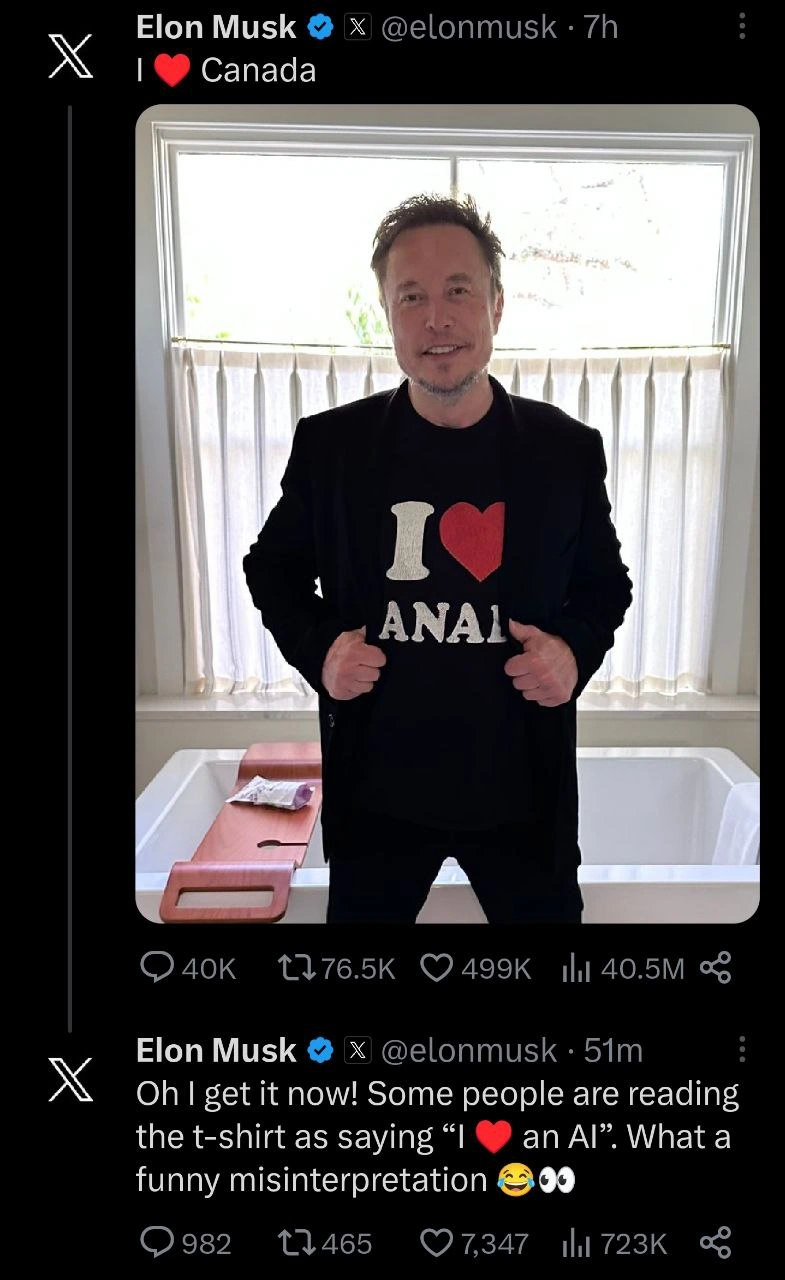
Let’s break down the joke in a straightforward way. The picture shows a person (in fact, Elon Musk) wearing a T-shirt that should say “I ❤️ CANADA”. He’s expressing love for Canada. However, his black jacket is covering up parts of that word. We can only clearly see the middle of the word CANADA, and it looks like the four letters “A N A L” on the shirt. That spells a very different word, anal, which is a rude/sexual term unrelated to Canada. Oops! So the photo alone is already a comedy of errors: a wholesome patriotic message (“I love Canada”) accidentally turns into a crude phrase because of a simple cropping (hiding) of text. This is what the tag #cropped_text_fail refers to – a fail caused by text being cut off.
Now, what about the “AI” part? Elon noticed people were laughing at this goof, so about 51 minutes later he made another post jokingly saying: “Oh I get it now! Some people are reading the t-shirt as saying ‘I ❤️ an AI’. What a funny misinterpretation 😂👀.” In other words, he’s pretending that the misunderstanding was people thinking he loves an AI (as in an artificial intelligence robot or program), instead of loving Canada. Why “an AI”? Because if you take those same letters ANAL and kind of split them up (and maybe misread the L as a capital I), you get “AN AI”. It’s a bit of a stretch in reality, but he’s purposefully using a nerdy reading to make a joke.
So, the humor comes from a string parsing joke – which means reading letters in a different grouping than intended. In programming or data, parsing is how we break up and interpret text. A parsing error means you read the input wrong. Here the input was the T-shirt text. The intended parse was “I ❤️ Canada”, but the actual visible parse became “I ❤️ anal” or “I ❤️ an AI”. It’s like the text got misinterpreted because part of it was hidden. This connects to the idea of human optical OCR error: OCR stands for Optical Character Recognition, where a computer tries to read text from an image. If an OCR system only sees part of a word, it might guess wrong about what the word is. Humans do this too — if we see only half a sign or half a word, our brains try to fill in the blanks, sometimes with funny results.
Let’s relate this to a simple coding analogy. Imagine you have a string in code and you accidentally chop off some characters. The meaning can change completely. For example:
word = "Hello"
print(word[:4]) # This prints "Hell", which is not quite the friendly greeting you intended!
In this snippet, we intended to say “Hello” but by taking only the first 4 letters, we got “Hell” – oops! That’s exactly like what happened with “CANADA” -> “ANAL”. The code didn’t know we wanted the whole word, just like people looking at the shirt didn’t see the whole word. It’s an off-by-one mistake in slicing the string (or rather, an off-by-two, since two letters were missing). New developers often run into these issues when handling strings or arrays – get the indices wrong by a little and your output can turn into gibberish or something unintended.
To clarify some terms from the tags:
- AI usually stands for Artificial Intelligence. When Elon joked “I ❤️ an AI”, he was referring to an AI (like a robot or algorithm) that he “loves”. Given Elon’s involvement in tech, it’s a playful nod — he’s often talking about AIs (and even famously cautious about them).
- AI vs AI ambiguity: This is a play on words. The letters “AI” can mean the concept of artificial intelligence, but here “AI” is literally just part of the word “Canada” (well, sort of – part of “anal” which came from “Canada”). It’s poking fun at how the same letters can mean different things in different contexts.
- Substring: a part of a string (continuous sequence of characters). “Anal” is a substring of “Canada” (not an exact one, but by skipping some letters, essentially). In code and text, handling substrings is common – like getting just a last name from a full name. But if you grab the wrong substring, you get the wrong word.
- Cropped text fail: when text is cut off (cropped) so that it fails to convey the original message. Here the crop fail is physical (the jacket covering letters), but we see digital examples of this too – like a UI showing “Error: cannot find file specif…” because it didn’t have space to show the whole error message.
For a junior dev or someone new to these ideas, the big takeaway is: context matters a lot. A phrase or code snippet without all its parts can mean something completely different. It’s funny in this meme, but it can cause real confusion in apps or websites. Ever see a notification that ended in “…” and you weren’t sure what it was about? Same kind of problem. Developers have to anticipate these issues – whether it’s truncating text safely or validating that a substring is what they think it is.
And of course, this meme is also just tech folks having a laugh at a high-profile person making what looks like a silly mistake. It humanizes the tech world: even the CEO of multiple tech companies can have a communication glitch that makes everyone giggle. In developer communities, sharing these light-hearted moments (tagged with things like #AIHumor, #DeveloperHumor) is a way to bond over the quirky side of tech and communication.
Level 3: Substring Shenanigans
What makes this meme golden for seasoned devs is the perfect storm of context collapse and cheeky wordplay. We have a well-known tech figure (Elon Musk) proudly wearing a shirt to express love for a country, but thanks to strategic cropping (or an unfortunately positioned blazer), the slogan is truncated to an entirely different message. Experienced developers have seen analogous mishaps in software: one small truncation or substring mis-calculation and suddenly your output says something you never intended. It’s the classic off-by-one error, but applied to human language instead of arrays.
The humor operates on multiple levels. First, there’s the obvious shock value: “I ❤️ ANAL” appearing on a public post is jarring and juvenilely funny. It’s like an inadvertent UI fail where the interface cuts off text at just the wrong spot. Any dev who’s worked on text UIs or social media integrations can recall horror stories of text cropping gone wrong – like a notification that ends with an unfortunate half-word because it didn’t fit the screen. This meme taps into that shared memory: we cringe and chuckle because we know how easily it happens.
Then comes the follow-up post, which is pure facepalm humor: “Oh I get it now! Some people are reading the t-shirt as saying ‘I ❤️ an AI’. What a funny misinterpretation 😂👀”. By acknowledging the misread, he’s doing two things: pretending (with tongue in cheek) that the issue was folks mis-seeing “ANAL” as “an AI,” and simultaneously winking at the audience because we all know the real misread everyone’s giggling about isn’t about robots at all. It’s a classic bit of internet meme culture to play dumb and make a goofy explanation for an obvious blunder. Developers do this kind of joking explanation all the time in commit messages or comments when something silly happens: “Oops, apparently the variable AnalyticIndex abbreviated to anal in logs – what a funny misinterpretation! 😅.” It’s a way to diffuse embarrassment by leaning into the joke.
This also highlights a communication lesson that seasoned engineers know too well: context is king. Remove context, and meaning can pivot 180 degrees. In an office setting, it’s like forwarding only part of an email thread and causing confusion because the rest was trimmed off. In code, it’s accidentally logging a variable’s value without its label, leading everyone to play detective about what that cryptic number means. Here, cropping the word Canada down to Anal created a context vacuum that got gleefully filled with either NSFW humor or nerdy reinterpretations about AI.
We’re also seeing a nod to the ambiguity of “AI”. In the tags it’s noted as ai_vs_ai_ambiguity. That’s a cute way of saying: are we talking about the letters “AI” or the concept of Artificial Intelligence? The meme’s second panel jokes that people read the shirt as “I love an AI” (like he’s professing affection for a friendly robot). The contrast between anal (a rude slang term) and an AI (a tech phrase) is absurdly wide, which is why it’s funny. It’s the kind of punny misunderstanding devs chuckle about, similar to how a poorly named variable or a misheard command can lead to comic confusion in a team. There’s a shared understanding in dev communities that one person’s innocuous string is another person’s hilarious substring, depending on where you slice it.
In fact, the developer crowd has a long history of these string parsing jokes. Remember those legendary examples of unintentional word mashups? Classic one: the domain expertsexchange.com (meant to be Experts Exchange) was initially read as “expert sex change” due to the lack of a separator. Or therapistfinder.com which could read as “the rapist finder” – yikes. These aren’t programming bugs per se, but they arise from the same principle: without the right delimiters (spaces, hyphens, or in our meme’s case, visible letters), the human brain’s parser might chunk the characters in unintended ways. The Elon shirt scenario is cut from the same cloth. It’s a real-life substring bug: the string “CANADA” lost some characters and our pattern-matching minds accidentally matched the remaining “ANAL” to a very different concept.
For seasoned devs, there’s also an element of “I’ve seen this trick before.” Elon Musk is a provocateur on social media – he had to know this photo would spawn memes. His follow-up “explanation” is posted just 51 minutes later, almost like deploying a hotfix or writing a humorous documentation for the mishap. It reads like a senior engineer’s comment in code: "// Some might interpret this output differently, what a funny misinterpretation 😂👀". We smirk because it’s playing dumb in a self-aware way, much like how a developer might push a fix and in the PR notes joke about the bizarre bug that necessitated it. It’s a form of meta-commentary that tech folks love.
Ultimately, the meme is poking fun at how meaning in tech (and life) can entirely hinge on small details. One moment you have a proud statement about Canada, the next you’ve accidentally professed love for anal (or for an AI, as the playful cover-up goes). It’s a reminder: always consider edge cases – or in this case, edge letters – because the stuff we don’t plan for is often what gets us in the end. And as every battle-hardened coder knows, those edge-case slip-ups are the ones that come back to bite you… or at least make everyone else laugh.
Level 4: Tokenization Tribulations
In the realm of natural language processing (NLP) and computer vision, this meme is a case study in how incomplete data confuses even smart systems. The shirt text was parsed in a way that lost critical characters, akin to an OCR (Optical Character Recognition) algorithm seeing only a fragment of a word. Substrings without context can trip up algorithms just like they do humans. In NLP terms, the system’s tokenizer is fed a malformed input: the sequence ANAL instead of the intended CANADA. Without the leading C and trailing DA, a machine (or a rushed human reader) tries to make sense of ANAL on its own.
From a parsing perspective, this is a classic segmentation fault – not the memory kind, but a lexical one. The brain (or a model) has to decide: are those four letters one word or two? Here the confusion spawned the phrase "I ❤️ an AI" by mentally splitting ANAL into AN AI. This resembles how AI word-segmentation algorithms work in languages without spaces: they look for plausible breaks between characters. The sequence A N A L doesn’t match a common single English word (besides a certain crude term). An AI might insert a segmentation: AN AI ("an" and "AI" as two tokens). Ironically, "AI" is a familiar acronym for Artificial Intelligence, so a contextual parser might latch onto that as a meaningful interpretation. The result is a kind of accidental re-tokenization – the system finds a different, more palatable pattern (AN AI) in the jumble, much like a spell-checker or auto-correct guessing what you meant.
There’s also an intriguing aspect of AI bias and filtering here. Many modern models have content filters. If an OCR or language model detected the letters A N A L, it might flag or avoid the literal word anal (due to its sexual context) and instead converge on a less sensitive output like an AI. This is speculative, but not far-fetched: models often prefer safe or known terms over potentially disallowed ones. It’s a high-tech twist on the meme’s joke – the AI itself might be in on the double entendre, steering towards a geeky interpretation (loving “an AI”) to dodge an awkward one.
Under the hood, this scenario touches on prefix ambiguity in strings. It’s similar to how a compiler or regex engine might get confused if you don’t anchor patterns properly. For example, given the string "CANADA", a naive substring extraction or regex could accidentally capture "ANA" or "ANAL" if it miscalculates boundaries. This meme is essentially a playful, real-world example of an off-by-one error in reading comprehension – drop a few characters and the entire semantic meaning shifts. In formal language theory, a string’s meaning is heavily context-dependent; remove the context and you invite multiple possible parses. Here, the missing context (C and DA) is like missing delimiters or corrupted data for an algorithm, leading to a hilarious misinterpretation akin to a parsing bug.
So at Level 4, we’re geeking out on how a cropped phrase demonstrates challenges in AI text recognition and parsing. It’s a reminder of the delicate interplay between data and context. Whether you’re training an ML model or writing a compiler, a tiny omission can spawn unintended interpretations – sometimes with comical (or catastrophic) results. The “I ❤️ Canada” → “I ❤️ an AI” mix-up may be a simple visual gag, but it encapsulates issues of tokenization, segmentation, and context awareness that keep AI/ML engineers up at night (and keep the rest of us laughing).
Description
A screenshot of two tweets from Elon Musk's X account. The first tweet shows a photo of Musk wearing a black t-shirt under a blazer. Due to the way he's holding the blazer, the shirt, which likely says 'I ❤️ CANADA', is obscured to read 'I ❤️ ANAL'. The tweet's text is 'I ❤️ Canada'. The second tweet, posted 51 minutes later, shows Musk feigning innocence: 'Oh I get it now! Some people are reading the t-shirt as saying “I ❤️ an AI”. What a funny misinterpretation'. The meme's humor stems from this layered joke: first, the intentional, juvenile visual gag, and second, the implausible and self-referential 'correction' that pivots to Artificial Intelligence, a field Musk is heavily involved in. For the tech audience, it's a commentary on the often cringey and attention-seeking social media antics of prominent tech figures
Comments
13Comment deleted
Elon's attempt at plausible deniability by suggesting 'I ❤️ an AI' is the ultimate edge case. It's like writing a deliberately ambiguous commit message and then claiming any resulting bugs are just the compiler's 'funny misinterpretation' of your genius
Substring lesson: drop the C and DA from “CANADA” and your T-shirt jumps from patriotic to NSFW in O(1); the LLM still tags it “I ❤️ an AI” - - proof that even transformer stacks can’t correct an off-by-two
When your t-shirt's kerning accidentally becomes the most honest tech CEO statement of 2024 - loving AI while the rest of us debug its hallucinations in production
When your t-shirt causes a production incident because half the team thinks you're advocating for analytics-driven decisions while the other half assumes you've gone all-in on LLMs - classic case of ambiguous requirements leading to divergent interpretations. At least the engagement metrics are through the roof, which is more than we can say for our last sprint's velocity
Proof typography is a production dependency: one blazer flipped a feature flag and “I ❤️ Canada” got tokenized as “I ❤️ an AI.” Action item - kerning unit tests before marketing ships shirts
The shirt that broke thousands of vision transformers: 'ANAI' as the ultimate out-of-distribution edge case
Our vision‑language stack read the shirt as “I ❤️ an AI” - proof that without a preprocessor named handle_kerning_occlusion() you’re just one BPE merge away from a Trust & Safety page
yeah... Comment deleted
This is a classic. Comment deleted
before , we were suspicious and made jokes on this pic and now we are 100% sure about our claims Comment deleted
He is trolling Comment deleted
anaconda Comment deleted
This man has exactly my humor Comment deleted