Skip to content
DevMeme
4895 of 7435
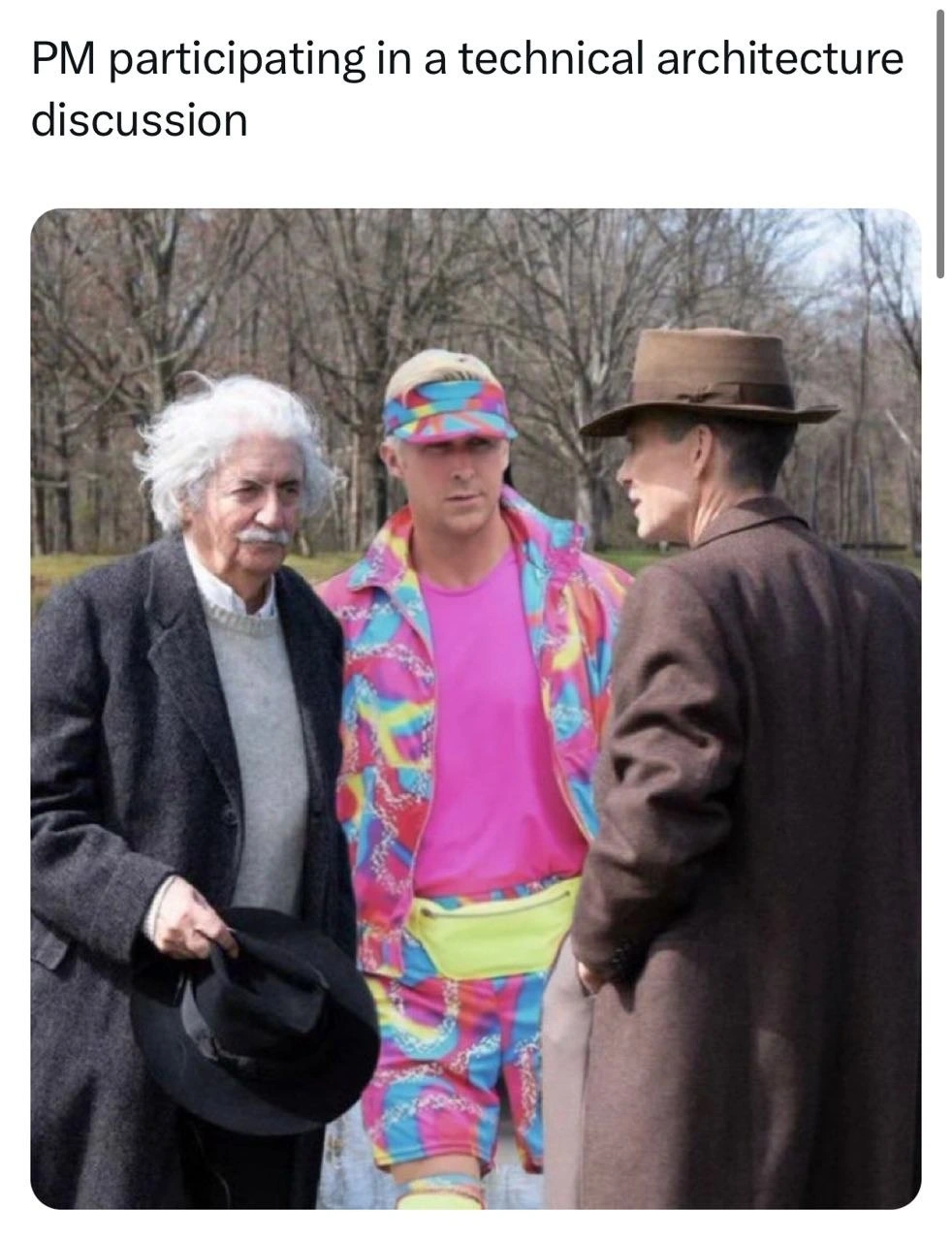
When the PM joins the architecture review
Management PMs Post #5357, on Aug 21, 2023 in TG

When the PM joins the architecture review

Why is this Management PMs meme funny?

Level 1: Odd One Out

Imagine you and your friend are quietly putting together a super complicated LEGO castle. You’re both serious and focused, carefully figuring out how each piece fits (this is like the engineers planning a system). Now suddenly, a third friend bursts into the room wearing a bright, goofy costume with neon colors, laughing and suggesting you add a giant glitter slide to the castle. It’s a funny interruption because it doesn’t match the calm, serious mood you and your friend had. You both look at each other, maybe giggle or roll your eyes, because your costumed friend seems like they came from a party while you were doing careful work. In the meme, the two serious people are the focused friends, and the person in the wild neon outfit is the silly friend. The picture makes us laugh because one person clearly doesn’t fit in with the others – just like a clown suit at a formal dinner. It shows in a simple way how one person (the product manager) is out-of-place among the others (the engineers) during a very serious talk. We find it funny and a bit awkward, the same way it’s funny if someone dressed for a carnival walks into a quiet library.

Level 2: Bridging the Gap

Let’s break down why this scenario happens and what all these terms mean, especially if you’re newer to software teams:

  • Product Manager (PM): This is the person responsible for the what and why of a product. They decide which features the product should have, prioritize what gets built first, and make sure the final result makes customers (and the business) happy. A PM is all about stakeholder expectations – keeping bosses, users, and clients satisfied. Notably, PMs are usually non-technical participants in the sense that they don’t write the code or design the system internals. They focus more on timelines, user experience, and business outcomes. In the meme, the PM is the one in the neon 90s outfit. That wild clothing is a funny way of saying, “This person doesn’t quite blend in with the technical folks.”

  • Technical Architecture Discussion: This is essentially a meeting where developers and software architects plan out how to build something big or complicated. Think of it like architects planning a house: they decide where the rooms go, how the wiring will be laid out, what materials to use, etc. In software terms, an architecture review means talking about how different pieces of the application will work together. For example, should we use one database or split data into two databases? Do we build one big application or break it into microservices? Which frameworks or libraries will support our needs? The conversation gets deep into technical details like data flow, security, performance, and maintainability. In our meme, the two people in coats are deep in this kind of discussion — serious faces, serious topics. It’s a system design talk, meaning they’re concerned with how the system’s pieces fit and function as a whole.

  • Design Patterns & Jargon: Design patterns are common solutions to recurring problems in software design. They have names like Singleton, Observer, or Model-View-Controller (MVC). When developers mention these, they’re referencing a whole idea in short-hand. Similarly, architecture discussions are full of jargon: you’ll hear terms like load balancer, API gateway, caching, throughput, latency, etc. These are all technical concepts. If you’re not familiar with them, an architecture meeting can sound like it’s in another language. In the meme scenario, the engineers (the two serious folks) are likely using this kind of language. The PM might not know these terms deeply (or at all), which makes them feel as out-of-place as their tie-dye jacket looks. Fun fact: the meme’s joke “Clash of Patterns” isn’t just about the clash of clothing patterns; it’s hinting at design patterns vs. fashion patterns. The engineers speak in design patterns, while the PM shows up literally wearing a crazy pattern – see the irony?

  • Communication Gap: This refers to the misunderstanding or talking past each other that can happen when people from different backgrounds try to discuss something complex. In a Communication context, engineers and PMs often have the same goal but different approaches. The PM might say, “We need this feature live by next month,” focusing on delivery and user impact. The engineer replies, “We have to refactor the data access layer to scale,” focusing on technical feasibility. They’re kind of like two ships passing in the night if they’re not careful – each talking, but not connecting on the same points. In meetings, this gap means the PM might ask questions that seem off-topic to engineers, or the engineers might dive into details that make the PM’s eyes glaze over. The neon outfit in the image exaggerates this gap – it’s a visual cue of someone who doesn’t match the corporate culture of that discussion. The humor is friendly here: it’s poking fun at how a PM’s perspective can seem almost alien in a hardcore tech debate.

  • Corporate Culture Clash: Within many companies, different teams develop their own sub-culture. Engineering teams might value precision, skepticism, and caution (often reflected in a serious tone during critical discussions). Management or product teams might value optimism, big-picture thinking, and quick decision-making. Neither is wrong – they just have different jobs. When a product-oriented person joins an engineering-heavy meeting, you often get a clash of these styles. It’s like dress codes: one side is metaphorically in a formal suit (engineers being methodical and reserved) and the other is in casual Friday Hawaiian print (PM being upbeat and visionary). The meme’s clothing contrast (muted brown vs. neon pink) is a funny literal depiction of this. MeetingHumor like this comes from relatable moments – everyone in tech has seen a bit of awkwardness when worlds collide in a meeting. But ideally, both sides can learn to appreciate each other: engineers understand user needs better, and PMs learn some tech basics over time. (And maybe next time the PM leaves the 90s windbreaker at home when visiting the architecture review!)

In essence, this meme highlights how a Product Manager can feel (or appear) completely out-of-place during a hardcore engineering design review. It’s exaggerating the situation to make us laugh: the mismatch in attire represents the mismatch in mindset and vocabulary. If you’re new to tech, don’t worry – it’s normal for there to be a learning curve when different roles work together. And if you ever find yourself as the neon-clad person in a room of suits, just remember: ask questions, listen actively, and maybe save the festival outfit for actual festivals 😉. The engineers will appreciate the effort (and maybe your funky style, eventually).

Level 3: Clash of Patterns

At first glance, this image is a pitch-perfect metaphor for an architecture review meeting gone awry. In a typical technical design discussion, you’ll find engineers huddled together in serious debate about system design trade-offs – imagine talk of microservices vs monoliths, database ACID properties, or which design patterns to apply. Everyone else is effectively wearing the equivalent of muted brown suits: reserved, focused, and using the lingo of software architecture. Now enter the Product Manager (PM), striding in with neon enthusiasm (literally dressed like a 90s rave). The PM’s very presence is as in-your-face as that tie-dye tracksuit, and it highlights a classic tech workplace scenario: the non-technical participant plowing into a deeply technical conversation. It’s a CommunicationGap so flagrant it might as well be wearing a pink shirt and a yellow fanny pack.

For seasoned developers, the humor cuts close to the bone. We’ve all been in that meeting where a well-meaning PM enthusiastically throws in an idea that’s completely out-of-sync with the engineering discussion. The meme’s caption "PM participating in a technical architecture discussion" sets the stage: two engineers (in their drab, all-business attire) are likely knee-deep in discussing, say, the pros and cons of an event-driven microservice architecture. They’re tossing around terms like scalability, fault tolerance, API gateways, and perhaps referencing the Observer or Factory pattern as natural as breathing. Then our PM, clad in metaphorical neon, chimes in: “Couldn’t we just do this faster if we use blockchain or AI or something?” The engineers exchange looks (just like the two gentlemen in overcoats sharing a glance in the image). It’s that mix of amusement and oh-no-not-again frustration. The flamboyant outfit is basically the PM’s thought bubble in visual form – bright, loud, and a bit out-of-place compared to the subdued, methodical tone of the architecture talk.

This misaligned expectations dynamic is why the meme elicits knowing chuckles. The PM is focused on the big picture and stakeholder promises: shipping the feature on time, satisfying the client, and maybe throwing in that trendy idea they heard at a conference. Meanwhile, the engineers are deep in the weeds of how to make it all work reliably – debating designpatterns and constraints that the PM might not even be aware of. The result? The PM’s contributions land with the subtlety of a neon fanny-pack at a funeral. It’s ManagementHumor gold because it’s true: the PM often feels out-of-place (and is out-of-place) in these scenarios, much like someone in festival gear crashing a somber business meeting. The meme exaggerates this by pulling the contrast into the physical world: neon vs. neutrals, wild vs. conservative, party vs. boardroom.

From a senior engineering perspective, there’s also a bittersweet layer here. This image hints at the classic corporate culture clash between product and engineering teams. The two overcoated figures could be seen as veteran architects – serious, historically-minded (one even looks like Einstein, emphasizing raw genius or deep technical wisdom). They represent tradition, careful planning, maybe even the weight of system design history (“let’s not repeat the mistakes of the past system”). The PM in neon? That’s the disruptor from another world – the world of business and user features – barging in with color and optimism, perhaps ignorant of past technical lessons. We laugh because we’ve seen it: the PM might cheerfully ask “Why is this taking so long?” or “Can we just reuse that old server to save time?” at the exact moment the architects are cautioning against a single point of failure or a risky shortcut. It’s the classic scenario of StakeholderExpectations colliding with engineering reality. And as any jaded engineer knows, that collision can be equal parts comedic and painful.

Importantly, the meme doesn’t necessarily villainize the PM; it just shows the cultural mismatch. In many tech organizations, including a PM in an architecture review is done with good intentions – to keep everyone aligned. But the reality (and the joke) is that if the PM isn’t versed in the technical side, they unintentionally derail the discussion or force the engineers to translate tech speak into plain English on the fly. The communication gap turns into a spectacle – as glaring as a fluorescent outfit in bare winter woods. Seasoned devs relate to the absurdity: it reminds them of meetings where they had to explain something like “we can’t skip input validation, it’s not just extra fluff” to a non-engineer. Over time, you develop a dark humor about it, embodied perfectly by this image’s contrast. In short, the meme is funny to experienced folks because it captures a truth of corporate life in a single frame: different roles sometimes live in totally different worlds, yet they have to stand in the same meeting trying to communicate. And nothing illustrates “different worlds” better than clashing dress codes from different eras.

Description

A three-person meme format with the caption 'PM participating in a technical architecture discussion'. The image shows three figures standing outdoors against a backdrop of bare trees. On the left is a man resembling Albert Einstein with his iconic wild white hair and mustache, wearing a dark tweed jacket over a light sweater. In the center is Ryan Gosling as Ken from the Barbie movie, looking slightly confused while dressed in a flamboyant, brightly colored pink, blue, and yellow windbreaker, a pink t-shirt, a colorful visor, and a neon yellow fanny pack. On the right is Cillian Murphy as J. Robert Oppenheimer, wearing a brown coat and fedora, engaged in conversation. The humor stems from the visual metaphor of placing the garishly dressed, fun-loving Ken between the two serious, intellectually formidable figures of Einstein and Oppenheimer. This represents the common stereotype of a non-technical or less-technical Product Manager being comically out of their depth in a complex, high-level technical architecture discussion with senior engineers or architects

Comments

7
Anonymous ★ Top Pick The architects are debating the trade-offs of a multi-region, active-active setup, and the PM chips in to ask if we can make the loading spinner a different shade of blue
  1. Anonymous ★ Top Pick

    The architects are debating the trade-offs of a multi-region, active-active setup, and the PM chips in to ask if we can make the loading spinner a different shade of blue

  2. Anonymous

    We’re deep in a Raft vs. Paxos debate when the PM strolls in, dressed like a YAML merge conflict, asking if we can “make the monolith serverless by quarter-end for brand consistency.”

  3. Anonymous

    The PM confidently suggesting we 'just use microservices' while the architects debate CAP theorem implications is like showing up to a quantum physics symposium with a Magic 8-Ball and unlimited confidence in Agile ceremonies

  4. Anonymous

    When the PM joins the architecture discussion between the senior principal engineer who's been with the company since the monolith era and the staff engineer who just migrated everything to microservices, they somehow manage to suggest a solution that violates both CAP theorem and common sense - yet still gets added to the roadmap because it aligns with OKRs

  5. Anonymous

    PM in arch review: 'Why not microservices in blockchain?' - Einstein nods politely while diagramming the inevitable distributed tech debt explosion

  6. Anonymous

    PM: can we make it event‑driven yet transactional across regions, keep p99 under 50ms, and ship by Friday - feels like a feature‑flag problem

  7. Anonymous

    Architecture review: we’re debating Consistency vs Availability; the PM shows up with their own CAP - Cost, Approval, PowerPoint - and insists we can have all three by Q3

Use J and K for navigation