Skip to content
DevMeme
3008 of 7435
Software Evolution as a Series of 'Minor' Pivots
TechDebt Post #3323, on Jun 24, 2021 in TG

Software Evolution as a Series of 'Minor' Pivots

Why is this TechDebt meme funny?

Level 1: Too Many Toys in One Box

Imagine you started building a LEGO car. At first, it’s simple and works fine as a car. Then your friend says, “Let’s make it a boat too!” So you add a boat hull to your car. Another friend comes and says, “It should fly like a plane!” so you stick on airplane wings and a tail. Then someone else thinks, “Can we give it a rocket to go super fast?” so you strap a big toy rocket on it, even if it doesn’t fit. And finally, your little sibling says, “I want it to look like Santa’s sleigh!” so you hook up a reindeer in front of it. Now your poor LEGO creation is a car-boat-plane-sleigh with a rocket – it looks totally silly and barely holds together. Each person’s idea sounded small (“just a minor change!”), but added up, you got a crazy mixed-up toy. The meme is funny because that’s exactly what’s happening in a software project: too many changes and ideas piled on top of each other, turning a simple thing into a ridiculous Frankenstein monster. It makes us laugh and cringe because it’s like when everyone keeps adding their ideas to one project, you end up with something that tries to do everything but ends up doing nothing well – just like our overstuffed toy vehicle that might not even move even though it has all those cool parts.

Level 2: Minor Changes, Major Chaos

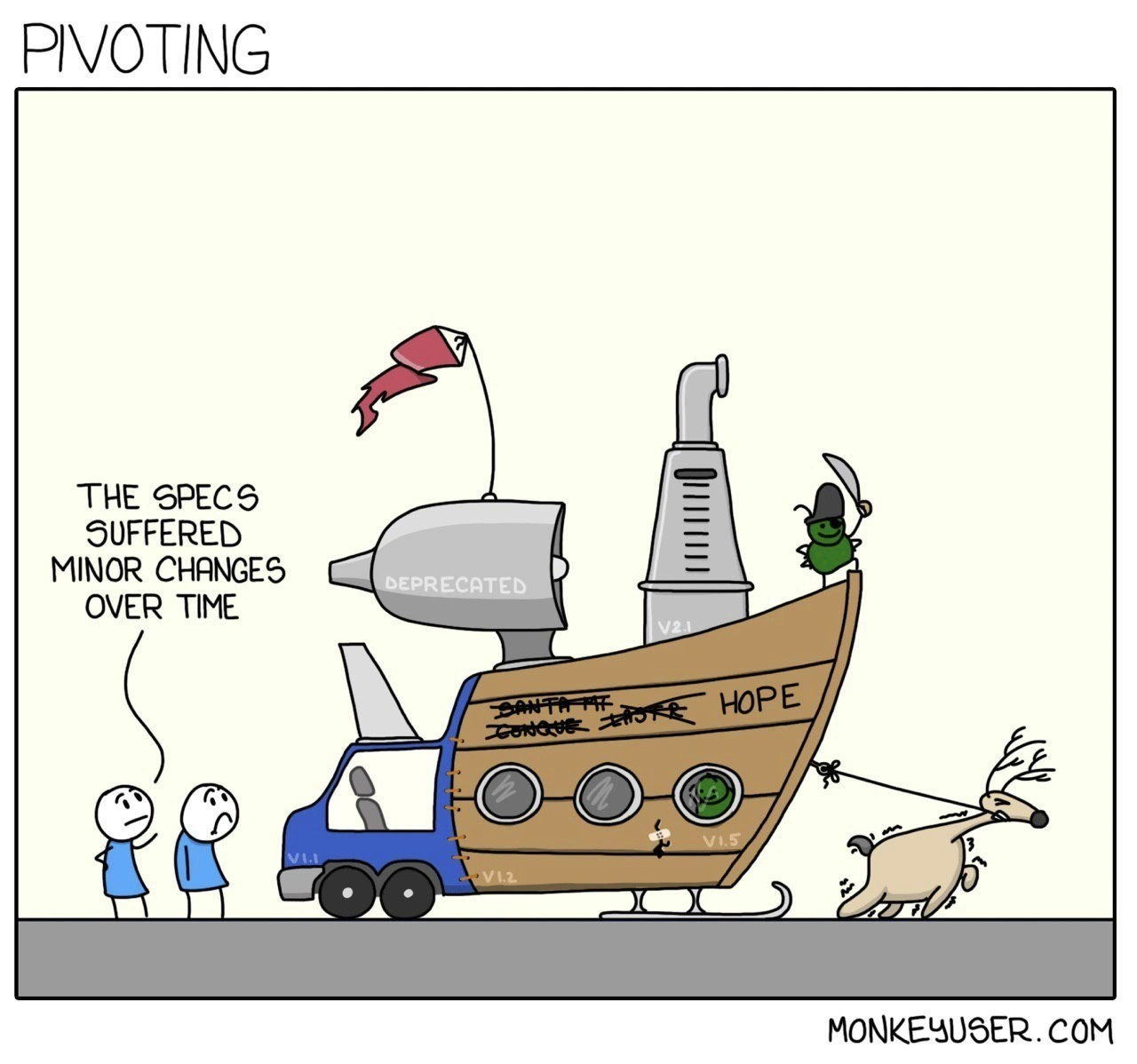
In software development, scope creep refers to the tendency of a project’s requirements to keep expanding over time – often without proper control. That’s exactly what this cartoon is depicting in a funny, exaggerated way. We have a project (represented by the vehicle) that started as one thing (a simple blue van labeled v1.2) and ended up as something completely different (a crazy hybrid machine). The phrase in the comic, “the specs suffered minor changes over time,” is an ironic understatement. Specs (specifications) are the description of what the product should do. Calling these changes “minor” is a joke, because clearly the changes were massive enough to turn a van into a ship-plane-rocket-sleigh contraption! This is a classic case of requirements change management gone wrong: instead of managing changes, they just kept tacking on new requirements without removing or reworking the old ones.

Let’s break down the parts of this patchwork product and what they represent in real-world software projects:

  • Blue Van (Front End, labeled v1.2): This likely represents the original project or feature set (version 1.2, an early release). It’s the base vehicle – perhaps the initial MVP (Minimum Viable Product) that met the original requirements. Think of it like the first version of an app that had just the core features.
  • Wooden Ship Hull (“HOPE”, with earlier name scratched out): At some point, someone in charge (maybe a client or a CEO) changed the direction of the project. Perhaps the product was repurposed for a new use (like turning a car into a boat). The crossed-out name (something with “Santa”) and the new name “HOPE” suggest the project’s goals or branding were completely revised. This is analogous to renaming a project and repurposing it for a new market or theme. In software, it could mean a major pivot like changing a mobile app for car rentals into a boat rental service – “Don’t worry, it’s a minor pivot!” – except it requires huge changes under the hood.
  • Airplane Tail Fin: Yet another change in direction – perhaps an additional feature to make the product “fly” (figuratively speaking). This could represent a requirement to add a major feature that wasn’t originally planned, like integrating air travel booking into that boat rental app (to continue the analogy). In software terms, it might be integrating with a whole new system or adding a new platform.
  • Giant Jet Engine (labeled “DEPRECATED”): The word deprecated in tech means something that is no longer recommended for use, often slated for removal, but still present for compatibility. Here it’s slapped on a huge jet engine – implying they once tried a high-powered solution or cutting-edge module that didn’t work out, but they never fully removed it. In real projects, this could be an ambitious feature or a new technology that got partially implemented and then abandoned. Maybe the team tried a new database or a microservices architecture (the “rocket engine” to speed things up) but later disabled it because it wasn’t stable – yet traces of that attempt remain in the code (like config flags, unused modules) because nobody had time to clean it up.
  • Smokestack (labeled v2.1): This indicates a version 2.1, suggesting an attempt to make a “second version” of the product. Perhaps management announced a big new version (2.0) to overhaul the system due to all the accumulated mess. But instead of rebuilding cleanly, they ended up just adding more stuff on top of version 1. The smokestack – something you’d see on an old steamship – might symbolize an outdated or legacy system that was added. Version 2.1 being on this smokestack implies that even the “new” version is running on old-fashioned fumes. It’s like when a software product releases a “2.0” but, behind the scenes, it’s still calling parts of the old 1.x code and carrying the old problems forward.
  • Tiny Pirate Mascot & Tattered Flag: These are humorous touches. The pirate on the bow could represent an oddball feature or theme that was thrown in. Maybe at one point, someone decided the product needed a “fun” element or a marketing gimmick (hence a pirate). Or it’s just symbolizing chaos – the project has gone off the map, into uncharted waters (pirate imagery). The tattered red flag suggests the project has been through battles and storms (lots of turmoil and maybe failed launches). In software terms, the team has probably gone through many iterations, some perhaps very rough (hence a tattered flag indicating survival through rough times).
  • Reindeer Pulling the Vehicle: This is a directly comical element. A reindeer (associated with Santa’s sleigh) is pulling this heavy, jumbled vehicle. This implies that even though the vehicle has engines (a deprecated jet and presumably the van’s engine), they might not even work together – so they resorted to something primitive to move it. A reindeer in tech terms could be like a manual workaround or hack. For example, imagine if a software system is so broken that an intern (the “reindeer”) has to manually run a script every day to transfer data because the automated part doesn’t work reliably. Or it could represent relying on an old legacy component to do something the new system should do (like using an old server or process as a crutch). Essentially, the high-tech solution failed, so a low-tech or human solution is pulling the weight, just to keep things running. It’s also a nod to the Christmas theme that might have been part of the project originally (Santa’s sleigh -> reindeer).

All these pieces together illustrate feature creep: lots of features and changes piled on top of each other without a unifying vision. In Agile project management, changing requirements are expected – “responding to change over following a plan” is a principle. But there’s a difference between controlled iteration and chaotic piling-on. Ideally, when specs change, you refactor (rework the design) or even remove old parts that no longer make sense. However, in many real projects, time pressures and stakeholder demands mean you take shortcuts: “We don’t have time to rebuild from scratch, just add it in there somehow!” Over time, this leads to accumulating technical debt – which is like doing things the quick and dirty way now, knowing that it will cause problems later. Each part of the contraption is like a chunk of technical debt or an unsolved old problem.

For a junior developer or someone new to these terms, here’s a quick glossary in context:

  • Scope Creep: When a project’s required features keep increasing. It “creeps” because it often happens gradually – a new request here, a tweak there – until you realize the project you’re building is much larger or different than first planned. In the meme, every new part of the vehicle (ship hull, tail fin, rocket, etc.) represents scope creep happening.
  • Feature Creep: Similar to scope creep, it specifically means adding more and more features. The product keeps “creeping” into new feature territory (“Wouldn’t it be cool if it also did X?”). That’s how you get a van that also flies and floats and goes to the North Pole – too many features added.
  • Pivoting: A term popular in startups, meaning to change your business strategy or product direction. For example, a company might start doing one thing, find it’s not successful, and pivot to a new idea. In the cartoon, the company or project pivoted many times (from whatever “Santa” project was, to something called “HOPE”, and who knows what else in between), each time altering the product.
  • Technical Debt: When you take shortcuts in code or architecture to move faster, you incur “debt” that you’ll have to “pay back” later by fixing or refactoring. Technical debt isn’t always bad, but if you accumulate too much without paying it off, your project becomes fragile and hard to change. In the meme, technical debt is symbolized by things like the deprecated engine left hanging on and the general patchwork nature of the vehicle. It’s stuff that really should be cleaned up or removed, but it’s still there, making everything more cumbersome.
  • Stakeholders/Clients: People who have a stake in the project – often managers, clients, or product owners – who request changes or new features. Misaligned stakeholder expectations can cause scope creep, for example, if marketing expects the product to attract pirates and another stakeholder expects it to serve Santa’s needs, you might end up trying to do both and satisfying neither.
  • Agile Humor: Agile is a development methodology that values flexibility and customer collaboration. This meme plays on Agile gone awry – the humor is that being too Agile (constantly changing direction without restraint) can lead to a ridiculous outcome. It’s funny because Agile projects are supposed to pivot gracefully, but here we see a parody of what excessive pivoting would look like.

The overall point for a newer developer: if you keep adding “just one more little thing” to a project without a clear plan, you can end up with a disjointed, hard-to-maintain system – much like a vehicle that’s part car, part boat, part plane, and part sleigh. It might technically have all the requested features, but it’s inefficient, confusing, and possibly barely works. This is why experienced developers and good project managers emphasize clearly defined scope, change control, and refactoring when requirements change. It’s not that change is bad – it’s that you have to manage change, or else you get a scope-creep creature of a project, as humorously shown in this comic.

Level 3: Franken-Architecture v2.1

At first glance, this comic’s contraption is absurd – a blue van front-end, a wooden ship hull rechristened HOPE after previous names were crossed out, an airplane tail, a giant jet engine labeled DEPRECATED, a smokestack stamped v2.1, and even Santa’s weary reindeer dragging it along. To a senior engineer, this Frankenstein architecture is painfully familiar: it’s what happens when a project undergoes constant pivoting and relentless scope creep. Each “minor spec change” bolted on another incompatible piece, until the product became a patchwork monster held together by duct tape, hope, and outdated parts nobody had time to remove. We’ve all seen software like this – an application that started as a simple MVP (Minimum Viable Product) but, after countless “just add this one small feature” requests, turned into a bizarre hybrid that tries to be everything at once.

This cartoon’s humor comes from exaggeration, but it’s rooted in real project dynamics. The front half being a van (with wheels labeled v1.2 and v1.3) hints at an original design for one purpose. Then stakeholders decided “Let’s also make it float!”, so a ship hull (with version v1.5 on a porthole) got bolted on. Later someone demanded moonshot features – hence the gigantic rocket engine that’s now literally stamped “DEPRECATED” (a graveyard of ambitious code that never got fully integrated, yet still lingers in the repository). The airplane tailfin? Probably a remnant of another pivot where management said, “Why not also make it fly?” Each addition was likely justified as a minor change or an Agile pivot, but together they form a ludicrous Franken-vehicle that no sane architecture would ever prescribe. This is a visual metaphor for version sprawl: multiple versions (v1.2, v1.3, v1.5, v2.1) layered awkwardly instead of a coherent redesign. The result is what software architects wryly call a “big ball of mud” – a system with no consistent shape, just accumulated patches upon patches over time.

Notice the pirate mascot on the bow and the tattered red flag on the mast. This hints that at one point the project’s theme or branding changed wildly (perhaps a pirate adventure pivot after the Santa’s sleigh idea didn’t pan out). In real life, this is like when marketing or a client keeps rebranding or shifting target audiences, and engineers have to retrofit the product each time. The crossed-out name on the hull (something with “Santa” originally) suggests the project’s original code name or feature set was Christmas-themed (hence the reindeer). Later it was renamed “HOPE” – which might be satire in itself, since by then hope is all that’s keeping the project afloat. Technical debt is scrawled all over this thing: that smokestack labeled v2.1 looks bolted on as an afterthought, implying they attempted a “version 2” major overhaul but only managed to graft new components onto the old system. It’s a tongue-in-cheek nod to how teams sometimes declare a new version (2.0!) hoping to clean up the mess, yet end up with v2.1 running on top of the same old foundation because of deadlines and pressure to deliver. The whole vehicle is being pulled by a tired reindeer instead of a proper engine – a brilliant metaphor for how legacy hacks or manual processes end up dragging a modern project forward when the proper solution isn’t implemented. (Ever seen a shiny web app that still requires an Excel macro or a cron job that Bob from accounting has to run? Yup, that’s the reindeer pulling the rocketship.)

The veteran humor here is darkly on point: calling these “minor spec changes” is like calling Frankenstein’s monster a “minor medical procedure.” Stakeholders or project managers often downplay changes to avoid pushback – “It’s just a small tweak, how hard can it be?” – meanwhile developers know that each little request compounds the complexity. This comic exaggerates it to hilarious effect: we end up with a Frankenstein’s software that’s part car (original requirements), part boat (new feature request), part plane (pivot to new market), with a rocket engine (ambitious idea that never fully took off) – plus a reindeer (a legacy system or hack that shouldn’t be there, but without which nothing runs). It’s a nightmare multi-architectural chimera, the product of misaligned expectations and design-by-committee. Every engineer who’s dealt with an over-scoped project or a client that can’t stop adding “one more thing” will recognize this. It’s both cathartic and cringe-funny, because we’ve either built or inherited one of these contraptions in our careers. The tech debt piles up to the point where the system’s architecture diagram looks as jumbled as this vehicle – and yet it’s somehow in production, wobbling along, just like the cartoon contraption manages to stand upright.

Ultimately, the meme is a sly critique of poor Requirements Change Management. In theory, Agile processes and product management are supposed to handle change gracefully – reprioritize backlogs, refactor code, pivot cleanly when needed. But in dysfunctional reality, changes often aren’t accompanied by refactoring or removing old features (“we might need that later!”), due to time pressure or fear of breaking things. So old parts accumulate. New parts get bolted on in haste. The codebase turns into a museum of past ideas – nothing gets fully removed, only deprecated and left to rust. The cartoon’s contraption vehicle captures this beautifully. It might still move (the project hasn’t been canceled yet – it’s called HOPE after all), but it’s inefficient, over-complicated, and probably one straw away from collapse. Seasoned devs chuckle because they know exactly how a team ends up here: one scope compromise at a time, until you’re steering a pirate sleigh-boat-car-rocket and calling it a “slight pivot.”

Description

A single-panel cartoon from monkeyuser.com titled 'PIVOTING'. It depicts a bizarre, composite vehicle that is the result of continuous, incremental changes. Two stick-figure developers stand to the left, with one explaining, 'THE SPECS SUFFERED MINOR CHANGES OVER TIME'. The vehicle itself is a monstrosity: it starts as a blue truck cab (V1.1), which is attached to a wooden ship hull on sled runners (V1.2), with 'HOPE' written on the side and old text like 'SANTA'S CONQUE...' crossed out. It has a deprecated engine, a V2.1 smokestack, and is being pulled by a reindeer. A small, green, pirate-like character stands on the bow. This comic brilliantly visualizes the concept of technical debt and scope creep, where a series of small, seemingly logical 'pivots' or changes accumulate over time, resulting in a complex, nonsensical, and unmaintainable system that barely resembles the original design. It's a deeply relatable scenario for senior engineers who have witnessed projects evolve into chaotic patchworks of legacy decisions
Comments

7
Anonymous ★ Top Pick The product manager calls it 'agile pivoting.' The principal engineer calls it 'building a Rube Goldberg machine on a foundation of technical debt.' The SRE just calls it 'un-pageduty-able'
  1. Anonymous ★ Top Pick

    The product manager calls it 'agile pivoting.' The principal engineer calls it 'building a Rube Goldberg machine on a foundation of technical debt.' The SRE just calls it 'un-pageduty-able'

  2. Anonymous

    After five ‘minor pivots’ we’ve ended up with a React cockpit bolted to a COBOL galleon, a deprecated Kafka afterburner, and a cron-job reindeer dragging it to prod - agility, right?

  3. Anonymous

    After 15 years in tech, I've learned that 'minor spec changes' is management-speak for 'we're building a completely different product but keeping the same Jira epic because changing it would require board approval.'

  4. Anonymous

    Ah yes, 'minor changes over time' - the technical equivalent of 'the ship of Theseus, but every plank replacement breaks backward compatibility.' When your architecture has more crossed-out names than a witness protection program and you're running V13 alongside a deprecated component from the Paleolithic era, you're not pivoting - you're Weekend at Bernie's-ing a codebase. The real tragedy? That poor dog pulling the whole contraption is your production infrastructure, and management still insists it's 'just a few tweaks.'

  5. Anonymous

    Every “minor pivot” turned into an adapter; now it’s a car‑boat‑plane dragged by a reindeer - classic distributed monolith. The only method we still guarantee in v2.1 is Hope()

  6. Anonymous

    Product kept calling them “minor changes” - our ADRs now read like a travel itinerary: car → boat → chimney → deprecated jet, reindeer as queue, shipping under codename HOPE

  7. Anonymous

    Pivoting: because 'minor spec tweaks' always evolve your monolith into a sleigh cluster with one-node reindeer failover

Use J and K for navigation