Skip to content
DevMeme
1951 of 7435
The Immaculate Grid of Network Cabling
Infrastructure Post #2160, on Oct 18, 2020 in TG

The Immaculate Grid of Network Cabling

Why is this Infrastructure meme funny?

Level 1: Tidy Wires, Happy Techs

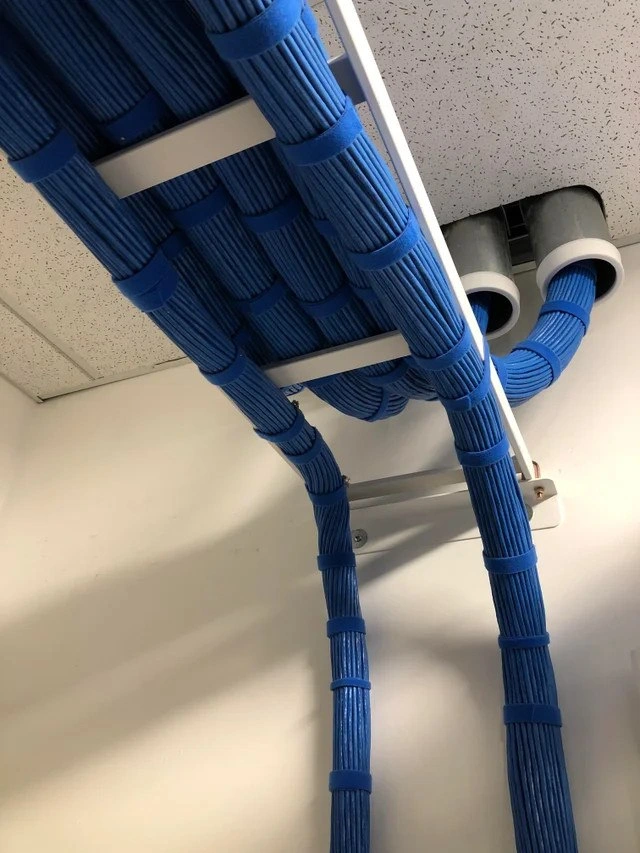
Imagine you usually see a bunch of wires all tangled up behind your TV or under your desk – kind of like a messy pile of spaghetti. It’s confusing and not pretty, right? But in this picture, the wires are super tidy: all the blue cables are lined up next to each other, wrapped together neatly, and running in straight lines along the ceiling. It’s as if someone took a bunch of jump ropes or yarn strings and arranged them perfectly side by side, tying little straps around them every so often so they stay in a bundle. They even curve the bundle gently when it turns, instead of making a sharp bend. The funny part is that these network folks made something as boring as cables look like a cool art sculpture on the ceiling! It’s like when you clean up your room and line up all your toys or books just so – suddenly the room looks awesome and mom or dad might jokingly say it’s worthy of a photo. Tech people feel that way about these cables. They’re happy (and a bit amused) because it’s so unexpected to see wires arranged so perfectly. It not only looks nice, but it also means if there’s a problem, they can find the right cable easily. In simple terms: neat wires make everyone’s job easier, and in this case, they even made the wires look like a piece of art. That surprise – that something ordinary like cables can be so organized and satisfying to look at – is what makes this both funny and uplifting for anyone who works with hardware. It’s the tech world’s version of seeing all your crayons in the box sorted by color – just plain pleasing to see everything in order!

Level 2: Parallel Perfection

Let’s break down what’s going on here in simpler terms, and why so many techies are excited about a bunch of blue cables. What you’re seeing is basically a masterclass in cable management within an IT infrastructure setting. These blue wires are Ethernet network cables – the kind that connect computers, servers, and networking gear so they can all talk to each other. In many server rooms or network closets, cables can get out of hand: imagine dozens of cords of varying lengths, all snaking around with no real order. It becomes really hard to follow one cable from end to end, and they tend to tangle or block things. But in this picture, the network team has done the opposite – they’ve arranged every one of those cables in a clean, orderly bundle. All the cables run perfectly parallel to each other, sort of like lanes on a highway moving smoothly in the same direction. Every few inches, you can see they’re gently strapped together with blue hook-and-loop straps (basically Velcro ties) which keep the bundle tight and tidy without biting into the cables. By doing this, none of the cables can stray out of line or form a messy loop. It’s a bit like keeping a bunch of unruly garden hoses or ropes in line by tying a soft band around them at intervals – you end up with one thick, organized trunk instead of 50 flailing strands.

The white metal frame that the cables are resting on is known as a ladder rack (a type of cable tray). It’s called that because it literally looks like a ladder attached to the ceiling, and its job is to hold up and route cables neatly across open spaces. Instead of having cables dangling or lying on ceiling tiles, they sit in this rack which supports their weight and guides them along a planned path. Following that path in the image: the cables come from somewhere above the ceiling (likely from other rooms or a central server area) and enter through the ceiling via those two big round conduits (the gray tubes at the top right). The conduits protect the cables as they pass through the ceiling opening – think of them as sleeves that prevent the wires from rubbing against sharp edges of the ceiling tiles or the metal hole. As the bundle comes out of the conduits, it curves gracefully along that wall-mounted bracket and heads downward, probably toward a network switch or patch panel on the wall just out of frame. Importantly, the curve isn’t a sharp bend; it’s a nice wide bend. This is deliberate: network cables don’t like being bent at hard angles (imagine pinching a hose, it restricts flow – same idea with data flow in cables). By keeping a wide bend, they ensure bend radius compliance – meaning they’re following the guideline of how gentle a turn a cable can take without risking damage or signal loss. Each cable has tiny copper wires twisted inside; a hard kink could untwist them or change the electrical characteristics, which might slow down the network or disconnect it entirely. So the team made sure every turn is smooth as a highway ramp, not a sharp hairpin turn.

Now, why all this fuss? A few big reasons. First, troubleshooting and maintenance: if something goes wrong or a cable fails, you can actually trace and pluck out the right cable quickly when they’re all arranged methodically. In this setup, you could run a finger along a single blue cable from the ceiling to the device it connects, with no confusion about which cable is which. In a messy tangle, you might lose track of the cable halfway and pull the wrong one by accident (which could disconnect something important unintentionally – oops!). Many newbies in IT have a story of accidentally unplugging the wrong thing because of messy cabling. With neat cabling, each wire is like a labeled highway – you know exactly where it goes.

Second, cooling and safety: server rooms have a lot of equipment that gets warm, and they usually rely on air moving through the racks to keep things cool. If you have a blob of tangled cables sitting on top of a switch, it’s like throwing a blanket on a heater – not good. This meme’s image shows cables routed along the ceiling and walls, leaving the spaces around the devices clear so air can flow. That helps prevent overheating. Also, by using the ladder rack and conduits, they keep cables off the floor (eliminating trip hazards and making it easier to clean or walk around) and adhere to fire codes (cables grouped in fire-resistant conduits through walls/ceilings reduce risk in a fire). It’s clear NetworkEngineering thinking: plan the physical layout so nothing is just ad-hoc or risky.

Third, let’s talk aesthetics (how nice it looks) and why tech people get a kick out of it. There’s a whole tongue-in-cheek subculture that calls images like this “cable porn.” Now, nothing dirty is happening here – it’s called that only because to certain folks (network admins, data center engineers), seeing cables organized so perfectly is oddly satisfying, almost in the same way some people love videos of things being perfectly arranged or satisfying patterns. It’s the same feeling you get when you see a drawer of color-sorted candies or a freshly tidied-up closet – everything is just so neat! In fact, there are online communities (like on Reddit and tech forums) where engineers post before-and-after photos of their cabling work. The “before” might look like a jungle of cords – chaotic and stressful – and the “after” is like this picture: clean rows of cables, all bunched and aligned, often even color-coded. People upvote those posts like they’re works of art, because in our line of work, they are kind of art. So when the caption jokes about “turning structured cabling into avant-garde ceiling art,” it’s only half-joking. This is essentially an art installation for anyone who knows what they’re looking at. The network team basically took a bunch of lazy, messy cables and gave them a disciplined makeover – and they likely did it for very practical reasons, but it ended up looking cool too.

For a junior engineer or someone new to hardware, this photo is also a great learning example. It highlights terms you might have heard: structured_cabling (meaning there’s a planned architecture to the cabling, with documentation and standards, rather than random wires everywhere), cable_tray (the pathways that carry cables across a room, like that ladder rack), and good NetworkInfrastructureDesign principles (keep things accessible, labeled, cool, and safe). If you’ve ever set up your own gaming PC or home network, you might have practiced a tiny version of this – routing your cables behind the desk or using little ties to keep USB and power cords from tangling. This is the same idea but on a larger, industrial scale. And just like a neatly wired PC is easier to work on later (you can swap a part without yanking on a knot of wires), a neatly wired network rack or DataCenter shelf is far easier for upgrades and fixes. As a junior person, you might not be the one designing ladder racks or calculating bend radii just yet, but you can definitely appreciate how life-saving a good labeling and bundling system can be when you’re asked to “go unplug Cable 37” and you find that Cable 37 is exactly where it should be, in plain sight. Plus, it’s a point of pride and teamwork: often the whole IT crew has to chip in to re-cable a closet like this, carefully unpatching and re-patching one cable at a time, like untangling a huge knot and then combing everything straight. When it’s done, everyone literally steps back to admire it. It’s one of those moments where engineering meets art and you’re happy to have been a part of it. So in summary, this meme is highlighting an example of superb cable management – something that makes techs cheer – and doing so in a fun, appreciative way. Even if you’re new, you can see why it’s awesome: the wires are tidy, the setup is safe and efficient, and it all just looks so satisfying.

Level 3: Rhapsody in Blue Cables

For those of us with some years in IT infrastructure, this photo hits like a greatest-hits compilation of CableManagement triumphs. The meme’s caption jokingly elevates a well-run cable bundle to “avant-garde art,” and honestly, every network engineer who’s crawled through a nightmare wiring closet finds this both amusing and glorious. Why? Because we’ve all seen the opposite: the dreaded “spaghetti monster” network closet where cables of random lengths and colors snarl together, crossing over rack units in a chaotic tangle. In those scenarios, a simple task like tracing one cable from a server to a switch port can feel like solving a labyrinth puzzle – except you’re on your knees under a hot rack, at 3 AM, with a major outage on the line. This image, by contrast, is the Holy Grail, the cable utopia we dream about during such on-call nightmares. The humor comes from that stark contrast: structured cabling done so perfectly that it’s whimsical to think of it as an art installation. It’s as if the network team said, “We’re tired of cable spaghetti, let’s make lasagna – neat layers only!” and the result was a DataCenter pasta masterpiece.

From a senior perspective, the combination of elements here is downright poetic. The identical blue cables running perfectly parallel along the ladder rack are like a well-rehearsed drill team marching in step. There’s a rhythmic symmetry that pleases the part of our brains wired (pun intended) for pattern recognition. It indicates an attention to detail that senior ops folks know is more than just OCD-level neatness; it’s about future-proofing and sanity-preserving. Maintenance is a breeze when cables are managed like this – each cable likely has a label on both ends, and because they’re bundled cleanly, you can visually follow a cable from the ceiling conduit down to the patch panel or switch with zero guesswork. That means faster troubleshooting: when an issue arises on Port 42, you’re not wading through a rat’s nest trying to find Port 42’s cable; you can pluck the correct blue strand from the bundle like picking a single spaghetti from a neatly laid box of pasta. In an emergency or a time-sensitive upgrade, this level of organization can save critical minutes (and a lot of cursing).

There’s also a strong element of shared industry catharsis here. Seasoned engineers swap horror stories of messy server rooms the way war veterans swap battle tales. “I once opened a cabinet and a bundle of unlabeled cords fell on my head,” one might say, or “We accidentally knocked out payroll systems because someone yanked the wrong gray cable among dozens that looked identical.” Scenes of cabling chaos are practically a trope in IT humor – entire forums and threads of HardwareHumor are devoted to “cable gore” pictures that make newbies gasp and veterans either laugh or cry. So when a photo like this comes along – showing the polar opposite, a zen garden of cables – it tickles that communal funny bone. It’s partially envy (“I wish our server room looked like that!”) and partially sheer satisfaction (“Finally, cables done right!”). The caption “turns structured cabling into avant-garde ceiling art” winks at the fact that network techs often half-jokingly call such sights cable_porn. That term might sound risque, but among IT folks it just means “extremely satisfying image of cables arranged perfectly.” This picture certainly qualifies as that – it’s the kind of thing a network engineer might actually show off proudly, the way an artist would show off a painting.

The industry patterns being satirized here include the often underappreciated labor of infrastructure teams. In many organizations, management and developers might not think twice about the cabling (“just plug it in and make it work!”), so network engineers sometimes work in the shadows, late at night, to impose order on the chaos. When they do it well, hardly anyone notices the cables at all – which is kind of the point – but within the tribe of IT, a photo like this gains instant respect and admiration. Think of it as a clever inside joke: we all know how not-fun and messy cabling can get, so we celebrate the over-the-top perfection when we see it. It’s also poking a bit of fun at just how passionate infrastructure geeks can be about something as mundane as cables. I mean, who else would spend their afternoon aligning wires at right angles and combing them into parallel lines? Yet, here we are, grinning at it. A senior dev or network architect might chuckle and say, “This looks better than modern art to me,” and only half-joke about wanting to frame it. We even anthropomorphize the network team as avant-garde artists – the joke being that Picasso’s medium was paint, but these folks create masterpieces with Cat6 and Velcro.

Another layer of humor is the sense of exceeding necessity. Realistically, you can have a functional network without this level of OCD cable grooming – plenty of places do, albeit with more headaches. But when it’s done to this extreme, it signals a kind of lovable overachievement, or what one might call “NetworkInfrastructureDesign as art form.” It reminds experienced folks of those times we maybe spent too long making something look perfect in the data center just because it felt satisfying. It’s a senior-level wink: “Sure, we could just have it work, but why not make it gorgeous too?” The result benefits everyone long-term (easier troubleshooting, scalable additions, better airflow so equipment doesn’t overheat under a pile of wires, etc.), but it also delivers that immediate dopamine hit to any tech who lays eyes on it. Honestly, when confronted with a sight like this in real life, a seasoned engineer might momentarily hear a choir of angels and drop a thankful tear. (Alright, that’s hyperbole – but only slightly!). The caption nails it by using an art metaphor; we truly do see this as a kind of modern art. In fact, don’t be surprised if a few net admins have this photo set as their desktop background for inspiration. It’s both a teaching example and an inside joke – the kind of thing a senior engineer will show a junior with a pat on the back, saying, “Now this is how you do cable management, folks.”

Level 4: Layer 1 Zen Garden

At the deepest technical level, this image showcases physical layer perfection – an almost meditative adherence to networking fundamentals. In the world of network engineering, the OSI model’s Layer 1 (Physical Layer) is where all the high-level magic ultimately hits copper and fiber. Here, we see dozens of identical blue Ethernet cables (likely Cat6 or similar) arranged with such geometric precision that it’s practically a transmission-line tapestry. Every bend and curve you see follows strict bend_radius_compliance – cables arc gently instead of kink sharply, because in high-speed networking even a too-tight turn can alter a cable’s impedance and introduce signal reflections or attenuation. These cables are carrying high-frequency signals (hundreds of MHz for gigabit or 10G Ethernet), and any physical distortion could mean lost packets or CRC errors. By respecting a generous bend radius (typically about 4x the cable’s diameter), the network team ensures the twisted pairs inside each cable remain spaced just right, preserving the delicate electromagnetic balance that keeps crosstalk and interference at bay. It’s as if each blue cable is a zen garden path, raked into smooth curves to allow data to flow freely.

Beyond bend angles, notice the uniform bundling and parallel routing on that white ladder-like structure. That isn’t just for show – it’s a cable_tray (often called a ladder rack) which supports and guides cables along the ceiling. By laying cables in orderly, parallel runs, the team achieves equal length and consistent tension for each cable. This uniformity means signals experience nearly identical conditions traveling from patch panel to switch: timing skew is minimized (important for protocols that send data over multiple pairs simultaneously), and no single cable in the bundle is pinched or overstretched. The hook-and-loop (Velcro) straps binding the bundle at intervals are a savvy choice: unlike plastic zip ties that can crush cable insulation and impair performance, Velcro strips apply gentle, adjustable pressure. They keep the bundle cohesive without deforming the cables, thus maintaining steady impedance and preventing alien crosstalk (the noise introduced between adjacent cables in large bundles). In essence, each blue Ethernet line gets a VIP lane with proper spacing, thanks to both physics (twisted pair design and spacing) and careful installation practices. The result is an electromagnetic harmony – a twisted pair nirvana – where signals travel with minimal interference despite being surrounded by “noisy” neighbors. It’s the networking equivalent of tuning a dozen instruments so well that even when they all play, none drowns out the others.

This meticulous installation aligns with formal structured_cabling standards (like EIA/TIA-568 and ISO/IEC 11801) that were developed to tame chaos and ensure reliability in large networks. Those standards specify everything from how cables should be run and secured to how connections are terminated, all with performance in mind. For example, TIA/EIA guidelines dictate maximum cable lengths and even how much you can untwist pairs at the ends. Here, the team isn’t just following the rulebook – they’re illuminating it. The cables enter through two round ceiling conduits that likely serve as firestop sleeves, maintaining safety codes and protecting cable jackets from rough drywall edges. The way the bundle gracefully bends down to the wall-mounted bracket shows respect for both form and function: the curve is smooth to protect signal integrity, and it drops at a convenient spot to reach patch panels or switches, minimizing any unnecessary slack. They’ve also kept data cables separate from any power cables up there, which reduces electromagnetic interference and follows best practices for NetworkInfrastructureDesign. And by using that overhead ladder rack, they leave room for airflow in the rack cabinets below – network switches and servers breathe easier without a blanket of tangled cords on top of them.

Historically, this level of cable craftsmanship harkens back to an older era of NetworkEngineering and telecom wiring, where technicians would practice the art of cable lacing. They’d use waxed nylon string to tie wiring harnesses with flawless knots, creating bundles that looked like fabric looms. The philosophy then and now is the same: orderly cables = orderly signals. Twisted-pair Ethernet itself was a revolutionary design to reduce noise: by twisting the two wires carrying opposite currents, interference is canceled out (a consequence of Maxwell’s equations in action). But that only holds if the twists and spacing are preserved – hence the almost doctrinal insistence on gentle bends and no crushing pressure. Seasoned hardware folks know that a messy patch cable spaghetti can lead to mystery issues – from unintentional stress on connectors (causing intermittent connections) to difficulty tracing a circuit in a hurry. In contrast, this image is the pinnacle of rack_room_aesthetics married to engineering rigor. The humor in calling it “avant-garde ceiling art” is that, by doggedly pursuing technical excellence (consistent cable routing, tight bend-radius control, etc.), the network team accidentally created something visually stunning. It’s form following function so well that form became beautiful in its own right. To a veteran infrastructure nerd, this isn’t just pretty wiring – it’s practically a shrine to Layer 1 best practices. One could say the network team has achieved enlightenment in cable management: a state of nirvana where data and beauty co-exist, hanging serenely overhead.

Description

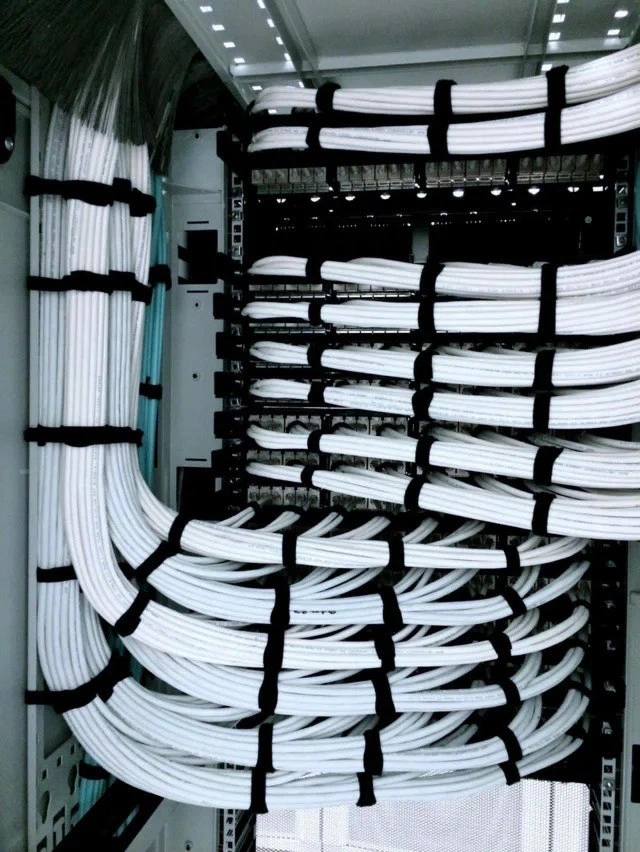
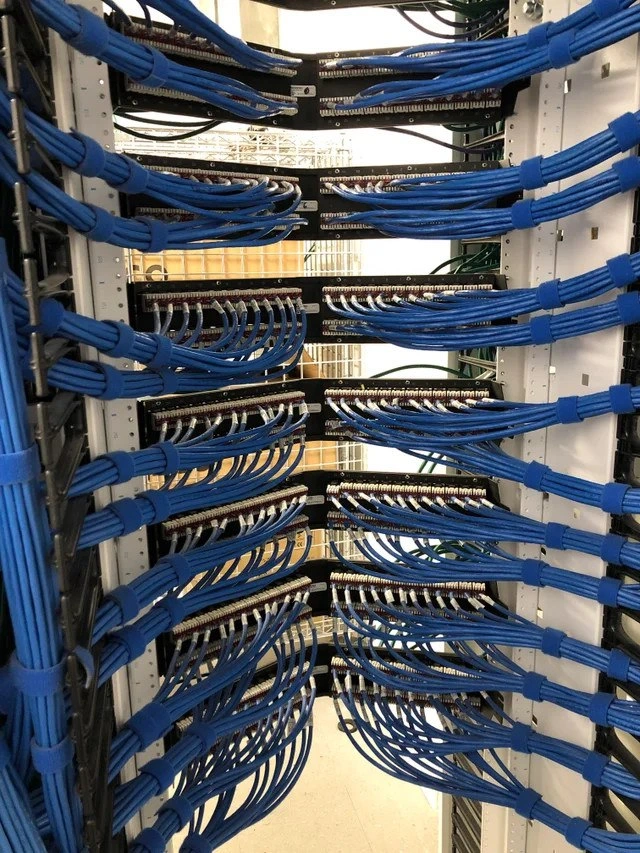
A photograph capturing a highly satisfying example of structured network cabling, often called 'cable porn'. Dozens of bright blue ethernet cables are meticulously bundled into thick, uniform conduits. These bundles are held together by matching blue velcro straps and run along a white metal cable tray mounted to a drop ceiling. The cables then curve smoothly downwards, entering the wall through large, clean-looking PVC pipes. The entire installation is exceptionally neat and orderly, demonstrating a high level of professionalism and attention to detail. For IT professionals, this image represents an idealized state of physical network infrastructure - a system that is not only aesthetically pleasing but also easy to manage, troubleshoot, and scale, contrasting sharply with the tangled mess often found in poorly maintained server rooms
Comments

7
Anonymous ★ Top Pick This is what happens when a network engineer is told 'the budget is unlimited' and 'the deadline is whenever you're done'. The rest of us just call it a unicorn
  1. Anonymous ★ Top Pick

    This is what happens when a network engineer is told 'the budget is unlimited' and 'the deadline is whenever you're done'. The rest of us just call it a unicorn

  2. Anonymous

    Layer-1 team casually delivers a deadlock-free, deterministic topology with nothing but Velcro - meanwhile we’re eight quarters into a service mesh trying to replicate that in software

  3. Anonymous

    This is what happens when you hire the engineer who actually reads the documentation and follows best practices - they spend three weeks perfecting cable management while the rest of us are in production with zip ties and prayer

  4. Anonymous

    When your network architect has OCD and actually reads the TIA-568 standards cover to cover. This is what happens when 'cable management' becomes a competitive sport and your infrastructure team treats every zip tie placement like a production deployment with full change control. Meanwhile, somewhere in this building, there's a closet where cables look like they were installed by someone who learned networking from a bowl of spaghetti - but we don't talk about that datacenter

  5. Anonymous

    HA tip: if your “redundant” links are zip‑tied in the same tray, you didn’t build high availability - you built a beautifully managed single blast radius

  6. Anonymous

    The physical manifestation of npm dependencies: tightly bundled, impossible to untangle without breaking prod

  7. Anonymous

    Layer 1 has better domain boundaries than our microservices - fan‑out capped, coupling minimized, and bend‑radius SLOs enforced with Velcro

Use J and K for navigation