Expert Coder, Novice Adult: The Developer's Dilemma
Why is this MentalHealth meme funny?
Level 1: Smart vs Clumsy
Imagine a person who is a superstar at one thing but a total goofball at another. It’s like a kid who can beat the hardest level of a video game, but then can’t even tie their shoes without tripping over the laces. We find it funny because you’d expect someone who’s so smart and skilled in one area to handle the simple stuff easily – but nope! The big surprise is that the same brain that solves a really hard puzzle can totally mess up an easy task. It’s a silly and friendly reminder that everyone has things they’re good at and things they’re not so good at. Seeing Patrick Star from SpongeBob act like a genius in one moment and a clumsy goof in the next makes us laugh because it shows that being great at something (like computers or games) doesn’t mean you’re great at everything. And that’s okay – it’s what makes people human, and it makes these little mix-ups so relatable and fun.
Level 2: Debugging vs Adulting
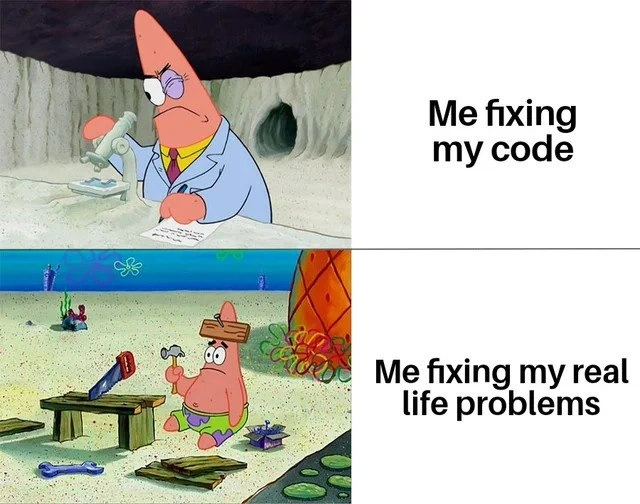
In this SpongeBob-themed meme, Patrick Star is used to humorously contrast two sides of a developer’s life: fixing code vs. fixing everyday issues. Let’s break down what’s happening in each panel. In the top image labeled “Me fixing my code,” Patrick (the pink starfish character from SpongeBob SquarePants) is dressed like a scientist: he’s in a blue lab coat with thick glasses, leaning over a microscope and scribbling on a notepad. This scene represents a programmer deeply focused on debugging their software. Debugging is the process of finding and resolving “bugs” – which are errors or flaws – in code. In other words, it’s like being a detective for programs: you investigate why the code isn’t behaving as expected and then fix the issue. Patrick peering into the microscope is a perfect visual metaphor. Just as a scientist uses a microscope to find tiny problems, a developer uses debugging tools to zoom in on tiny bugs in the code. The notepad implies he’s carefully noting down observations or trying different ideas to figure out the solution. This is exactly how debugging often feels: slow, careful, and detail-oriented, almost scientific.
Programmers usually approach debugging in a very systematic way. For example, if your program is crashing or giving a wrong result, you might do the following:
- Examine error messages or logs: These are like clues. A log file or an error printout might show a stack trace, which is a report of the sequence of function calls right when the error happened. A stack trace can point you to the exact part of the code that blew up, much like a trail of footprints leading to the bug.
- Use breakpoints and a debugger: A breakpoint lets you pause the program at a specific line of code while it’s running. It’s like freezing time in a movie so you can inspect everything in the scene. You can check the values of variables at that moment, see what the program was about to do, and basically look at the program’s state under a microscope (just like Patrick is doing).
- Change one thing at a time and test: You form a hypothesis (“maybe the user object is null here”) and then change the code a bit or add a print statement to test that idea. If the hypothesis was wrong, you undo that change (or try a different one) and iterate. This cautious, step-by-step process helps isolate the exact cause of the problem without introducing new ones.
- Repeat until fixed: You keep iterating through this process – often also searching the web or checking documentation for clues – until you finally identify the bug and fix it. Then you run the program again (or your test cases) to make sure everything now works. Debugging can take a while, but when you see the program working correctly, it’s a great feeling.
Now, contrast all that with the bottom panel, captioned “Me fixing my real life problems.” Here, Patrick is in a much sillier situation. He’s outdoors, next to what looks like a little DIY project – there are wooden planks, a saw, and a hammer lying around. Patrick has a hammer in his hand, but instead of fixing anything, he’s somehow nailed a wooden board to his own forehead! The workbench is crooked, and nothing seems to be going right. This image is a funny exaggeration of how the same person (who was so precise with code) might handle an ordinary real-world task very clumsily.
Think of “real life problems” as all the non-computer issues that come up day-to-day. This could be fixing something broken in your house, assembling new furniture, doing chores, or even organizing personal tasks. In the meme, they chose a physical task (like a small construction or repair job) as the example. Fixing a wobbly bench or hammering nails looks simple, but Patrick clearly messes it up. The board on his head is cartoon slapstick – it shows he not only failed to fix the problem, he actually made things worse (and hurt himself in the process). It’s the meme’s way of saying, “I can code complex things, but don’t ask me to use a hammer without something going wrong!”
This stark difference is funny because it’s true for a lot of people. Many developers (especially those of us who spend most of our time in a digital world) find that our skill with computers doesn’t always translate to skill in practical real-life tasks. You might know a friend who can debug a crashing app in minutes but will spend an hour trying (and failing) to hang a simple shelf on the wall. It’s a relatable scenario in the tech community. We often joke about not being able to ‘adult’ properly. “Adulting” is an informal term that refers to doing grown-up things – like paying bills, cooking meals, doing laundry, or fixing things around the house. It’s stuff that adults are expected to do, but no one is born knowing how to do any of it, and it doesn’t come with a manual. People in tech sometimes use “ugh, I have to adult now” as a way to say they have to step away from their familiar coding world and deal with everyday chores or problems. In this meme, “fixing my real life problems” is basically a tongue-in-cheek way of saying “doing my adulting duties”. And the joke is: I’m way better at handling code bugs than life stuff.
One reason this rings true is that coding and daily life require different kinds of problem-solving. Writing or fixing code is usually a very logical process. The computer does exactly what you tell it (even if you told it to do the wrong thing by mistake!). So if there’s a bug, a programmer trusts that there’s a logical explanation and a logical fix. We have a toolbox for code issues: debuggers, Google, documentation, other developers’ advice on Stack Overflow, etc. We can experiment in a safe environment (like a development server or by running the program in test mode) to see what works. And importantly, if we mess up, we can often revert the code back to a previous state – kind of like hitting a undo Ctrl+Z on our changes.
Real life problems often aren’t so tidy. Let’s say your door is squeaking. There’s no error message telling you “Error: hinges need oil.” You might guess that the hinges are the issue, try oiling them, and if that doesn’t work, you have to guess again. Or let’s say you’re assembling a table and you accidentally put a piece in upside down early on. You might not realize it until much later when the table doesn’t fit together right. There’s no quick “undo” for drilling a hole in the wrong spot or hammering a nail in the wrong place – you’re stuck with the mistake (and maybe a literal hole to patch up!). No wonder a lot of us techies feel more comfortable debugging code than tackling a home repair. The stakes and feedback are just so different. In code, a mistake usually just crashes a program or throws an error, which you can fix and learn from. In home projects, a mistake can break something physical or even cause a minor injury – hence Patrick’s new head accessory!
The meme exaggerates it to make the point clear: the developer (represented by Patrick) transforms from a genius in front of the computer into a klutz in real life. It’s using cartoon comedy to highlight a real feeling. The top-half scientist Patrick is like “Wow, look at me solving this complicated code issue carefully,” and the bottom-half clumsy Patrick is like “I have no idea what I’m doing with this hammer, send help!” For many of us, that juxtaposition is super relatable and reassuring. It tells us that it’s okay (and actually pretty funny) that we can’t be good at everything. Being great at technology doesn’t automatically make you great at handyman stuff or other life skills, and vice versa. Even someone who hacks together brilliant programs can feel completely lost trying to, say, bake a cake or fix a bicycle.
Finally, it’s worth noting the use of Patrick Star as the meme’s star (pun intended!). Patrick is known in the cartoon for often being clueless or making silly mistakes, which makes him the perfect character to portray the “me fixing my real life problems” part. The extra humor is that in the first panel he’s acting out of character – looking studious and ultra-competent. That contrast alone is funny if you know the show. But even if you don’t know SpongeBob, the images are universally understandable: lab coat = smart and careful, plank nailed to head = dumb and clumsy. The meme communicates its message visually in a split second.
In summary, this meme jokes about the gap between a developer’s proficiency in coding versus everyday problem-solving. It’s saying, “I can solve the toughest algorithmic puzzles, but don’t ask me to solve a simple real-world snafu.” That’s a scenario many of us find hilarious and relatable because we live it. So if you’ve ever fixed a gnarly bug at work and felt like a hero, then went home and felt totally defeated by a jammed door or a burnt dinner, this meme is basically your life in two pictures. It’s a light-hearted reminder that everyone has different kinds of smarts, and sometimes the simplest real-life tasks can humble even the brainiest coders. And hey, at least we can all laugh about it together!
Level 3: Stack Trace vs Sawdust
This meme nails a classic developer irony: the same person who debugs code like a forensic scientist can turn into a hapless amateur when facing a mundane real-world fix. In the top panel, we see Patrick Star (yes, the goofy starfish from SpongeBob SquarePants) in full scientific mode – blue lab coat, thick glasses, peering intently through a microscope at the "bug" in his code. It’s a spot-on metaphor for a programmer’s meticulous troubleshooting process. When we debug a tricky issue, we adopt a methodical mindset: we gather data (logs, stack traces), form hypotheses about what’s broken, run controlled experiments, and carefully note the outcomes. Picture a developer at 2 AM, stepping through code line-by-line in a debugger or adding printf/console.log statements one at a time, almost like Patrick jotting notes in a lab notebook. It’s painstaking and scientific – developer productivity at its peak.
But then the bottom panel hits: Patrick sitting outside with a board literally nailed to his forehead, holding a hammer amid a carpentry disaster. The caption “Me fixing my real life problems” says it all. That same brilliant bug-sleuth at the computer becomes a bumbling DIY newbie in real life. The careful lab coat logic gives way to caveman tactics – it’s brute force, trial-and-error chaos. No more microscope and notes; now it’s just whack the problem with a hammer and hope it works. The meme humorously captures that jarring shift. It’s exaggeration, of course (most of us don’t actually end up with a plank on our face when assembling IKEA furniture), but it feels true. Tech humor like this resonates because it taps into a shared developer experience: being masters of a complex digital domain and total clowns in the physical world. We laugh (perhaps a bit nervously) because we see ourselves in both of Patrick’s roles.
This contrast isn’t just visual slapstick – it highlights real differences in problem-solving context. In code, problems are mostly logical and contained. You can often break a bug down systematically: binary-search your code (git bisect those commits), use breakpoints to freeze time and inspect state, or consult the vast knowledge base of Stack Overflow for a clue. There’s a comforting sense that with enough brainpower and the right tools, you can conquer the bug. And if a fix doesn’t work, no biggie – you revert the code, back out the commit, restore from backup. Debugging frustration is real, but it’s a puzzle we’ve been trained to methodically solve. In life, however, issues rarely come with log files or an “Undo” button. If the kitchen sink is leaking or the table you’re building is wobbling, there’s no stack trace pointing to a culprit line in “plumbing.py”. You often only know you made it worse when water is spraying everywhere or when you, like Patrick, end up literally nailing yourself. The shared pain here is that clever logical minds often find everyday issues infuriatingly illogical. Real life problems can be ambiguous, multi-faceted, and lacking documentation – the opposite of a nicely defined software bug.
Let’s pseudo-code this comedic discrepancy. In the spirit of a true dev, we’ll write a short script contrasting the approaches:
# Fixing a code bug: careful, iterative debugging
while bug_not_fixed:
analyze_problem() # inspect, read logs, gather clues
test_hypothesis() # try a potential fix in a controlled way
if not result_improved():
rollback_change() # undo if that fix didn't work, try next hypothesis
else:
bug_not_fixed = False
# Fixing a real-life problem: Patrick's brute-force attempt
try:
use_hammer(size="small") # give it a gentle tap to see if it helps
except ProblemStillThere:
use_hammer(size="BIG") # didn't work? hit it harder!
# outcome: problem still unresolved, plus now there's a board stuck to my forehead
In the code world, we’re disciplined: isolate the issue, refine our approach, and back out if we’re wrong (no shame in a rollback or three). In the real-world scenario, the “plan” is basically hit and hope. The comment at the end of our pseudo-code says it all – you end up with the original issue and a headache. This reflects the meme’s two halves perfectly.
On a deeper level, the humor lands because many engineers pride themselves on rational thinking and developer productivity at work, yet secretly (or not so secretly) struggle with “adulting.” The term “adulting” encapsulates those real-life tasks – paying bills, fixing a shelf, organizing one’s schedule – that aren’t covered in the computer science curriculum. We pour years into honing our craft in front of a screen, so our brains become optimized for that environment. Need to optimize a search algorithm or troubleshoot a memory leak? No problem – we approach it calmly, systematically, maybe even with excitement. But a straightforward household fix might leave us perplexed or procrastinating, using the wrong tools, and making silly mistakes. It’s the classic “absent-minded professor” syndrome modernized for the coding era: brilliant in a specialized domain, clueless in another.
There’s also an element of comfort and control in coding that real life doesn’t offer. Code is ultimately deterministic – computers do exactly (well, almost exactly) what you tell them. When something’s off, there is a reason, even if it’s deeply buried in a call stack or a misconfigured setting. The satisfaction of debugging is that eventually, the puzzle pieces will click into place and you can declare “found it!” with a triumphant commit. Real life problems, on the other hand, can be wickedly non-deterministic. That wobbly bench might be due to an uneven floor, warped wood, or the bent nails you didn’t notice – who knows? There’s no unit test to definitively pinpoint it. And unlike in code, you can’t simply import a library of instant solutions for personal issues (if only pip install life-solutions were a thing…).
The meme strikes a chord in the developer community because it’s both humbling and affirming. It’s humbling to realize that being an ace coder doesn’t exempt anyone from everyday silliness – we’re all human, after all. But it’s also affirming (in a twisted way) to know other devs are the same: that incredibly smart colleague who refactors complex legacy code in their sleep might also be the person who floods their laundry room because they “fixed” the washing machine wrong. It’s a relatable dev experience that bonds engineers together. We’ve all felt that whiplash going from “I am an engineering god” at our desk to “I have no idea what I’m doing” in real life. In other words, our coding superpowers can eclipse our real-life problem solving skills – and yes, that meme title pun on “Eclipse” gave every Java developer a chuckle, because sometimes our IDE (like Eclipse) feels more under control than our daily lives!
Ultimately, “When your debugging skills eclipse your real-life problem solving skills” is a light-hearted tech-culture reminder to stay humble. No matter how many bugs we conquer in code, life can still kick our butt in hilarious ways. If you’ve ever felt more confident reading an error log than reading an IKEA instruction manual, this meme is a friendly wink from the universe (or at least from Patrick Star) telling you that you’re in good company.
Description
A two-panel meme using scenes from SpongeBob SquarePants to contrast a developer's professional and personal problem-solving skills. The top panel features Patrick Star in a lab coat, looking intently into a microscope with a serious, scientific expression, paired with the text "Me fixing my code". This illustrates a methodical, precise, and highly skilled approach to technical challenges. The bottom panel shows a starkly different scene: Patrick, looking confused with a board nailed to his head, sits clumsily on the sand attempting to build something with a hammer and saw. This image is labeled "Me fixing my real life problems", humorously depicting a complete lack of practical skills outside the digital realm. The meme plays on the common stereotype of developers who are brilliant with complex logical systems but can be inept at handling everyday, practical tasks
Comments
7Comment deleted
My approach to fixing real-life bugs involves setting breakpoints in conversations and trying to step through my partner's logic. So far, the debugger keeps crashing
I can bisect a decade-old git history, attach eBPF probes, and hot-patch prod without downtime - yet every time the smoke alarm chirps I open a Jira ticket and hope someone else picks it up
I can architect a distributed system with eventual consistency across 12 microservices, but I've been "eventually consistent" about doing my taxes for three years now
The classic developer paradox: spending 6 hours debugging a race condition that affects 0.01% of edge cases while your apartment looks like a failed garbage collection cycle and you haven't responded to texts in three days. At least the code compiles cleanly now - unlike your life, which is throwing unhandled exceptions everywhere
Code: RCA, tests, idempotent patch. Life: Friday hotfix to prod, no staging - banking on eventual consistency and a TODO to refactor personality
I can git bisect a regression in minutes; real life ships without logs, trace IDs, or a staging environment, so the incident response is just a hammer and vibes
Code gets binary search debugging; life gets exponential backoff with no convergence