Skip to content
DevMeme
1711 of 7435
Peak Career Goal: God-Tier JIRA Estimation
Agile Post #1913, on Aug 14, 2020 in TG

Peak Career Goal: God-Tier JIRA Estimation

Why is this Agile meme funny?

Level 1: Guessing from a Glance

Imagine your teacher gives you the title of a book, but no summary, and asks you to tell exactly how long it will take you to read it and write a book report – without even opening it. Sounds crazy, right? The book title might be short and simple, but the story inside could be easy… or it could be super complicated. In the same way, this meme jokes that a programmer would need almost magical powers to look at the name of a task and know how much work it is. It’s like being asked to predict the future from a tiny hint. It’s funny because everyone knows that normally you’d need to read the book (or at least the back cover blurb!) to make a good guess. Only a mind-reader or a wizard could do it with just the title – basically a superhero-level person. The bottom line: the joke is that figuring out how long a coding task takes from just a one-line title is as hard as making a perfect guess from a quick glance. It’s a silly, impossible challenge – and that’s why we grin at the idea of someone who could actually do it.

Level 2: Ticket Title Telepathy

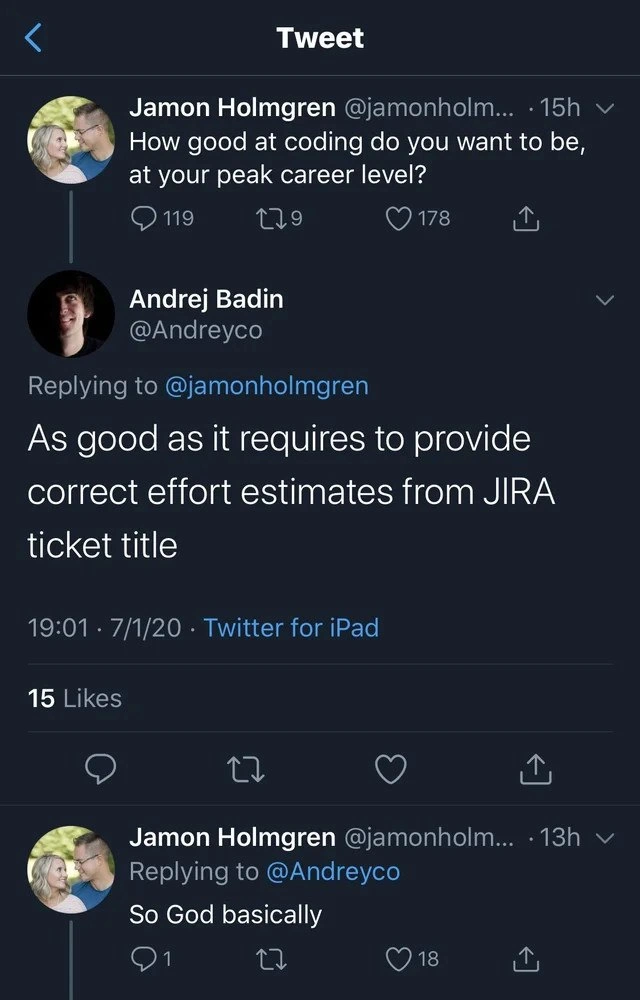
Let’s break down the terms and context for those newer to the Agile circus. JIRA is a popular tool used in software teams to track tasks, often called “tickets.” Each ticket usually has a title (a short summary of the task) and a description (detailed requirements and acceptance criteria). SprintPlanning is a meeting where the team decides which tickets to tackle in the next development cycle (a sprint, typically 1-2 weeks) and estimates how much effort each will take. Story_pointing (or giving story points) is how Agile teams estimate effort: instead of hours, they assign a relative size or difficulty to each task (common scales are Fibonacci numbers like 1, 2, 3, 5, 8...). It’s a way to abstract estimation so that it’s not an exact hour count but a rough measure of complexity. Now, in a perfect world, every JIRA ticket would be well-defined. You’d have a clear description, maybe user stories (“As a user, I want to reset my password...”) with well-scoped acceptance criteria so you actually know what needs to be done. Effort_estimation would then involve discussing the details with the team, considering potential pitfalls, and then collectively deciding if a task is a 2-point easy win or an 8-point monster. But the meme jokes about the opposite scenario – where you only have the ticket_title and nothing else. For example, you see a ticket titled “Upgrade Authentication System” in the sprint backlog and someone asks, “How long will this take?” If you’re new to this, you might think: how can I possibly know without more info? Exactly! That’s why the tweet punchline implies you’d need telepathic powers to pull it off. In real life, developers often struggle with estimation even with details. A title alone is like a book’s title – you can’t know the whole plot just from those few words. The humor here is that someone says they want to be as good at coding as it would take to do this impossible task of perfect one-glance estimates. It’s a tongue-in-cheek way to elevate what sounds like a mundane skill (giving good estimates) to a mythical status. DeadlinePressure is a real thing too: managers and clients often want exact timelines. When a project manager asks for an estimate before details are fleshed out, devs feel that pressure to produce a number out of thin air. A junior developer might not have experienced this yet, but they soon learn that estimation is hard. Even senior devs often joke that we’re doing “guesstimation.” The tweet in the meme is actually a real conversation on Twitter (notice the avatars and the UI). One person asks, essentially, “How skilled do you want to become?” and the response is a witty twist – not “I want to write flawless code” or “I want to architect scalable systems,” but “I want to be so skilled I can estimate from just a title correctly.” It’s funny because it’s unexpected and so relatable to anyone who’s been in an Agile team. The format being a Twitter screenshot is common in DeveloperHumor: a lot of jokes and insights get shared on Twitter, and people screenshot the best ones to share in meme galleries. So if you’re new: yes, making accurate project estimates is considered one of the toughest parts of software development. There are entire books and methodologies on it, yet every team still struggles. This meme is a lighthearted way of saying, “Yeah, we know it’s basically guesswork – you’d have to be a mind reader (or a deity) to always get it right from minimal info.”

Level 3: Clairvoyant Story Pointing

This meme hits home for seasoned developers because it satirizes the Agile ritual of effort estimation and the absurdity we often face in SprintPlanning. Imagine a sprint planning meeting where a project manager cheerily asks the team to size a new ticket. The catch? The ticket’s description is one sparse line—practically just a title. Cue the eye rolls. We’ve all been there, confronted with a JIRA item like “Implement new login” with zero details. A senior dev might quip, “Sure, let me just dust off my crystal ball.” The joke in the tweet reply – “As good as it requires to provide correct effort estimates from JIRA ticket title” – is a wry acknowledgement that nailing estimates under such conditions would take supernatural talent. It lampoons the ProjectManagement fantasy that a truly “10x” developer (at their peak career level) could glance at a vague ticket and immediately derive a perfectly AgileHumor-worthy, precise story point estimate. The original poster’s response, “So God basically,” seals the punchline: only an omniscient being could meet such expectations. This is classic DeveloperHumor born from DeveloperPainPoints. Everyone in software has felt the pain of DeadlinePressure made worse by under-scoped tickets and optimistic guesses. We laugh (perhaps a bit darkly) because we recall real incidents: that “quick 2-point task” which ballooned into a two-week death march, or the SprintPlanning session where the team spent more time deciphering a one-line user story than implementing it. It’s ProjectManagementHumor too – even project leads and Scrum masters chuckle nervously, because they know the Agile ideal of perfectly groomed backlogs often crashes against the reality of shifting requirements and half-baked ticket descriptions. The meme’s format as a Twitter screenshot also amplifies the relatability: it’s a conversation any dev could imagine having, laid out in the familiar dark-mode UI we stare at after long days of coding. The sarcastic tone (“correct effort estimates from JIRA ticket title”) pokes fun at the cult of metrics and planning in Agile. In practice, story points are meant to be a team’s rough consensus after discussing a task in detail – but here we’re joking that a ticket’s title alone should suffice if you’re an über-pro coder. It’s an exaggeration that exposes the truth: accurate estimation is hard. The interplay between the tweets hints at a shared industry truth: even at our most experienced, software folks remain terrible fortune-tellers. The best of us rely on experience, analogies to past work, and some buffer for the unknown unknowns – yet we still get it wrong regularly. So when someone says their ultimate aspiration is solving the estimation problem at a glance, any battle-worn engineer will smirk. We know that feeling: after years of late-night deployments and pushed deadlines, you half-jokingly wish you had Ticket Title Telepathy to warn you what lies beneath those innocent few words in JIRA. Until that miracle skill manifests, we’ll keep estimating with a mix of educated guesses, healthy skepticism, and a dash of cynicism – and we’ll keep laughing at memes that commiserate with how far from divine our planning abilities really are.

Level 4: The Halting Problem of JIRA

In theoretical computer science, predicting a program’s outcome (or runtime) without actually executing it is exemplified by the Halting Problem – an undecidable problem. Estimating software effort from only a one-line JIRA ticket title is a close cousin to that impossible feat. A ticket title is essentially a high-level abstraction, a compressed description of a task. From an information theory perspective, it lacks the necessary detail (the “entropy”) to deduce the full scope of work. It’s like trying to reconstruct a complex codebase from a vague spec – there’s an infinite number of ways the details could unfold. In fact, determining how long a coding task will take can be as intractable as solving an NP-hard optimization problem. Without the actual specification and context, effort_estimation becomes a problem of extrapolating a solution space from minimal clues. This is fundamentally constrained by Kolmogorov complexity: a short description (like a ticket title) can’t magically reveal the length or complexity of the shortest program (implementation) that satisfies it. The meme jokes that you’d need a God-like omniscience to bridge that information gap – essentially solving an undecidable problem by divine insight. In other words, expecting accurate story_pointing from a title alone is like expecting a compiler to optimize code without even parsing it. Hofstadter’s Law famously quips: “It always takes longer than you expect, even when you take into account Hofstadter's Law.” This law underscores a core truth in both theory and practice: future complexity hides in unseen details. Only an all-seeing oracle could consistently divine the true workload from a brief title. The meme’s punchline (“So God basically”) nods to this fundamental impossibility – hinting that achieving god_level_skill in estimation would require transcending the theoretical limits that govern prediction and computation in software projects.

Description

A screenshot of a Twitter conversation between three users. The initial tweet from Jamon Holmgren asks, 'How good at coding do you want to be, at your peak career level?'. Andrej Badin replies, 'As good as it requires to provide correct effort estimates from JIRA ticket title'. In the final reply, Jamon Holmgren responds, 'So God basically'. The image captures a humorous and deeply relatable exchange for software developers. The joke lies in the universally acknowledged difficulty of accurately estimating the effort required for a task based solely on its often vague and simplistic JIRA ticket title. The exchange satirizes this by elevating the skill of accurate estimation to a divine, unattainable level, a sentiment that resonates strongly with experienced engineers who understand the hidden complexities in seemingly simple tasks

Comments

7
Anonymous ★ Top Pick The only thing a JIRA ticket title accurately estimates is the minimum number of meetings you'll need to figure out what the title actually means
  1. Anonymous ★ Top Pick

    The only thing a JIRA ticket title accurately estimates is the minimum number of meetings you'll need to figure out what the title actually means

  2. Anonymous

    When I can glance at a JIRA titled “Enable CSV export” and instantly map the 17 legacy SOAP calls, two GDPR sign-offs, and one Friday deploy freeze - yet still poker-face it as a 5-pointer - I’ll know I’ve hit engineer nirvana

  3. Anonymous

    After 20 years in tech, I've mastered distributed systems, led architectural transformations, and debugged kernel panics at 3am. But accurately estimating a story from 'Fix the thing that's broken' in JIRA? That's when I realize I'm still a junior

  4. Anonymous

    The progression from junior to senior developer: Junior thinks they can estimate from a ticket title. Mid-level knows they need the full ticket, acceptance criteria, and three clarifying meetings. Senior knows that even with all that, they're still just making an educated guess multiplied by π. Staff engineer? They've achieved enlightenment - they know the estimate will be wrong regardless, so they pad it by 3x and call it 'risk mitigation.' But someone who can accurately estimate from just a JIRA ticket title? That's not senior engineering - that's divinity with a Confluence login

  5. Anonymous

    Accurately sizing work from a JIRA title means your cone of uncertainty collapsed into a Dirac delta - at that point you’re not senior, you’re divine

  6. Anonymous

    JIRA estimates: where PMs channel divine optimism, and only dev gods deliver without refactoring reality

  7. Anonymous

    Peak seniority is reading a JIRA title like “Enable SSO” and instantly translating it to: 3 vendors, 5 SAML dialects, a compliance audit, and a P95 of two quarters

Use J and K for navigation