
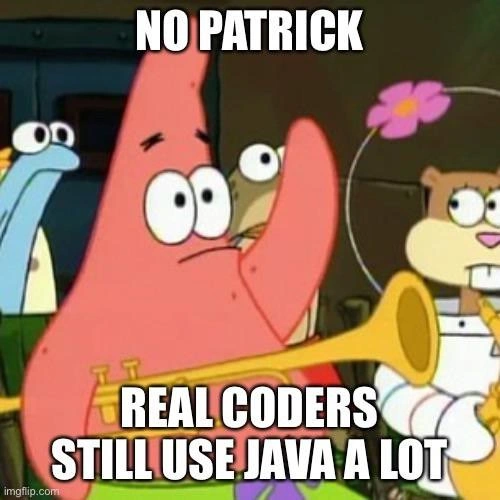
Defending Java's Honor in the Language Wars
Description
This image uses the 'Is Mayonnaise an Instrument?' meme format from the animated series SpongeBob SquarePants. The scene features Patrick Star looking confused while holding a trumpet, as if having just asked a silly question. The text, in a bold, white impact font, is split into two parts. The top line reads, 'NO PATRICK'. The bottom line delivers the punchline: 'REAL CODERS STILL USE JAVA A LOT'. The meme humorously defends the ongoing relevance of the Java programming language. It frames the notion that Java is obsolete as a naive or foolish idea, akin to one of Patrick's nonsensical questions. This joke resonates with experienced developers, particularly in the enterprise space, who know that despite the hype around newer languages, Java remains a robust and widely-used workhorse for large-scale backend systems, Android development, and big data processing
Comments
51Comment deleted
Claiming Java is dead is a classic junior move. Seniors know that legacy enterprise systems running on Java 8 will outlive us all, guarded by the ghosts of ten thousand AbstractFactory patterns
Sure, the new hires push Rust and serverless, but every quarter-close reminds them: nothing says “enterprise-grade” like a 300 MB Java WAR quietly running payroll since 2006
Patrick's right though - while we're all debating Rust vs Go in our side projects, half the Fortune 500 is still running on Spring Boot apps maintained by teams who've perfected the art of AbstractFactoryFactoryBean configuration
Java has been declared dead annually since 1999, yet it still processes your paycheck, your flight booking, and the Kafka cluster that lost neither
The irony here is that Patrick is actually correct - despite the constant 'Java is dead' proclamations from HN and Reddit, TIOBE consistently shows Java in the top 3, and if you've ever tried to hire for a Fortune 500 backend position, you know the JVM ecosystem isn't going anywhere. The real joke is that while everyone's chasing the new hotness, there are literally millions of production Java applications quietly running the world's financial systems, e-commerce platforms, and Android devices. Patrick's megaphone is just drowning out the sound of Spring Boot applications starting up in every data center on Earth
Java: Biennially declared dead since '96, yet still the unseen JVM monolith powering 70% of Fortune 500 backends
Every roadmapping meeting ends the same: someone suggests Rust, the CAB estimates the blast radius, and we ship another Spring Boot jar because -Xmx40G costs less than a compliance audit
Everyone dunks on Java until your throughput SLA has commas - then suddenly you’re fluent in GC pause times, JIT warm-up, and which Spring Boot actuator you forgot to lock down
Sad Comment deleted
But true Comment deleted
Just use Kotlin... Comment deleted
No Patrick, OOP is actually very useful and a lot of developers use it Comment deleted
https://loup-vaillant.fr/articles/deaths-of-oop Comment deleted
I'm in programming 4 years and saw articles, that oop died, 3 or 4 times and all programmer's still using oop Comment deleted
Well, did you read this one? Just because you write in a language that has something called classes or objects doesn't mean that what you do in it has to be OOP. Similarly just because language has functions you aren't necessarily doing functional programming. Those are design philosophies that have been around for a while and for OOP specifically people just can't agree on what it actually means. In the end what people do is a hodgepodge of different design approaches and languages are adapted to that. What is dead is the OOP purism of 90s and early 2000s. Smalltalk's ivory tower toppled, object databases are nowhere to be found and people no longer think layers of abstraction will make code infinitely reusable. There are lot of ideas that were used by people to sell OOP and OOD that since died completely or are no longer seen as cure-all. It's a quite significant shift you might not realize since what you were taught as OO is already a mix of different approaches that have nothing to do with OOP of old. Comment deleted
I did read that, and I don't care. OOP is what the people think it is, not what some dude on the internet thinks it should be. It's a vague description, sure, but so is 'functional programming' Comment deleted
for the record: I don't think generics has anything to do with OOP. Just bc I remember the blog post saying that this is one of the things that got associated with OO Comment deleted
If Alan Kay and Bjarne Stroustrup are "some guys on the internet" I really don't know who to turn to for definition of OOP. Comment deleted
sometimes even the inventors are wrong about their inventions. (also I don't know who that is) Comment deleted
Nope. Functional programming is defined by pretty straightforward principles based on lambda calculus, which is described formally. However OOP is based on idea that code must be viewed as number of interacting objects and is defined by set of patterns which are created from subjective collective experience. This subjective experience can vary and produce different points of view on 'code quality and layout', i've seen it many times. You can definitely tell what seems like pure functional programming, what is mixed and what isn't at all. You can't say so about OOP. TLDR: basics of FP are formally described. Basics of OOP was born from ideas and subjective experience Comment deleted
let me clarify: functional programming as defined by the populus is a vague term. Just not using OOP is enough for most people to call it functional. Comment deleted
That's procedural Comment deleted
Ayo, it's april and it's snowing Comment deleted
same here Comment deleted
global warming Comment deleted
global warming is a pretty bad name for what it is tbh Comment deleted
cause it's fucking global colding Comment deleted
no, it does get warmer on average. The thing is that it gets colder in places that are already cold and hotter in places that are already hot. Which also increases the amount of extreme weather, etc. Comment deleted
More entropy in the system => more extreme weather conditions. Comment deleted
REN-TV said [some time ago] global warming is mask of global cooling Comment deleted
well, yesterday. Today it's just cold as shit Comment deleted
and I thought that Object Orienting means literally that the code is built up around the objects that represent the binary data, that's how it is in C# for example? those principles are still there, isn't it? I've read through the article and actually I can't really say that I understood what I just read 😵💫 Comment deleted
and those ~7ish principles described in the article are still applicable in C#, why it is considered as dead? Comment deleted
It indeed is pretty confusing because there are so many conflicting definitions and even more languages that kinda maybe fit the bill depending on which one you pick. Ultimately the problem that object oriented programming aimed to solve was modularity and code reuse. There is very nice interview with Barbara Liskov after she got her Turing award about how all this went down. The big programming languages of the time were Fortran, Lisp and Algol and while all of them had ways to split code into independent reusable sections there wasn't any unified language feature allowing for related groups of procedures to be exchanged one for another given they perform the same task. Soon an experimental languages Simula and after a little bit CLU popped up, mostly syntactic clones of Algol. Former was virtual world simulation system and very focused on code reuse for behaviors of simulated objects. It tried to achieve that via deep hierarchy of classes that inherit procedures from their parents. On the other hand CLU focused on replaceability of implementations, mainly for various data structures (today called Liskov substitution principle) with "clusters" of coupled code and data that can be referred to as an unit. Meanwhile Lisp dialects started to implement lexical scoping rules (notably Scheme) so closures (data private to dynamic function definitions) behaved predictably and could be used for constructing first class modules. ML then extended this with powerful type system and functional languages had their own answer for the question of growing code bases and amount of independent libraries. At roughly same time Unix and Smalltalk popped up. Unix's answer was to keep each program simple and separate and let it call other programs via asynchronous communication channels. Smalltalk's author Alan Kay had very similar idea. He decided that everything in this system will be represented as "object", objects will be able to hold references to other objects and use that to send each other messages as the sole mechanism of interaction. Notably reading or writing data to other objects isn't something you can do. The programmed responses to these messages (methods) will be inherited in the style of Simula, except without classes but instead object directly from object (prototypes). He called this "object-oriented programming", thinking of code structure resembling physical objects or cells with thick walls one next to each other. He acknowledged you can code this way in Lisp but he wanted language specifically encouraging this style of structure. Smalltalk-80 was the first "hit" OO language. That version done away with asynchronous messaging model and instead replaced it by synchronous method calls you know today and the original approach to OO with asynchronous messaging was later revived in Erlang and rebranded as Actor Model. Suddenly there were a lot of OO fans and some quite amazing projects. The focus was on skeuomorphic design, introspection, live code modification and persisting data together with code (environment snapshots, object databases). Problem was it really tried to be it's own operating system and didn't play well with outside environment. Ivory tower of pure design so to speak. On the inside everything was easy to inspect and modify object, but if something wasn't easy to inspect modify and persist you weren't able to simply get it into the system. Comment deleted
While Smalltalk got it's core fandom it's practical utility wasn't that great and after the initial hype most programmers stopped caring about "object-orientation" fairly quickly. After all you didn't need a specialized language to couple data and code, it just required some discipline to keep everything organized. It was the times of C, Pascal and Basic. Then one year this weird extension to C called Objective-C was picked up by NeXT (later merged with Apple) as the main language of their new lineup and Bjarne Stroustrup released first version of C++, later to be foundation of WinAPI. This was start of the second wave of popularity of OOP and it was very different from the first. The main draw of C++ was that it, back then, didn't really require separate compiler and programmers didn't have to get new expensive tooling they weren't familiar with. You could just generate bunch of C structs that coupled function pointers and data to operate on. You could treat it as a macro set that allowed you to namespace your code so making one monolith application instead of code separated into several processes became way easier. (Both Sun and Microsoft kernels were notoriously bad at multiprocessing and pushed threads quite hard as a workaround.) It took hierarchical class structure of Simula and generally ignored all the evolution of OO since 1962, way before the term was ever coined. Memory management was manual, which was unheard of for OO language. All the dynamic properties of Smalltalk ignored - no dynamic types, all classes need static definitions, you can't dynamically dispatch method to another object to act as a proxy, not everything can be treated as object, … it was virtually impossible to write Smalltalk-style designs in C++. It didn't even get the parametrized types from CLU and had to resort to specialized templating language. No wonder Alan Kay denounced C++ loudly. Late 80s and early 90s were a turbulent time of great investment into computing. Dot-com bubble still wasn't on the horizon but economy was on the rise and there was something new: software aimed not at users but other software developers. Before this was strictly the realm of compilers and development environments. Now it was economically feasible to outsource parts of your codebase to external companies. This was start of OOP evangelism as a means of market capture. "If you only did object oriented design the right way code composition would be easy and you would save so much on reused code." And many they fell for the false promise of C++ of making that possible. In fact the properties of the language are as such the ABI is extremely fragile and the slightest change of implementation bubbles up to disturb the binary linking. Microsoft starts inventing long line of workarounds starting with COM objects, OLE and ActiveX. Large conferences about OOP and how to do it right (i.e. without causing more harm then benefit) are held. Everyone tries to sell their idea of one true way to write object-oriented software there. The main narrative of OOP evangelists is that before OOP code composition was impossible, relying on "structured programming" discipline was ineffective as it was manual and there is no other good way to do modularity, despite many contemporary examples to the contrary among both imperative and functional languages. The core principles of OOP are defined as "encapsulation, inheritance, polymorphism". GoF writes first edition of their Design Pattern book with examples for Smalltalk and C++. It says inheritance is stupid and should be avoided. Non-C++ programmers immediately point out more than half of those design patterns are just very verbose workarounds for features commonplace in other languages. Nobody listens to them at the time. (to be continued, if I get more time) Comment deleted
I've read that in one breath I really appreciate that you found some time to write that to some random guys on the internet, but I personally want to thank you and say that it was interesting to learn how did you know so much about that? You writing it like you were there actually Comment deleted
I started paying attention to programming in early 00s so I wasn't really there. But many people that made this happen are still alive! They go around, give talks, write essays and I find it really enlightening to learn the history and reasons for their decisions. I also tend to hang out about PLT/language design folks so these kind of things do come up in conversations. Comment deleted
please do write some article on where ever you like but this is awesome Comment deleted
You should publish it in a blog. I like programming history too. That way people know why things change and why they still use it. Comment deleted
It would be really great if you published this on hackernews or something Comment deleted
absolutely agree Comment deleted
This would get at least some attention, and, consequently, some meaningful comments you would probably love to hear Comment deleted
If I get time to finish it I might. There's still too much to be told. Comment deleted
oop is about objects that use many or none forms of binary data, cos is it unrelated to it. ofc there is standard objects with binary data inside, but there is more. objects are abstract thing, you can make object of integer or of user profile. you can make object of planet in some sort of simulator. or you can make function into object and pass it around inside of some sort of math app. Comment deleted
kids in r/programminghumor be like Comment deleted
What does r/ mean? Comment deleted
it's a reddit thing, subreddits are marked with r/ Comment deleted
Uh, thanks Comment deleted
No new memes? Comment deleted
Really good question Comment deleted
++ Comment deleted