The Tone-Deaf Lockdown Productivity Question
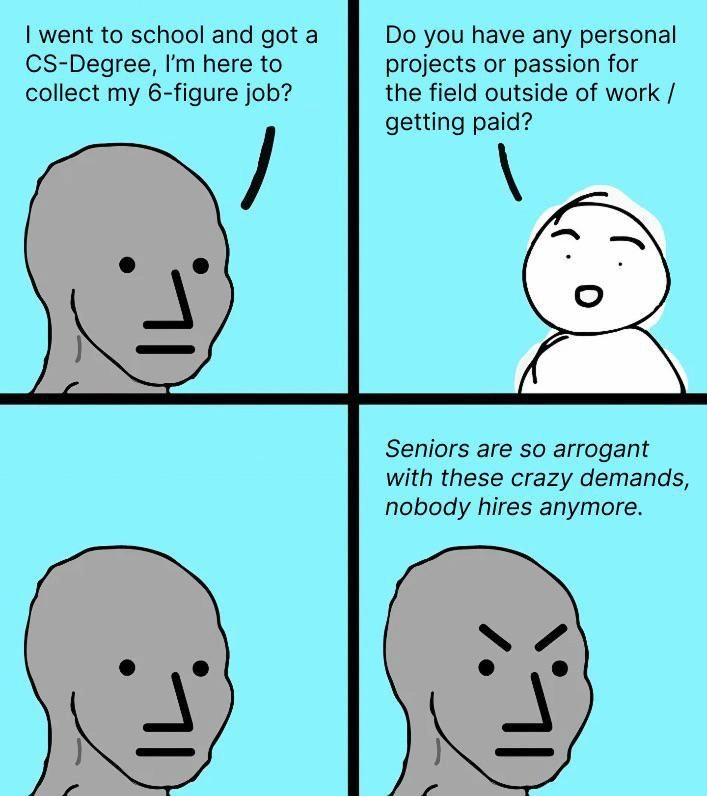
Why is this Career HR meme funny?
Level 1: Homework in a Hurricane
Imagine you're stuck at home because there's a huge storm outside – the kind where school is canceled and everyone is just trying to stay safe. You might spend the day with your family, maybe playing a board game or watching your favorite show, just trying to stay calm until the storm passes. Now imagine if your teacher came and asked, "Since you were home all day during that storm, did you use the time to do extra homework or build a cool science project?" You'd probably think, "What? Of course not – I was just trying to get through the storm!" It would seem pretty silly for someone to expect you to do a bunch of extra work in the middle of a crisis, right? Well, that's exactly what happened here. The pandemic lockdown was like one big storm for everyone. But the interviewer still asked if the person spent that tough time doing even more work (like special coding projects). It sounds strange because most people were busy just coping and staying okay. We laugh at how ridiculous that question is – it's funny and a bit eye-rolling because it expects way too much from someone during a really hard time.
Level 2: Hustle Culture 101
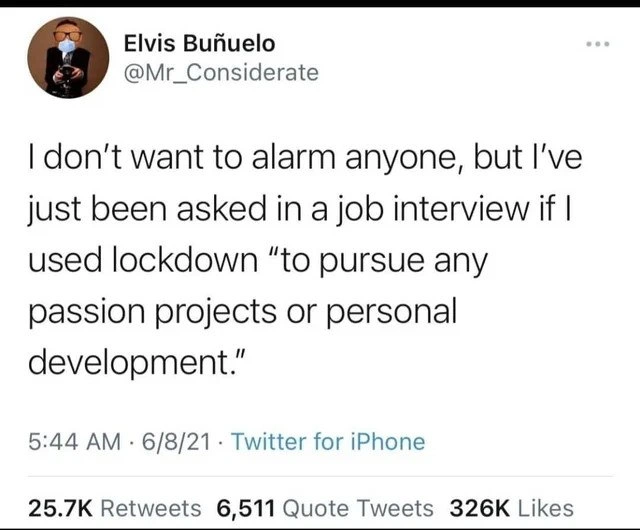
This meme highlights a common interview process scenario taken to an extreme. The image is a tweet where a job candidate is surprised at being asked whether they used the COVID-19 lockdown to work on any passion projects or do extra personal development. In plain terms, the interviewer basically asked: "While you were stuck at home during the pandemic, did you build anything cool or learn new tech skills on your own?" The candidate is sharing this on Twitter with a tone of disbelief, implying this question felt out of line or like a big red flag (a warning sign about the job).
First, let's break down those terms. A passion project in developer lingo means any programming project you do on the side because you enjoy it, not because it's your job. For example, maybe you coded a little game app on weekends, or you built your own website or a fun robot just for personal satisfaction. Personal development means improving yourself or learning new skills. In tech, that could be taking an online course on a programming language, reading some coding books, or practicing with programming challenges to get better. The interviewer is basically checking if the candidate used their free time during an unprecedented global event to further their tech skills or create something new.
Why would they ask this? Often in tech interviews, beyond just testing your coding ability, companies want to gauge your enthusiasm for the field. They might ask about passion projects to see if you code for fun or if you're curious enough to learn outside of work/school. It's part of assessing "culture fit" – in theory, a person who loves coding will keep learning on their own and bring that energy to the job. There's even a saying in tech circles, "Always Be Coding," which captures the idea that good developers are constantly honing their craft. Some tech communities encourage what's known as hustle culture – a mentality that you should always be working on something, always grinding to improve. Under normal conditions, an interviewer might casually ask, "What do you do to keep your skills sharp in your free time?" as a friendly way to discuss your interest in technology.
However, this particular question dropped into a pandemic context feels very unrealistic. During lockdowns, people's lives were disrupted. Many developers were suddenly working from home (often for the first time), sometimes while taking care of family or even dealing with illness. Stress and anxiety were high for a lot of folks. So asking, "Did you use lockdown to pursue any projects or self-improvement?" can come off as tone-deaf. It's like the company expects that of course you had extra time and energy to dedicate to coding a new app or learning a whole new framework just because you weren't going out. This plays into what we can call passion project pressure – the feeling that you should constantly have a side project going to prove you're passionate and productive, even in your off hours.
From a junior developer's perspective, this could be pretty intimidating. Imagine you're just starting your career, maybe you graduated during the pandemic or had your first job while everyone was remote. You might have been focusing on simply getting your work done or finding any job at all in a tough time. Hearing an interview question like this, you might panic and think, "Uh oh, should I have built a whole app during my lockdown spare time? Did I miss the memo?" It can create a sense of impostor syndrome (doubting yourself or feeling like you don't measure up) because not everyone had the bandwidth to take on extra projects during such a chaotic period. If you didn't, you might worry that you'll look less dedicated compared to someone who, say, contributed to open source or built a cool COVID-tracking website for fun.
The tweet hints that the candidate sees this as a red flag about the company's culture. In job-hunting, a "red flag" means a clue that something might be wrong or demanding about the work environment. Here, the red flag is that the company could have unrealistic expectations of its employees. If they're asking this in the interview, they might expect employees to spend personal time on work-related learning constantly. It's a sign they might value constant productivity over work-life balance. For example, a healthy company might ask what you learned in your last role or what you enjoy in tech, but they wouldn’t implicitly shame you for not doing extra work during a global crisis. So a question like this can signal a workplace where overtime or sacrificing personal time is considered normal.
This ties into remote work culture during the pandemic. Some bosses or companies assumed that because everyone was at home and not commuting, that meant more free time to devote to work or self-improvement. In reality, remote work often blurred the line between work and life – many people ended up working more hours, not fewer, and dealing with new distractions or burnout (hello, Zoom fatigue!). The expectation that lockdown was basically a developer bootcamp opportunity (like an intense training period) is quite flawed. A coding bootcamp usually means an intensive, short-term programming course where you spend weeks or months learning to code full-time. Treating a year-long lockdown like it was just free training time ignores the psychological and practical challenges people faced in that period.
For a new or aspiring developer, the humor here is also a bit of relief: you're not the only one who didn't turn the lockdown into a multi-project coding marathon. Many folks will laugh at this tweet because they've either been asked something similar or they can’t believe someone actually did. It’s poking fun at interview culture and unrealistic career expectations in tech. The industry sometimes forgets that we’re humans, not machines that code 24/7. So when the candidate says, "I don’t want to alarm anyone..." in the tweet, he’s being tongue-in-cheek. He is kind of alarmed, and he’s sharing it to say, "Isn't this crazy?" Everyone liking and retweeting it is essentially agreeing, "Yeah, that’s ridiculous, and we get what you mean."
In short, this meme uses a bit of pandemic humor to highlight how absurd it is to expect developers to have treated a difficult lockdown as a big productivity contest. It’s a lighthearted way to call out how some interviewers or companies have expectations that are way out-of-touch. If you're a junior dev, the takeaway is: it's completely fine if you didn't build the next big app while just trying to survive a lockdown – and if an interviewer places too much value on that, it's a reflection of their mindset, not your worth.
Level 3: Passion Project Pressure
For a battle-tested developer, this interview question sets off all the alarms. “Used lockdown for passion projects?” Immediately, it reads as a giant red flag. It's not just small talk – it's the interviewer probing whether the candidate turned a global pandemic into a personal dev bootcamp. In other words, "We were all stuck at home; surely you spent that time churning out side projects or upskilling, right?" This hints at tech’s notorious hustle culture – the unspoken expectation that a passionate engineer should be Always Be Coding, even when the world is falling apart.
Interviewer: "So, did you pursue any passion projects or personal development during lockdown?"
Candidate (inner monologue): "Aside from navigating an existential crisis? Sure, I built the next Facebook between sourdough loaves..."
The humor (and horror) here comes from the absurdity of gauging someone’s worth by what they accomplished during a once-in-a-century global crisis. Many developers spent lockdown simply coping – juggling work-from-home, family responsibilities, and the mental toll of isolation. It wasn't exactly a sabbatical to launch a new app or magically master a new programming language every week. Yet this question assumes lockdown was a golden opportunity for extra productivity. It's a tone-deaf litmus test for "real" passion, wrapped in HR-friendly wording.
In the industry, asking about passion projects is a common interview tactic to see if you code for fun outside work. Companies claim they want self-motivated, curious coders. But framing it as "What did you do with all that free time in quarantine?" crosses into insensitive territory. It implies a belief that if you didn't emerge from 2020 with a new GitHub repo or a tech certification, you somehow lacked drive. Seasoned devs recognize this as a sign of a possible workaholic culture – a place that might expect 12-hour days or that you sacrifice personal time regularly.
Even before COVID, tech interviews often danced around this Always Be Coding mindset. Candidates might get asked about open-source contributions, hackathon wins, or weekend app tinkering. The underlying message: real engineers live and breathe code. During the dot-com boom and beyond, wearing exhaustion as a badge of honor was common. But injecting that expectation into a pandemic scenario is an extreme sport in tone-deafness. It's like they took the old "What do you do beyond your 9-to-5 to keep learning?" and cranked it up to "Even global crises won't stop me from coding."
Seeing this tweet go viral (tens of thousands of retweets, hundreds of thousands of likes) confirms it struck a nerve industry-wide. A lot of developers clearly went, "Yep, been there – or dread being there." We collectively recognize that feeling when an interviewer cares less about your actual resilience through adversity and more about whether you used unpaid, traumatic downtime to sharpen your LeetCode skills. It’s simultaneously cathartic and frustrating to laugh at.
From a systems perspective, this question reveals a certain hiring mindset. The company might be thinking in terms of output maximization – they assume more input (extra time at home) should equal more output (projects, skills). But any senior dev can tell you that's a flawed model because humans don't run on unlimited battery, especially not under stress. This unrealistic mental model is exactly why the scenario is both funny and painfully relatable.
To put it in pseudo-code, the candidate likely expected something in life like:
if (globalPandemic) {
focusOnSurvival(); // take care of health, family, sanity
} else {
pursuePassionProjects(); // code all the things in free time
}
But the interviewer seems to operate with a code path that ignores the first condition – as if globalPandemic never triggers focusOnSurvival(). The candidate’s stunned tweet ("I don’t want to alarm anyone, but...") drips with sarcasm. It effectively says "Red alert – we've got a live one here!" It’s gallows humor for developers: laughing at the possibility of an employer so deep in hustle culture that even a deadly virus outbreak is just "extra time to skill up."
Ultimately, at this senior level of insight, the meme is a commentary on remote work culture and interview expectations gone awry. It spotlights the disconnect between human reality and corporate ideal. The candidate senses the warning signs: if a company expects pandemic productivity sprints, what do they expect under normal circumstances? Probably an “always-on” coder who treats programming as life 24/7 – a mindset many veterans view with a heavy dose of skepticism (and a pinch of dark humor).
Description
A screenshot of a tweet from the user Elvis Buñuelo (@Mr_Considerate). The tweet, posted on June 8, 2021, reads: 'I don't want to alarm anyone, but I've just been asked in a job interview if I used lockdown "to pursue any passion projects or personal development."'. The post has significant engagement, with over 326,000 likes. This meme captures a specific moment in time where the pressures of tech 'hustle culture' clashed with the reality of a global pandemic. For senior engineers, the humor is a mix of exasperation and validation. It critiques the corporate expectation that personal time, even during a crisis, should be optimized for professional gain. The question is seen as a major red flag, revealing a company culture that may lack empathy and a respect for work-life balance, turning a serious global event into a productivity litmus test

Comments
18Comment deleted
My biggest passion project during lockdown was migrating my sanity from a monolithic architecture to a serverless one. It didn't scale, and there were constant cold starts
Interviewer: “Did you build anything during lockdown?” Me: “Sure - an eventually consistent homeschooling platform with two unpredictable junior stakeholders and a 24/7 on-call rotation. It survived production traffic, but apparently that doesn’t count as ‘personal development.’”
The only passion project I pursued during lockdown was successfully migrating from Zoom fatigue to Teams exhaustion while maintaining backwards compatibility with my will to live
Ah yes, the classic interview trap: 'What did you build during lockdown?' Translation: 'Please tell me you spent your global pandemic stress-coding a distributed systems framework in Rust while simultaneously learning Kubernetes, contributing to three open-source projects, and writing a technical blog that went viral - because if you just survived and maintained your mental health, we're not sure you're passionate enough about technology.' Bonus points if the interviewer themselves spent lockdown binge-watching Netflix and doomscrolling, but somehow expects candidates to have emerged as polyglot full-stack architects with a side hustle in quantum computing
If your hiring bar is "built a startup during a pandemic," your SLO for empathy is undefined
Lockdown 'passion projects'? Corporate code for 'did you accrue tech debt on spec while the world paused?'
Sure - during lockdown I migrated a monolith household to a distributed system with eventual consistency and zero downtime; the interviewer couldn’t find the repo
Who don't? Comment deleted
whoever had kids at home I guess. Comment deleted
whoever had a job that didn't require them to be present Comment deleted
But everything just whent on remote for programmers, lockdown wasn't a break from a job, why everyone thinks that you had a lot more time than usual ? Comment deleted
because people were at home and the average Joe thinks that that's equal or at least similar to time off. Comment deleted
Schools also be like Comment deleted
well… yes… Comment deleted
Looks like a trap question... Comment deleted
😆😆 same. They are against this. Comment deleted
this gives me anxiety Comment deleted
Had one remote job before lockdown, got another one during lockdown Yeah, side projects, aha Comment deleted