The Absurdity of JavaScript Device Drivers
Why is this Languages meme funny?
Level 1: Square Peg, Round Hole
This joke is basically about putting something in a place where it really doesn’t belong, and everyone can see it’s a bad fit. Imagine trying to use a balloon to hammer a nail, or using spaghetti as building material for a house – it’s silly, right? That’s why this picture is funny to programmers. They took the idea of a device driver (which is super close-to-the-hardware, serious computer stuff that usually needs a very specialized approach) and said, “Hey, let’s do that with JavaScript (which is a language we normally use for making websites pretty and interactive).” It’s like suggesting we should use a crayon to do a surgeon’s job. On the cover, you actually see a cow trying to ride a horse – that’s a goofy image because cows don’t ride horses! The phrase “square peg in a round hole” really sums it up: the two things just don’t fit together. So even if you don’t know anything about coding, the idea is meant to sound obviously wrong in a humorous way. In simpler terms, it’s funny because it’s such an absurd mix-and-match. It’s as if someone said, “I love my skateboard so much, I think I’ll try to use it as an airplane.” Everyone who hears that goes, “Uh, good luck with that!” and has a little laugh, because we all know it’s not going to work out.
Level 2: High-Level vs Low-Level
Let’s break down why the idea in this meme is so absurd, in more straightforward terms. It boils down to the difference between high-level programming and low-level programming, and why certain languages are used for certain tasks.
Device drivers are a prime example of low-level programming. A device driver is the software that tells your operating system how to interact with a piece of hardware. For instance, your computer has drivers for your keyboard, your printer, your graphics card, etc. These drivers often run in the kernel, which is the most privileged part of an OS – basically the “brain” that directly controls hardware and manages everything in your system. Code running in the kernel can do things like flip bits in hardware registers (tiny switches in the hardware), manage memory addresses directly, and handle interrupts (urgent signals from hardware saying “Hey, I need attention NOW!”). Because of this, driver code needs to be fast, efficient, and predictable. If a driver is slow or does something wrong, it can crash the whole computer or cause your device to malfunction. That’s why drivers are almost always written in languages like C or sometimes C++, and increasingly there’s interest in Rust for drivers (since Rust can offer memory safety while still producing very efficient, low-level code). These languages are close to the metal – meaning they don’t have a lot of automatic stuff going on in the background. The programmer has to manage memory manually (like deciding when to allocate and free memory), but in return, the code runs very fast and with very little overhead. In low-level programming, you trade convenience for control and performance.
Now, JavaScript is on the opposite end of the spectrum – it’s a high-level language. It was originally created to make web pages interactive in browsers. High-level means it abstracts away details of the computer. In JavaScript, you never deal with memory addresses or worry about how the data is stored in RAM; the language runtime handles that. JavaScript has features like garbage collection, which automatically frees up memory that you’re no longer using, so you don’t accidentally cause memory leaks. It runs inside an engine (for example, the V8 engine in Google Chrome or Node.js) that acts as a middleman between your JS code and the actual machine. JS is interpreted/JIT-compiled, which means your code is translated to machine instructions on the fly while the program runs, rather than being compiled ahead of time into a neat binary. All of these traits are fine (even beneficial) for typical uses of JS: building websites, scripting some server logic, making desktop apps with existing web technologies, etc. In those environments, if the JS engine needs to pause for a few milliseconds to clean up memory (garbage collect) or if it adds some overhead, it’s usually not a big deal. A user might not even notice a brief pause or a slight inefficiency in a web app.
However, those traits are terrible for a device driver. In a driver, “a few milliseconds pause” due to something like garbage collection would be a disaster. Imagine a simple example: a driver for a disk might get an interrupt saying “data is ready to be read now.” In C, the driver would immediately go handle it and move the data from the disk into memory. If that driver were somehow written in JavaScript and at that exact moment the JS engine said, “Hang on, I’m cleaning up some variables you don’t need,” the driver might not get around to handling the disk data in time. The disk could think “Hm, nobody’s picking up this data, something’s wrong” and you’d get a hardware error or data loss. Drivers often have to respond very quickly and consistently; you can’t have random unpredictable delays. Determinism (predictable timing) is important. JavaScript’s runtime behavior is non-deterministic in that sense (you don’t know exactly when it will do certain housekeeping tasks or how long they’ll take). That’s one major reason we don’t use it for low-level work.
Another issue is direct hardware access. In a driver written in C, if you need to talk to hardware, you might write to a specific memory address that the hardware listens to, or read from it. For example, a network card might be accessible at some memory-mapped address and the driver can check that address for new data. In JavaScript, you have no way to just read from or write to an arbitrary memory address – the language doesn’t allow it. JavaScript code is sandboxed in a way; it can only manipulate memory that the JS engine lets it, and it can’t poke into the system’s hardware registers directly. To do anything like that, you’d need some binding to native code (like a C++ addon in Node.js). But at that point, the heavy lifting is again being done by C or C++ under the hood, so why involve JS at all? It would be like telling someone else to do all the real work while you just press a button – extra steps with no benefit.
We also have to consider where code runs. JavaScript runs in user space – which means it runs as a normal application, on top of the operating system. Device drivers run in kernel space – as part of the operating system itself. Normally, user-space programs aren’t allowed to mess directly with the hardware or with the memory of other programs; they have to ask the kernel to do that. This boundary is important for stability and security. To use JavaScript for a driver, you’d essentially have to push a user-space environment into the kernel, or constantly go back and forth between user space and kernel space. Neither is practical: pulling a whole JS engine into kernel space makes the kernel bloated and unsafe, and shuttling every little operation between a user-space JS process and the kernel would be horribly slow and complex.
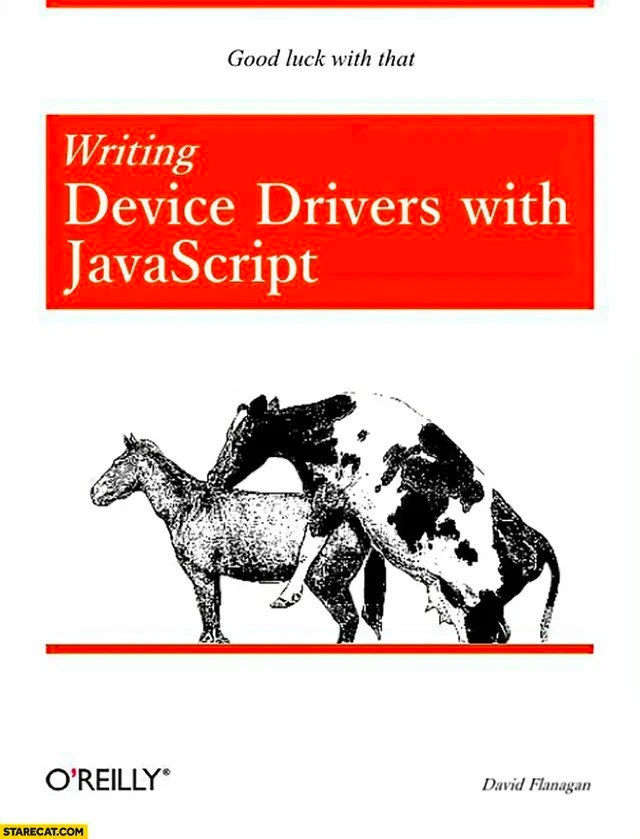
The meme uses the well-known style of an O’Reilly book to frame this joke. O’Reilly Media’s books are iconic in programming – if you see one, you expect to learn some serious tech topic. They often have fun, quirky illustrations of animals on the cover, but the content is very authoritative. For example, there’s a real book called Linux Device Drivers (for writing device drivers in Linux, using C) and another classic called JavaScript: The Definitive Guide (about mastering JavaScript). The parody here merges those two very different worlds into one fake book, Writing Device Drivers with JavaScript. Just reading that title, an informed reader will realize it’s a joke because, in reality, nobody writes drivers in JavaScript. The line “Good luck with that” on the cover is basically the meme-maker’s wink to the audience – it’s like them saying, “If you actually attempt this, you’re gonna need all the luck you can get, haha!”
And then there’s the cow mounting a horse illustration. Normally, O’Reilly might have, say, an elegant drawing of a fox or a snake to symbolize something (sometimes it’s a pun or a reference to the subject). Here we have a deliberately ridiculous image: a spotted cow trying to ride on the back of a horse. It’s funny to look at, but it’s also symbolic. Think of the horse as the “system/hardware” and the cow as “JavaScript” – the cow is large, not exactly meant for riding, and the horse is looking like “what the heck are you doing on me?” 😂. It visualizes the concept of mismatch or misuse. A cow isn’t a racehorse, and you don’t use it like one. Similarly, JavaScript isn’t a systems programming language, and you wouldn’t use it to write a driver. The phrase that comes to mind is “square peg in a round hole.” You can force it maybe, but it’s not going to fit properly or work well.
To make this even clearer, let’s compare some characteristics in a simple table:
| Aspect | Typical Device Driver (C/Rust) | JavaScript Environment |
|---|---|---|
| Runs in | Kernel space (OS core, full privileges) | User space (on top of OS, not in kernel) |
| Memory management | Manual or static (no automatic GC); you control when memory is freed | Automatic GC (garbage collector runs when it wants to) |
| Timing | Mostly deterministic; can be real-time or near real-time | Non-deterministic pauses (e.g., GC or JIT compilation can pause execution) |
| Hardware access | Direct (read/write to memory addresses, I/O ports, handle interrupts) | Indirect (no direct access; would need native modules/APIs) |
| Performance overhead | Minimal overhead (code is compiled to machine code ahead of time) | Higher overhead (code is interpreted/JIT-compiled on the fly, with an event loop) |
| Dependencies | None (runs on bare metal with the OS; no extra runtime needed) | Requires a heavyweight runtime (JS engine, which in turn needs an OS) |
| Typical usage | OS internals, hardware control, real-time tasks | Web development, servers, apps – things far removed from hardware control |
As you can see, a device driver’s characteristics are basically the opposite of what JavaScript provides. The meme is funny to programmers because it’s blatantly mixing up these columns in a nonsensical way. It’s as if someone said, “I really like this hammer (JavaScript), so I’m going to use it to perform surgery (device driver development).” Any engineer can tell you that’s a bad idea.
So, in plain terms: writing a device driver with JavaScript would mean trying to use a high-level, very abstracted tool to do one of the lowest-level, most precision-demanding tasks in programming. It’s a crazy mismatch. The meme delivers that point in a humorous way – by presenting it as a fake book cover, it’s implicitly saying “this is so ridiculous, it could only be a joke textbook.” It’s a classic case of using the wrong tool for the job (again, that square peg, round hole situation). Even if you haven’t written a driver before, you can understand that something meant for making web pages dance around is not what you’d use to make your hard drive or keyboard work with your OS. In the world of programming, that contrast is extreme, and that’s why this parody lands as a joke.
Level 3: Hype vs Hardware
At a glance, any seasoned developer can see this is a tongue-in-cheek O’Reilly book cover parody. O’Reilly’s real books are staples on programmers’ shelves – classic titles like Unix Network Programming or Learning Python – and they all have that distinctive cover style (white background, a bold red or blue title banner, plus an old-school engraved animal illustration). Here we have Writing Device Drivers with JavaScript emblazoned in that familiar font, which immediately reads as a joke because in reality no such book exists (and if it did, most of us would either laugh or shudder). The small text at the top, “Good luck with that”, sets the snarky tone. It’s as if the publisher themselves are slyly saying, “Think you can pull this off? ...Yeah, right.” That phrase basically echoes what any experienced engineer’s inner voice would say upon hearing someone wanting to use JavaScript for a device driver: a mix of amusement and “this is doomed” skepticism.
The humor comes from the extreme clash of domains. In the past decade or so leading up to 2019, JavaScript had seen an incredible expansion beyond its humble beginnings. What started as a simple scripting language to make web pages interactive became a juggernaut running on servers (Node.js), on mobile via cross-platform frameworks, and even on desktop (thanks to Electron, which let people build desktop apps with web tech). This “JavaScript everywhere” trend is well-known in the industry – some call it hype, some call it innovation. There was a period where it felt like anything and everything could be done in JavaScript. Got a new problem? Solution: throw JavaScript at it! We saw databases controlled with JS, robots programmed with JS, even attempts at IoT devices using JS. This meme takes that trend to a satirical extreme: Sure, we’ve put JavaScript on the client, on the server, on the fridge... why not inside the operating system kernel too! It’s poking fun at the notion that JavaScript is the hammer and absolutely every problem must be a nail.
For veteran developers, the absurdity is crystal clear and pretty hilarious. Device drivers are the epitome of low-level programming – the kind of coding where you’re counting bytes, flipping specific bits in registers, and worrying about hardware states. Typically, you write drivers in C (or maybe modern C++ for some OSes, and now there’s experimentation with Rust) because those languages give you precise control and have minimal runtime overhead. Suggesting to use JavaScript, a garbage-collected, dynamically typed language that runs inside a hefty runtime, is utterly counterintuitive. It’s like suggesting building a rocket out of Lego bricks: Legos are great for toys (and you can even make impressive models), but no sane engineer is fueling up a Lego rocket to send astronauts to space. So when an old-timer sees “JavaScript” and “Device Drivers” in the same sentence, the immediate reaction is a chuckle followed by, “Yeah, good luck, buddy.” It’s a bit of dark tech humor that plays on the experience we have of seeing projects choose completely wrong tools. Many of us have a war story or two about a project where someone insisted on using the hot new language or framework du jour in a place it didn’t belong, leading to predictably dismal results. This fake book cover is basically that scenario on steroids.
The choice of imagery – a cow awkwardly mounting a horse – is spot on and adds another layer for those familiar with O’Reilly covers. Normally, O’Reilly animals are somewhat relevant metaphors or at least dignified representations of the subject matter (for instance, a book on sed/awk had a bird known for repetitive calls, a bit of a pun). Here, the cow on a horse is an immediate visual gag about a mismatch. It’s portraying JavaScript as a big, clumsy cow trying to ride the slim horse of low-level hardware control. Neither the cow nor the horse is in their happy place at that moment. The horse looks burdened and confused; the cow looks like it absolutely doesn’t belong up there. That’s exactly how a systems programmer imagines a JavaScript engine would feel inside a kernel: hugely out of place and pretty much destined to fail humorously. It’s a sight gag for software folks: two things that just don’t go together, presented in the faux-serious format of a book cover. If you’ve ever seen colleagues roll their eyes at somebody choosing the wrong technology, that horse is basically the seasoned C developer, and the cow is the overeager JavaScript zealot trying to “mount” the OS. 🐄🐎
Another insider nod is the author name on the cover: David Flanagan. That’s not a random pick – David Flanagan wrote JavaScript: The Definitive Guide, one of the most renowned real O’Reilly books on JavaScript (often simply called the Rhino book, because it had a rhino on the cover). By listing him as the author of Writing Device Drivers with JavaScript, the meme creator layered in a sly joke: who better to tackle this ridiculous subject than the guy who literally wrote the book on JavaScript? It’s an extra wink to those in the know. Of course, Flanagan never wrote such a drivers book, but seeing his name there just makes the parody feel that much more authentic and tongue-in-cheek. It’s like casting a famous chef to write a book on microwaving ice cream – the credibility makes it funnier, because we all know that expert would never actually endorse the absurd practice.
From an industry perspective, this meme encapsulates a gentle criticism of overengineering and hype-chasing. It’s common in tech for people to get excited about a language or tool and try to apply it everywhere, even where it’s a terrible fit. We’ve seen debates in these language wars: folks arguing that their favorite language can do anything. This image basically says, “Sure, you can try to use your favorite language for absolutely everything, but that might lead to insanity.” It reminds experienced engineers of those moments in architecture meetings where someone suggests a completely off-the-wall tech choice and the room goes silent before someone says, “…you’re kidding, right?”. Sometimes it’s a junior dev saying “Why not write the whole thing in JavaScript so we only use one language?”, and then a senior dev has to explain all the reasons why not. This meme is that explanation condensed into a comedic visual. It’s the seasoned perspective scoffing at the notion through satire instead of a lecture.
Moreover, by August 2019 when this was posted, there actually was a serious movement to introduce Rust into the Linux kernel (a sensible attempt to modernize driver development with memory safety). That underscores how outlandish JavaScript in the kernel is: the community was carefully debating Rust (a compiled, performant systems language) as a maybe-acceptable alternative to C for some drivers. But JavaScript? That wasn’t even on the table – except as a joke like this. So the meme also serves as a reality check: it humorously reassures us that no matter how wild the JS hype gets, there are still domains that firmly belong to low-level, close-to-hardware languages. It’s a bit of comfort for the C veterans: “Don’t worry, they’re not writing device_drivers in Node.js… yet.” 😉
In summary, an experienced dev finds this meme hilarious because it lampoons the idea of using the completely wrong tool for a very specific job. It encapsulates that facepalm feeling in a clever way. The O’Reilly cover format gives it a satirical deadpan delivery – presenting an obviously ludicrous premise as if it were legitimate. And the phrase “Good luck with that” is exactly what a grizzled engineer might say, with a smirk, if a naive programmer insisted on doing something as crazy as writing a kernel module in JavaScript. It’s a perfect mix of insider reference, tech culture critique, and plain absurdity. Any senior developer who has lived through a fad or two immediately recognizes the truth in the joke: some things just don’t mix, and trying to force them will only end in tears (or laughter, from those watching).
Level 4: Garbage Collection vs. Interrupts
At the deepest technical level, this meme highlights a fundamental mismatch between a high-level runtime environment and low-level system programming. Writing a device driver means running code in the kernel (the core of an operating system, often in CPU ring 0 with direct hardware access). In this domain, every microsecond counts and unpredictability can be fatal. Drivers handle hardware interrupts – signals from devices that something (like incoming data or a status change) needs immediate attention. In a kernel driver written in C or Rust, when an interrupt occurs, the driver’s interrupt handler runs right away, often with strict rules (no sleeping, minimal work, high priority) to service the hardware and get out. Now imagine introducing JavaScript into this picture: JavaScript code runs inside a JavaScript engine (like V8 or SpiderMonkey) which is a user-space process normally. That engine has a garbage collector (GC) that periodically pauses execution to clean up memory. It also typically uses a single-threaded event loop for scheduling tasks. None of this is designed for the real-time, preemptive scheduling world of kernel interrupts. If a JS-based driver’s GC decided to run at the wrong moment, an interrupt from a device could be delayed or missed. The hardware isn’t going to wait for your runtime to finish its stop-the-world GC cycle – it will assume the driver didn’t respond in time and potentially reset or signal an error. In a worst case, delaying critical interrupts (say from a disk or network card) could hang the entire system or cause a kernel panic because the expected service routine didn’t run when it should.
There’s also the matter of just-in-time compilation and runtime overhead. Modern JS engines optimize code by JIT-compiling hot functions on the fly, which involves observing the code for a bit, making assumptions, compiling machine code, and possibly deopting if assumptions fail. All that machinery is great for speeding up web apps, but in a device driver context it’s a nightmare. An interrupt handler might need to execute in, say, under 50 microseconds. If the JS engine is busy deciding whether to inline a function or unroll a loop, the hardware could overflow its buffers or time out. By the time the V8 JIT “warms up” your driver routine for optimal performance, the opportunity to handle the hardware event has long passed. In kernel programming, consistency and guaranteed timing often beat peak theoretical throughput – we avoid unpredictable pauses. Garbage collection vs. interrupts is an unfair fight: an unexpected GC pause of even a few milliseconds is enormous when you’re talking to hardware that might require service hundreds or thousands of times per second.
Another deep issue is memory access and safety. Device drivers often manipulate specific memory addresses – for example, writing to memory-mapped I/O registers that control device behavior. In C, you might do something like dereference a pointer to 0xF00... (some hardware address) and write a value. In JavaScript, you simply can’t do that. The language doesn’t even expose the concept of raw pointers or arbitrary memory addresses; all memory is abstracted away. You would need a native bridge (probably written in C/C++ anyway) to perform such operations. This means every time your JS driver needed to touch the hardware, it would call into a lower-level language – incurring a context switch or function call overhead crossing from managed JS to native code and back. That’s like adding extra layers of bureaucracy just to flip a bit in a device register. Each layer is another thing that could go wrong or slow down. And if something does go wrong in a kernel driver (say, writing to the wrong address or dereferencing a null pointer), in C it might crash the system – but at least the code path is straightforward. If it happens via a JavaScript stack trace bubbling through the engine and into native code, debugging that crash would be a herculean task. You’d be knee-deep in engine internals trying to figure out why a segfault or page fault occurred.
Security is yet another concern at this level. Running JavaScript in the kernel means embedding a massive runtime (millions of lines of code) into the most privileged part of the system. Every JavaScript engine is itself a complex piece of software with its own bugs. Normally, if V8 or Node.js has a vulnerability, it might let an attacker break out of a sandbox or crash a program – bad, but not total system compromise. If that engine is in the kernel, a bug in it could mean a full privilege escalation or kernel compromise. Kernel code has to be extremely minimal and robust for this reason; we don’t even include most regular C libraries in the kernel, let alone something as heavyweight as a JS engine. The user space vs kernel space separation is there for safety – and this idea obliterates that separation. Historically, attempts to use managed or high-level languages in kernel have had to contend with that risk. SPIN (an experimental OS from the 90s) let you write safe kernel extensions in Modula-3, and Microsoft’s research OS Singularity used a C#-like language in the kernel, but they achieved safety by statically verifying memory safety and forbidding pointers – not by hauling a GC and JIT into ring 0.
In short, the meme is joking about something that’s nearly impossible given fundamental computing constraints. It’s not just a bad idea – it’s contrary to how kernels, hardware, and high-level runtimes operate. The caption “Good luck with that” is a tongue-in-cheek way of saying that you’d need a miracle (or a complete break from reality) to ever make JavaScript and real-time device driver duties play nicely together. The laws of physics and computer architecture are stacked against you here. You’d be fighting the scheduler, the garbage collector, the security model, and the raw need for speed, all at once. It’s a bit like proposing to power a Ferrari with a JavaScript-based engine – technically, if you rebuild the whole car around it, maybe, but… good luck with that.
Description
A parody of a classic O'Reilly technical book cover. The cover has the signature white background with a bold red banner at the top containing the title: 'Writing Device Drivers with JavaScript'. Above the title, in a smaller font, is the sarcastic subtitle, 'Good luck with that'. Instead of the usual intricate animal line drawing, the cover features a bizarre and comical black-and-white illustration of a very large, black-and-white spotted bull-like animal attempting to mount a much smaller horse. At the bottom are the 'O'REILLY' logo and the name 'David Flanagan' (a real O'Reilly author). This meme is a sharp satire on the 'JavaScript everywhere' trend, humorously pointing out the language's unsuitability for low-level systems programming like writing device drivers, which requires direct memory and hardware access typically found in languages like C or Assembly. The absurd animal pairing visually represents this profound technical mismatch, making it instantly funny to any experienced engineer
Comments
7Comment deleted
I tried to write a device driver in JavaScript. The garbage collector caused a race condition with the interrupt handler and now my toaster only makes promises
Nothing says “real-time” like a JavaScript PCIe driver - IRQ fires, we await setImmediate, GC reclaims the DMA buffer, and in the post-mortem we just call it “event-driven I/O.”
The sequel covers implementing interrupt handlers with async/await and managing DMA transfers through npm packages, with a foreword by the engineer who suggested Electron for the Mars rover
Ah yes, writing device drivers in JavaScript - because nothing says 'deterministic real-time performance' and 'direct memory access' quite like an event-loop-based, garbage-collected language that was originally designed to validate form fields. I'm sure the kernel will love those async/await calls when handling hardware interrupts at microsecond precision. At least when it inevitably crashes, you can console.log() your way through the postmortem... oh wait
Good luck debugging USB interrupts with console.log when the GC decides to pause your ISR
Device drivers in JavaScript - nothing says “hard real-time” like an interrupt handler that awaits a Promise and gets preempted by GC
Sure, let’s ACK an interrupt by returning a Promise - nothing says predictable ISR latency like a stop‑the‑world GC negotiating with ring 0