OpenAI's Boardroom Purge: A Historical Parody
Why is this CorporateCulture meme funny?
Level 1: Vanishing Friends
Imagine you have a group photo of you and three friends all together. Now picture this: one day, you look at the photo and one of the friends is gone from the picture – as if someone erased them. The next day, another friend is gone from the photo too, and finally it’s just you and one friend left in the picture. It’s almost like doing a magic trick with an eraser, making your friends vanish one by one in the photo. Sounds silly, right? You’d laugh because you remember that all four of you were actually there when the photo was taken. You might even think, “Who are they trying to fool? I know my friends were there!”
This meme is joking about a similar kind of silly “vanishing act,” but with people in a company. It’s like the company had four big leaders one week, then the next week only one was left, and they acted like that was totally normal. Everyone watching is like, “Huh? We saw the other people there before!” It’s funny in the same way a bad magic trick is funny – you can clearly see what disappeared and that someone tried to cover it up. It’s basically showing how crazy it was that the company changed its story so fast, just like scribbling friends out of a photo and hoping no one notices.
Level 2: Edited Out of History
Let’s break down the joke in simpler terms. First, Git is a popular system developers use to track changes in code. Think of Git as a timeline of code changes, where each change is a commit (kind of like a save point or snapshot). Normally, when you share code with others (via a central repository, often on services like GitHub), you push your new commits to the repo so everyone can see them. A git push publishes your new changes. Now, a git push --force is a special (and somewhat scary) command that says: “I’m not just adding new changes, I’m replacing what’s there with my version of history.” In other words, it lets you rewrite the timeline by possibly deleting or altering commits that were already shared. It’s usually only used in specific cases (like cleaning up a messy series of commits before anyone else has based work on them). If used recklessly on a shared project, it’s like ripping out pages from everyone’s project history book – pretty confusing and often discouraged!
Now, what does it mean for an organization to do a “force-push on its leadership history”? This is a metaphor. Leadership history here means the record of who was in charge (CEO, board members, etc.) and what happened to them. Normally, a company’s leadership changes are part of its story – like chapters in a book: “Alice was CEO, then Bob became CEO,” and so on. You don’t usually pretend a CEO was never there; you just say they left and someone new came in. But in this recent OpenAI saga, things happened so rapidly and strangely that it’s as if the company tried to pretend one sequence of events didn’t happen. OpenAI is a major company in the AI/ML (artificial intelligence) field, and in that week of November 2023, its CEO (Sam Altman) was fired, an interim CEO was put in place, and then Sam was hired back and the board of directors was largely replaced. It was a rapid board turnover. If you wrote it out step by step, it’d be: Sam in, Sam out, Interim in, Interim out, Sam back in – all within a few days. A lot of internal announcements on their Slack (a workplace chat app companies use for communication) and even public statements were likely made and then updated or reversed in that short span. When the dust settled, the end result was that Sam Altman was CEO again and the previous board was gone. It’s almost like someone “deleted” the part where he was fired and the interim leadership happened, because the final configuration looked a lot like the original, just with a new board. That’s why the joke says the org did a force-push on its history: they overwrote the messy middle bit. Of course, in reality, everyone knows it happened – you can’t truly erase real events – but the official narrative quickly shifted from “Sam was fired” to “Sam is our CEO (welcome back!)” as if clicking “Undo” on a crazy timeline.
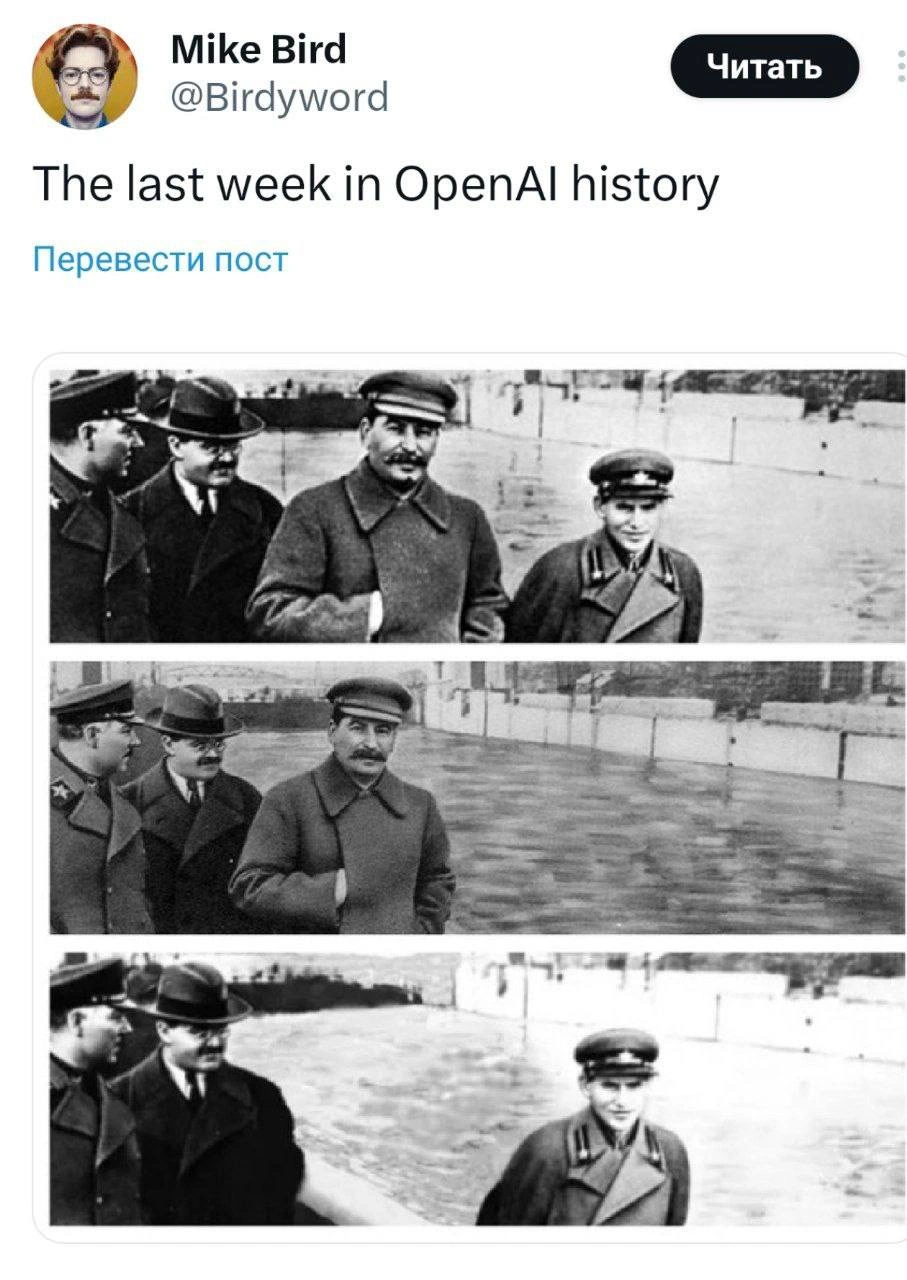
The meme uses those black-and-white photos as a visual analogy. They are actually famous images of Joseph Stalin, a Soviet dictator, with his officials. Historically, Stalin would remove people from photos after he had them kicked out of the government (or worse). In the first frame, you see Stalin standing with three other men. In the next frame, one man is gone (literally erased from the photo). In the last frame, only Stalin and one other remain – the others have vanished from the picture entirely. This really happened – Soviet photo editors would airbrush out people who fell out of favor, to propagate the idea that those people were never important or never even there. It’s a grim example of historical revisionism – basically editing history to suit your needs. The meme creator pixelated the faces (probably to emphasize the idea of data being scrubbed or just to add humor), but the progression is clear: people are disappearing from the image, just like executives disappeared from OpenAI’s org chart overnight.
So, combining these: the tweet text “The last week in OpenAI history” with the disappearing-people photos implies that in one week, OpenAI’s leadership went through a purge-like change. People at the top were removed so fast it felt like how Stalin’s comrades disappeared from photos. It’s a form of corporate humor and management humor because it’s making light of a company’s internal chaos. Instead of a literal purge, think of it like people being removed from email lists, Slack channels, and the company “About Us” webpage within days – one day they’re listed as leaders, the next day they’re just gone, as if deleted. And the phrase “force-push on its own leadership history” ties it all together by referencing the Git command symbolically: it’s saying the company edited its history (like a force-push edits commit history) so that all these changes look seamless and maybe the bad bits are hidden.
Also, there’s a nod to AI humor with the term “model alignment.” In AI, “alignment” means making sure AI systems act in line with human values/intents. OpenAI talks about aligning AI models a lot (to avoid AI going rogue). The meme cheekily says corporate Slack threads and press releases can be redacted faster than you can say “model alignment.” It’s a play on words: as fast as they try to align AI models, they were also aligning their story or aligning what employees/public see, by redacting (editing or deleting) messages. In plain terms: the company was super quick to edit what was being said internally and externally, probably to minimize confusion or backlash – though it comes off as trying to control the narrative.
In summary, to a junior developer or someone new to these terms: the meme jokes that OpenAI’s management tried to rewrite history (in a PR sense) in a rush, just like a developer might clumsily rewrite a project’s commit history. It highlights the absurdity of trying to erase events that everyone witnessed (since the whole drama was very public). The historical Stalin reference is an exaggerated comparison to stress how abrupt and thorough the “disappearing act” felt – mercifully without the deadly stakes, but definitely with a sense of “Wait, that person was here a minute ago, now it’s like they never existed?” It’s a joking caution that even in cutting-edge tech firms, truth can be stranger (and funnier) than fiction when organizational turmoil hits.
Level 3: Corporate Force-Push
This meme takes a spicy jab at corporate culture using developer lingo and a bit of dark historical humor. The caption “When your org does a force-push on its own leadership history” immediately mixes a coding concept (git push --force) with a management shake-up. It’s poking fun at the recent turbulence at OpenAI, the famed AI/ML research lab behind ChatGPT, where the executive lineup changed so fast it gave everyone whiplash. In the week leading up to November 22, 2023 (when this was posted), OpenAI’s CEO was suddenly fired by the board, then the board itself essentially got fired/replaced, and the same CEO was rehired – all in a matter of days. It was a rapid board turnover and executive ousting drama of historic proportions. For those watching tech industry news, it felt like the company’s leadership timeline was being rewritten overnight. The meme comically compares this to doing a git push --force on the “org history” – essentially overwriting the official record of who’s in charge, as if the chaos never happened.
The images drive the joke home with a visual metaphor. They’re a sequence of infamous Soviet-era photographs featuring Joseph Stalin, where one by one Stalin’s colleagues vanish from the image. In the first frame, Stalin is standing alongside several officials; by the last frame, he’s alone – the others have been literally edited out. This actually happened in real history: when someone fell out of Stalin’s favor (often in a deadly way), Soviet propagandists would erase that person from official photos and documents, pretending they never existed. It’s the ultimate example of corporate revisionism – well, state-sponsored revisionism in this case – and it’s become a dark meme template (sometimes called the “Stalin photo editing meme”). By invoking this, the meme winks that OpenAI’s leadership saga was so insane, it felt like the company was purging people from its “photo” and pretending nothing happened, Stalin-style. It’s TechIndustryHumor with an edge: equating a modern tech boardroom fiasco to a literal purge (minus the executions, of course – here it’s careers and reputations being “executed”).
Why is this particularly funny (and cringy) to seasoned developers and insiders? Because we’ve seen similar, if less extreme, patterns in the tech industry and big companies. When a high-profile CEO or CTO suddenly “resigns” under murky circumstances, by the next day their name might vanish from the company website, Slack channels might get scrubbed of their mention, and the official story gets a quick rewrite. It’s like a commit that got deleted from the project history. Everyone in the company gets that awkward email: “FYI, so-and-so is no longer with the company. We thank them for their contributions.” And then poof – they’re written out of the narrative going forward. It’s a corporate disappearing act. We joke that it’s a git commit --amend or a force-push on the org chart: one moment the org chart (like a tree of who reports to whom) had a node with that person’s name, the next moment it’s as if that node was never there. In OpenAI’s case, this happened at ludicrous speed and in public view. One day, Sam Altman was CEO and appearing in all-hands meetings; then an announcement comes (seemingly out of nowhere) that he’s fired for not being “candid” enough with the board (yikes). Within hours, the Reddit and Twitter (er, X) rumor mill is on fire, employees are posting cryptic 😬 emojis, and internal Slack threads are no doubt exploding. By the next morning, you have an interim CEO in place (another commit on the timeline). Then Microsoft tries to swoop in and hire the ousted team, while OpenAI’s staff threaten mutiny. Fast forward a couple of days: the original CEO is coming back and the board is largely gone. The final state: Sam Altman (CEO) and a new board installed. It’s as if the organization did a hard reset to the “Sam is CEO” state, with a few new faces — effectively erasing those tumultuous 3-4 days from the official storyline. The tweet in the meme calls it “The last week in OpenAI history,” which is a tongue-in-cheek way of saying “Wow, that week was so crazy it’s already being spoken of as if it’s just ‘history’ now – we’re moving on as if it were all a bizarre dream.”
For developers, a force-push has a very specific connotation: it’s what you do when you absolutely need to rewrite the commit history on the remote repository. It’s usually frowned upon on shared branches because it can wreak havoc. Imagine you and your team all cloned a repo, and then someone force-pushes a new history that doesn’t include some commits you already had – you’d all get errors and have to manually fix your local copies (git pull won’t work cleanly because the histories diverge). It’s a bit of chaos and a breach of trust unless everyone agreed to it. That’s why this situation at OpenAI felt analogous: the leadership changed and changed back so quickly that employees, investors, and the public were left scratching their heads: “What exactly is the current truth? Which leadership version are we on?” It’s like we all pulled the latest updates from “origin/OpenAI” on Friday, and by Monday there was a force-push that removed Friday’s commit. ManagementHumor often anthropomorphizes companies as having a codebase or doing “releases” of news, so saying the org did a force-push on its leadership is hilarious: it implies the company just wiped out the record of those inconvenient changes.
There’s also a sly pun about AI in the description: “redacted faster than you can say ‘model alignment’.” Model alignment in AI refers to making sure an AI’s behavior aligns with human values and intentions – a hot topic for a company like OpenAI. The meme joke suggests that the company’s communications were being “aligned” (read: censored/edited) at breakneck speed. Slack messages announcing leadership changes might have been edited or deleted, and press releases revised, almost in real-time, to keep up with the shifting reality. It’s corporate PR doing an emergency hotfix on the narrative. For a cynical veteran, the humor here is painfully relatable: we’ve seen companies handle crises by swiftly “updating the README” of their public story – sometimes hoping no one notices the earlier revision. Of course, everyone does notice. In OpenAI’s situation, the whole world noticed. The transparency that tech companies often champion was momentarily replaced by a very old-school playbook: deny, delete, and rewrite. In short, this meme lands its punch by combining AI humor, tech industry humor, and management humor in one go. It says: “This AI company just acted like a paranoid version-control tyrant, LOL.” And every engineer who’s been told “just force-push it, no one will know” is nodding and smirking, because we all know how well that usually ends.
Level 4: Immutable Logs vs Memory Holes
At the most theoretical level, this meme is a collision of version control principles with historical revisionism. In software, especially with tools like Git, we treat the commit history as an immutable ledger of truth. Each commit is a permanent record (with a unique hash) of changes. In a well-behaved world, history is append-only: you add new commits to reflect new changes, preserving what came before. This is analogous to an append-only log or even a blockchain ledger – once something is recorded, it’s immutable (cannot be changed) without everyone noticing. A git push --force is the rare exception, a command that says: “I’m rewriting history, and everyone else’s copy must now accept this alternate timeline.” It’s a powerful but dangerous tool, because in a distributed system each developer’s repository might have the old history. Forcing a new history creates divergence until everyone manually aligns to it. In effect, a force-push invalidates previously shared truths, which can lead to confusion or lost work if not coordinated.
Now consider the real-world parallel: authoritative regimes rewriting the historical record. In the 1930s Soviet era (captured by those Stalin photos in the meme), the state was the single source of truth. If the regime decided someone should disappear from history, they literally erased them from photos and texts. There’s no distributed consensus in a dictatorship – the “remote repository” of official history is forcibly updated, and all “clones” (public knowledge) are expected to follow. This is the original centralized version control: one authority deciding what the history books (or images) show. It’s an Orwellian form of version control, where inconvenient commits are scrubbed out of existence (the infamous “memory hole” from Orwell’s 1984 comes to mind, a chute for inconvenient records). Just like an aggressive git rebase can drop commits, historical revisionism drops people and events from the narrative. But an important caveat from information theory: in a truly distributed system (like the internet or collective human memory), it’s nearly impossible to erase something everywhere. There’s always a backup, a screenshot, or a memory – an analog to a developer who still has the old commit on their laptop. This fundamental tension – centralized power vs. distributed memory – is what makes the concept funny and poignant to tech folks. We know how fragile a forced history rewrite is in Git; it’s equally (if not more) fragile and absurd when attempted in real life, whether by corporate PR or by Soviet photo editors with airbrushes.
In essence, the meme highlights a deep truth: whether in code or corporate history, rewriting the past is technically possible but fraught with peril. We have entire systems (like Git’s reflog or the Internet Archive) devoted to remembering “deleted” history. The humor comes from seeing a bleeding-edge AI company inadvertently emulate a version-control anti-pattern that even junior devs handle with caution. It’s a high-level reminder that while machine learning models might strive for model alignment, human leadership can still fall back on blunt tools like “aligning the narrative” after the fact – a move that is as technically jarring as force-pushing a public Git repo.
Description
A screenshot of a tweet from user Mike Bird (@Birdyword) with the text 'The last week in OpenAI history'. Below the text is a three-panel meme using a famous set of historically altered black-and-white photographs of Joseph Stalin. In the top panel, Stalin is seen walking by a canal with three other Soviet officials. In the middle panel, one official (Nikolai Yezhov) has been visibly doctored out of the image. The bottom panel shows a further altered version where the remaining two officials have also been removed, leaving Stalin walking alone. This meme format, known as 'Stalin's Disappearing Commissars,' uses the historical reality of political purges and photographic censorship as a metaphor. The technical context is the intense and chaotic leadership crisis at OpenAI in November 2023, where CEO Sam Altman was abruptly fired by the board, followed by other key figures resigning or being removed. The meme darkly jokes that the rapid succession of firings and departures at the AI company resembled the ruthless political purges of Soviet Russia, where former allies were 'erased' from the official record
Comments
25Comment deleted
The OpenAI board's original model was clearly overfitted on 'aligning AGI.' The fine-tuning phase involved removing conflicting parameters, also known as the CEO and the President
OpenAI basically ran `git rebase --interactive --drop=director && git push --force` on its org chart - CI still green, morale not so much
When your board meetings have higher turnover than a Node.js project's package-lock.json, you know it's time to implement version control on your C-suite - though unlike git revert, you can't just cherry-pick your CEO back from Microsoft after force-pushing him out
When your company's leadership changes happen so fast that even your git history can't keep up with who's been force-pushed out of main. At least Stalin had to wait for the photo lab - OpenAI's board operates at O(log n) purge complexity. The real question: did they use DALL-E to generate the 'after' photos, or is this just aggressive dependency pruning in the executive package.json?
OpenAI ran git filter-repo on the org chart and force-pushed to main - CI passed because the required reviewers were removed too
OpenAI's C-suite: overfitting to drama while catastrophically underfitting on stability
OpenAI ran an org-level git filter-repo on the board; turns out trust and governance aren’t squashable - force-pushing history just compounds merge debt
Man appears and vanishes. Comment deleted
https://www.theverge.com/2023/11/22/23967223/sam-altman-returns-ceo-open-ai Comment deleted
Minus 1 dictator 🥳👏 Comment deleted
Does anyone know any pyhon libraries to get GPU tempreture ? Comment deleted
first and maybe dumbest way comes to mind is to make some specific nvidia-smi request and parse result Comment deleted
I tried it but couldn't get the tempeh temporary temperature Comment deleted
Use a real programming language Comment deleted
Also what OS are you on? Windows? Linux? MacOS? Comment deleted
Windows Comment deleted
Ffs just use HWMonitor or smth Comment deleted
Fucking msi afterburner doesn't show gpu temperature so I decided to write my own Comment deleted
But if it doesn’t then it means WMI wont list it as such. Can you see it in task manager? Comment deleted
Yeah I can. Tadk manager shows temperature. gputil also shows it but the problem is with msi afterburner Comment deleted
you need this ,,,, think a way put the digital display on your screen. no need python! Comment deleted
When I see somebody using python: https://youtube.com/shorts/vxjkQ2fNcE8 Comment deleted
Ah yes the linux way Comment deleted
Rather than gputil Comment deleted
Gputil shows it but that mf doesn't Comment deleted