The First OpenAI CEO War: A Wikipedia Infobox Parody
Why is this CorporateCulture meme funny?
Level 1: The Schoolyard Showdown
Imagine a group of kids working on a huge science project, and they have a beloved team leader who’s guiding them. One day, a few adults in charge (kind of like school supervisors) suddenly kick out that team leader without telling the kids exactly why. The kids are shocked and really upset — they trust this leader and think the supervisors made a terrible choice. In fact, all the kids band together and say, “If our leader doesn’t come back, we’re not playing anymore!” They even have a big friendly neighbor (let’s say the local science fair sponsor) on their side, who also says, “Hey, that leader was making great progress, what are you doing?” For a few days, there’s chaos: lots of angry meetings, sleepless nights, and frantic phone calls. Everyone in the neighborhood is gossiping about it, like it’s the biggest drama ever. In the end, the adults who caused the trouble give up and leave, and they let the team leader return. The kids cheer because their favorite person is back, and the big friendly neighbor now has an even bigger say in how the project will go. This meme retells that whole wild story as if it were an epic little war — listing the “fighters,” the “leaders,” and even funny “casualties” like lost sleep and trust — to poke fun at just how crazy the situation was.
Level 2: Battle Lines and Buzzwords
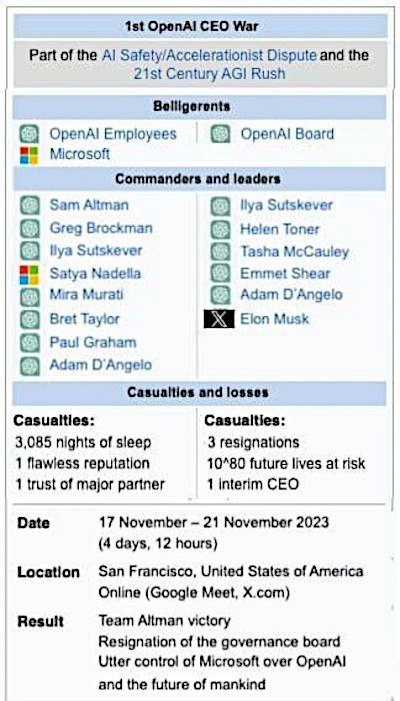
At its core, this meme is a parody of a Wikipedia “infobox” for a war, applied to the recent OpenAI company fiasco. OpenAI is the famous AI research company behind ChatGPT. In mid-November 2023, OpenAI’s board of directors suddenly fired its CEO, Sam Altman, which led to a huge uproar. Think of the “1st OpenAI CEO War” as a humorous label for that internal fight between two groups: on one side, almost all the OpenAI employees (and even their big investor Microsoft), and on the other side, the OpenAI board (the small group of people supposed to oversee the company). It wasn’t a literal war, of course, but the disagreement was so intense and public it felt like a big battle in the tech world. The meme-maker used the Wikipedia war infobox style (the blue-grey table with sections for belligerents, commanders, casualties, etc.) to summarize the whole saga in a fun, familiar format.
Let’s break down the sections of this “infobox”:
Belligerents: In a real war infobox, this lists the opposing parties (countries or factions). Here, on the left, it lists OpenAI Employees and Microsoft as one side, and on the right, the OpenAI Board as the opposing side. This shows it was essentially the staff (plus Microsoft’s backing) versus the board of directors. Microsoft got involved because they’ve invested billions in OpenAI and weren’t happy to see the CEO (and the company’s momentum) suddenly derailed. So the “war” was insiders + partner vs. the oversight board.
Part of the AI Safety/Accelerationist Dispute and the 21st Century AGI Rush: This subtitle line places the “war” in a bigger context. AI Safety vs. Accelerationism refers to an ongoing debate in the AI field. One camp (“AI Safety”) urges caution with advanced AI – they worry about things like AI becoming too powerful or misaligned with human values (think of it as wanting to put safety measures and brakes on AI development). The other camp (“Accelerationist”) believes in moving fast and pushing AI forward aggressively – they want to accelerate progress, believing the benefits will outweigh the risks or that delaying is itself risky. The meme suggests this OpenAI conflict was part of that broader philosophical dispute. And “21st Century AGI Rush” likens today’s race to create AGI (Artificial General Intelligence, a very advanced AI that can do anything a human can do intellectually) to a gold rush or arms race. Many companies are rushing to be the first to build AGI, so there’s huge pressure – just like a high-tech gold rush. OpenAI is one of the front-runners in that race, which explains why tensions were so high.
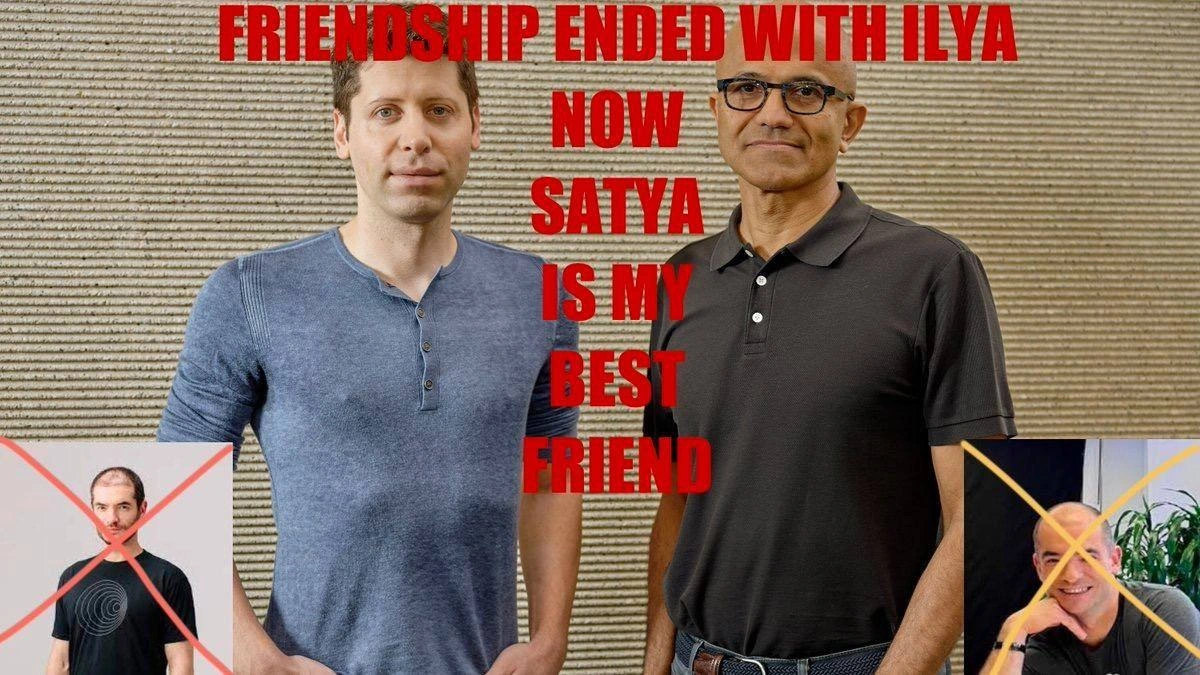
Commanders and leaders: This lists the key figures on each side of the conflict, much like Wikipedia would list generals or heads of state in a war. On the employees/Microsoft side, first is Sam Altman – the CEO who was fired and then, after the “war,” rehired. He’s effectively the “general” for the employee side because the entire staff wanted him back. Next is Greg Brockman – he co-founded OpenAI with Sam and was the chairman of the board until he quit in protest over Sam’s firing. Greg effectively switched sides immediately, going from board member to Sam’s ally, helping unite employees. Satya Nadella appears here too – he’s the CEO of Microsoft. Microsoft wasn’t going to sit quietly after its partner’s CEO was ousted; Nadella personally got involved, supporting Sam (at one point Microsoft offered Sam and all OpenAI employees an alternative job if the board didn’t reverse course!). Mira Murati is listed – she’s OpenAI’s CTO (Chief Technical Officer). Right after Sam was fired, she became interim CEO for a couple of days, but later she also supported bringing Sam back. Bret Taylor is a former co-CEO of Salesforce and a respected tech executive – he wasn’t part of OpenAI during the drama, but he was later named as a member of the new board that formed to fix things, effectively on Team Altman. Paul Graham is a prominent startup investor (co-founder of Y Combinator); he loudly criticized the board’s decision on social media, so the meme lists him as a “leader” on Sam’s side too, showing how many big names rallied behind the employees. Interestingly, Adam D’Angelo (CEO of Quora and one of OpenAI’s board members) is listed on both sides in the meme. That reflects reality: Adam was initially with the board (he voted to remove Sam), but during the fallout, he was also involved in talks to bring Sam back and ended up on the reconstituted board that welcomed Sam’s return. So he kind of straddled both camps by the end, which the meme creator found funny enough to list him twice.
On the board side, the first name is Ilya Sutskever – another co-founder of OpenAI and the chief scientist. He was one of the board members who fired Sam (reportedly, he initiated it), so you can think of him as the “general” on the board’s side. Helen Toner and Tasha McCauley are also listed; they were outside board members (with backgrounds in AI policy and technology) who sided with Ilya. Emmet Shear shows up – he wasn’t a board member, but the board appointed him as interim CEO right after firing Sam (Emmet is known for co-founding Twitch). Including him under “commanders” for the board side signals he was basically the board’s pick to lead OpenAI during those four chaotic days. And then there’s Elon Musk with a black “X” icon next to his name – this is a playful addition. Elon Musk helped start OpenAI back in 2015 but left a few years later; however, he often comments on AI issues and was tweeting during this incident. The black X is the logo of X.com (which is what Musk renamed Twitter). By putting Musk in the commanders list, the meme jokes that he had an influence or at least a strong opinion from the sidelines, as if he were an unofficial ally of the ousting board. (He wasn’t literally involved in the decision, but his presence in the AI world is big, and he seemed to approve of shaking up OpenAI’s leadership.)
Casualties and losses: In a real war infobox, this would list how many soldiers or equipment each side lost. Here it lists more abstract or humorous “losses” each side suffered:
For OpenAI Employees/Microsoft (Team Altman):
- “3,085 nights of sleep” – Basically, a lot of people lost sleep over this. OpenAI has roughly 770 employees, and the ordeal lasted around 4 nights, so if each person missed one night of sleep worrying or plotting, that’s about 770×4 = 3,080 sleepless nights. The meme slightly overshoots it to 3,085 for comic effect, but the idea is everyone was stressed and up all night working the phones or Slack. It captures the human cost in a funny way – exhaustion.
- “1 flawless reputation” – This suggests that something or someone that had an unblemished reputation got tarnished. It could mean Sam Altman’s personal reputation took a hit by being at the center of controversy, or that OpenAI as a company lost its aura of stability and goodwill. Before this, OpenAI was seen as having visionary leadership (Sam) and was widely trusted; that image isn’t “flawless” anymore after such public chaos. Essentially, Team Altman “lost” the illusion of being perfectly on top of things.
- “1 trust of major partner” – This refers to Microsoft’s trust. The board’s action to fire Sam without consulting Microsoft was seen as a huge breach of trust. Microsoft was OpenAI’s key partner and investor, and suddenly Microsoft was in the dark and scrambling. So the employees’ side lost the assumption that their big partner’s confidence was a given. In short, the relationship with Microsoft was damaged in those days (though it was later repaired when Sam returned). It’s phrased as if “the trust” was a thing that got destroyed in battle.
For OpenAI Board:
- “3 resignations” – This is literally what happened to the board’s side. Within a few days, at least three board members (Ilya, Helen, Tasha) resigned or agreed to leave as part of the peace deal. The board basically fell on its sword. So their side had heavy losses in leadership – they lost their positions (and some lost face in the industry).
- “10^80 future lives at risk” – This one is a bit tongue-in-cheek and requires context. 10^80 is an astronomically large number (a 1 followed by 80 zeroes). It’s roughly an estimate of the number of atoms in the observable universe – essentially a way to say “a practically infinite number.” By saying “future lives at risk,” the meme is referencing the board’s motivation: the board was reportedly concerned that Sam Altman’s rush toward more powerful AI could risk future lives (like if an AI became dangerous, it could harm humanity). People in the AI safety community sometimes talk about preserving the far future of humanity – trillions of potential lives – by not unleashing a possibly rogue AI. So the meme jokes that from the board’s perspective, one casualty of their defeat is that now an unfettered Sam/Microsoft might inadvertently endanger basically all possible humans (a hilariously exaggerated way to frame their worst fear). It’s the meme’s darkest joke, poking fun at how grandiose the stakes sounded.
- “1 interim CEO” – This refers to the board’s handpicked interim CEO, Emmet Shear. He was put in charge for a very short time (just a few days). When Sam Altman came back, Emmet stepped down. So the board lost their newly installed CEO almost immediately – essentially that “asset” was taken out of play. It underscores that the board’s plan didn’t hold for long at all.
Date (17 November – 21 November 2023, 4 days, 12 hours): These dates correspond to the real timeline of the drama. Sam Altman was fired on November 17, 2023, and by November 21 (about four and a half days later) a new agreement was reached: the board was gone and Sam was coming back (albeit under a new arrangement brokered with Microsoft’s help). Wikipedia often notes the duration of a conflict in parentheses, so seeing “4 days, 12 hours” drives home how insanely fast this “war” was. In the tech world, it was one very intense long weekend. Many people joked it felt like living through a year’s worth of news in a few days.
Location: “San Francisco, United States / Online (Google Meet, X.com).” OpenAI’s headquarters are in San Francisco, so that’s the physical location of the turmoil (that’s where the staff and interim CEOs were, and likely where in-person meetings happened). The addition of “Online (Google Meet, X.com)” highlights that much of the battle was fought via online means – Google Meet likely refers to video meetings (for example, Microsoft’s Nadella said he found out about Sam’s firing via a Zoom/Meet call with the board, and negotiations to fix things probably happened over video chats and emails). X.com (formerly Twitter) is mentioned because a lot of the drama spilled onto social media: employees were tweeting heartbroken or resolute messages, tech figures were subtweeting opinions, and news was breaking on Twitter in real-time. It’s highlighting that this conflict wasn’t confined to a boardroom – it played out very publicly on the internet. Essentially, “location” being partly online is a nod to our modern era: even power struggles have a virtual battlefield.
Result: “Team Altman victory, Resignation of the governance board, Utter control of Microsoft over OpenAI and the future of mankind.” This line sums up how things ended, in a facetiously epic tone. In plain terms: Sam Altman’s side won. The board members who fired him resigned, effectively ending that leadership crisis. And Microsoft, by stepping in to support Sam (even threatening to hire him and nearly the whole company away), ended up with significantly more influence — practically speaking, Microsoft ensured the outcome it wanted, so it now has even more sway over OpenAI’s direction. The phrase “utter control of Microsoft over OpenAI” exaggerates a bit, but it reflects a common sentiment after the dust settled: Microsoft was the power behind the throne. “...and the future of mankind” is where the meme goes full tongue-in-cheek: it implies that because Microsoft now has such influence over a leading AI company, they also have huge influence over whatever advanced AI comes next — something that could affect humanity at large. It’s simultaneously a joke and a tiny bit of real concern wrapped together. By phrasing it like the outcome of a war, it humorously dramatizes the consequences of this corporate showdown.
So, putting it all together: this meme takes a very CorporateCulture incident – an internal management crisis at a tech company – and cleverly frames it in terms of an armed conflict. For someone newer to tech, the key things to know are: OpenAI had a sudden leadership crisis where the board (concerned about AI ethics and possibly disagreements with Sam Altman) fired the CEO. The employees and investors rebelled because they believed in Sam and felt the firing was unjust or harmful. After a chaotic few days of negotiations and public drama (tweets, leaked emails, etc.), Sam Altman was brought back and the old board was gone. The Wikipedia-like graphic is a joke format to recap those events in a fun way. It’s packed with references that engineers who were glued to the story would recognize (like the sleep deprivation, the existential AI risk talk, and Microsoft’s intervention). ManagementHumor and TechIndustryHumor often use exaggeration like this because it helps us laugh about stressful real situations. Here, the exaggeration is that a messy office politics fight is presented as if it were a grand historical war – and given how globally watched and suspenseful it was, it kind of felt like one!
Level 3: The Corporate Coup d’Infobox
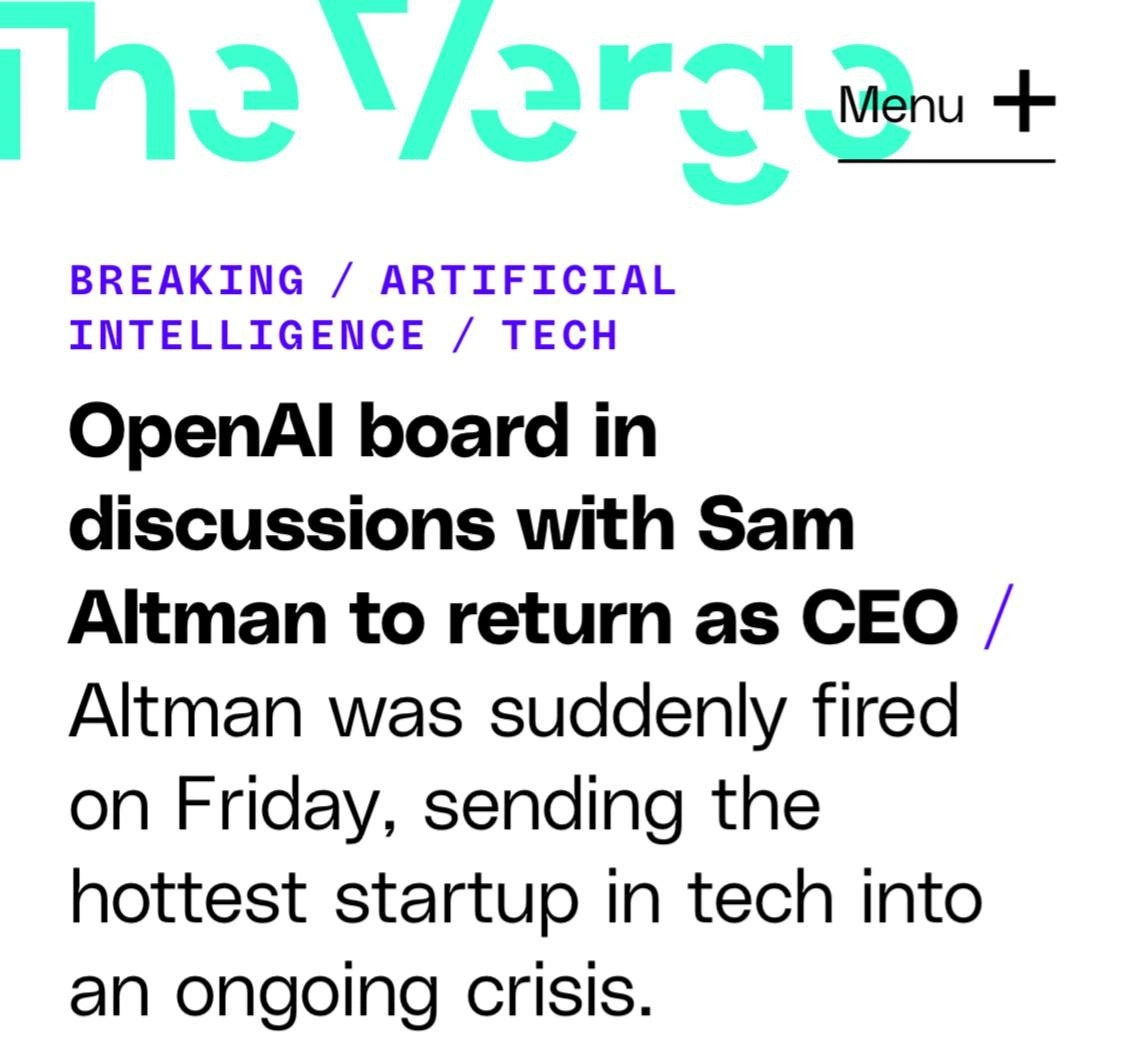
This meme masterfully recaps a real openai_ceo_drama by styling it as a Wikipedia “war infobox,” turning a corporate coup into a historical battle parody. Anyone who followed the saga on Slack or X.com (formerly Twitter) saw it unfold like a rapid-fire war story, so the format feels hilariously apt. In the left “belligerents” column we have OpenAI Employees and Microsoft, effectively “Team Altman.” On the right: the OpenAI Board, which had surprised everyone by suddenly firing CEO Sam Altman. Listing these factions as if they were opposing nations highlights the board vs employees showdown: nearly the entire 770-person workforce (and their $13 billion investor Microsoft) versus the four-person board of directors.
Under “Commanders and leaders,” the meme names the key players on each side. On Team Altman, there’s Sam Altman himself (the ousted CEO turned folk-hero in this drama) and Greg Brockman (co-founder who resigned from the board in protest, immediately rallying with Sam). They’re joined by heavyweights like Satya Nadella (Microsoft’s CEO, who wasn’t about to let his $13B AI partner implode) and Mira Murati (OpenAI’s CTO, briefly interim CEO after Sam’s firing, who ultimately sided with Sam’s return). There’s also Bret Taylor and Paul Graham – notable tech figures who, despite not working at OpenAI, publicly backed Team Altman during the chaos (tech allies piling on as unofficial generals).
On the Board’s side, we see Ilya Sutskever (OpenAI’s chief scientist and co-founder, reportedly the prime mover behind Sam’s ouster) alongside board members Helen Toner and Tasha McCauley. The meme even sneaks in Emmet Shear (the ex-CEO of Twitch whom the board installed as interim CEO for a weekend) as a “commander.” Notably, Adam D’Angelo (Quora’s CEO and an OpenAI board member) is cheekily listed under both sides – reflecting how he initially backed the board’s decision but later helped broker Sam’s return, effectively switching camps. And then there’s the black “X” logo for Elon Musk on the board side, a satirical touch. Musk wasn’t literally on the board, but he co-founded OpenAI and often tweets doomsday warnings about AI; the meme playfully casts him as a shadow commander, as if he had been egging on the board from the sidelines via his platform X. This TechIndustryHumor inclusion gets a knowing chuckle – Musk looms over any AI drama these days, so of course his X-shaped specter appears in the “war.”
The “Casualties and losses” section is where the humor shines in neon. Instead of listing lives lost or tanks destroyed, it tallies abstract damage:
Employees’ side casualties: “3,085 nights of sleep” – an approximate sum of all-nighters pulled by OpenAI staff and anxious observers over those four days (if you’ve ever been on an on-call rotation or a crunch-time product launch, you feel this exhaustion). “1 flawless reputation” – a sly nod that someone’s sterling rep took a hit. This likely references Sam Altman’s once-unquestioned status: being abruptly fired in public view put a crack in his invincible image (and the company’s image, too). And “1 trust of major partner” – meaning the OpenAI board spectacularly lost the trust of Microsoft, their biggest partner. (Microsoft was blindsided by Sam’s firing; when your $10-billion ally suddenly doesn’t return your calls, you’ve burned some trust capital. In corporate terms, that’s a huge casualty – akin to losing air support in battle.)
Board’s side casualties: “3 resignations” is literally what happened – within days, most of the board who led the coup were gone, resigning under pressure. That board effectively self-destructed. “10^80 future lives at risk” parodies the board’s lofty rationale: they acted as if preventing an AI apocalypse was worth any turmoil. 10^80 is an astronomically high number (roughly the number of atoms in the universe) and here it mocks the board’s suggestion that by losing this fight, humanity’s entire cosmic future might be imperiled. It’s exaggeration wrapped in truth – the board was concerned with existential AIEthicsConcerns, but the meme lampoons how grandiose it sounded. And finally “1 interim CEO” – poor Emmet Shear, who stepped in as a temporary CEO only to step right back out when Team Altman reversed the situation. He was essentially a pawn that got captured almost immediately in this war.
The infobox’s Date says “17 November – 21 November 2023 (4 days, 12 hours)” – amazingly short for a war, emphasizing how breakneck and chaotic this sam_altman_rollback was. Many of us spent that weekend glued to updates; it felt like watching a high-speed time-lapse of what is normally a months-long corporate saga. The Location reading “San Francisco, United States of America / Online (Google Meet, X.com)” cracks a grin too. The battle took place not on a physical battlefield but in conference rooms and virtual spaces. “Google Meet” alludes to frantic board meetings and negotiations happening via video calls (remote board members scrambling to justify or undo the firing), while “X.com” flags the theater of public opinion on Twitter – where leaks, employee open letters, and Nadella’s one-line tweets formed a live commentary front. It’s a modern war where Slack channels, Zoom calls, and tweet threads are the trenches and artillery.
Finally, the Result: “Team Altman victory, Resignation of the governance board, Utter control of Microsoft over OpenAI and the future of mankind.” This gleefully over-the-top summary reads like a history book verdict. “Team Altman victory” – indeed Sam Altman and the staff prevailed, as he was hired back (by a new board) and the mutinous board was shown the door. The “Resignation of the governance board” is exactly what happened: the old guard board members either quit or were removed en masse due to the backlash. The kicker is “Utter control of Microsoft over OpenAI and the future of mankind.” That’s the meme-maker’s sardonic takeaway: by the end, Microsoft’s CEO Satya Nadella was essentially the kingmaker (to the point of being jokingly called OpenAI’s new puppet-master on tech Twitter). Microsoft had leveraged the chaos to tighten its influence – offering Sam and his team jobs gave Microsoft root access to the situation (microsoft_gains_root, indeed). Now Microsoft’s interests are deeply entwined with OpenAI’s direction, for better or worse. The “future of mankind” part lampoons the grandiosity of it all, implying that this corporate power shuffle might have literally world-altering consequences (a pinch of truth dressed as hyperbole, since OpenAI’s tech does have far-reaching impact).
For seasoned engineers and industry watchers, this infobox meme hits home because it compresses a wild Silicon Valley drama – involving corporate governance, AI hype, ethical dilemmas, and big tech power plays – into a familiar, geeky format. It’s CorporateCulture meets battlefield satire. We’ve all seen internal company conflicts (though rarely this extreme), and turning it into a fake Wikipedia page is both a clever meta-joke and a cathartic way to say, “Yep, that really happened. It was nuts.” The humor emanates from contrast: using the dry, factual tone of Wikipedia to describe something that had us all emotionally whiplashed on Slack threads. By parodying an encyclopedia entry, the meme invites us to laugh at how absurdly history-book-worthy those four days felt. It resonates especially with developers who lived through the frenzy online – we joke because otherwise we’d cry at how management decisions can jeopardize AIHypeCycle projects overnight. In short, this meme is a perfect storm of TechIndustryHumor: it leverages an inside joke format (the Wikipedia war infobox) to lampoon a very real, very crazy chapter in tech management history that we all just witnessed in real-time.
Level 4: Guardrails vs Gas Pedal
At the highest level, this meme satirizes a clash between AI safety ideals and accelerationist ambitions – essentially the tension between hitting the brakes and flooring the gas on advanced AI. It alludes to the deep AI alignment debate: how do we ensure a super-intelligent system’s goals stay compatible with human values? The faux-infobox’s mention of “AI Safety/Accelerationist Dispute” hints at this philosophical standoff. The ousted OpenAI board represented the cautious camp, worried that racing ahead toward AGI (Artificial General Intelligence) without proper safeguards could be courting an existential disaster (hence the darkly comic casualty “10^80 future lives at risk,” a tongue-in-cheek reference to astronomical stakes often cited in long-term AI risk scenarios). In contrast, Team Altman (the employees, backed by Microsoft) personified the move-fast-and-innovate ethos – believing that delaying progress might be the bigger risk in a competitive AIIndustryTrends race. The meme’s war analogy underscores how fundamental this conflict was: not a mere office squabble, but an ideological confrontation over the AIEthicsConcerns of unleashing powerful AI. By framing it as the “1st OpenAI CEO War,” the image wryly suggests tech industry humor can barely exaggerate the reality – this real-life corporate drama felt as consequential and complex as a miniature Cold War over our AI future. The result declared in the infobox – “Utter control of Microsoft over OpenAI and the future of mankind” – is a sardonic nod to what the safety camp feared: a profit-driven acceleration taking the helm, with Big Tech tightening its grip on AGI’s destiny. It’s a lot to unpack in a meme: behind the laughs about Wikipedia pages and corporate tantrums lies a genuine question of AIAlignment vs. ambition, and how those forces collided in four frantic days in 2023.
Description
A meme presented as a Wikipedia-style infobox for a military conflict, humorously titled the '1st OpenAI CEO War'. It frames the November 2023 leadership crisis as a historic battle. The 'Belligerents' are listed as 'OpenAI Employees' and 'Microsoft' on one side, against the 'OpenAI Board' on the other. The 'Commanders and leaders' section lists key figures like Sam Altman and Satya Nadella for the victorious side, and Ilya Sutskever and Helen Toner for the board's side, with Elon Musk's name crossed out. The 'Casualties and losses' section is satirical, listing '3,085 nights of sleep' and '1 flawless reputation' for Altman's side, versus '3 resignations' and the existential '10^80 future lives at risk' for the board. The 'Result' is declared a 'Team Altman victory', leading to the board's resignation and the 'Utter control of Microsoft over OpenAI and the future of mankind'. The meme masterfully uses the formal, serious layout of a Wikipedia entry to satirize the intense, dramatic, and widely-publicized corporate power struggle
Comments
7Comment deleted
The '1st OpenAI CEO War' infobox is missing the most important battle metric: the number of hastily drafted open letters per hour that peaked during the conflict
Proof that even the most advanced AGI lab can still deploy to production without a proper governance CI check - then spend four days hot-fixing the board with a midnight Git revert
When your corporate governance dispute gets its own Wikipedia battle box, you know you've achieved the rare distinction of making Conway's Law look like a feature, not a bug
When your board fires the CEO for moving too fast on AGI, but 700+ employees threaten to quit and join Microsoft instead - turns out the real alignment problem wasn't the AI, it was aligning the humans. The '10^80 future lives at risk' casualty count is peak effective altruism math: can't save humanity if you can't even save your org chart
Postmortem summary: the governance layer wasn’t idempotent, so after a four‑day incident Microsoft ran a compensating transaction and rolled leadership back to Altman@HEAD - now that’s vendor lock‑in
OpenAI's board proved distributed systems wisdom: in leadership consensus, they prioritized Partition over both Consistency and CEO Availability
Org charts obey CAP too - when the board created a partition, Microsoft maximized availability by spinning up a Redmond replica and restored consistency via a very expensive two-phase commit called 'offer letters'