Skip to content
DevMeme
5191 of 7435
A Board Member's Public Plea for a Rollback Strategy
CorporateCulture Post #5690, on Nov 22, 2023 in TG

A Board Member's Public Plea for a Rollback Strategy

Why is this CorporateCulture meme funny?

Level 1: When Grown-Ups Goof Up

Imagine a group of kids building a very tall LEGO tower together. There’s one kid who’s the best at guiding the build – kind of the leader of the project – let’s call him the “builder-in-chief.” Now, a couple of other kids (let’s call them the “planning committee”) suddenly decide, without asking anyone else, that this lead builder kid should be kicked out of the game. Maybe they were worried the tower was getting too tall or unsafe – who knows? They tell him to leave and take over the tower themselves. This is like a really sudden, not-thought-out change in plans, just like that!

What do you think happens to the LEGO tower and the other kids when the best builder is kicked out? Chaos. The tower starts wobbling because that lead builder was literally holding pieces together (he knew how to balance it). The other kids building it get upset and confused – some even stop building at all because their friend was treated badly and they’re angry. The fun project they had is now completely paused. In “technology words,” we’d say the project is experiencing an outage – nothing is working right now.

Now the planning committee kids see this and go, “Uh-oh, this is not what we wanted!” They thought getting rid of the lead builder would make things better ( maybe they had some reason, like thinking he was building it wrong), but it backfired – everything’s worse. Realizing their mistake, they quickly invite the lead builder back to the game, saying, “Okay, okay, you can come back!” They are basically trying to undo their big oopsie. This is the “rollback” – putting things back how they were, like saying “Just kidding, please return!”

But even though the lead builder comes back, the situation is a mess. The tower isn’t as sturdy as before, some pieces fell off (some progress lost), and more importantly, all the kids are a bit shaken and not as trusting of the planning committee kids now. The planning committee caused a lot of hurt and confusion. Now imagine one of those planning kids scratching their head, asking everyone around, “How do I fix this mess?”

It’s funny in a way because it’s so silly and obvious: they shouldn’t have broken the good-working system (the team with the lead builder) in the first place! It’s like watching someone deliberately trip the captain of a soccer team during a match, then panicking when the whole team stops playing well. Of course the team is upset! Of course the match is in trouble! The solution was not to trip the captain! A kid hearing this story can tell you the planning committee messed up big time, just like you know you shouldn’t break your own toy and then wonder why it’s broken.

This meme is making the same point, but about real adult bosses at a real company: The board of a company (a group of top bosses – like the planning committee) kicked out their CEO (the lead builder of the company) thinking it was a good idea. It immediately caused a huge problem (everyone got upset and the company stopped working normally – like the tower starting to collapse). They quickly tried to fix it by bringing him back (undoing the mistake), but the damage was done and it was a big, big drama. And the internet is laughing because these grown-ups running a big fancy AI company acted without thinking it through – a big goof-up – and then had to ask, essentially, “How do we clean this up?” It’s a bit like watching an adult spill a giant bucket of paint on the floor and then ask a kid, “Uh, how do I clean this paint?” Silly, right? But also kind of satisfying to see that even important people can make very simple mistakes.

Level 2: Hotfix Havoc 101

So, what’s going on here, in plainer terms? This meme uses a developer metaphor to poke fun at a major management screw-up. Let’s decode the jargon first:

  • Board-level hotfix – In coding, a hotfix is a quick patch applied directly to the “live” system (production) to urgently fix an issue. It often bypasses the usual testing process because something’s on fire. Here, “board-level” means the company’s Board of Directors (the group of top decision-makers, basically the bosses of the CEO) did their own version of a hotfix. The “issue” they saw wasn’t a software bug but presumably some company or leadership problem. Their hotfix solution? Fire the CEO – essentially yanking out the company’s leader, thinking that would instantly solve things.

  • Deployed to prod – In software, deploying to production means releasing a change to the real-world system that users interact with (as opposed to a test or development environment). In the meme’s analogy, the board’s radical decision was put into effect immediately in the real company (no trial run, no internal beta). They didn’t just discuss firing the CEO; they actually did it, publicly and for real. That’s like shipping code straight to customers without a safety net.

  • Instantly rolls back – A rollback is when you undo a change because it caused problems. If a new software release breaks the website, developers might roll back to the previous stable version. In the story this meme references, the consequences of firing the CEO were so bad so fast that the board tried to undo their decision. “Instantly” is only slight exaggeration – within days (even hours) of the firing, there was immense pressure and moves to reverse the decision (bring the CEO back, or some equivalent face-saving fix). It’s like hitting Ctrl+Z on a massive command because oops, that didn’t go as planned.

  • Causes an outage – In tech, an outage means the service is unavailable or non-functional (think of your favorite app going completely down). By firing the CEO of a fast-growing AI company, the board caused the equivalent of a company-wide outage. The CEO in a small, innovative company is often crucial for operations, morale, investor confidence – basically the “uptime” of the organization. Suddenly removing that figurehead made the company chaotic: productivity stalled, employees got upset and stopped normal work, and external partners freaked out. The company wasn’t functioning normally – that’s the outage. If this were a website, you’d be seeing a big “503 Service Unavailable” error. For the company, it was front-page news, employees threatening to quit en masse, and projects on hold.

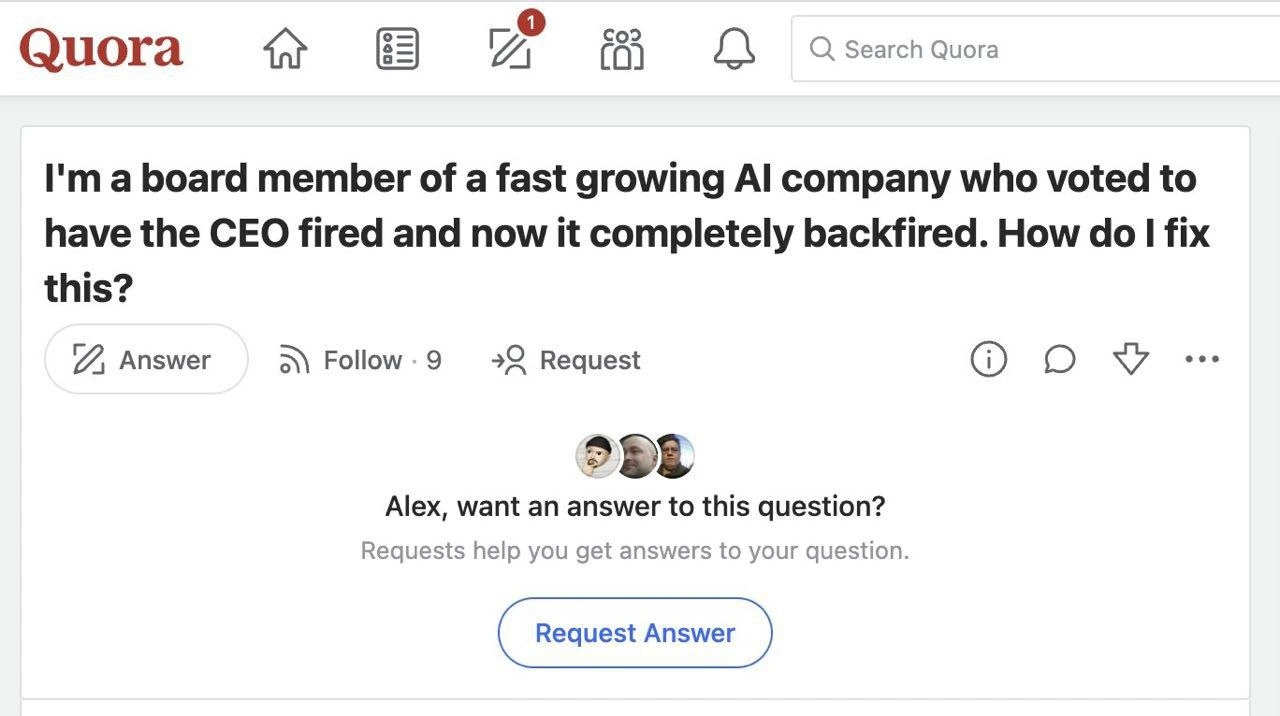
Now, the meme itself is presented as if it’s a question on Quora. Quora is a popular Q&A website (like a more general version of Stack Overflow, where people ask and answer all sorts of questions). The meme shows a fake Quora question written from the perspective of one of the board members who did the firing. The question (paraphrased) is: “I’m a board member of a fast-growing AI company who voted to have the CEO fired and now it completely backfired. How do I fix this?” The humor here is multi-layered:

  1. Role Reversal: Typically on sites like Quora or Stack Overflow, it’s juniors or people with a problem asking experts for help. Here we have a board member (a very senior, supposedly experienced leader) essentially admitting total cluelessness and begging the public for an answer to an almighty screw-up. It’s as if a chief architect broke a system and then went on Stack Overflow asking “Hey, how do I un-break our server?” It’s absurd, which is why it’s funny.

  2. Direct Reference to Real Events: This question is a clear allusion to what happened in real life with OpenAI (the “fast growing AI company” in question). In November 2023, OpenAI’s board of directors abruptly fired their superstar CEO, which caused a huge backlash: the employees and many in the tech community were extremely unhappy, and within a couple of days it turned into a crisis. Eventually, most of the staff threatened to leave and the board essentially had to reverse course (the CEO was in talks to come back and the board members themselves were on the way out). The meme is basically satirizing that situation. It’s saying, imagine one of those board members is now on Quora asking how to clean up the mess they made. It’s a form of tech industry in-joke: if you know about the OpenAI drama, you immediately get who “Alex” might be (a playful nod: the Quora UI in the screenshot even says “Alex, want an answer to this question?”, possibly hinting at one of the people involved or just a generic user name).

  3. The DevOps Analogy: The title given to the meme describes it in IT terms as if the board’s action were a software deployment: “Board-level hotfix… deployed to prod… rolls back… causes an outage.” For a junior developer or someone new: this is making a direct analogy that firing the CEO unexpectedly (board-level hotfix) and then having to undo it (roll back) is just like pushing a bad code change to your live app and crashing it. Corporate governance is being humorously likened to managing a codebase. The implication is that the board should have followed a better change management process – like testing this leadership change or at least anticipating impact – the way good DevOps practices would demand testing and gradual rollout for critical changes.

Let’s clarify some of the key roles and concepts in simpler terms:

  • Board of Directors (the “board”): This is a group of people who oversee a company at the highest level. They can hire or fire the CEO, and set broad directions, kind of like the highest administrators. Think of them as editors who can approve or reject big chapters in a project. They’re usually not involved in day-to-day work (that’s management’s job) but they have ultimate power over top decisions. In our analogy, they’re like the operators with permission to directly change major parts of the system configuration.

  • CEO (Chief Executive Officer): This person is the head of the company, the one who runs it day-to-day and is often the public face. In a fast-growing tech company, the CEO (especially a founder-CEO like Sam Altman of OpenAI) is a pivotal figure – they hold a lot of the company’s vision and also staff loyalty. You can think of the CEO as the main thread of execution or the central controller in the program of a company. Cutting out the CEO suddenly is like terminating the main process of an application without spawning a replacement – everything else can go into chaos or idle.

  • Firing: To “fire” someone means to terminate their employment suddenly. In context, the board essentially ejected the CEO from the company. It’s analogous to removing a critical component from a live system.

  • Backfired: This means the action had the opposite effect of what was intended, causing harm to the one who initiated it. The board hoped firing the CEO would solve something (maybe they had concerns the CEO was misaligned with the company’s mission or taking too many risks). Instead, it backfired spectacularly: it made things much worse for the board and the company. Like applying a patch that was supposed to fix a bug but instead introduced a much bigger bug.

  • Follow/Request Answer (Quora UI): The screenshot shows typical Quora buttons like “Answer”, “Follow · 9”, “Request”. Those aren’t deeply important to the joke, but they make the fake question look real. It even shows a prompt like “Alex, want an answer to this question? Requests help you get answers…” etc., which is just Quora’s interface encouraging user engagement. The key detail is the content of the question itself and the absurdity of the situation described.

For a junior developer or someone early in their career, the meme’s lesson can be interpreted as: even at the highest levels of a company, rash decisions without testing consequences can wreak havoc. Just like you wouldn’t merge a big change into main without running it in staging or at least doing a code review, the board probably shouldn’t have kicked out their “main” leader without consulting anyone or considering the fallout. It’s a comedic way to say “measure twice, cut once” – whether you’re cutting code or cutting CEOs. The context tags like leadership_refactor and corporate_git_revert emphasize this parallel: the board tried a leadership “refactor” (restructuring) the same way a dev might refactor code, but they ended up using git revert (undoing the change) because it didn’t compile with reality.

Also, this meme touches on AIHypeVsReality: The company in question deals with advanced AI, super futuristic tech. Yet, the problem that nearly sunk them wasn’t technical at all – it was old-fashioned human misjudgment. No fancy AI system saved them; it took human outrage and then human negotiation to resolve it. The IndustryIrony here is palpable: We can have super-intelligent models, but it doesn’t prevent people from making super-dumb mistakes. A junior employee might find comfort (and humor) in that: even the big shots are fallible, sometimes in very silly ways.

In summary, at Level 2 we see the meme as a clever analogy and a teaching moment: technical terms (hotfix, rollback, outage) are used figuratively to describe a high-level corporate blunder. If you’ve ever nervously deployed a fix and watched things blow up, you can relate – now you know even CEOs and boards can “deploy” bad decisions with similarly chaotic results! It’s a crash course in both humility and humor within tech and management.

Level 3: No Quorum on Quora

At first glance, this meme mashes up corporate governance fiascos with classic developer disaster jargon, and oh boy does it hit home for anyone who’s survived a 3 AM outage caused by a rushed fix. The Quora-style question reads: “I'm a board member of a fast growing AI company who voted to have the CEO fired and now it completely backfired. How do I fix this?” — a tongue-in-cheek reference to the recent real-world drama where an AI startup’s board did exactly that. In true engineer fashion, the meme frames this boardroom blunder as a “hotfix” gone wrong in production.

Think of the board’s abrupt firing of the CEO as running sudo rm -rf / on the company’s leadership in prod on a Friday afternoon. What could possibly go wrong? 🙃 Just like a panicked dev pushing an untested patch, the board deployed a governance change without a safety net or a rollback plan. The result? Immediate outage — not of servers, but of the entire organization’s functioning. Employees revolted (massive production errors), investors and partners sounded the alarm (monitoring alerts blowing up), and the company’s productivity flatlined (total downtime). In distributed systems terms, the “leader node” was abruptly removed, and the cluster (employees, stakeholders) couldn’t reach quorum on a new state. Essentially, the board introduced a Byzantine fault into the human network: trust evaporated, and all consensus was lost.

Senior engineers will recognize this pattern: a quick fix aimed at a symptoms (“CEO not aligning with our immediate vision, let’s yank him out!”) ends up breaking far more than it fixes. It’s the organizational equivalent of a database schema change deployed without migrations – absolute chaos. And just like in tech, they had to initiate an emergency rollback. Within days, the board was scrambling to undo the damage (inviting the ousted CEO back or otherwise mitigating the backlash). This is basically a git revert at the executive level – reversing a commit in the company’s “org.git” repository. But as every seasoned dev knows, reverts don’t erase the outage: data gets corrupted (critical talent leaves, trust is lost) and you still have to explain the blunder in a post-mortem. In fact, this meme’s title “Board-level hotfix deployed to prod instantly rolls back and causes an outage” reads like a change log entry in the incident report from that AI company’s lost weekend.

Why is this so darkly funny to us in tech? Because we’ve all been there in some form. Maybe not firing a CEO, but we’ve seen panicky higher-ups or product owners make knee-jerk decisions that felt like a /throw grenade, hope for best/. The humor comes from the IndustryIrony of it all: a cutting-edge AI/ML company, hyped to be solving super-complex problems, gets utterly tripped up by the oldest bug in the book – human error and poor communication. The board acted like a dev team bypassing QA and pushing to master on Friday 5 PM. Classic CorporateCulture mistake of not gauging stakeholder impact – in dev terms, not running integration tests with the actual user base (employees, investors). The “fast-growing AI company” here is clearly a nod to OpenAI’s boardroom saga, where the directors attempted a bold refactor of leadership (supposedly for safety or strategic reasons) and triggered an unprecedented org-wide crash. The backfire was immediate and spectacular: nearly the entire staff threatened to rage-quit leave, the investor community went into full-blown panic mode, and even rival companies (or rather one giant partner company) stepped in as an emergency failover. It was a governance_hotfix so misguided that it not only rolled back but also rolled over the credibility of the board – akin to pushing a patch that not only fails but also wipes out your error logs on the way out.

Let’s break down the alignment between the board’s move and a tech fiasco for clarity:

Board’s “Hotfix” Dev Equivalent Outcome
Secretly fired the CEO (on a Friday) Remove a critical service in production, unscheduled 🙄 System-wide crash (organization in turmoil)
Immediate about-face: beg CEO to return (Rollback) git revert HEAD~1 right after deploy fails Partial recovery, but with major collateral damage (trust lost, team shaken)
Board in disarray, credibility gone Dev team’s hotfix breaks prod, on-call gets paged 😤 Long nights of incident response and a very awkward retro/post-mortem

Every line of that table is basically a facepalm in engineering terms, and that’s exactly the reaction the tech community had watching this real saga unfold. The meme slyly uses a Quora question format – implying the board is so clueless after the backfire that they’re asking the public “How do I fix this?”. This is satire at its finest: it’s as if a developer who took down the site with a bad deploy went on Stack Overflow to ask how to bring the site back up. It shouldn’t happen, but if it does, you know it’s a total clown show. The ManagementHumor here is pointed – it highlights how even top-tier leadership can act as recklessly as an inexperienced coder, and how in tech, Leadership mistakes propagate just like bad code.

Historically, we’ve seen this movie before. Seasoned folks remember tales like Apple’s board ousting Steve Jobs in 1985 – a “refactor” that backfired so badly they spent a decade in the wilderness until they essentially rolled back by bringing Jobs home. More recently and relevantly, this openai_board_drama showed that in the era of AI hype, even the board might underestimate the codependency between a visionary CEO and the product/people. It’s a cautionary tale in StakeholderManagement: when you ignore the human elements of your system, be it a codebase or a company, you risk a cascade failure. The meme brilliantly captures that TechIndustryHumor sweet spot: comparing a high-stakes corporate blunder to a slapstick DevOps fail. And let’s be real, the reason it resonates is because it’s uncomfortably real. The next time someone in upper management proposes a drastic “quick fix” without consulting the team, every senior dev’s mind will flash to this infamous incident: Remember what happened when the board did a force-push to prod? You get an outage — and a big one at that.

Description

A screenshot of a question posted on the Q&A website Quora. The question, posed anonymously, reads: 'I'm a board member of a fast growing AI company who voted to have the CEO fired and now it completely backfired. How do I fix this?'. The image captures the standard Quora interface, including the platform's logo, search bar, and buttons to 'Answer', 'Follow', and 'Request'. This meme is a satirical commentary on the chaotic events at OpenAI in November 2023. It humorously imagines one of the OpenAI board members, after their decision to oust CEO Sam Altman resulted in a near-total employee revolt and massive public pressure, turning to a public forum like Quora for desperate advice. The joke highlights the perceived incompetence and lack of foresight of the board, framing their disastrous corporate maneuver as a personal problem they need to 'fix'
Comments

11
Anonymous ★ Top Pick They tried to git revert the CEO, but forgot to check if the commit had force-pushed 95% of the company to a new remote
  1. Anonymous ★ Top Pick

    They tried to git revert the CEO, but forgot to check if the commit had force-pushed 95% of the company to a new remote

  2. Anonymous

    Pro tip: if your board meeting ends with `git push --force` on the CEO branch, make sure you’ve tested the rollback plan - and maybe set a quarantine window in the bylaws

  3. Anonymous

    Ah yes, the classic 'git push --force' on production governance - when you try to rebase the CEO but forget the entire company has already pulled from main and your force push gets rejected by 700 angry employees threatening to fork the entire company

  4. Anonymous

    When your board's git revert --hard on the CEO fails because you forgot to check if production dependencies were still intact. Now you're stuck in a detached HEAD state with no rollback strategy, the investors are demanding a hotfix, and Stack Overflow's top answer is 'have you tried not firing the person who wrote all the institutional knowledge?'

  5. Anonymous

    Treating a CEO termination as a hotfix without change control is like shipping a breaking change to a widely used interface - you just discovered how many clients depended on undocumented behaviors

  6. Anonymous

    You tried a leader election without a quorum and force-pushed governance to prod; the other partition re-elected the same leader - next time use a feature flag and have a rollback plan

  7. Anonymous

    Boardroom coup without a git revert: now the company's reward function is pure regret

  8. @TheUnstupidOne 2y

    cloud-delivered AI is a bubble, simply too expensive to maintain. Plus even the best models are hallucinating way too much. The tech is cool, but has way too many pitfalls Considering what's going on globally, locally hosted personal use models are the future long-term. At least i think so. Let the shitstorm begin.

    1. @SmirnGreg 2y

      For locally-hosted AI every user, including mobile and iot, would have to use its own TPU for inheritance. It will idle most of the time, and this makes locally-hosted models are even more expensive to maintain

      1. @TheUnstupidOne 2y

        that's the tricky part the cost is passed down to the user, so corpos don't give a shit They're gonna force TPUs down our throats and call it a day

  9. @Johnny_bit 2y

    Asked by: Ilya S. :P

Use J and K for navigation