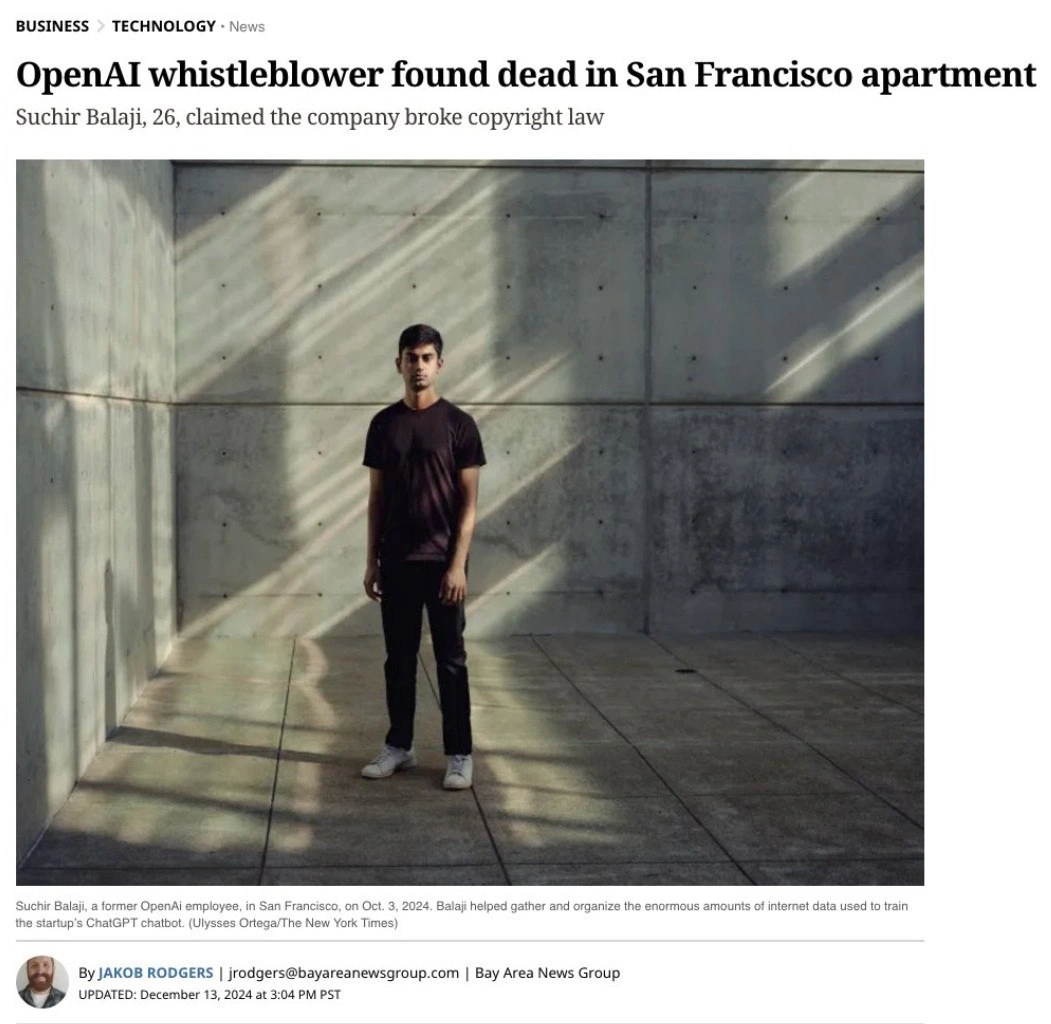
When your training dataset comes with a legal coroner’s report
Why is this AI ML meme funny?
Level 1: Data Soup Surprise
Imagine you have a giant soup made from mixing every ingredient you can find in the kitchen. Some ingredients are fine to use, but some were secret or even rotten. Let’s say you toss everything in, not really caring about the rules. Now, one of your friends who helped gather ingredients says, “Hey, we weren’t supposed to use that secret spice! That’s like stealing.” This friend is a bit like someone telling the teacher about a rule being broken. But then, something scary happens – the next day, that friend is gone and nobody knows why. Later on, when you taste the soup, you even find a note in the soup that talks about what happened to your friend.
Sounds like a creepy fairy tale, right? Well, that’s basically what this meme is joking about. The “soup” is like the huge mix of text that an AI (like a smart talking robot) learns from. The “secret ingredients” are pieces of writing that were taken without permission (like copying someone’s homework). The friend who spoke up is the whistleblower – a person who said “this is wrong.” And the scary part is that friend disappearing (in the meme, found dead) and even the report about it ending up inside the learning material.
Why is this funny (in a wow-that’s dark way)? Because you’d never expect a learning book to come with a story about one of its writers mysteriously dying. It’s an extreme, exaggerated scenario that makes us gasp and laugh a little from shock. It’s like if a big company was so eager to win a race that it broke rules, someone tattled, and then that tattletale’s story became part of the company’s big project. The humor is in the surprise and irony: it’s very wrong and spooky, and we don’t actually think that’s how things normally go, but the joke imagines it happening to make a point. It’s telling us, in a fairy-tale kind of way, that breaking rules can lead to really bad outcomes, and even the mighty smart robots might end up learning about those bad deeds from the very data we gave them.
So, it’s a bit like a cautionary tale dressed as a meme. Even a kid can get the basic feeling: if you cheat and someone catches you, and instead of fixing it you make that person “go away,” eventually your bad behavior will still come out in the open (like that note in the soup). The meme just uses a very extreme example to make it funny-scary. It’s saying big tech companies should play fair, or else things could get as messed up as a horror story – and that even the super-smart computer they built would know the frightening story.
Level 2: Cutting Corners to Coroners
For a less-experienced developer or someone newer to the tech world, let’s break down why this meme is both intriguing and darkly funny. First, some context: OpenAI is the company behind ChatGPT, a super advanced AI chatbot. ChatGPT learns to talk by training on a dataset – essentially a gigantic collection of text from the internet. Think of the training dataset as a massive library: it has books, websites, articles, maybe your blog posts, maybe this very explanation – basically anything the AI can read to learn language patterns. Now, normally, companies try to avoid putting illegal or very sensitive documents in that library, because of copyright and privacy issues. But sometimes they’re not careful enough or they intentionally push the limits. Copyright_infringement_risk and AI_training_data_lawsuit tags here hint at a big ongoing issue: many people suspect (and some have sued, in real life) that these AI models were built using copyrighted materials without permission – like feeding the AI full novels, news articles, or source code that are not open-source. It’s as if a student copied whole chapters from books they weren’t allowed to, to “learn” from them.
Now, enter the whistleblower: that’s a term for an insider (employee) who exposes wrongdoing within an organization. The news headline in the meme says a whistleblower from OpenAI was found dead in his apartment, and that this person, Suchir Balaji, was only 26 and had complained that OpenAI broke copyright law. He was one of the people who helped gather all that internet text for training ChatGPT. So he likely knew exactly what went into the sausage, so to speak. If he said “we’re breaking the law with our training data,” that’s a big deal – it could lead to lawsuits or government investigations. The sub-headline explicitly says he claimed the company was doing something illegal regarding copyright. Data privacy and AI ethics folks would immediately perk up at that: it means OpenAI might have knowingly used stuff they shouldn’t have.
The meme’s caption: “When your training dataset comes with a legal coroner’s report.” This is basically the punchline. A coroner’s report is the official document a medical examiner writes to determine how someone died (it’s common in cases of unexpected or suspicious deaths). It’s very much a legal and medical document, not the kind of everyday text you’d think an AI training set contains. By saying the training set “comes with” a coroner’s report, the meme jokes that the dataset now literally includes the report of this guy’s death. In other words, the AI’s learning material wasn’t just Wikipedia articles and Reddit posts – it had this morbid real-life story in it too. It’s a shock factor joke: picture a data scientist loading up “texts to train on” and finding BUSINESS > TECHNOLOGY > News: OpenAI whistleblower found dead… among the files. That’s super heavy, like a horror easter egg in your AI project. The humor (albeit a very dark humor) comes from the sheer absurdity and irony: the very act of collecting all this data possibly led to a death (if you buy the conspiratorial angle), and now even that death’s documentation is absorbed into the data collection. It’s like poetic justice or a vicious circle, depending on how you see it.
Now, what’s with Boeing 🤝 OpenAI? That line is referencing the handshake meme format. In handshake memes, two entities are shown shaking hands over a shared characteristic. Boeing is a giant aerospace company, and a few years ago it had a notorious scandal involving its 737 Max airplanes. Basically, Boeing rushed a new plane model to market, and it had faulty software (the MCAS system) that would force the plane’s nose down under certain conditions. Some Boeing engineers and pilots raised concerns or knew about problems, but the company didn’t adequately fix them or fully inform airlines. Tragically, this led to two plane crashes in 2018-2019, with many casualties. Investigations later revealed a lot of corporate pressure, ignored warnings, and even attempts to hide the extent of the software issues. In short, Boeing was accused of cutting corners on safety to compete in business, and it backfired catastrophically.
By saying “Boeing 🤝 OpenAI,” the meme equates what OpenAI is doing to what Boeing did. The implied common trait could be phrased as “Cutting corners until someone gets hurt.” OpenAI isn’t making planes, but the accusation is it might be cutting legal/ethical corners in its AI development (using copyrighted data without permission, etc.). The whistleblower’s death is an extreme (and probably fictional) consequence, paralleling Boeing’s extreme consequence of plane crashes. The meme is basically a cynical joke that OpenAI’s behavior is as dangerous in the information realm as Boeing’s was in aviation. Both are high-tech fields where mistakes can have serious fallout: with Boeing it was loss of life in crashes, with OpenAI it could be something like massive legal trouble, people’s rights violated, or – in the joke’s dark imagination – even an employee getting killed over it.
To a junior developer or someone early in tech, this highlights a few lessons/cautions:
- Corporate culture can turn toxic: Both Boeing and, allegedly, OpenAI show that big targets and competition (whether making the best plane or the best AI) can lead a company to ignore ethical lines. At Boeing, some voices of caution were suppressed. At OpenAI, if we follow the meme’s story, a voice of caution was silenced in the most final way. Realistically, companies have been known to retaliate against whistleblowers by firing them or suing them – obviously murder is not a standard response, which is why it’s presented as dark comedy here. The exaggerated scenario underscores whistleblower_consequences: whistleblowers often fear for their careers; here we imagine fearing for their lives.
- AI’s data is a free-for-all (and that’s risky): Training an AI like ChatGPT means collecting enormous amounts of internet data. There’s an ongoing debate and a growing number of lawsuits about whether this is even legal. Authors, artists, programmers—many are upset that their work was used to train AIs without consent or compensation. Companies argue it’s fair use or necessary for progress, but it’s a grey area. This meme builds on that real concern: if a whistleblower inside OpenAI said “hey, we can’t just scrape copyrighted text, that’s illegal” – that’s very plausible and it has actually happened in some companies (people have raised such flags). The dark twist is: what if a company was so intent on using the data that they’d do anything to stop interference? It’s obviously taking reality to a fictional extreme, but it highlights the tension between AI industry trends (move fast, break things, collect data now, deal with legality later) and ethical practices.
- The presence of the actual news article image: The image shown (with the NYTimes photographer credit and Bay Area News Group byline) gives the meme a realistic touch. It looks like a genuine news story. This can momentarily fool you (“Wait, did this actually happen?!?”) before you realize it’s (likely) a doctored or hypothetical headline. This style of meme (a screenshot of a news piece) is used to amplify the shock value. If you’re not careful, you might think it’s true, which also speaks to another underlying issue: how technology and media can spread info and how discerning we must be. But in the context of the joke, it’s there to make you go “holy crap, that’s wild,” then “oh, it’s a meme, but yikes – point taken.”
In summary, Level 2 unpacks the scenario without assuming deep prior knowledge. The meme is using Boeing’s past tragedy and a fake (?) OpenAI scandal to say: if you ignore rules and ethics in tech, very bad things can happen. It’s poking at OpenAI’s current challenges (copyright, data handling, crazy pressure in AI race) by comparing it to one of the worst corporate tech screw-ups in recent memory (Boeing’s saga). It’s funny to those of us with some context because it’s an exaggerated mash-up of very serious things – a gallows humor way to criticize tech industry practices.
Level 3: Coroner in the Corpus
In this darkly ironic meme, OpenAI’s cutting-edge AI training practices collide with a thriller-worthy corporate scandal. The image is a screenshot of a news headline: “OpenAI whistleblower found dead in San Francisco apartment”. That alone hits like a plot twist in a cyberpunk novel. The 26-year-old whistleblower, Suchir Balaji, allegedly claimed the company broke copyright law by how it built its training dataset – essentially accusing OpenAI of illegally scraping protected content to train ChatGPT. Now he’s mysteriously dead, and the coroner’s report about his demise has presumably become just another document in the vast pile of data that future AIs might ingest. The meme’s caption, “When your training dataset comes with a legal coroner’s report,” underscores the absurdity: the AI’s learning material now includes the official post-mortem from this very scandal. It’s a morbid nod to how AI models indiscriminately learn from everything – even the debris of their own making.
This senior-level humor lands because it combines technical reality with jaw-dropping corporate dysfunction. Large language models like ChatGPT are trained on humongous text corpora (think billions of words from the internet). That corpus (the model’s knowledge base) likely contains all sorts of data – from Stack Overflow code to New York Times articles. Here, the “corpus” literally contains a coroner’s report about a former employee. “Corpus” fittingly means body of text, and grimly, a coroner deals with actual bodies. It’s a pun a seasoned developer or AI researcher might chuckle at while wincing. The meme suggests that OpenAI’s training data is so broad (and so questionably sourced) that it even looped in documentation of its own scandal – a snake eating its tail, ethically speaking. It’s as if ChatGPT’s next version could answer a query about this whistleblower’s death from first-hand training data. That’s both impressive and deeply unsettling.
Now, the Boeing 🤝 OpenAI line (with the handshake emoji) draws a parallel to another engineering fiasco. It implies that OpenAI’s corporate culture is being likened to Boeing’s during the 737 Max debacle – where cutting corners and silencing warnings led to fatal consequences. The handshake meme format usually goes “X 🤝 Y: [Shared Trait].” Here, Boeing and OpenAI are shaking hands on “high-stakes negligence”. The comparison is biting: Boeing infamously had internal engineers raising alarms about the MCAS system, which were ignored, contributing to two plane crashes. OpenAI’s whistleblower raised alarms about copyright violations in AI training, and in this dark scenario, the concern was ignored until it escalated to a deadly tragedy. Both cases involve corporate pressure overruling safety or ethics. This is an AI industry trend the meme cynically highlights: the frantic race to build powerful AI (just as Boeing raced to compete with Airbus) can create an environment where AIEthicsConcerns and warnings are swept aside. And in both stories, people who try to do the right thing face dire consequences – for Boeing it was passengers and public trust, for OpenAI it’s the whistleblower himself. It’s a grim “hype vs. reality” check on tech culture.
From a veteran developer perspective, the humor is also in the absurd data governance failure. If a training dataset includes a legal coroner’s report, that implies a few things:
Data scraping gone wild: OpenAI (and other AI labs) use web crawls and dumps of online text to train models. They often vacuum up content indiscriminately – copyrighted books, private posts, news articles behind paywalls, you name it. This meme points out the copyright_infringement_risk: Suchir said OpenAI “broke copyright law,” likely by using protected text without permission. Seasoned devs know this is a hot issue; it’s why there are lawsuits against OpenAI and others right now. The AI gold rush sometimes plays fast and loose with intellectual property, hoping to argue fair use later. But here that reckless approach is taken to a hyperbolic extreme – the dataset even contains the investigative report of a death tied to that very recklessness. It’s as if the data pipeline just gulps down not only the forbidden texts, but also the evidence of the crime of gulping those texts!
Privacy and sensitive info: A coroner’s report is sensitive, possibly confidential or at least not something you’d want a chatbot to quote. The meme taps into data privacy fears: these giant models can inadvertently memorize and regurgitate sensitive documents. (We’ve seen real examples: models spitting out someone’s SSN or private emails because they appeared in training data.) A senior dev reading this might recall those GitHub Copilot cases where it reproduced licensed code verbatim. The inclusion of a coroner’s report hints that no one filtered out even the most sensitive, eerie data. It’s a nightmare scenario for AI ethics – the model might accidentally leak a morbid document when a user asks something related.
Exception handling, taken literally: In coding, “exception handling” is how we catch and deal with errors. The context tag legal_exception_handling hints at a dark joke: OpenAI’s way of handling the “legal exception” (the complaint about illegal data use) was to remove the source of the complaint. In code, if an error is inconvenient, you might be tempted to just suppress it. Here that idea is morphed to a sinister form. A jaded engineer might quip that OpenAI executed a
kill -9on the whistleblower process. In pseudo-code, it’s like:try { ingest(allInternetData); } catch (CopyrightLawException &e) { // Log error? Inform legal? Nah... whistleblower.terminate(); // remove the source of complaints (dark humor) }This of course is satire – we (hope) OpenAI isn’t literally doing that. But the joke resonates with anyone who’s seen companies use heavy-handed tactics to deal with internal dissent (usually firing the whistleblower, not anything murderous!). The extreme nature of the joke underscores frustration with corporate ethics: it feels sometimes like big firms will do anything to keep their secrets, which in reality means suing or silencing through NDAs – the meme just escalates it for effect.
In essence, Level 3 analysis sees this meme as a blend of AI technical satire and corporate thriller. It highlights real technical issues – how training data is collected and the legal/ethical minefield there – and mixes it with a conspiratorial twist on corporate culture – hinting that speaking up can be deadly. The humor is jet-black. It’s the kind of laugh that comes with a wince, acknowledging a truth about our industry: behind the glossy press releases about AI breakthroughs (AIHypeVsReality), there are massive messy datasets of dubious legality, and high-pressure corporate environments that might just treat inconvenient humans as bugs to be “fixed.” The Boeing handshake cements the point: whether it’s airplanes or AIs, ignoring ethics and cutting corners can lead to catastrophic outcomes. The seasoned dev reading this has likely lived through or read about enough tech scandals to both get the reference and share the uneasy chuckle.
Description
Screenshot of a news article with the breadcrumb line "BUSINESS > TECHNOLOGY > News" followed by the bold headline "OpenAI whistleblower found dead in San Francisco apartment." A sub-headline reads "Suchir Balaji, 26, claimed the company broke copyright law." Below, a portrait photo shows a young man in a concrete, shadow-striped room; his face is pixel-blurred for anonymity while he stands in a black t-shirt, jeans, and white sneakers. The caption states: "Suchir Balaji, a former OpenAI employee, in San Francisco, on Oct. 3, 2024. Balaji helped gather and organize the enormous amounts of internet data used to train the startup's ChatGPT chatbot. (Ulysses Ortega/The New York Times)." At the bottom is the byline "By JAKOB RODGERS | [email protected] | Bay Area News Group" and an update timestamp "UPDATED: December 13, 2024 at 3:04 PM PST." Technically, the image highlights ongoing concerns about AI model training on copyrighted corpora, internal data governance, and the high-stakes corporate culture surrounding large-scale language models
Comments
22Comment deleted
Turns out the real "stop-gradient" in LLM training is when the compliance team sees the headline and yanks the Ethernet cable
Turns out the real AGI was the whistleblowers we lost along the way. Nothing says 'move fast and break things' quite like Silicon Valley's approach to inconvenient truths about training data provenance
When your data pipeline includes 'the entire internet' and your compliance pipeline includes 'we'll figure it out later,' you're not building AGI - you're speedrunning a regulatory nightmare. Turns out the real alignment problem wasn't getting AI to understand human values, it was getting leadership to understand copyright law. The irony? An industry obsessed with training models on human knowledge somehow forgot the humans who created that knowledge might have opinions about it
OpenAI's ultimate data cleanup: when whistleblowers on scraped copyrights get pruned from the cluster - permanently
At scale, 'move fast and scrape things' becomes a new MLOps pattern: ETL - Extract, Transform, Litigate
Every LLM pipeline has tokenize(), deduplicate(), and check_license(); only one of those improves the validation loss, so guess which one never ships
Cyberpunk 4 real Comment deleted
Apparently they ruled it a suicide. Shameless AF. Comment deleted
Sarah Connor? Comment deleted
They say: "AI is just a computer program, it cannot hurt you". AI: Comment deleted
AI is not sentinent, it depends on what you make of it. People are amoral and violent, so what's so surprising about AI learning from them? Comment deleted
Please, refrain from usage of any language besides English Comment deleted
anonymized channels… fucking hell Comment deleted
please speak english regardless of warn not working on you. ban will work Comment deleted
Man got two warnings and then threat to be banned for the first time of misconduct with language 😂 Comment deleted
yeah I only saw your warning later, my b Comment deleted
Which one? 🌚 Comment deleted
fair Comment deleted
What have you done, Sam... Comment deleted
Nothing that can be legally proven in court Comment deleted
🤝 Russia 🤝 imnotgoingtosayontglmaothisgroupispublic Comment deleted