Skip to content
DevMeme
7042 of 7435
OpenAI Joins the Lobster Trend and Ruins It for Everyone
IndustryTrends Hype Post #7722, on Feb 17, 2026 in TG

OpenAI Joins the Lobster Trend and Ruins It for Everyone

Why is this IndustryTrends Hype meme funny?

Level 1: The Cool Hat Problem

Some kids at school start wearing silly hats they made themselves, just for fun. Soon everyone thinks the hats are hilarious and great. Then the biggest, richest kid in school shows up wearing one, puts his name sticker on it, hands out factory-made copies, and high-fives his friends about how fun they are. Suddenly nobody who started it wants to wear the hats anymore — because the fun part was never the hat, it was that they made it up. The broken hats all over the ground show what's left when someone buys a joke instead of getting it.

Level 2: How a Trend Becomes a Product

The comic compresses a lifecycle you'll watch happen repeatedly in tech:

  • Organic phase — a few people in a community (open-source hackers, a Discord, a forum) start doing something playful with no business model. Authenticity is the whole point.
  • Viral phase — the trend spreads; everyone's posting about it. This visibility is what attracts attention from companies, who track community buzz the way surfers track waves.
  • Appropriation — a large company adopts the trend as branding or ships it as an official product. The term trend appropriation covers this: taking culture you didn't create and monetizing it.
  • Abandonment — the original community moves on, because the trend no longer distinguishes insiders from marketers.

For someone early in their career, the practical takeaway: when a big vendor "embraces" the community tool you love, read the roadmap carefully. Sometimes it means resources and longevity; often it means the weird, fun version you joined for is about to be deprecated in favor of an enterprise tier.

Level 3: Embrace, Extend, Exoskeleton

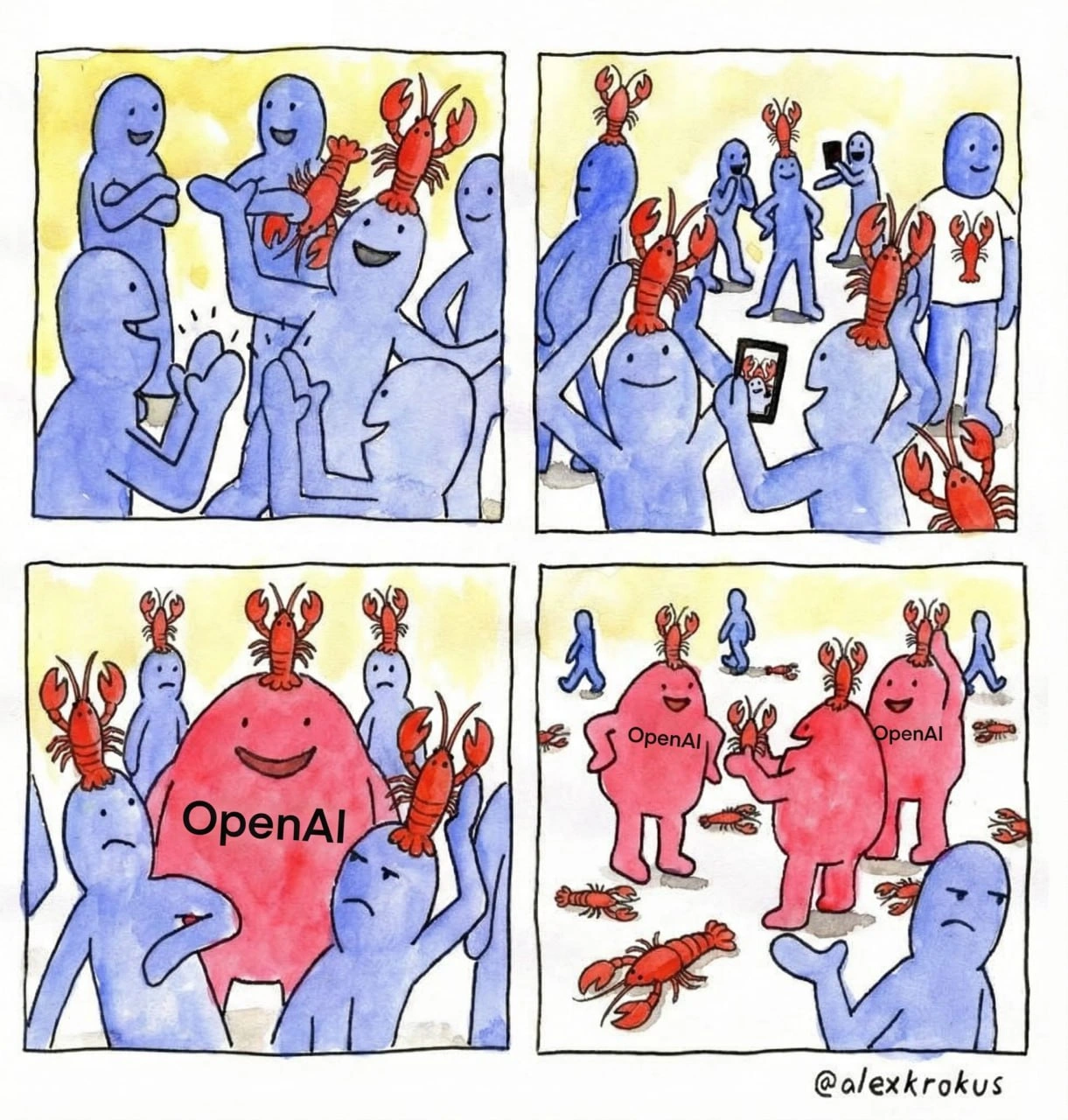
This @alexkrokus watercolor is his classic "corporations discover the fad" comic with a 2026-specific edit: the corporate blob is labeled OpenAI, and the fad is wearing live lobsters on your head. The four-panel arc is a complete anthropology of internet culture death. Panel one: blue figures delight in friends wearing lobsters — weird, organic, theirs. Panel two: virality — phones out, photos snapped, one figure already in a lobster t-shirt (merchandising appears before the corporation does; the community monetizes itself first, gently). Panel three: an enormous grinning pink blob wearing both a lobster and the label "OpenAI" looms over visibly unimpressed blue figures. Panel four: the original people are gone or leaving in disgust, three OpenAI-branded blobs high-five each other — and the ground is littered with dead lobsters.

The lobster isn't random. The AI community's grassroots obsession of the moment is the lobster-mascot agent craze — the open-source, hacked-together, slightly unhinged personal-agent scene that grew out of community projects rather than vendor roadmaps. The comic skewers the platform-capture playbook the industry knows by its Microsoft-era name, embrace, extend, extinguish: a foundation-model vendor watches a community invent something genuinely fun, then ships a productized version with a keynote slide, a waitlist, and a trademark filing. The crucial detail is panel four's plural blobs high-fiving each other. The corporation doesn't join the community; it replaces the community with copies of itself, celebrating a trend whose entire value was that no one official was doing it. The dead lobsters scattered on the ground are the part veterans feel in their spines — every absorbed hackathon project, every acquired-and-sunset startup, every meme that became a marketing campaign.

What makes the satire durable is that it isn't even about malice; it's about incentive gradients. A company whose valuation depends on owning every layer of the stack cannot let an organic ecosystem stay organic — community traction is just unpriced market signal. And the community's exit in panel four is equally mechanical: the moment a trend signals "corporate," it stops signaling "us," and its social value drops to zero. The fad doesn't die because the corporation did it badly. It dies because the corporation did it at all.

Description

A four-panel watercolor comic by @alexkrokus (an edit of his classic 'corporations ruin the fad' lobster comic). Panel 1: cheerful blue figures admire friends wearing live red lobsters on their heads - a quirky organic trend. Panel 2: the trend spreads; crowds photograph lobster-wearers with phones, one wears a lobster t-shirt. Panel 3: a huge smiling pink/red corporate blob labeled 'OpenAI' shows up wearing a lobster, while the blue figures look annoyed and skeptical. Panel 4: multiple 'OpenAI'-branded red blobs wear lobsters and high-five while dead lobsters litter the ground and the original blue figures walk away disgusted. The comic satirizes big AI companies appropriating grassroots community culture and trends (the lobster nods to the open-source lobster-mascot AI agent craze), commercializing the joke until it's dead - literally, in lobster terms
Comments

6
Anonymous ★ Top Pick Step 1: community invents a weird joke. Step 2: it trends. Step 3: a foundation-model vendor ships it as a product. Step 4: deprecation notice for the lobster
  1. Anonymous ★ Top Pick

    Step 1: community invents a weird joke. Step 2: it trends. Step 3: a foundation-model vendor ships it as a product. Step 4: deprecation notice for the lobster

  2. @SamsonovAnton 4mo

    Requesting immediate explanation support! We are under heavy bombardment by AI-related memes completely out of context! Explanation squad, come in! How copy? Over!

    1. @deimossos 4mo

      Openai has hired Peter Steinberger, the developer of openclaw

  3. @sysoevyarik 4mo

    Tf is openclaw Upd Ah its another ai garbage nah

  4. @agonyship 4mo

    Jordan Peterson Cast

  5. @callofvoid0 4mo

    I might try this claw thingy out

Use J and K for navigation