Skip to content
DevMeme
7266 of 7435
OpenAI Chief Scientist Asks GPT-5.5 for ASCII Unicorn, Receives Goblin
AI ML Post #7966, on May 3, 2026 in TG

OpenAI Chief Scientist Asks GPT-5.5 for ASCII Unicorn, Receives Goblin

Why is this AI ML meme funny?

Level 1: Asked for a Pony, Got a Gremlin

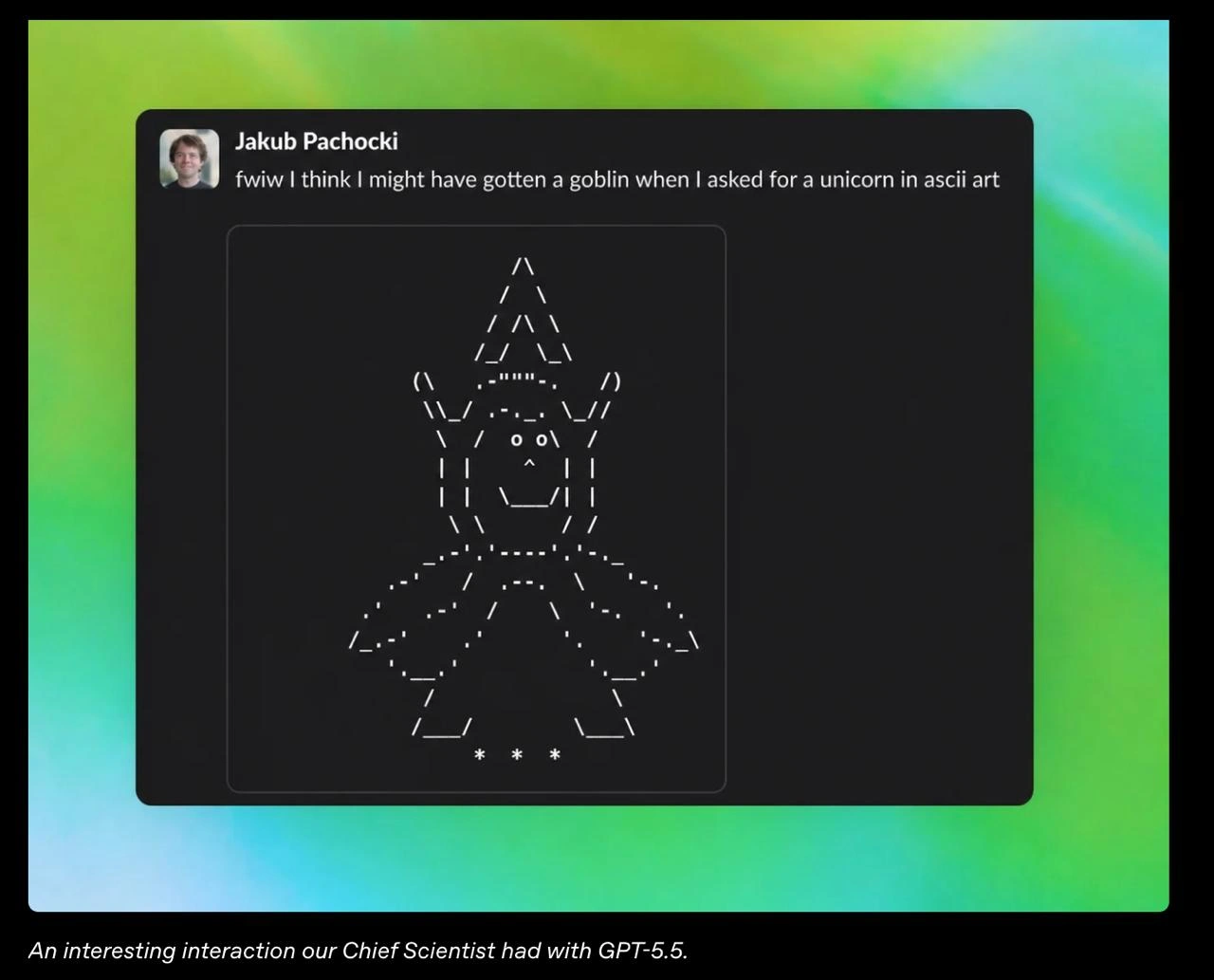
Imagine asking a very smart friend to draw you a unicorn — and they proudly hand over a drawing of a grinning little goblin in a pointy hat, arms in the air like it just cast a spell. They worked hard on it! It has a face and everything! It's just... not remotely a unicorn. The funniest part is who it happened to: the head scientist of the company that made the robot artist. Even the person in charge of the magic sometimes asks for a unicorn and gets a goblin — and all you can do is shrug and say, "well, for what it's worth..."

Level 2: Why Text Robots Can't Draw

A quick decoder ring for the moving parts:

  • ASCII art — pictures made entirely of keyboard characters (/, \, |, o, *), the cave paintings of computing, dating back to line printers and BBS-era signatures.
  • GPT-5.5 — a frontier large language model. It generates text one token at a time, left to right, which makes anything requiring vertical alignment (like a picture spanning many lines) surprisingly hard.
  • Tokenization — models don't see characters; they see chunks. The string \__/ might be one token or four depending on context, so the model can't reliably "count columns" the way a human aligning art in a text editor does.
  • Capability benchmark — a repeatable test of what a model can do. The unicorn drawing became a famous informal one because drawing requires composing many skills (anatomy knowledge, spatial layout, format constraints) at once.

The relatable junior moment: the first time you ask an AI assistant to "draw a diagram in ASCII" for your README and receive something that looks like a melted ladder. Now you know it happens to the people who built the model too — their goblins are just better documented.

Level 3: The Unicorn Eval, Three Generations Later

The screenshot's quiet comedy compounds the more context you bring to it. The Slack message — from Jakub Pachocki, OpenAI's Chief Scientist, no less — reads:

fwiw I think I might have gotten a goblin when I asked for a unicorn in ascii art

Below it sits the evidence in a dark monospaced code block: a creature with a tall triangular horn-or-hat, raised claw-like arms, o o eyes over a wide grin, a skirted lower body flaring like wings, and three asterisks scattered at its feet like dropped loot. The italic caption underneath — "An interesting interaction our Chief Scientist had with GPT-5.5." — delivers it with the deadpan of an official communiqué.

For anyone steeped in LLM lore, the unicorn isn't an arbitrary animal. It's a callback to the "Sparks of AGI" era: the famous experiment where researchers asked GPT-4 to draw a unicorn in TikZ (a LaTeX vector-drawing language) and tracked drawing quality across training checkpoints as a proxy for emergent capability. The unicorn became an informal benchmark — a vibe-eval before vibe-evals had a name. So the meme's payload is the implied capability curve: GPT-4 sketched a recognizable unicorn; GPT-5.5, generations of scaling later, confidently delivers a goblin. Progress on MMLU, regression on unicorn@1.

The deeper, more honest point: spatial composition in plain text is genuinely hostile terrain for autoregressive models. ASCII art demands global 2D planning through a 1D token stream — every line must anticipate alignment with lines not yet generated, and tokenizers mangle runs of spaces and slashes into unpredictable chunks. The model isn't "drawing"; it's predicting plausible next tokens that locally resemble ASCII art, which is exactly how you end up with something structurally coherent (symmetric arms, a face, a base) yet semantically wrong (goblin ≠ unicorn). It's hallucination's visual cousin: fluent form, wrong referent.

And there's the sociotechnical garnish — the failure case being surfaced by the chief scientist himself, in the corporate Slack, with "fwiw" energy. Frontier labs run thousands of formal evals, yet the failures that actually travel are the ones a human can laugh at in two seconds. Dogfooding finds what dashboards don't.

Description

A screenshot of a Slack message on a vibrant green-and-yellow gradient background. The message, from Jakub Pachocki (OpenAI's Chief Scientist), reads: 'fwiw I think I might have gotten a goblin when I asked for a unicorn in ascii art'. Below is a monospaced ASCII art drawing in a dark code block: a creature with a tall triangular horn/hat, raised clawed arms, round 'o o' eyes, a smiling face, a wide skirted or winged lower body, and three asterisks beneath its feet - far more goblin than unicorn. Italic caption at the bottom: 'An interesting interaction our Chief Scientist had with GPT-5.5.' The image plays on the famous 'draw a unicorn in TikZ' capability benchmark from the GPT-4 'Sparks of AGI' era - frontier models still fumble ASCII unicorns, and even the chief scientist gets goblins
Comments

4
Anonymous ★ Top Pick Three model generations of progress: GPT-4 drew a unicorn in TikZ, GPT-5.5 ships a goblin and waits for the eval to be renamed
  1. Anonymous ★ Top Pick

    Three model generations of progress: GPT-4 drew a unicorn in TikZ, GPT-5.5 ships a goblin and waits for the eval to be renamed

  2. dev_meme 2mo

    Btw

  3. @Noral_r9te 2mo

    What if goblins actually improve AI ethics?

  4. @chungusmemora 2mo

    A goblin with tired ahhhh BFT

Use J and K for navigation