Skip to content
DevMeme
2964 of 7435
A Museum-Worthy Bit Flip Operation
CS Fundamentals Post #3274, on Jun 17, 2021 in TG

A Museum-Worthy Bit Flip Operation

Why is this CS Fundamentals meme funny?

Level 1: Opposites with Fingers

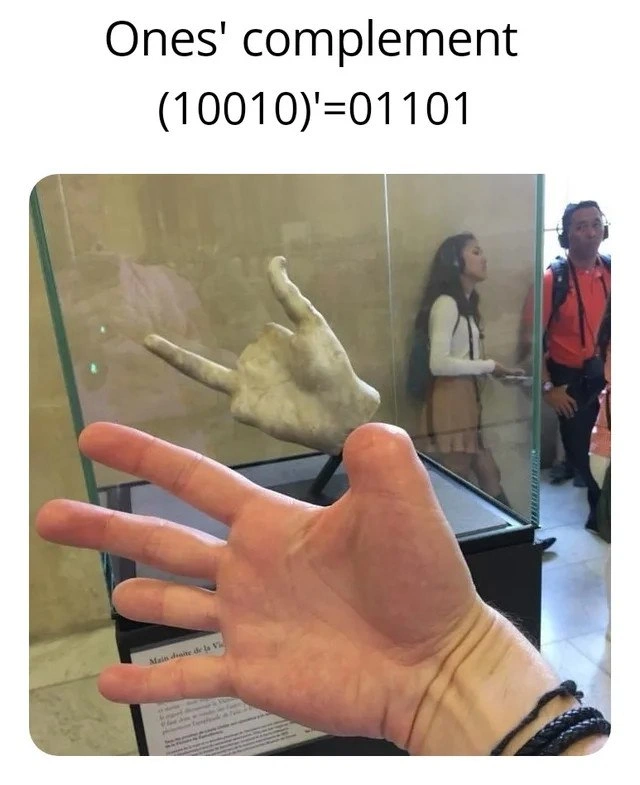
Imagine an easy game of opposites using your hands. One hand (the statue’s hand) makes a certain shape with some fingers sticking up and the rest down. The other hand (the person’s hand) does the exact opposite: for every finger the statue has up, the person keeps that finger down; and for every finger the statue keeps down, the person puts that finger up. It’s like if your friend made a V-for-victory ✌️ sign (index and middle fingers up, others down) and you responded by closing those two fingers and sticking out all the others instead. It looks silly, but you can tell one hand is doing the reverse of the other. This meme is funny because it shows that idea of perfect opposites in a really unexpected place. A museum statue and a real person are effectively playing a little finger-opposites game! In a way, it’s imitating how a computer might flip things between “on” and “off,” but you don’t need to know that to laugh. It’s just clearly one hand-sign reversed by another. The surprise of seeing someone do that in front of an old sculpture – turning a serious artwork into a goofy opposite-hand demonstration – is what makes it so amusing and memorable.

Level 2: Handy Bit Flips

This meme is demonstrating a basic CS fundamental concept called ones' complement, which means flipping every bit of a binary number to its opposite. Remember, binary is the way computers count using only two digits: 0 and 1 (off and on). So if you have a binary pattern like 10010, its ones’ complement is 01101. All we did was change each 1 to a 0 and each 0 to a 1. The caption even shows this using a prime ' symbol:

Ones' complement: (10010)' = 01101
Here, (10010)' means “take the bitwise NOT of 10010,” and the result is 01101. You can think of it like a row of switches: if the switch was up (1), you flip it down (0); if it was down (0), you flip it up (1).

Now, instead of just writing the binary numbers on a board, this meme uses hand gestures to represent the bits. Think of each finger as a binary bit: an extended finger means that bit is a 1 (like saying “on” or “true”), and a folded finger means that bit is 0 (“off” or “false”). The marble sculpture’s hand is making the classic "rock on" sign (🤘): the index finger and pinky are sticking out (those positions are 1s), while the thumb, middle, and ring fingers are curled down (those positions are 0s). If you label each finger as a bit, the statue is effectively displaying the pattern 10010 with its fingers. Now look at the real hand in front of the statue: it’s doing the exact opposite. The person has the thumb, middle, and ring fingers extended (these were the fingers the statue kept down), and their index and pinky are bent (the two fingers the statue had up). That new configuration corresponds to 01101. In other words, the live hand’s bits are the inverse of the statue’s bits: wherever the statue showed a 1, the person shows a 0, and wherever the statue showed a 0, the person shows a 1. It’s a perfect visual bitwise NOT. You can literally read the statue’s hand as a 5-bit binary number and the real hand as the flipped 5-bit number. The two hands are like mirror images in terms of binary code – one is the logical negation of the other.

If you’ve taken an introductory programming or computer organization course, you might have encountered this concept. Ones' complement is basically the same as the bitwise NOT operator in many programming languages. For example, in C/C++/Java-style languages you’d use ~ to flip all the bits of a number. If we had a variable x with the binary value 10010, then ~x would give us 01101 (assuming we’re only dealing with those five bits). In practice, computer numbers are stored with a fixed size (like 8-bit, 16-bit, 32-bit), so the complement operation would flip all bits in that size, but the idea is identical. This sort of binary flipping is a fundamental part of how computers work under the hood. It shows up in contexts like low-level hardware programming, optimizing code with bit masks, or implementing certain algorithms. It’s also taught when learning how negative numbers can be represented in binary (though modern systems use an added step called two’s complement, as mentioned above).

For a newer developer or someone just learning, the takeaway is: bit = binary digit (0 or 1), and ones' complement means flip each bit. The meme takes this dry definition and makes it tangible. It falls squarely into CodingHumor/ComputerScienceHumor because you need to know a bit about binary to get the joke. If you didn’t know about bit-flipping, you might just see a random hand pose in front of a statue and not think much of it. But once you understand that each finger position represents a 1 or 0, the lightbulb goes on. 💡 Suddenly it’s obvious: the two hands are showing a before-and-after of a binary inversion. It’s a clever, hands-on way (literally!) to illustrate a concept that usually lives in textbooks and code. For those learning about binary, it’s a memorable demonstration of how a computer might interpret opposites. And for those who already know, it’s a funny reminder that even something as abstract as a bitwise operation can pop up in real life scenes. In short, the meme is both educational and amusing — turning a simple binary math lesson into a visual gag you can share with your nerdy friends.


Level 3: Inversion at Hand

At its core, this meme is a perfect physical pun about bitwise NOT (the ones' complement operation) using a statue and a live hand. Behind museum glass, a marble hand is frozen in a classic devil horns pose — index and pinky fingers raised — while in front of it a real hand displays the exact inverse gesture. The meme’s caption even spells it out: turning (10010) into 01101 by flipping every bit. In other words, the statue’s hand is portraying the binary number 10010, and the person’s hand in front performs a logical NOT to produce 01101. It’s a deliciously geeky sight: a concept from digital logic class enacted in a museum hallway for all to see.

For seasoned developers and computer scientists, ones' complement is a blast from the past that recalls the nitty-gritty of data representation. In binary, taking the ones' complement means inverting each bit — 1s become 0s, and 0s become 1s. Historically, some early computers used ones' complement to represent negative numbers (meaning to get -X, you just flipped all the bits of X). This had some quirky side effects – notably the existence of both a “+0” (0000...0000) and a “-0” (1111...1111) in those systems. Because of oddities like that, modern architectures switched to two's complement (flip the bits and then add 1) to represent negatives and eliminate the -0 issue. But in the context of this meme, we don’t need that extra +1 step; it’s illustrating the pure bit-flip of a ones' complement, which is much easier to demonstrate with static fingers. (If this had been two’s complement, they’d have to somehow add an extra “1” finger to the inverted hand – not exactly feasible with a marble statue!)

What makes this meme extra satisfying is how it turns an abstract binary operation into a tangible truth table you can see. In digital logic, a NOT gate outputs the opposite value of its input: 1 → 0 and 0 → 1. Here, the marble sculpture’s extended fingers act as input bits set to 1, and its folded fingers are 0. The real-life hand provides the output by swapping each state: every finger that the statue had raised (1) is now down (0) on the human hand, and every finger that was down (0) is now up (1). In programming terms, the person essentially applied a ~ operator to the statue’s bit pattern. It’s a binary mirror image come to life – a literal hand-crafted ones' complement. Seeing someone perform a low-level bit flip with their bare hand in a crowded museum is the kind of nerdy surprise that experienced devs live for.

For extra nerd cred, notice the numeric relationship: the binary 10010 (which is 18 in decimal) plus its ones’ complement 01101 (13 in decimal) equals 11111 (31, in decimal). That 11111 is a 5-bit pattern of all 1’s. In general, any n-bit number X added to its ones' complement yields 2^n - 1 (a number with n ones in binary). Here n=5 (five fingers acting as five bits), so 2^5 - 1 = 31 (which is 11111 in binary). The meme subtly encodes this property: the two hand configurations are complementary pieces that fill all five bit positions with 1s when combined. It’s like the statue and the person’s hand together form a full house of bits, high-fiving each other in base-2. 🤘✋

And speaking of hands, there’s a fun poetic twist: the word “digital” comes from digitus (Latin for finger). Here we have actual digits (fingers) representing digital digits (binary bits). Counting in binary on your fingers is a classic party trick among engineers — one hand can count from 0 to 31 by treating each finger as a bit worth 1, 2, 4, 8, or 16. This meme plays on that idea with artistic flair. The marble hand’s rock on gesture (🤘) corresponds to a specific binary value, and the person responds with a sort of “rock off” anti-gesture that represents the inverted value. It’s as if the statue says "rock on" (with those bits turned on), and the human replies "rock off" (turning those bits off). This works on multiple levels: it’s a sight-gag with a heavy-metal vibe and simultaneously a lesson in ones-and-zeros. You can almost imagine the two hands having a silent conversation across time – an ancient marble artifact unknowingly throws a 5-bit signal, and a modern geek instantaneously decodes it and answers back in complementary binary. The whole scene is an ingenious blend of art and science.

To a veteran programmer, stumbling upon this in a museum is both hilarious and heartwarming. It showcases how deeply those CS_Fundamentals are ingrained in our brains: we tend to see binary patterns and bitwise jokes everywhere, even in a random sculpture behind glass. This meme nails that “aha!” moment of recognition, turning a dry textbook concept into a visual gag. It’s definitely humor for the technically inclined – a perfect example of DeveloperHumor where understanding the joke means you’ve spent some quality time with binary math or low-level code. In essence, the meme shines a spotlight on a core piece of LowLevelProgramming (bit-flipping) in the most unexpected setting. It reminds us that even the most fundamental, hardwired concepts of computer science can be a source of fun and creativity outside the IDE. When art and binary collide like this, the result is pure nerd delight. 😄


Description

A meme connecting a low-level computing concept to a high-culture setting. The top of the image features white text on a plain background that reads: "Ones' complement" followed by a correct binary calculation "(10010)'=01101". Below the text is a photograph taken inside a museum. In the foreground, a person's left hand is held open, palm facing forward, with all fingers extended. In the background, behind a glass display case, is a sculpted, disembodied hand made of white stone. The sculpture is making a 'rock on' or 'horns' gesture, with its index and pinky fingers extended upwards and the other fingers curled. The joke is a clever, multi-layered pun. It juxtaposes the abstract, technical concept of a 'complement' in binary arithmetic (inverting bits) with the visual act of a person's hand 'complementing' or mirroring a sculpture's pose. This type of humor is highly appreciated by experienced developers who have a foundational understanding of computer science principles and enjoy seeing them applied in absurd, real-world contexts
Comments

9
Anonymous ★ Top Pick Modern CPUs are so complex, but it's comforting to know that deep down, they're still just flipping bits like a tourist mocking a statue. Some things are fundamental
  1. Anonymous ★ Top Pick

    Modern CPUs are so complex, but it's comforting to know that deep down, they're still just flipping bits like a tourist mocking a statue. Some things are fundamental

  2. Anonymous

    Ones’ complement: a fossilized hand gesture that’s been throwing the horns from the IPv4 checksum since ’81 - yet I’m the heretic for suggesting two’s complement in the RFC review

  3. Anonymous

    After 20 years of explaining two's complement to junior devs, I finally understand why we deprecated one's complement - it leaves too many hands-on debugging sessions with negative zero edge cases that'll cost you an arm and a leg in production

  4. Anonymous

    When you realize ancient civilizations were already debugging signed integer overflow issues - they just called it 'counting on your hands.' Meanwhile, modern developers still argue whether one's complement or two's complement is more intuitive, completely missing that the real complement was the museum visitors we confused along the way. At least this exhibit proves that bitwise NOT operations have always been handy

  5. Anonymous

    Great bitwise NOT demo - just document the finger endianness, or half the team ships horns while the rest ship the Vulcan salute and someone files a bug about negative‑zero handshakes

  6. Anonymous

    One's complement: preserving +0 and -0 since the 1950s, because who needs unique zero in prod?

  7. Anonymous

    Ones' complement: the encoding where -0 exists and you need an end-around carry - great for IPv4 checksums, less great for payroll

  8. @furqan 5y

    That's dark 😂

  9. @wizaral 5y

    Oh shit, night started so fast

Use J and K for navigation