Skip to content
DevMeme
7217 of 7435
Office Space Tom Explains His Job: Pasting Jira Tickets Into Claude Code
AI ML Post #7915, on Apr 12, 2026 in TG

Office Space Tom Explains His Job: Pasting Jira Tickets Into Claude Code

Why is this AI ML meme funny?

Level 1: The Telephone Kid

Imagine a kid whose entire job in the group project is carrying messages between the teacher and the smart robot that actually does the homework. One day the principal asks, "So... what exactly do you do?" and the kid, panicking, shouts: "I ALREADY TOLD YOU — I carry the messages so the teacher doesn't have to walk over there!" Everyone laughs because the kid is terrified of being useless — but also, secretly, everyone watching is a little nervous, because the robot is getting really good at homework and we've all been the kid carrying messages at some point.

Level 2: The Cast of Characters

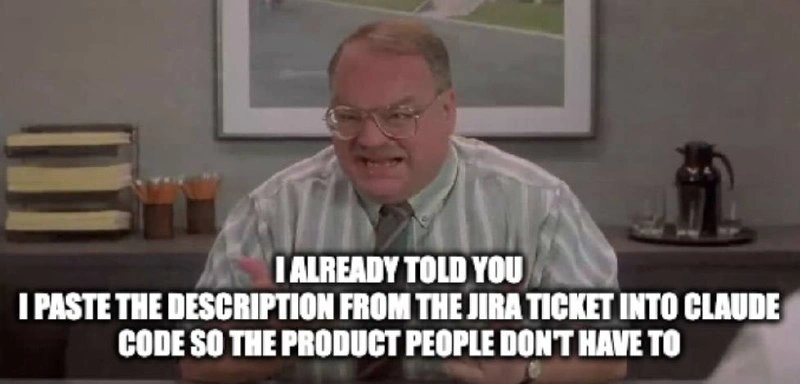
  • Office Space: Mike Judge's cult comedy about soul-crushing office work at a software company. The scene shown — nervous man in glasses gesturing across a table — is his job-justification interview with "the Bobs," two efficiency consultants deciding whom to fire. "What would you say... you do here?" became the canonical question for roles of unclear value.
  • Jira ticket: the unit of work in most software teams. A ticket holds a task's description, priority, and discussion. In theory it's a precise spec; in practice it's often two vague sentences written in a hurry.
  • Claude Code: an AI coding agent — you describe a task in plain language and it reads the codebase, writes the code, runs tests. It's the "software engineer" half of Tom's old sentence, now available as a subscription.
  • Human middleware: tech slang for a person whose job is moving information between systems or groups without transforming it much — copy from tool A, paste into tool B. It's the first kind of work automation eats, which is why claiming it as your defense is the joke.

The early-career takeaway: the durable skill was never typing the code or relaying the ticket — it's the translation layer in your head that turns a mushy request into precise constraints. Develop that, and you're the author of the spec; skip it, and you're the clipboard.

Level 3: What Would You Say You Do Here

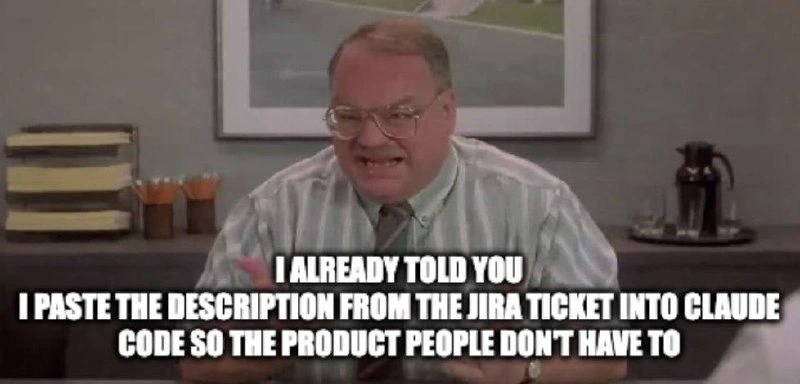
"I ALREADY TOLD YOU — I PASTE THE DESCRIPTION FROM THE JIRA TICKET INTO CLAUDE CODE SO THE PRODUCT PEOPLE DON'T HAVE TO"

The genius of grafting this onto Tom Smykowski is that Office Space (1999) already litigated this exact anxiety, a quarter century early. In the original scene, Tom — sweating in front of the Bobs, the consultants hired to decide who gets laid off — defends his job with the immortal "I take the specifications from the customers and I bring them down to the software engineers... I'm a people person!" His role is pure human middleware: a lossy transport layer between requirements and implementation. The meme performs a one-line sed substitution on his defense: customers → product people, engineers → Claude Code, and suddenly the 1999 satire compiles cleanly against the 2026 toolchain.

What experienced engineers wince at is how uncomfortably load-bearing the joke is. As AI coding agents absorb the implementation layer, a real question emerges about who in the chain still adds entropy-reducing value. The defensive posture — Tom's flailing hands, the "I ALREADY TOLD YOU" exasperation — mirrors the tone of a thousand threads where developers justify their role in an agentic workflow. The dark twist the meme smuggles in: Tom was the go-between who got mocked for not building anything, while the engineers were safe. Now the engineer is the one reciting Tom's speech, because the building part is delegated and what remains is... relaying the Jira ticket. The food chain didn't add a new bottom; it rotated.

Of course, the senior-engineer rebuttal is also baked into why this is funny rather than terrifying: anyone who has actually pasted a raw Jira ticket into an LLM knows that the ticket says "make the export button work like the other one" with no acceptance criteria, three contradictory comments, and a screenshot of the wrong screen. Translating that into something an agent can execute — supplying the missing constraints, catching the requirement that contradicts the data model, knowing which "done" the stakeholder actually means — is the unglamorous judgment work Tom was right about all along. He dealt with the goddamn customers so the engineers didn't have to; the prompt-wrangler deals with the ambiguity so the model doesn't hallucinate it away. Whether management perceives that value before the Bobs arrive is the part nobody's laughing about. And the meme's sharpest barb hides in the final clause: "so the product people don't have to" — implying product could, in principle, paste their own tickets. Tom's firewall has become a convenience.

Description

A meme using the famous Office Space scene where Tom Smykowski (balding man with large glasses, checkered short-sleeve shirt and tie) gestures defensively at the table during his interview with the Bobs consultants; office decor with trays, pencil cups, and a coffee carafe is visible behind him. The Impact-font caption reads: 'I ALREADY TOLD YOU / I PASTE THE DESCRIPTION FROM THE JIRA TICKET INTO CLAUDE CODE SO THE PRODUCT PEOPLE DON'T HAVE TO'. It updates Tom's iconic 'I take the specifications from the customers and bring them to the engineers - I'm a people person!' justification for the AI era: the developer's entire value-add is being middleware between the ticket tracker and an AI coding agent, satirizing role redundancy when LLMs do the implementation
Comments

1
Anonymous ★ Top Pick He's a people person, dammit - he handles the handoff between PRODUCT and the LLM so the engineers don't have to. The engineers, incidentally, are also the LLM
  1. Anonymous ★ Top Pick

    He's a people person, dammit - he handles the handoff between PRODUCT and the LLM so the engineers don't have to. The engineers, incidentally, are also the LLM

Use J and K for navigation