Object-oriented path to riches: the classic inheritance joke for OOP devs
Why is this CS Fundamentals meme funny?
Level 1: Grandpa's Toolbox
Imagine being asked, "What's the easiest way to get rich?" and answering, "Have a rich grandpa." That's the whole joke — except programmers use the exact same word, inheritance, for something in their code: a way for a new piece of a program to instantly receive everything an older piece already had, like a kid inheriting grandpa's entire toolbox without buying a single tool. The humor is that one word means both things perfectly: getting valuable stuff without doing the work. And just like in real life, what you inherit isn't always only treasure — sometimes the toolbox comes with grandpa's rusty hammer you're somehow never allowed to throw away.
Level 2: What Inheritance Actually Does
Object-Oriented Programming (OOP) organizes code into classes — blueprints that bundle data and behavior. Inheritance lets a new class (the child or subclass) automatically receive everything from an existing class (the parent or superclass), then add or override what it needs:
class Parent:
def __init__(self):
self.wealth = 1_000_000
def lecture(self):
return "Back in my day..."
class Child(Parent): # inherits wealth AND the lectures
pass
heir = Child()
print(heir.wealth) # 1000000 — didn't write a thing
print(heir.lecture()) # the liabilities come with the assets
It's one of the four pillars you learn early (with encapsulation, abstraction, and polymorphism), and your first Dog extends Animal exercise feels magical: code reuse for free. The standard rite of passage comes later, on a real codebase, when you trace a bug through five levels of extends to find which ancestor actually defines the method that's misbehaving. That's when a senior first tells you about composition over inheritance — building objects out of smaller parts you plug in, rather than family trees you're born into — and the joke's double meaning fully unlocks: inheritance gives you a lot, whether or not you wanted all of it.
Level 3: Everything the Parent Class Left Behind
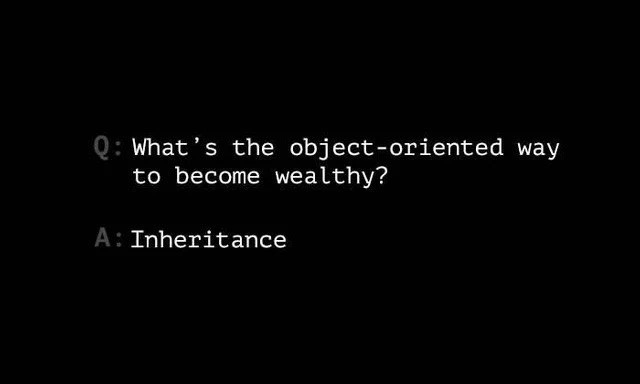
Q: What's the object-oriented way to become wealthy? A: Inheritance
The pun is clean, but the reason it resonates with working engineers is that both meanings of inheritance share the same underlying mechanic: acquiring assets you didn't build, along with liabilities you didn't choose. In OOP, a subclass inherits its parent's methods and fields for free — and also its bugs, its assumptions, its protected internals, and every design decision someone made in 2011. In life, you inherit the estate — and the mortgage, the tax paperwork, and the relatives. Neither form of wealth is earned by writing anything yourself, which is precisely the joke's seductive promise and its trap.
Seasoned developers read this meme through twenty-plus years of accumulated skepticism. The Gang of Four book — the very text that codified OOP design patterns — opens with "favor object composition over class inheritance," and the industry has spent decades relearning why. Deep inheritance hierarchies become fragile base class problems: change the parent, and subclasses you've never heard of break three repos away. The classic failure modes are practically folklore:
- The
AbstractBaseManagerFactorythat exists only so two unrelated classes can share one utility method - The diamond problem in multiple inheritance, which C++ answers with virtual bases, Java answered by banning it, and Python answers with MRO linearization rules nobody can recite under pressure
- Liskov Substitution Principle violations — the square-extends-rectangle textbook trap — where a subclass technically compiles but semantically lies
- Overriding a method, calling
super(), and discovering the parent's method secretly depended on call order
So "the object-oriented way to become wealthy" carries a darker corporate truth too: a developer's actual inherited wealth is usually the legacy codebase — a sprawling class hierarchy bequeathed by departed seniors, where extends was the architectural answer to every question. You become rich in features overnight and spend years paying the estate taxes, which the industry politely calls technical debt. Modern language design quietly agrees: Go shipped without inheritance entirely, Rust chose traits, and even Java's ecosystem drifted toward interfaces and composition. Inheritance, like its monetary cousin, remains the fastest way to get wealthy and the slowest way to find out what it cost.
Description
The meme shows white monospace text on a solid black background, mimicking a terminal or slide. It reads exactly: "Q: What’s the object-oriented way to become wealthy?" followed by a line break and "A: Inheritance". The humor hinges on the dual meaning of “inheritance” in object-oriented programming (code reuse via class hierarchies) and real-world wealth transfer. Visually minimal, the gag appeals to seasoned developers familiar with OOP principles and CS terminology, offering a quick pun that also highlights how jargon overlaps with everyday language
Comments
7Comment deleted
Inheritance feels lucrative - right up until the diamond problem shows up at probate; these days I’d rather compose a trust
The irony is that after 20 years of arguing for composition over inheritance, the only inheritance that actually worked was from my parents
Twenty years of GoF wisdom says prefer composition over inheritance - yet nobody's ever turned down what the parent class left behind
The real irony is that in most OOP languages, you can't actually inherit wealth - just technical debt from your parent classes. Though I suppose if you're working with a legacy codebase, you're inheriting someone else's fortune... of poorly documented spaghetti code and deprecated dependencies
Favor composition over inheritance? Tell that to my rich uncle's will
Prefer composition over inheritance - unless you’re trying to ship generational wealth
Sure, it’s the OOP get‑rich pattern - but the fragile‑base‑class tax and LSP audit mean composition is what actually compounds interest