NVIDIA's product strategy: one step forward, 4GB of VRAM back
Why is this Hardware meme funny?
Level 1: Big Trunk vs Fast Car
Imagine you have an old trusty van that can carry 12 boxes of stuff, and someone offers you a brand-new sports car that can only carry 8 boxes. Sure, the sports car is faster and newer, but if you have 10 boxes of toys to move, that shiny new car suddenly isn’t very useful, right? You’d laugh and say, “No thanks, I’ll stick with my old van – it fits all my things!” In this meme, the old GPU is like that big-trunk van with 12 GB of space for work, and the new GPU is the speedy sports car with only 8 GB of space. It’s funny because usually new things are better, but here the new GPU can’t hold all the “stuff” (game files or AI data) people need. So just like you wouldn’t upgrade to a cooler car that makes you leave your favorite toys behind, tech folks joke that they won’t upgrade to the newer graphics card because their old one has the bigger “trunk” (memory) that fits everything they want to do. The result? The new fancy ride stays parked, and the old reliable one keeps on rolling.
Level 2: Why VRAM Matters
Let’s break down the key terms and why this meme is such a big nod-fest in the tech community. GPU stands for Graphics Processing Unit – it’s a specialized processor for handling graphics and parallel computations. NVIDIA is a leading GPU maker (that bright green NVIDIA logo in the meme is their badge). Each GPU comes with its own onboard memory called VRAM (Video Random Access Memory). Think of VRAM as the GPU’s private workspace or container for data: it holds the images, textures, or numerical data the GPU is crunching. In gaming, VRAM stores things like textures, models, and frame buffers (the images you see). In machine learning, VRAM holds large matrices, neural network parameters, and other data for computations. More VRAM means the GPU can handle larger or more detailed tasks without running out of space.
Now, RTX 3060 12 GB vs RTX 4060 8 GB: these are two generations of NVIDIA’s graphics cards. The RTX 3060 (from the 30-series, “Ampere” generation) has 12 GB of VRAM. The newer RTX 4060 (40-series, “Ada” generation) has 8 GB of VRAM. Normally, when a new generation of GPU comes out, people expect improvements – usually more speed, sometimes more memory, new features, etc. The funny (and frustrating) twist here is that the older card actually has 50% more memory than the presumably superior new card (12 GB vs 8 GB).
Why does that matter? Because if you’re a developer or gamer, that memory can determine what you can run. For example, if you’re doing Machine Learning experiments, using frameworks like Nvidia CUDA with libraries such as PyTorch, having 12 GB instead of 8 GB might let you train a model in one go rather than crashing or having to use a smaller batch of data. If you’re playing or developing a game, 12 GB VRAM might let you use higher-resolution textures or run the game smoother on a 4K monitor, whereas 8 GB could force you to lower the quality to avoid slowdown. Essentially, VRAM is a limiting factor: an application will refuse to load assets or data beyond the VRAM capacity. It’s like a hard cap. So even though the RTX 4060’s GPU chip is more powerful in terms of processing, it’s constrained by having less memory to work with.
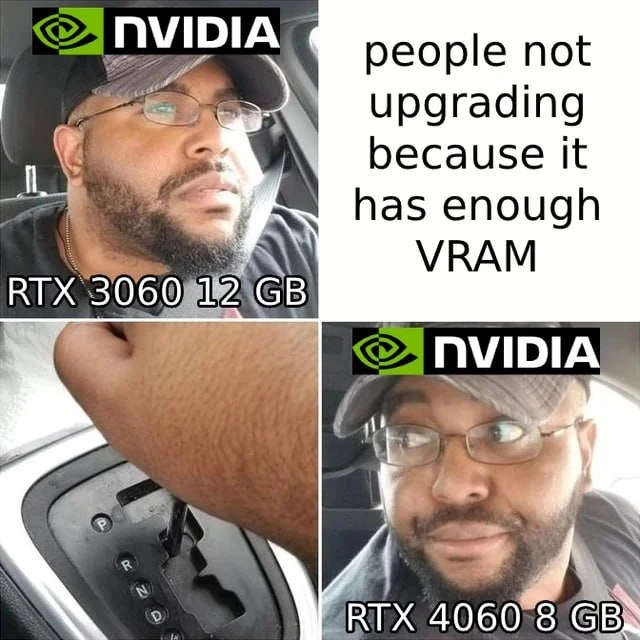
In the meme’s panels, the top-left shows a driver labeled “RTX 3060 12 GB” – this represents the older GPU confidently in control. The top-right text says “people not upgrading because it has enough VRAM”, which is the core joke: folks see the 12 GB as “enough” for their needs, so why bother upgrading? The bottom-left image (the gear shifter stuck in Park) visually conveys refusal to move forward – the 3060 (older card) is literally preventing the shift to Drive, i.e., stopping the upgrade. Finally, the bottom-right shows the passenger labeled “RTX 4060 8 GB” looking a bit defeated – that’s the newer GPU, essentially stuck and unable to go anywhere because the driver (3060 with its big VRAM) has put the brakes on.
To a junior developer or someone new to hardware, here’s the takeaway: more VRAM = handle bigger tasks. The RTX 3060 might be a bit slower in raw performance than the RTX 4060, but if your project (say an AI model or a high-res video render) needs, for example, 10 GB of data in memory, the 8 GB card simply can’t do it without workarounds. The 12 GB card can. So people end up holding onto older hardware that can do the job, rather than newer hardware that technically is faster but fails their specific needs. This is a classic hardware tradeoff scenario. NVIDIA likely gave the 4060 only 8 GB to keep costs down and differentiate it from higher models (the more expensive 4070 cards, for instance, usually have more memory). But many users see that as a poor tradeoff because it limits longevity and capability for certain tasks. Thus, the meme humorously captures a lot of chatter in forums: “I’m not upgrading to a 4060 because my 3060’s 12 GB VRAM is actually more useful!” Everyone who’s struggled with a GPU memory error or had to shut off a fancy effect in a game due to VRAM limits can relate to that sentiment.
Level 3: Generational VRAM Paradox
For seasoned developers and GPU enthusiasts, this meme hits on a performance tradeoff paradox that’s all too familiar: a supposed “upgrade” that feels like a downgrade in a critical spec. The RTX 4060 is newer and packs more raw compute and efficiency improvements, yet its 8 GB VRAM feels like a step back from the RTX 3060’s 12 GB. This GPU upgrade dilemma has caused a stir especially in communities focused on AI/ML and high-end gaming. Why? Because in practical terms, VRAM matters as much as (or sometimes more than) GPU horsepower for many tasks.
Think of a developer training a neural network model or a researcher fiddling with large datasets: they often choose a GPU by how much memory it has. An RTX 3060 with 12 GB became a surprise darling for budget-conscious machine learning folks – it could fit moderately large models, images, or batch sizes that an 8 GB card might choke on. Meanwhile, the shiny new RTX 4060, despite higher CUDA core counts and fancy features (like improved ray tracing and DLSS 3.0 for gaming), can’t even load some of those workloads without running out of memory. The meme’s humor stems from this real-world performance tradeoff: it’s like NVIDIA inadvertently put the brakes on their own upgrade cycle by reducing VRAM. The image of the gear shifter jammed in “Park” perfectly symbolizes enthusiasts refusing to “shift” to the next generation – the RTX 3060 (the driver) is physically stopping the car from going into drive, i.e., stopping users from upgrading to the RTX 4060 (the passenger). In the caption, “people not upgrading because it has enough VRAM,” everyone in the know nods and smiles: hardware value-per-dollar can’t be measured by raw teraflops alone; if the new card doesn’t let you do more than the old one because of memory limits, what’s the point?
This resonates especially due to recent trends. The huge AI hype wave means GPUs aren’t just for gamers pushing frames in Fortnite – they’re now the workhorses for training machine learning models, running GPU-accelerated data science, and even powering hobby projects like Stable Diffusion image generation. In these tasks, having more VRAM is like having a bigger workspace: you can train larger neural nets or process higher resolution images without crashing. Developers who tried running a new model on an 8GB card likely encountered the dreaded OutOfMemory errors in frameworks like PyTorch or TensorFlow. Meanwhile, the trusty 12GB RTX 3060 often manages to execute the same code, albeit slower in raw compute – but working slowly is better than not working at all. That’s a huge trade-off in practice: the newer 4060 might benchmark higher FPS in games or higher FLOPS in theory, but if you’re hitting a VRAM wall, those gains are moot.
Even in gaming and content creation, we’ve seen a VRAM hunger. High-resolution textures, 4K rendering, and complex scenes can easily gobble more than 8 GB. Many gamers remember stuttering or texture pop-in when VRAM maxes out – it’s a performance cliff, not a gentle slope. So an “upgrade” to a card with less memory can actually degrade the experience in such cases. This is why the meme’s HardwareHumor feels so spot-on: it satirizes NVIDIA’s hardware tradeoffs (like choosing a smaller memory pool to cut costs or upsell a pricier model) and the community’s reaction of “No thanks, I’ll stick with what works.” It’s a punchy commentary on generation benchmarking vs real-life needs: sure, the RTX 4060 benchmarks great in controlled tests, but when hardware value per dollar is weighed for specific use cases (like ML workloads, modded games, or future-proofing), that extra 4 GB on the older card can be the deciding factor. In essence, the industry rule “newer is better” hits a hilarious exception here, and every developer or gamer who’s faced a GPU memory error or had to lower texture settings can relate. The shared experience being satirized: the almost absurd feeling of putting the brakes on an upgrade because the spec sheet took a backward step. As one might quip in dev circles, “I’d love to enjoy the 4060’s performance… if only it would fit my workload in memory!”
Level 4: The 128-bit Handcuff
At the lowest level, this meme underscores a GPU architectural trade-off. The older RTX 3060 has a 12 GB VRAM on a wider memory bus (reportedly ~192-bit), whereas the newer RTX 4060 is limited to 8 GB on a narrower 128-bit bus. In GPU design, memory capacity isn’t chosen arbitrarily – it’s constrained by the memory bus width and chip densities. A 192-bit bus, for instance, often pairs with 6 memory channels, enabling odd capacities like 12 GB (6 × 2 GB chips). Conversely, a 128-bit bus (4 channels) naturally leads to 8 GB (4 × 2 GB) unless pricier higher-density chips are used. NVIDIA’s decision to give the RTX 4060 only 8 GB is a textbook case of hardware tradeoffs and product segmentation: a narrower bus reduces cost, power, and PCB complexity, but also handcuffs memory size and bandwidth.
Under the hood, the RTX 40-series (“Ada Lovelace” architecture) tries to compensate for the bus width diet with a buffet of L2 cache and memory compression technology. The RTX 4060 packs a much larger on-chip cache (tens of MB, significantly more than the RTX 3060’s few MB) to minimize expensive trips to VRAM. This cache acts like a high-speed staging area, so in theory an 8 GB card with a big cache can punch above its weight by reusing data efficiently. However, if a working dataset or game assets don’t fit into those 8 GB at all, no amount of cache sorcery can save the day – the GPU will stall waiting for data from system memory or simply refuse to run certain workloads. It’s a classic case of a memory-bound scenario: the compute cores on the 4060 might be faster on paper, but they’re starved for data when VRAM runs out. The meme highlights this bottleneck: new generational performance gains are put on hold by a fundamental memory constraint. It’s almost like Amdahl’s Law applied to GPUs – the overall speedup is limited by the slowest part, and here insufficient memory is acting as the brake. In extreme cases such as large-scale machine learning or high-resolution rendering, an 8 GB limit means the GPU either has to “swap” data via the slow PCIe bus or can’t even load the full problem into VRAM. The mathematical truth is that if the required data > available VRAM, performance = 0 for that task (you simply cannot run it). That stark reality is why those extra 4 GB on the older card aren’t just a spec number – they determine whether certain heavy workloads are feasible at all. This deep technical context explains why NVIDIA’s green-eyed logo in the meme might be looking a bit apprehensive: the hardware humor here has roots in real architectural limits and design choices.
Description
This is a four-panel meme using the 'Car Reversing' format to criticize NVIDIA's product decisions. In the top-left panel, a man wearing a cap with the NVIDIA logo looks forward while driving, with the text 'RTX 3060 12 GB' below him. The top-right panel provides the context: 'people not upgrading because it has enough VRAM'. The bottom-left panel shows a hand shifting an automatic car's gear into reverse. In the final panel, the man, again representing NVIDIA, looks back over his shoulder with a sly smirk, and the text now reads 'RTX 4060 8 GB'. The meme humorously illustrates the community's perception that NVIDIA deliberately released its newer-generation RTX 4060 with less video memory (VRAM) than its predecessor. This is seen as a cynical business move to create an artificial bottleneck, especially for VRAM-heavy tasks like AI/ML model training and high-resolution gaming, thereby encouraging users to buy more expensive cards or upgrade sooner

Comments
35Comment deleted
Upgrading from a 3060 to a 4060 is like refactoring your code and ending up with fewer features and more memory swapping
Convincing a 3060-12 GB owner to “upgrade” to a 4060-8 GB is like mandating a Rust rewrite for performance but capping the heap at 512 MB - looks great in the micro-benchmark, face-plants the moment a transformer wanders in
NVIDIA's product team discovering that developers actually use VRAM for more than just storing their collection of unhandled exceptions and memory leaks - turns out those ML models and 4K textures need actual memory, who knew?
When your 'upgrade' path involves explaining to stakeholders why the newer GPU generation has less memory than the old one, and they ask if you're sure you read the spec sheet correctly. RTX 4060: proof that in GPU land, progress isn't always linear - especially when product segmentation meets the reality of LLM fine-tuning requirements
4060 8GB is the PM’s idea of an upgrade: bigger number, smaller heap - great in the deck, same OOMs in production; I’m keeping the 3060 12GB
NVIDIA's genius: Shrink VRAM to 8GB on 4060 so your fine-tuned Llama finally learns humility via OOM
Calling 8GB an upgrade over a 12GB predecessor is the GPU equivalent of moving to microservices and halving every service’s heap - enjoy torch.cuda.OutOfMemoryError
Actually, the 4060 (8GB) seems to be better than the 3060 (12GB) https://gpu.userbenchmark.com/Compare/Nvidia-RTX-4060-vs-Nvidia-RTX-3060/4150vs4105 Comment deleted
Don't use userbenchmark Comment deleted
Why do you point out to benchmark when the meme is about the VRAM size? A bit better performance not gonna help if you are getting out of fast memory located next to the chip Comment deleted
Because the “extra” memory is valuable, but it’s useless if the performance is not good. In my experience, having more is not always a synonym for better, but having the proper balance is what outstands overall. Comment deleted
With the current gen of consoles the minimum requirement for vram on PC is 12 GB, which comes from the way consoles memory subsystem works. This may partially change with dataset streaming but it's yet to be seen. That's why any new GPU having less than that and not being lowest-end is a waste of sand. It's Nvidia's/AMD/Intel job to design GPU in a way that it can efficiently use such memory buffer Comment deleted
true, as far as you want to play PS5 games on PC through Play Station PC distributor - but if you want to buy a graphics card that is as expensive as a next-gen console, then maybe consider if you can’t just buy the console itself, as it has been created for games and it doesn’t have the performance issues reported on PC Comment deleted
ps5 has no games Comment deleted
Switch has all the games Comment deleted
There’s just too many tasks when 8Gb is just not enough anymore, especially if we are talking about gaming Best reference made in the chat is that video memory size on consoles is what should be used as reference for middle-level renderers and nvidia specing 8Gb model for -60 model is nothing but a dirty game Comment deleted
https://www.youtube.com/watch?v=RQSBj2LKkWg Comment deleted
It's perhaps the worst benchmark out there Comment deleted
You're probably better off reading marketing materials from corporations than this crap Comment deleted
I honoured owner of 3060 12G, and only my next upgrade going to be 4080/4090 in September after (I hope 😭) price drop when "new" ti cards showing Comment deleted
Why not Radeon? Comment deleted
some people are just Nvidia fan-boys (in the same way that you can find a “war” between Intel and AMD followers) Comment deleted
And some have use cases like professional workload or streaming and they require CUDA or part of the drivers suite that Radeon doesn't have Comment deleted
Fuck 4060 Comment deleted
consoles usually are better for gaming; PC wins if you want to mod games - unless you need that GPU for work Comment deleted
Me crying with my 3070 and 8gb ram:/ Comment deleted
you see, it runs a whole GHz faster Comment deleted
Yes especially if clown influencer on YouTube try to compare arm benchmark scores with amd64/x86_64/i64 Comment deleted
muh m1 is fastor intel iz ded letz boy obble silicon for 5k$ Comment deleted
M is still pretty for now it will have the same overblowting broblem and if actually decides to remove hardware features because they become legacy then say welcome to a new locked down shit that wont even support apps that are older than 6 years lmao Comment deleted
apple user spotted the apple symbol is not unicode standardized and only appears on (most) apple products. everyone else sees the "unknown symbol" box Comment deleted
I know don’t worry I set up my keyboard to replace every time I write apple to the logo lmao. Btw 🍎🍏🍏 Comment deleted
🍏 Comment deleted
Is there a ascii apple art? Comment deleted
M1 is not technically ARM (they'd have to pay licensing fees if it was ;P) Comment deleted