Skip to content
DevMeme
276 of 7435
When 40-bit encryption keys were literally considered ammunition by the NSA
Cryptography Post #332, on Apr 24, 2019 in TG

When 40-bit encryption keys were literally considered ammunition by the NSA

Why is this Cryptography meme funny?

Level 1: Butterfly or Bullet?

Imagine someone sees a cute little butterfly and panics, yelling “Ah! It's a bullet!” That mix-up sounds silly, right? That's basically the joke here. A long time ago, the government treated a strong secret code (just a harder way to hide information) as if it were a dangerous weapon. It’s like a teacher insisting that using a super-hard secret code in a note is as bad as bringing a toy gun to class. We laugh at the meme because we all know a butterfly isn’t a bullet – and in the same way, a longer secret code was never actually a real weapon.

Level 2: 40-Bit History Lesson

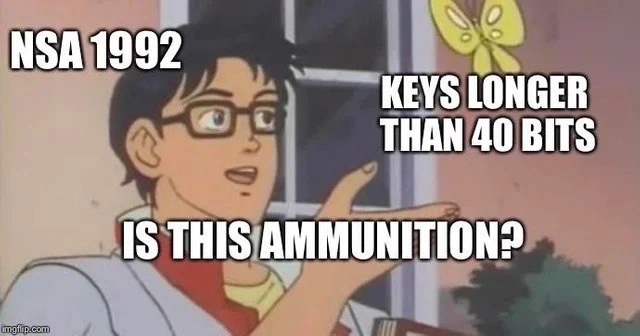
The meme shows the classic “Is this a pigeon?” anime scene. Here, the man (labeled “NSA 1992”) is looking at a butterfly (labeled “Keys longer than 40 bits”) and asking, “Is this ammunition?” It’s referencing a real historical quirk: back in the early 1990s, the U.S. government had export control laws treating strong computer encryption like a weapon. The NSA (National Security Agency) is the part of the U.S. government that deals with codebreaking and communications spying, so they were heavily involved in these rules.

Let’s break it down: encryption means scrambling data with a secret key so that only someone with the right key can unscramble it – kind of like sending a message in a special secret code. The strength of encryption depends on the key size, often measured in bits (binary digits). A “40-bit key” is a pretty short secret number by today’s standards – it’s on the order of a few billion possible combinations. That might sound like a lot, but modern computers can crank through billions of guesses very fast. By contrast, 128-bit keys (common in modern secure systems like AES-128) have unimaginably more possible combinations (on the order of undecillions, which is a 1 followed by 38 zeros!), so they’re effectively impossible to brute-force. In the early ’90s, however, the US government decided that any key longer than 40 bits was too strong to let out of the country without special permission. They literally put encryption software in the same category as weapons and ammunition when it came to export licenses. So a web browser or program with strong encryption features was treated kind of like it was a piece of military hardware! If a company wanted to sell software overseas, they often had to dumb down the encryption to use a 40-bit key. This is why the meme has the NSA guy looking at anything “longer than 40 bits” and calling it ammo – it’s poking fun at that policy from the past.

Today, this seems pretty silly because 40-bit encryption is very weak. It can be cracked easily with modern computing power (even a single PC or a few cloud servers working together can brute-force a 40-bit key in a reasonable time). Using such a short key now would be like locking your door with one of those tiny toy locks – it won’t stop any serious intruder. Modern security standards use 128-bit or 256-bit keys for encryption, which are astronomically stronger. And of course, nobody treats encryption technology as literal weapons anymore. Those old rules were relaxed by the late 1990s when people realized they were outdated and even harmful – after all, the rest of the world could develop strong crypto anyway, and e-commerce needed real security. The humor in the meme comes from knowing this history: the NSA’s stance in 1992 looks as clueless as an anime character confusing a harmless butterfly for something as dangerous as a bullet. It’s a lighthearted way to remember a time when our approach to digital security was, well, a bit backward.

Level 3: When Code Was Ammo

This meme lands because it references a real and absurd chapter in tech history: the time when software encryption was treated like an arms deal. In the early '90s, U.S. crypto export regulations put a hard cap on cryptographic strength – the infamous 40-bit key restriction. Anything above 40 bits was literally considered ammunition under U.S. law, requiring a special export license. So the text "NSA 1992" and "Keys longer than 40 bits" on the anime character and butterfly aren’t random: they point to how the NSA (and the government at large) saw strong encryption as a literal weapon. The meme's punchline "Is this ammunition?" is funny because, yes, back then an algorithm could be deemed munitions in a legal sense. This led to surreal situations: web browsers like Netscape and Internet Explorer had "international" editions with deliberately weakened encryption (40-bit SSL) for overseas users, while Americans could use 128-bit keys. Developers had to juggle two versions of their software – one safe for export (i.e. easy for the NSA to crack) and one with robust security for domestic use. Shipping strong crypto overseas felt like smuggling contraband; Phil Zimmermann, the creator of PGP (Pretty Good Privacy), was even investigated for exporting encryption after his code spread online. In one famous act of protest, programmers printed encryption source code on T-shirts and in books (since free speech protections covered printed material) to mock how absurd it was that code in electronic form was treated as more dangerous than code on paper. The whole saga became known as the “Crypto Wars,” with civil liberties groups, academics, and software companies on one side and agencies like the NSA on the other. The government even tried a backdoor scheme via the Clipper Chip, proposing that all encryption devices escrow a copy of the keys for Uncle Sam – which predictably went down in flames amid public outcry. Seasoned engineers who lived through this era remember the mix of frustration and dark humor: needing to ask permission to use a stronger algorithm felt like something out of a satire. And indeed, the legacy of those days lingered – decades later, vulnerabilities like the TLS “FREAK” attack traced back to leftover support for those 1990s export-grade ciphers. In hindsight, this weak encryption episode is equal parts comedy and cautionary tale. The meme perfectly captures that feeling: a bureaucrat so paranoid about a cryptography butterfly that he calls it a bullet. It’s a nod to an era when adding a few extra bits to a key caused government panic – a reminder of how far off-base policy can be when it tries to police math.

Level 4: Munitions-Grade Math

Encryption strength is measured in bits of key length, and it grows exponentially with each additional bit. In theoretical terms, if no shortcut attacks exist, breaking an $n$-bit key by brute force has to try on the order of $2^n$ possibilities – an exponential complexity problem (roughly O(2^n) operations). That means a 40-bit key yields about $2^{40}$ possible keys (over a trillion), whereas a 128-bit key skyrockets to $2^{128}$ possibilities (an astronomically larger number, roughly $3.4 \times 10^{38}$). The jump from 40 to 128 bits isn't just a linear upgrade – it's like comparing a firecracker to a supernova. Back in the early 1990s, U.S. officials effectively drew a theoretical line in this sand of exponentials. Under that policy, any cryptosystem using keys longer than 40 bits was treated as advanced weaponry, effectively classifying robust cryptography as a munition on par with fighter jets or missiles. It’s a stark illustration of how mathematics collided with geopolitics: an extra few dozen bits of key entropy transformed a string of 1s and 0s from a simple cryptographic algorithm into a regulated munition in the eyes of the law. In fact, strong encryption beyond 40 bits was literally listed alongside bombs and rockets on the U.S. Munitions List. This decision was rooted in a strategic calculus: a 40-bit key was within the reach of exhaustive search by state-sponsored supercomputers of the time, but a 64-bit or 128-bit key would push the problem well beyond feasible cracking into the realm of intractable complexity. By classifying stronger encryption as munitions, agencies like the NSA aimed to cap civilian cryptography at a level they could still theoretically defeat. In essence, they tried to enforce a hard limit on the entropy of secrets – a peculiar arms-control treaty written in bits and bytes.

Description

Accessibility: Classic "Is this a pigeon?" anime frame shows a young man in a white jacket with a red collar, standing outside a window, palm up toward a yellow butterfly. Bold white all-caps overlay text reads, top left: "NSA 1992?"; overlaying the butterfly: "KEYS LONGER THAN 40 BITS"; bottom center: "IS THIS AMMUNITION?" The scene is set against pastel walls and a small shrub in the lower right. Technical context: The meme jokes about early-1990s U.S. export-control rules that classified cryptography with keys longer than 40 bits as munitions, requiring NSA approval, a policy now viewed as absurd given how weak 40-bit encryption is by modern security standards

Comments

7
Anonymous ★ Top Pick We used to need an export license for 41-bit keys; now every microservice casually burns 128 bits just to tag a log line - guess munitions went SaaS
  1. Anonymous ★ Top Pick

    We used to need an export license for 41-bit keys; now every microservice casually burns 128 bits just to tag a log line - guess munitions went SaaS

  2. Anonymous

    The same government that couldn't crack 56-bit DES without a room full of custom hardware somehow convinced us that 40 bits was plenty for everyone else's e-commerce

  3. Anonymous

    The NSA classified strong crypto as ammunition, so naturally developers printed RSA on T-shirts and became walking arms exports

  4. Anonymous

    Back when the NSA thought 40-bit keys were 'strong enough for civilians' and anything longer was basically a nuclear weapon. Meanwhile, modern developers casually throw around 256-bit AES like it's a hello world example. The real ammunition was the friends we encrypted along the way - assuming you had export approval, of course

  5. Anonymous

    Clipper chip era: when 40-bit keys were 'civilian-grade' and anything stronger triggered ITAR as a WMD

  6. Anonymous

    1999: >40‑bit keys were “munitions”; 2025: they’re just the annual pen‑test bingo square on that one legacy appliance nobody admits owning

  7. Anonymous

    We banned strong crypto, shipped ‘EXPORT’ ciphers, and decades later FREAK proved governance bugs outlive key rotation

Use J and K for navigation