The Media and Big Tech NPC Choir on Democracy
Why is this DevCommunities meme funny?
Level 1: Monkey See, Monkey Do
Imagine you’re in a classroom and the teacher asks everyone to write a sentence about why honesty is important. But instead of coming up with their own ideas, every single student writes down the exact same sentence, word for word: “Honesty is the best policy because lying is harmful.” It would look pretty suspicious and a bit silly, right? You’d think, “Did they all just copy from each other or from the same source?” There’s no originality or independent thought – it’s just one idea cloned many times.
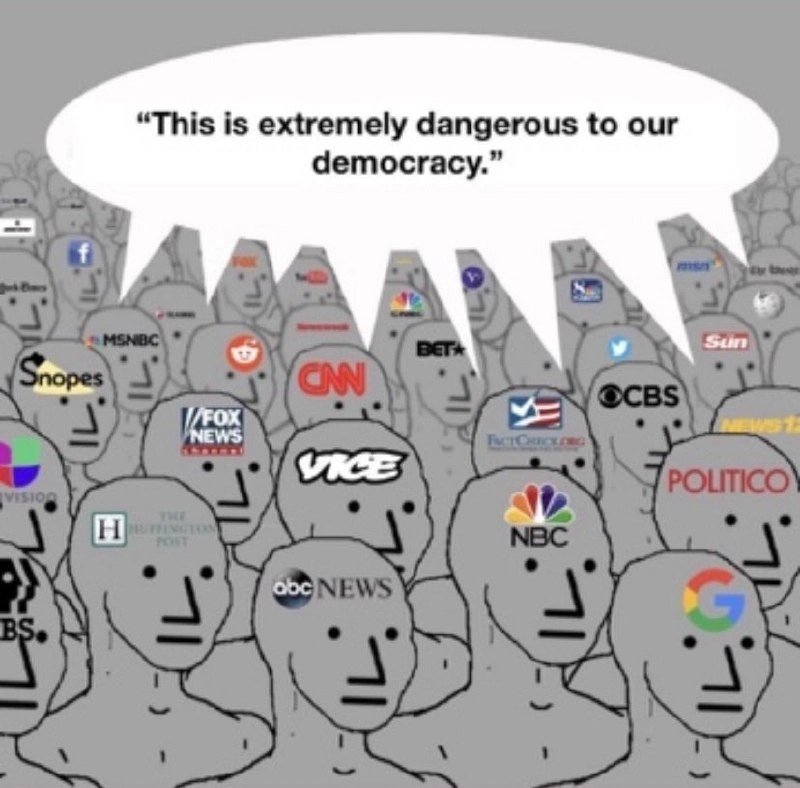
That’s essentially the joke of this meme. It shows a bunch of cartoon people (they’re grey and kind of blank-looking) all saying the exact same line in unison: “This is extremely dangerous to our democracy.” Each of these cartoon characters has a different news logo on their forehead (like one is labeled CNN, another Fox News, another NBC, and so on), which means they’re supposed to represent different TV news channels or media companies. Normally, you’d expect different news channels to say different things or have their own opinions. But here, they are all copying one another, saying the very same words as if they were robots.
Why is that funny or interesting? It’s the absurdity of everyone being a copycat. It’s like a whole room of parrots that have all been taught the same phrase. The first time you hear a parrot mimic a human phrase, it’s funny and cute. But imagine walking into an aviary and every parrot squawks the exact same sentence at the same time – “Polly wants a cracker” over and over in perfect chorus. You’d probably laugh at how strange and comical that is, and maybe feel a little creeped out that they’re so perfectly in sync.
Now, relate this to something in everyday life or simple terms: Have you ever played a game of telephone, or seen how rumors spread in a group? Sometimes one person comes up with something, and then everyone else just repeats it without checking if it’s true or adding their own take. By the end, you have a bunch of people saying the same thing. If that thing turns out to be wrong or bad, it’s a problem that everyone is saying it. In the meme, the phrase they’re all saying has a serious tone (“This is extremely dangerous to our democracy”), so it feels especially odd and a little wrong that no one is varying it or explaining it – they’re just obediently repeating.
For a very simple analogy: think of a troupe of monkeys who see one monkey wash a piece of fruit in water. If all the other monkeys just copy that action exactly without knowing why, they’re doing “monkey see, monkey do.” It might not harm them – maybe washing fruit is good – but if the first monkey was doing something silly or dangerous, all the others would be doing it too blindly. In this meme, all the “monkeys” (the news outlets or, by analogy, developers in a coding scenario) are doing the same thing without showing independent thought.
The feeling this image gives is that copying without thinking can be both funny and scary. It’s funny because of the sheer uniformity – it’s ridiculous to see so many individuals act like one giant echo. And it’s a bit scary because if everyone is just repeating one message, who’s actually thinking for themselves or double-checking the facts? In a less serious sense, if all your friends jumped off a bridge because one friend said it was a good idea, that’d be a big problem of copying-gone-wrong! We usually count on different people to have different ideas so we can compare and find the truth or the best solution.
So, the core of the joke is: “Look, they’re all just copying!” It highlights how silly it looks when no one comes up with their own way of saying or doing something. Whether it’s on the news or in a coding project or even kids in a class, it’s generally better (and safer) when people use their own brains a bit instead of just being copycats. The meme uses a funny picture to remind us of that in a dramatic way.
Level 2: Copy-Paste Brigade
This meme uses a well-known internet character, the NPC (Non-Player Character) Wojak, to represent people (or developers) who just repeat what they’re told. All the grey faces look the same and even have the exact same blank expression. Each one is labeled with a different media company logo – like CNN, Fox News, NBC, Politico, Google and more – but despite those different labels, they’re all saying the exact same sentence in unison: “This is extremely dangerous to our democracy.” The image is pointing out how all these media outlets ended up with identical messaging, as if they simply copy-pasted a script from one master source.
For a junior dev or someone new to programming, the connection might not be obvious until you think of what happens in coding. Copy-paste coding is when a programmer takes code written by someone else (perhaps from an online example or another part of the project) and pastes it into their own code without much modification or understanding. It’s a common habit, especially early on: you need a function to do X, you Google it, find a snippet on Stack Overflow, and you drop it in. Voilà, it works! But if you (and everyone on your team) do this repeatedly, you end up with the same piece of code scattered everywhere. That’s known as having a lot of boilerplate code — basically repeated blocks that are often identical. There’s even an acronym programmers use: DRY, which stands for “Don’t Repeat Yourself.” The meme is highlighting a situation that’s the opposite of DRY: every outlet (or every part of a codebase) repeating the exact same thing.
Let’s break down why that’s an issue. In the meme’s context, media outlets all repeating one line feels eerie — it suggests a lack of independent thought or analysis. In a coding context, if every junior developer just copies the same function or snippet without thinking, it suggests a lack of understanding and creativity. For example, imagine ten different apps all use the same code they found on some blog to handle user login. If that code has a mistake or a security flaw, now all ten apps have that same problem. This is how bugs or vulnerabilities can spread widely: one person’s error becomes everybody’s error because of copy-paste. It’s like everyone in a study group copying the same wrong answer; the mistake multiplies.
The grey NPC figures are a meme way to show people acting like robots or drones. In programming, we sometimes joke about “copy-paste drones” or “cargo cult programming.” Cargo cult programming means using code or patterns blindly, without understanding why, just because others are using it – much like a cargo cult imitates something without grasping its inner workings. A junior dev might see a complex chunk of code in an example and include it as is because “that’s what everyone uses,” even if their project doesn’t need all of it. Over time, entire code bases can fill up with these cargo-culted pieces – lots of code that is copied everywhere, often unnecessary or poorly understood, making the system bloated and fragile.
There’s also a communication facet here, connecting to the tag CommunicationBreakdown. In healthy software development, team members communicate about how to solve problems and come up with the best approach. But if communication breaks down, one dev might just grab whatever Google finds and others will mimic it, rather than discussing “hey, what’s the right way to do this?” Similarly, in an organization (CorporateCulture), if leadership hands down a directive (“use this script” or “use this library”), sometimes everyone will follow blindly, even if it might not be the best choice. The result is uniformity – which can be good for consistency, but dangerous if the directive is flawed.
The meme’s caption explicitly says “like junior devs” to make sure we draw that parallel. It’s saying: look, when every news outlet copies the same script, they’re behaving like inexperienced developers who copy-paste code without their own input. It’s a bit of a roast to both groups. The TechSatire here is that we expect better from both journalists and coders – we expect originality or at least proper understanding. When we see clones instead, it’s both funny and a little alarming.
In practical terms, as a new developer, the lesson behind the humor is to be careful with copy-paste. Reusing code isn't inherently bad – in fact, using shared libraries and common solutions is a cornerstone of development. But blindly duplicating code everywhere (“spamming CTRL+C, CTRL+V”) can lead to a maintenance nightmare. Developers have a saying: write it once, use it many times. That means it’s often better to put common logic in one function or module and call it from multiple places, rather than copy the whole chunk into each place. That way if you need to change it, you change it in one spot. In the world of the meme, that would be like having one central truth that everyone refers to, rather than everyone memorizing a script that might be wrong.
Finally, let’s talk a bit about why this uniformity can feel “extremely dangerous” in either scenario. In news media, if all sources sound the same, the public can’t tell if something is true or just repeated. In code, if all parts of the system have the same weakness, a single exploit or crash can take everything down. Diversity – whether in viewpoints or in code implementations – adds some safety. It’s like not planting an entire farm with just one crop, because if that crop gets a disease, the whole farm suffers. In software, if we try solving problems in slightly different ways (or at least understand the code we copy), we might avoid one failure wrecking the entire system.
So the meme is a communication satire wrapped in a dev joke. It reminds junior devs: don’t be an NPC in your codebase. Think about what you’re copying. And to any viewer, it’s making fun of how silly it looks when every individual just copies the same thing without adding their own thought. It’s saying “Hey, we can do better than a copy-paste brigade,” whether we’re writing news or writing code.
Level 3: Monoculture at Scale
At first glance, this meme sparks a tech satire scenario that seasoned engineers know all too well. It depicts a swarm of identical grey NPC Wojak figures, each stamped with a different media logo (CNN, Fox News, NBC, Google, etc.), all parroting the exact same line: "This is extremely dangerous to our democracy." For a senior developer, this immediately translates to visions of a codebase where every module has the same copy-pasted code — a monolithic script replicated everywhere. In both cases, monoculture has taken over at scale: one script to rule them all, whether it’s a news narrative or a Stack Overflow snippet.
This uniformity is sarcasm aimed at our industry’s copy-paste culture. We’re seeing a parallel between corporate media messaging and corporate coding habits. In media, dozens of supposedly independent outlets ended up reciting an identical script (a real event in 2018, when local news stations were given a central script about “danger to our democracy”). In software teams, we similarly witness one “example” solution being cloned into dozens of projects. The meme’s humor lies in that painful recognition: as developers, we’ve encountered CopyPasteCoding where every service, library, or microservice repeats the same code like a herd of brainless NPCs.
Why is this funny to the battle-scarred coder? Because it’s too real. We know the CommunicationBreakdown that happens when everyone blindly follows a template. In a newsroom, repeating one authorized script erodes genuine discourse – ironically a “danger to democracy.” In a codebase, repeating one borrowed snippet erodes code quality – genuinely a danger to our codebase. If every component uses the same hardcoded logic or secret key or bug, a single flaw becomes an everything flaw. This is the classic hazard of software monoculture: lack of diversity means a single virus or bug can spread like wildfire. Seasoned devs think of events like the widespread OpenSSL Heartbleed vulnerability – one faulty library copied everywhere left countless systems open to attack. We also recall the infamous Apple goto fail; incident, where a duplicated line of code disabled a critical security check. One copy-paste error, repeated, and poof – massive security hole. Indeed, “This is extremely dangerous to our codebase.”
From a CorporateCulture perspective, the meme jabs at how top-down directives create drone-like uniformity. The NPC figures all chanting in unison is like a row of junior devs following an outdated company coding standard without question. A cynical veteran might chuckle (or grimace) remembering times when a VP insisted “everyone use this one script I found,” and suddenly every code repo had the exact same util function – bugs and all. This herd mentality in coding can come from communication breakdown in teams: no one questions the original source, no one communicates alternatives, so the one way becomes the only way. The meme exaggerates it with news logos, but the core is an IndustrySatire of how organizations (media or tech) can end up with creepy uniformity.
Technically, this points to the DRY principle being thrown out the window. Don’t Repeat Yourself is something we preach to avoid maintenance nightmares. But here, repetition rules. It’s like each media outlet is a function copy-pasted from a single template, rather than a single well-maintained function call. Veteran devs see the speech bubble covering all those NPCs and think of a giant comment at the top of dozens of files – identical boilerplate text that nobody dares change. The risk? When you discover a typo or vulnerability in that boilerplate, you’ve got to fix it in 50 places (if you even manage to find them all). Meanwhile, management wonders why a “simple change” takes days – it’s because we built an NPC army of code clones. This meme nails that absurdity.
On a deeper level, there’s a communication aspect: each NPC news anchor believes they’re informing the public, but collectively they’re just echoing one voice. Similarly, in a dev team, each copied code block might seem harmless or even helpful, but collectively they drown out innovation and leave everyone blindly reliant on that initial source. It’s a subtle warning about herd thinking. When everyone marches in lockstep with the same script, be it in news or code, you lose resilience. A diverse set of approaches (or opinions) might be messier, but it avoids single points of failure. The cynical truth: whether it’s editorial independence or robust architecture, monoculture makes systems fragile. The meme’s grim, grey uniformity captures that fragility in a single, striking image.
And let’s admit, the meme is darkly humorous in its exaggeration. Seeing Fox News and CNN – outlets that usually clash – both as identical grey faces saying the same line is absurd. It’s like imagining developers from rival companies accidentally using the exact same bad hack. (It happens – how many codebases share that one StackOverflow regex to validate emails? Spoiler: a lot, and it’s often flawed.) The humor has a bite: it implies that behind the colorful logos or different app names, maybe everyone’s just copying from the same playbook. As a TechSatire, it’s poking fun at our illusions of variety. The experienced engineer in me laughs, then winces, thinking of all the times I’ve seen code duplication or groupthink taken to ridiculous extremes. In short, the meme cleverly compresses a senior-level cautionary tale: Copy-paste culture is the NPC of coding, and it’s extremely dangerous to our (software) democracy.
Description
This meme uses the NPC Wojak comic format to depict a large, uniform crowd of grey, expressionless figures. Each character, representing a non-player character (NPC) from video games, has the logo of a major media outlet, social media platform, or tech company on its forehead. Visible logos include CNN, Fox News, MSNBC, Reddit, Google, Facebook, Twitter, Vice, Politico, and many others. A single, large speech bubble emerges from the crowd, containing the collective statement: 'This is extremely dangerous to our democracy.' The meme satirizes the perceived monolithic response of mainstream media and big tech to events or ideas that challenge their status quo. The use of NPCs implies a lack of independent thought or critical analysis, suggesting these entities are simply repeating a programmed narrative. For a technical audience, especially in late 2022 when this was posted amidst the Twitter takeover controversy, this resonates with discussions about centralized platform control, content moderation policies, and the potential for coordinated narrative-setting across supposedly independent entities

Comments
7Comment deleted
It's the ultimate distributed monolith: dozens of supposedly independent nodes, all failing with the exact same error message
Watching every outlet chant the same line feels like that legacy shared-utils.jar our entire microservice fleet imported - one silent update and both the news cycle and prod go down together
When every platform's recommendation algorithm independently arrives at the same conclusion, you know someone finally solved distributed consensus
When your distributed system achieves perfect consensus but you realize it's because all nodes are running the same buggy implementation - at least Byzantine fault tolerance assumes *some* nodes think independently
Looks like the newsroom cluster implemented Raft: one log entry replicated everywhere - “This is extremely dangerous to our democracy.” Perfect consistency, zero entropy
Media's CAP theorem: full Consistency and Availability in outrage, zero Partition tolerance for dissent
Like a hundred Kubernetes replicas behind one ConfigMap: flip a single string and every node suddenly agrees - strong consistency, questionable independence