Skip to content
DevMeme
5900 of 7435
Whatever happened to the Redstone hackers and home-brew console crackers?
TechHistory Post #6460, on Dec 17, 2024 in TG

Whatever happened to the Redstone hackers and home-brew console crackers?

Why is this TechHistory meme funny?

Level 1: Treehouses vs TikTok

Imagine an older kid or an uncle looking at today’s youngsters and saying: “Back when I was your age, we built giant treehouses in the backyard and took them apart just to see how they worked. Now all you kids do is watch TikTok on your phones!” This meme is the tech version of that feeling. It’s comparing building something yourself to just watching quick videos. The older generation is nostalgically joking that in their time, kids were like little inventors and adventurers – they’d tinker with computers and games in creative ways (like making a toy computer inside another game, or unlocking a game console to play around with it). That was their “treehouse” – a big project that took time and imagination. Today, they feel kids are more into instant fun, like scrolling through short, snappy videos (their version of hanging out on the couch watching cartoons). The meme is funny because it exaggerates this contrast: of course there are creative kids now too, but we often hear grown-ups playfully grumble that “things were better before.” It’s basically saying: In the past, young tech whizzes were building cool crazy stuff for fun; now it seems like they mostly consume content. It’s a lighthearted way to express a bit of sadness and pride – sad that the old tinkering spirit seems less common, proud of the cool things they did “back in the day.” Even if you’re not a tech person, you get the gist: every generation thinks the next one is missing out on the real fun. It’s like saying, “We used to cook our meals from scratch, and you guys just order fast food.” Here, the “cooking from scratch” is those big DIY tech projects, and the “fast food” is the quick videos and corporate apps. The humor and heart of it come from that universal back-in-my-day vibe, which anyone can recognize and chuckle at.

Level 2: Teenage Tech Rebels

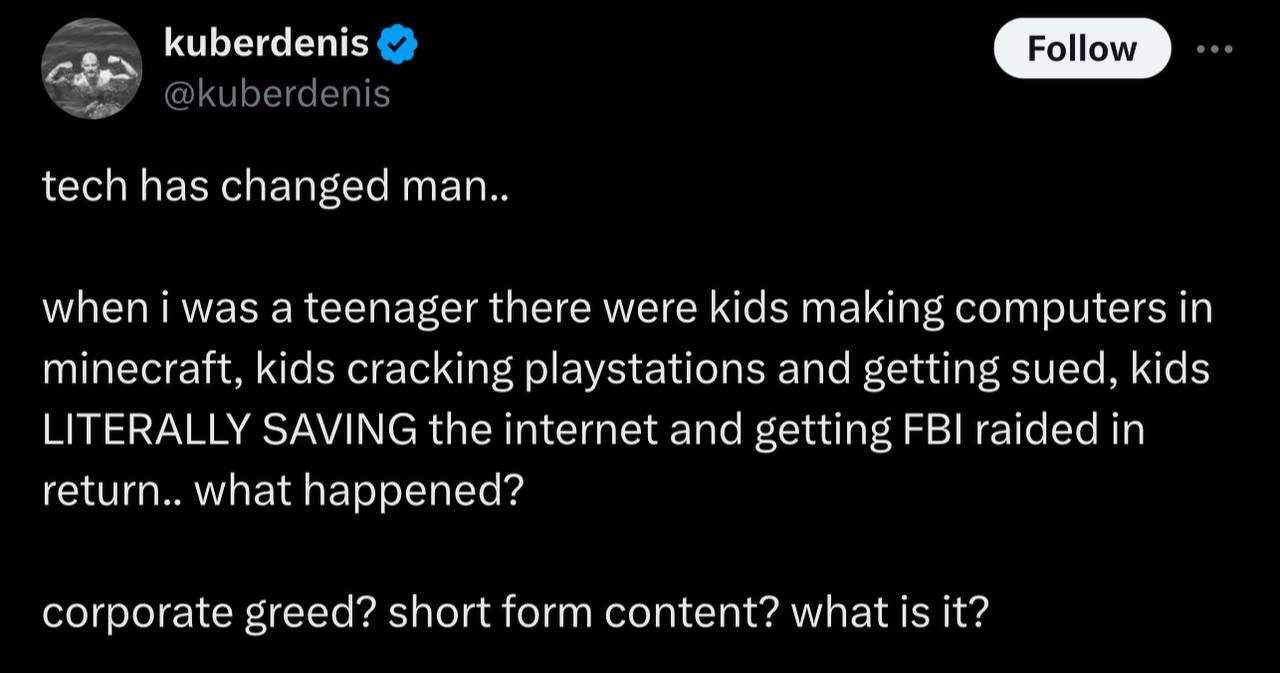
Let’s break down what this meme is talking about and why it resonates. The tweet is basically saying: “Technology culture has changed a lot since I was young. Back then, teenage geeks were doing some crazy cool stuff – like building whole computers inside the game Minecraft, hacking (jailbreaking) their PlayStation consoles, and even heroically protecting the internet (only to get in trouble for it). Where did those days go? Is it because big companies got too controlling, or because social media and short videos changed people’s behavior? What’s the reason?” In simpler terms, it’s expressing DeveloperNostalgia – a longing for the earlier days of HackerCulture – and wondering why things feel different now.

First, Minecraft Redstone computers: In Minecraft (a popular block-building game), there’s an element called Redstone that works like electrical wiring. Players discovered they could use Redstone components (wires, torches, repeaters) to create logic circuits – basically the building blocks of real computers. Yes, this is a thing: kids (and curious adults) have built calculators and simple CPUs inside Minecraft. For example, a teen might arrange Redstone torches to act as tiny on/off switches and connect them in such a way that they perform addition or store memory. It’s like making a Lego version of a computer processor. This requires understanding how a computer adds numbers or processes signals – pretty advanced stuff for a middle or high schooler. When the tweet says “kids making computers in Minecraft,” it’s referencing those ingenious projects. In the early 2010s, videos of these Minecraft machines would go viral in the tech community. It was inspiring: someone so young figuring out how to simulate a functional computer using a game’s mechanics. If you’re new to programming, imagine building a calculator not by writing code, but by literally constructing it piece by piece in a game world – that’s what these teens did for fun. It’s a perfect example of DevCommunities sharing and celebrating technical creativity.

Next up, “kids cracking PlayStations and getting sued.” Here, cracking a console (like a Sony PlayStation) means breaking the device’s protections so it can run unofficial software. Companies usually lock down game consoles so you can’t, say, install your own games or cheats – they only want you to run approved (and often paid) content. But tech-savvy folks always find ways in. Jailbreaking a console involves a lot of technical skill: you might exploit a weakness in the console’s software or hardware to get around its security. For example, a teenager might discover a bug in how the console checks game signatures and use it to run homemade games or even pirated ones. Back when the PlayStation 3 was current (late 2000s), a famous young hacker named GeoHot managed to unlock it. Companies don’t like that at all – it undermines their control and profits – so Sony sued him. The tweet’s mention of kids “getting sued” is about these real incidents where big corporations took teen hackers to court to stop them. For a junior developer today, think of it like this: you find a cool trick to make your iPhone do something Apple normally forbids, and the next thing you know, Apple’s lawyers are sending you notices. It’s scary, right? Those stories were both alarming and legendary in the tech world. They highlighted a clash between HackerCulture (which values openness, modding, “this is my device, I can tinker with it”) and CorporateCulture (which values control, user agreements, and protecting intellectual property). A lot of today’s older programmers look back at those console hacking days with a mix of pride (for the hackers) and frustration (at the corporations).

The tweet also talks about kids “LITERALLY SAVING the internet and getting FBI raided in return.” This is a dramatic way to describe young people who did something that benefited everyone online but still got treated like criminals. One interpretation: it refers to ethical hackers or activitists. For instance, there have been teenagers who found major security holes in widely used software – holes that bad guys could have abused to hurt the internet. By discovering and maybe even patching these holes (or alerting others to fix them), they kind of “saved the internet” from a disaster. But because the methods to discover those holes might involve probing or hacking without permission, law enforcement sometimes stepped in. An FBI raid means agents literally show up at your house, seize your computers, and treat you like a cyber-criminal. Imagine being 16 and seeing that because you tried to help secure something! Another angle is activism: some young tech-savvy folks campaigned against laws or actions that would harm the open internet (like censorship or anti-piracy laws that go too far). They “saved” the internet by rallying people to fight those laws. Yet, some of them faced serious legal consequences for other things (downloading data, etc.), which feels like a betrayal. A famous young activist, Aaron Swartz, fits this description: he helped keep the internet free of certain restrictions, but was later arrested for downloading academic articles en masse (as an act of protest for open access to information). Sadly, his story ended tragically, which deeply affected the developer community. So, in essence, the tweet is reminiscing about these heroic-yet-tragic hacker stories. If you’re newer to tech, these are almost like modern legends – tales of brilliant young people vs. powerful institutions. They’re the kind of stories that might have inspired you or your peers to get into coding or security, because they’re full of drama and purpose.

Now, why does the tweet ask “what happened? corporate greed? short form content?” This is the poster speculating why we don’t hear about such exploits as much anymore. “Corporate greed” is the idea that big tech companies might have squashed that independent hacker spirit. Over the past decade, tech companies have indeed gotten a lot more aggressive in protecting their turf. Devices are harder to open up now (e.g., phones have secure bootloaders that are nearly impossible to hack without expert resources). Companies also use legal threats (like the DMCA, a copyright law) to shut down tinkering – for example, modding a console or even modifying your tractor’s software can technically violate copyright law. The tweet is suggesting that maybe all this corporate control and desire for profit snuffed out the fun. If everything is a locked black box or a subscription service now, how do kids learn by taking things apart? Many older devs feel that things became too consumer-oriented and less hacker-friendly.

The “short form content” part points to a cultural shift: platforms like TikTok, YouTube Shorts, Instagram Reels, etc. Today’s teens (and frankly, all of us) are often glued to these endless feeds of bite-sized videos and content. The meme is half-jokingly blaming this trend for the change in tech hobbies. The idea is, back then a bored teenager might start a coding or hardware project over summer break; now they might just endlessly scroll through memes and 60-second videos or aspire to become a content creator themselves rather than a creator of tech. It’s a bit of an exaggeration – there are still plenty of young programmers out there doing amazing things – but it’s capturing a general feeling. From a junior developer’s perspective, you might have noticed how a lot of content is about quick tutorials, flashy demos, or “making coding fun in 5 minutes,” which can sometimes emphasize quick gratification over deep understanding. The tweet (and folks who agree with it) worry that this environment might produce fewer truly deep-diving hackers. Why painstakingly figure out how to, say, program an Arduino or build a game mod from scratch when you can get quick dopamine from social media or use a ready-made template from the internet? It’s a broad stroke argument, so take it with a grain of salt – but it’s certainly a popular talking point among veteran tech folks.

Let’s put it in relatable terms. Then vs Now, roughly speaking, is what the tweet is humorously comparing:

Early 2010s Hacker Kid (Then) 🕹️ Early 2020s Tech Kid (Now) 📱
Spends months building a complex calculator or even a tiny computer inside Minecraft, block by block, for fun and learning. Spends time watching or making short TikTok videos, maybe quick Minecraft hacks, but often prefers quick entertainment over long projects.
Jailbreaks a PlayStation or phone to run custom apps and games, pushing technical limits (even if it risks bricking the device). Uses devices mostly as-is with official apps; might customize the look or use mods from app stores, but less likely to risk breaking terms-of-service for a hack.
Finds a major security bug on a website/game, tells the world to fix it (maybe via a forum) – a bit of a renegade move. If they find a bug, they might go through a formal bug bounty program or just shrug it off; hacking for the greater good is more organized and permission-based now.
Might get in trouble with companies or even law enforcement as a result of ambitious tinkering (wearing it as a badge of honor in forums). Probably steers clear of anything illegal; more likely to seek recognition through streaming, coding challenges, or startup ideas, rather than hardcore exploit development.

(Of course, these are generalizations – there are exceptions on both sides. But this table shows the stereotype the meme is playing with.)

So, as a junior developer or someone newer to the scene, why is this meme funny or interesting? It’s poking fun at that “back in my day” sentiment that older tech folks have. Picture an experienced programmer reminiscing: “When I was a kid, we were tearing apart gadgets and coding up crazy stuff! Now you kids just watch influencers unbox phones and do TikTok dances.” It’s half joke, half genuine concern. The humor comes from the exaggeration and the recognition. Even if you weren’t around for those earlier exploits, you can understand the dynamic: every generation thinks the next one has it easier or is missing out on something. Here it’s framed in the context of programming and hacking. The tweet captures a moment in TechHistory and contrasts it with today’s IndustryTrends (like content creation and corporate dominance). Many in the dev community find it relatable – maybe you yourself got into coding by messing around with games or devices, and you hope that spirit is still alive in today’s teens. The meme assures you that others are pondering this too, and it gives a light-hearted shrug: has tech culture changed for the worse, or are we just getting old? Either way, it’s a fun reflection on how the DevCommunity has evolved (or maybe devolved, depending who you ask!).

Level 3: From Redstone to Reels

For the seasoned developer, this meme hits with a pang of developer nostalgia. It’s a tongue-in-cheek lament about how hacker culture ain’t what it used to be. The tweet lists off a trio of legendary teen-tech exploits: building computers in Minecraft, jailbreaking PlayStations, and even “saving the internet” only to get raided by the FBI. If you were around the tech communities of the late 2000s and early 2010s, you probably remember these kinds of stories circulating on forums and IRC. Kids making computers in Minecraft was the sort of thing that would blow up on Reddit’s r/gaming and r/redstoneengineering – a 16-year-old wiring up a working calculator or a basic CPU using Minecraft’s Redstone dust and pistons. It was equal parts impressive and endearing: a virtual science fair project that actually demonstrated how real CPUs work (just way slower and cuddlier). We all shared the YouTube videos of those Redstone contraptions, thinking “Dang, this kid basically built a working ALU during summer vacation.” It was a pure display of curiosity-driven learning, the kind that gives experienced devs a warm fuzzy feeling about the next generation.

Then there were kids cracking PlayStations and other consoles – a true rite of passage in hacker folklore. Back in the day, hardware hacking communities were vibrant. Names like GeoHot (George Hotz) became legendary when, as a teenager, he cracked the iPhone and later the PS3’s protections. The tweet references those youths “getting sued” for it – and that actually happened. In 2011, Sony famously took legal action against GeoHot for publishing the PS3 jailbreak. The community rallied behind the kid; it was almost Robin Hood-esque. Here was this lone teenager versus a mega-corporation, with the freedom to tinker on the line. Seasoned engineers remember that saga as more than just tech drama – it symbolized the tension between open tinkering and corporate control. The meme’s author asks “what happened?” because such bold, high-profile hacks by young independents feel rarer now. Many senior devs nod knowingly at this: we’ve seen computing platforms go from hobbyist-friendly (or at least hackable) to heavily locked-down. The rise of DMCA laws and aggressive legal teams means if you try to peek under the hood (to mod a console or explore an iPhone’s internals), you might get a cease-and-desist, or worse. That Wild West period, where a clever exploit could make you a community hero, has largely given way to walled gardens and EULAs that forbid “unauthorized tampering.” It’s not that no one is hacking hardware anymore (modding scenes still exist), but the stakes are higher and the spotlight is dimmer. Often, the really sharp kids are channeled into official bug bounty programs or recruited by companies straight out of high school – the rebellious free-for-all ethos has been co-opted into structured, corporate-sanctioned activities.

And what about “kids LITERALLY SAVING the internet” and getting raided? This line resonates with anyone who recalls the era of idealistic hacktivism. Think about the battles over net neutrality and internet freedom circa 2010-2012. Many young developers and activists (some barely out of their teens) were at the forefront of stopping bad laws and security threats. The tweet likely hints at people like Aaron Swartz – a young programmer who helped stop SOPA (a draconian anti-piracy bill) which, had it passed, could have fundamentally changed the internet. He was hailed as a hero in the tech community for safeguarding the free and open web – but shortly after, he was aggressively prosecuted by authorities for an unrelated act of civil disobedience (downloading academic articles). Or it brings to mind the image of a teenage security researcher who finds a huge bug in a major system, responsibly reports it to fix a gaping hole in the internet’s infrastructure, and then one morning finds the FBI knocking, because somewhere in the fine print of the law, what they did wasn’t exactly legal. Seasoned devs have seen this pattern enough times to sigh. The industry trends here are clear: once upon a time, being a whiz-kid hacker could make you a folk hero, but now it often lands you in a tangle of legal trouble or moral dilemmas. Organizations today are quicker to litigate than to celebrate an unsanctioned savior.

So why the shift? The meme rhetorically asks: “Corporate greed? short form content? what is it?” This is basically throwing darts at two big culprits in the eyes of old-school techies. Corporate greed captures the idea that as tech became the world’s most profitable industry, big companies tightened their grip on everything. There’s less tolerance for the rogue genius in a garage, because he might disrupt a revenue stream or reveal an embarrassing security flaw. Companies lock down ecosystems (closed app stores, encrypted bootloaders) precisely to prevent the kind of jailbreaking that those kids used to do. The bottom line: free-wheeling innovation doesn’t always align with quarterly profit goals. Why let some 15-year-old mod the device you sold him to run homemade games, when you can force him to buy your official ones? Why applaud a teen for finding a vulnerability in your system, when you can quietly patch it and perhaps make an example of them to dissuade others? That’s the CorporateCulture cynicism the tweet is poking at.

Then there’s the short form content phenomenon – essentially pointing a finger at the TikTok-ification of youth attention. This is the “kids these days have no attention span” trope, updated for the 2020s. Veteran developers remember spending months on a project (like painstakingly wiring a Minecraft contraption or reading console memory dumps for clues to a vulnerability). But now, the stereotype is that young folks prefer quick hits of dopamine from 15-second videos and trendy social media challenges. Instead of toiling away on an ambitious long-term hack, the next generation might be more interested in becoming a YouTube influencer or making the next viral meme. It’s a generalization – obviously, there are still many brilliant young programmers and hackers out there – but it’s a feeling many older devs share when they see the content landscape today. It used to be tutorial blogs and forum write-ups; now it’s TikTok coding tips and flashy Instagram demos. The tweet humorously suggests that maybe this shift to short_form_content and “influencer culture” has dampened the appetite for deep, not-immediately-rewarding projects. Hard to spend weeks debugging a Redstone CPU when your phone is buzzing with a hundred new entertainment clips, right? It’s a bit of a “get off my lawn” moment for sure, but one grounded in genuine observation of changing DevCommunities and habits.

In essence, this meme is funny (and a bit poignant) to experienced devs because it rings true about the TechHistory they lived through. It contrasts two eras: one where youthful exuberance in tech meant hacking for the joy of it, pushing boundaries and occasionally sticking it to The Man – versus today, where things feel more sanitized, monetized, and bite-sized. We chuckle because the tweet exaggerates for effect (“LITERALLY SAVING the internet”), yet we all recall actual incidents that fit that bill. It’s a shared wink among folks who’ve been in the trenches long enough to remember the “wild west” days of the web and computing. At the same time, it’s a self-aware nod that we’ve become the old farts grumbling about “kids these days.” The phrase “tech has changed, man…” could have easily been uttered by a grizzled sysadmin at a Meetup, shaking their head at how things are locked down and commercialized now. The meme packs in TechHumor and wistfulness: we’re amused at how true it is, and a little saddened too. The next generation of teen hackers might be less visible or diverted by different priorities, and that reflects broader IndustryTrends. Ultimately, we recognize in this tweet a commentary on how our tech community’s soul has shifted – from open hacking and community-driven innovation to corporate-driven platforms and content feeds. It’s funny, it’s rueful, and it makes for a perfect “you had to be there” punchline for those of us who were.

Level 4: Turing-Complete Sandbox

At the deepest technical level, this meme evokes a bygone era of unbridled hacker ingenuity – a time when teenagers were effectively doing grad-level projects out of sheer curiosity. Consider the Minecraft Redstone computer: Minecraft’s Redstone system is essentially a digital circuit simulator. It’s Turing-complete, meaning given enough in-game torches, dust, and repeaters, you can construct any computation (yes, even a working CPU) inside the game. Teenagers literally built ALUs and 8-bit adders in a virtual sandbox. This isn’t trivial toy work – it mirrors real-world computer architecture. They had to understand logic gates (AND, OR, NOT), binary arithmetic, and timing issues (Redstone signals have propagation delay, much like real circuit latency). In academic terms, they were creating a rudimentary Von Neumann architecture within a game environment. It’s as if a CS professor’s boolean logic lecture sprung to life on screen: flip a Redstone torch (an inverter), send a pulse through repeaters (delay lines), and you can add two numbers in binary. The glorious absurdity of it? A middle-schooler could claim they built a functioning computer from scratch, albeit one made of virtual blocks and glowy dust. This showcases the theoretical concept of computational universality in an accessible medium – a video game turned computing sandbox. It’s a beautiful union of play and Computer Science 101: building a binary adder in Minecraft teaches the same principles as wiring up a real breadboard, just at 1 FPS and with more zombies lurking about.

Meanwhile, other tech-savvy youths were cracking open devices that billion-dollar companies insisted were unbreakable. Take the PlayStation jailbreak saga: consoles like the PS3 employed sophisticated cryptography and hardware locks to prevent unauthorized code. But a determined kid (or a small group of them) could unravel those secrets. The infamous PS3 crack around 2010 exploited a subtle math flaw in Sony’s implementation of ECDSA (Elliptic Curve Digital Signature Algorithm). In essence, Sony’s engineers reused a cryptographic nonce when signing firmware updates – a big no-no. To a layperson, that’s like using the same secret “random” key twice, which let clever hackers solve for the console’s master key as if they were cracking a Sudoku. Mathematically, once the same random number k is used in two ECDSA signatures, the equations can be manipulated to reveal the private key. It’s high-end number theory and algebra at play, the kind you’d find in a cryptography research paper – except a teenager with enough brains and boredom pulled it off in their bedroom. On the hardware side, these home-brew console crackers also poked at memory buses, buffer overflows, and glitching attacks to get past the PS3’s hypervisor and execute custom code. Essentially, they treated a closed system like an open textbook, reverse-engineering the console’s innards. The technical depth here is hardcore: they navigated encryption schemes, kernel exploit development, and hardware interfacing. This is the kind of work that would fit right into a DEF CON talk or an academic thesis on system security – yet it was being done by self-taught kids fueled by curiosity and perhaps a dash of mischief.

And then there were the teenage idealists “literally saving the internet.” This part reads almost mythically, but it has real parallels in tech history. Think of young hackers who discovered critical zero-day vulnerabilities in widely used software or protocols and responsibly disclosed them to prevent catastrophe – effectively saving the internet from major disruptions. Or recall activists in their early 20s who fought against internet censorship and won, only to face legal repercussions. A notable example: Aaron Swartz, who in his mid-20s helped defeat SOPA/PIPA (proposed laws that threatened online freedom) – a victory often described as “saving the internet.” Yet he was later raided by the FBI and charged (in his case, for an unrelated act of downloading academic journals in bulk). Or consider Marcus Hutchins, the 22-year-old who halted the WannaCry malware outbreak (buying the world crucial time by triggering a kill-switch domain) – celebrated as a hero one moment, then arrested by the FBI the next for past hacking activities. These stories highlight a stark dichotomy: youthful geniuses using tech skills for the public good, versus the heavy hand of law enforcement and corporate lawyers coming down on them. It’s like a real-life enactment of the proverb “no good deed goes unpunished.” Underneath this lies complex tensions between cybersecurity ethics and an evolving legal framework that hasn’t caught up with the nuanced motives of hacker culture. The FBI isn’t exactly known for understanding teenage curiosity – a port scan from a basement can look like an act of cyberwar to an uninformed authority. So we see a clash of worlds: the open ethos of early internet hackers vs. the closed, monetized, and securitized world that technology has become.

In summary, the tweet nostalgically references a Technological Cambrian Explosion of the early 2000s-2010s, when computing knowledge was democratized enough that unsupervised kids could perform feats worthy of PhD accolades. These teens were exploring the boundaries of what their devices (or games) could do – plumbing the depths of operating systems, cryptographic algorithms, and digital logic design. The meme laments that such grassroots innovation and rebellious exploration have since been muzzled or at least become rare. It subtly points to foundational shifts: from open tinkering to walled gardens, from a TechHistory of hobbyist breakthroughs to an era of polished corporate ecosystems. On a theoretical level, it’s hinting at how incentive structures and legal frameworks influence technological progress. When the underlying math and the hardware allow something (be it Minecraft’s logic or a console’s flawed encryption), but CorporateCulture or law discourages it, the result is a cultural about-face. The tweet asks “what happened?” – the answer lies partly in the physics and math enabling those old exploits, and partly in the economics and law that now stifle them. In other words, the conditions that allowed a quirky Redstone computer or a console crack to flourish were both technical (Turing-complete games, cryptographic mistakes) and social (a vibrant, permissionless hacker culture). Remove or change those conditions, and that golden age of teenage tech rebellion naturally wanes. This highest-level view reveals an interplay of technology, theory, and society: a reminder that behind every fun hacker story, there’s deep science – and behind its disappearance, there are deeper systemic shifts.

Description

Image is a dark-mode screenshot of a tweet from user “kuberdenis” (blue-check account, circular avatar of a person swimming) that reads: “tech has changed man.. when i was a teenager there were kids making computers in minecraft, kids cracking playstations and getting sued, kids LITERALLY SAVING the internet and getting FBI raided in return.. what happened? corporate greed? short form content? what is it?”. White text sits on a solid black background in typical Twitter UI, with the ‘Follow’ button visible top right. The tweet nostalgically contrasts early-2010s hacker culture (Minecraft redstone CPUs, PlayStation jailbreaks, heroic teenage bug-hunters) with today’s perceived focus on monetization and fleeting short-form content. For seasoned engineers, it evokes the shift from grassroots tinkering and curiosity-driven exploits to a landscape dominated by corporate platforms, legal landmines, and viral attention economics
Comments

26
Anonymous ★ Top Pick We went from teens reverse-engineering PS3 bootloaders to influencers reverse-engineering the algorithm - turns out the latter has far fewer opcodes and way more sponsorship slots
  1. Anonymous ★ Top Pick

    We went from teens reverse-engineering PS3 bootloaders to influencers reverse-engineering the algorithm - turns out the latter has far fewer opcodes and way more sponsorship slots

  2. Anonymous

    The same kids who built functioning CPUs in Minecraft are now arguing about whether to use tabs or spaces in JIRA tickets while their manager asks them to add more story points to the sprint because 'velocity looks low this quarter.'

  3. Anonymous

    Remember when 'moving fast and breaking things' meant a teenager reverse-engineering Sony's hypervisor at 3 AM, not a PM prioritizing which A/B test to ship? Now the most rebellious thing a kid can do is choose Vim over VSCode - and even that gets them a LinkedIn post about 'developer productivity optimization.'

  4. Anonymous

    We went from root‑or‑bust to please‑like‑and‑subscribe; the only exploit with product‑market fit now is the dopamine scheduler optimizing CPM

  5. Anonymous

    Kids once earned FBI raids for red-teaming the net; now the real hack is dodging Jira tickets to ship a hotfix

  6. Anonymous

    We traded redstone ALUs and PS3 hypervisor bugs for OKRs on average watch time - turns out root access lost to reach metrics

  7. @phobosperi 1y

    can somebody explain why bro angry

  8. @M4lenov 1y

    is this ironic post? because he answers the question in the question

  9. @ickep 1y

    минусы?

    1. dev_meme 1y

      Please, refrain from usage of any language besides English

      1. @ickep 1y

        minuses?

        1. @hur7m3 1y

          -?

  10. @lilfluffyears 1y

    Whats the saving internet and getting raided story?

    1. @SamsonovAnton 1y

      1. Somebody leaks classified documents to the internets (anonymously). 2. You download the internets. 3. FBI comes to your house and finds tons of classified documents in your computer. 4. You are sentenced for the rest of your life.* 5. PROFIT! (FBI is rewarded.) * Unless you happen to be the president or at least a candidate.

      1. @callofvoid0 1y

        was that leaked data a trap?

      2. @callofvoid0 1y

        cause how would feds know and knock your door

        1. @TheFloofyFloof 1y

          ISP tracking downloads You used a torrent You used tor (many exit nodes are monitored) You tried to be secure and used a VPN (monitored through claims to be no logs) Site was a trap

        2. @SamsonovAnton 1y

          They cannot trace the source of the leak, but can trace you accessing the site under their monitoring.

          1. @callofvoid0 1y

            couldn't they trace the leaker accessing site?

            1. @SamsonovAnton 1y

              The leaker is supposed to take good privacy protection measures, unlike a casual user who is just "downloading the internets", that is doing bulk crawling without any sentient approach.

      3. @hur7m3 1y

        >put classified internets on the internets >get scraped by everyone, including china/russia/north korea >raid a random fucktard >profit

        1. @TheFloofyFloof 1y

          War thunder forums be like

  11. @Bitals 1y

    Kids these days are maintaining the Unity DE.

    1. @Araalith 1y

      Ah, that's why...

  12. アレックス 1y

    https://youtube.com/watch?v=DcYLT37ImBY

  13. アレックス 1y

    Made by a 14 year old

Use J and K for navigation