Pick Your Party: From VIM Barbarian to TCP-Tracing Druid, Dev Edition
Why is this DeveloperExperience DX meme funny?
Level 1: A Silly Group of Friends
Imagine you have five friends who are very different but all have to work together on a project – it’s a bit like a funny adventure! One friend is like a stubborn old craftsman who only wants to use grandpa’s old tools and ways (he refuses to use new gadgets and types everything by hand – that’s our Barbarian). Another friend is a sneaky kid who always finds shortcuts: sometimes he cheats or lets others do his homework and he’s even used pirated (stolen) video games – that’s the Rogue. Then there’s the genius friend who seems to know everything – they build awesome things really fast, like magic, but when something breaks it takes three other kids to figure out what he did (that’s the Wizard). Next, you have a friend who is super precise and careful – they follow every rule from the teacher’s book, double-check every detail, and won’t finish the project until they’ve tested every little thing; they might take a long time, but their work is always spotless (that’s the Cleric). Finally, there’s the quiet friend who runs the whole clubhouse – they set up the computers, fix the Wi-Fi, and even enjoy looking at the internet’s secret network data for fun. This friend has a quirky side too: after homework is done, they want to play pretend as their favorite animal character and they’d love you to call them by that character’s name (that’s the Druid). Now picture all five friends trying to do a big group task together, like cleaning up a park or putting on a school play. Each one has their own special strength and an odd habit, and they sometimes clash or joke about each other. It’s funny because they’re as different as can be – like heroes in a fairy tale team – but in the end, they all bring something important to the team. The meme is laughing about how in real-life coding teams, people can be just like this: a mix of smart, silly, old-fashioned, sneaky, picky, and mystical folks all on one adventure to make software together. And just like a cartoon or story, their differences make the journey challenging but also really fun.
Level 2: Party Roster Breakdown
Let’s break down each developer class from the meme and explain the terminology and jokes in simpler terms. This will connect the fantasy dnd_class_metaphor to real-world developer behaviors and tools. Imagine these as five types of developers you might meet, each with unique skills and quirks:
Barbarian – This represents a legacy_language_fanatic, someone who loves older programming languages and tools. Programming languages written before 1990 include classics like C (first released in the 1970s), COBOL (from 1959, used in old banks), or Fortran (from the 1950s, used in science). The Barbarian trusts these because they’re battle-tested over decades. They can recite man pages from memory – man pages are the manual pages on Unix/Linux systems that document commands and functions. Most of us type
man <command>to read them, but this person has used them so often that they know the content by heart! They likely grew up before the web had all the answers, so they RTFM (“read the friendly manual”) extensively. The Barbarian only uses VIM, which is a very powerful old-school text editor that you operate entirely with the keyboard (no mouse needed). VIM is famous for having different modes (insert mode, command mode) and keyboard shortcuts for everything. For a Barbarian, removing hands from the keyboard is considered failure – that humorously means if they ever have to touch the mouse or leave the terminal, they feel they’re doing something inefficiently. Early-career developers might find this intimidating: if you’ve ever seen a senior dev coding at lightning speed in a dark terminal, jumping between files without a mouse, that’s the Barbarian vibe. Key terms defined: VIM is an editor favored for its speed once mastered; man pages are basically the offline help files for Unix; and using only languages from before 1990 implies sticking to tried-and-true tech, avoiding newer languages like JavaScript (1995) or Python (1991, just after 1990) out of preference or distrust.Rogue – This one represents an ethically flexible or highly resourceful developer. They spend their day trying to find compromised servers for crypto mining. A compromised server is a computer server that has been broken into by hackers. Often, hackers will install crypto mining programs on victims’ servers – crypto mining means using computing power to generate cryptocurrency (like Bitcoin), which can make money, but doing it on someone else’s server is basically stealing resources. So if a dev is searching for such servers, they might be either trying to prevent misuse in their own company’s systems or, as the joke implies, looking to exploit them. The Rogue also outsources their work to low-income contractors. To outsource in this context means they secretly pay someone else (often in another country with lower wages) to do the tasks they were assigned. This actually happened in real life – a developer once hired a foreign firm to do his entire job while he relaxed! It’s not standard or ethical to do without permission, but it’s the kind of cunning trick a “rogue” character might pull. Additionally, the Rogue has never paid for a software license. Software often requires a license, which is basically paying for a legal copy. If they never paid, it means they use pirated or cracked software – essentially stealing software rather than buying it. This hints at a person who cuts costs (and corners) wherever possible. Key concepts: crypto mining on compromised servers refers to unauthorized use of others’ computers to mine cryptocurrency; outsourcing work means paying someone else to do your programming tasks (which junior devs usually can’t imagine doing without getting fired, but a rogue tries anyway); and software license means a paid right to use software – skipping that implies piracy. Overall, the Rogue is depicted as a sneaky developer who bends rules to get ahead, something a new developer might recognize as the “hacker” or “rule-breaker” type in the office.
Wizard – The wizard is a metaphor for the ultra-experienced, library_wizardry master – the one who knows every library and framework. In programming, a library is a reusable collection of code someone else wrote (for example, a library for drawing graphs so you don’t have to code it from scratch), and a framework is a broader structure or platform to build applications on (like React for web front-ends or Django for web back-ends). A wizard knowing all of them means they’re extremely knowledgeable about many tools and technologies. They deliver new features daily using advanced methods. “Advanced methods” might include complex algorithms, design patterns, or cutting-edge techniques (maybe they use machine learning, or write multi-threaded code, or do fancy stuff with cloud architecture) – things that seem advanced to others. Shipping new features daily means they code very fast – possibly a nod to the idea of a “10x developer” who is super productive. However, their code requires at least 3 developers to debug. To debug means to find and fix bugs (errors or issues) in code. If it takes three people to debug one wizard’s code, that suggests the code is really complicated or hard to understand. Perhaps the wizard wrote very abstract or clever code (sometimes called “clever hacks” or one-liners) that other programmers struggle to follow. For a junior developer, encountering a wizard’s code might be overwhelming – you step through the code with a team, scratching your heads because it’s doing 10 things in one line using features of the language you didn’t even know existed. The wizard archetype stands for the “genius” programmer – amazing and inspiring, but also a bit scary to work with because their work isn’t easily picked up by others. Key terms: library/framework are pre-written code tools; feature is a piece of new functionality in an app; debugging is the process of troubleshooting code issues. The humor here is a gentle warning: just because something’s coded in a very advanced way doesn’t mean it’s easy for the team to maintain!
Cleric – The cleric is the clean_code_evangelist, basically the priest of best practices. They speak in references to Clean Code and Design Patterns. "Clean Code" is a famous book (by Robert C. Martin, a.k.a. “Uncle Bob”) that many developers treat like a bible for writing readable, maintainable code. It preaches things like clear naming, small functions, and not repeating yourself. Design Patterns refer to classic solutions to common software design problems, from a well-known book titled "Design Patterns: Elements of Reusable Object-Oriented Software" (often just called the “Gang of Four” book). If someone constantly references patterns, they might say things like “We should use a Strategy Pattern here” or “This smells like a Factory Pattern issue” – essentially quoting known solutions and principles instead of just casually talking about code. The cleric has never written a line of production code without a test. Production code is code that runs in the live application users interact with. Writing a test for every code change indicates Test-Driven Development (TDD) or at least a very test-heavy workflow: before adding any new feature or fix, they write an automated test (like a small program) to check the code, and only then implement the code to make the test pass. This means they have a lot of unit tests (small tests for individual parts of the code) and other kinds of tests. As a result, the cleric takes months to deliver a feature, but the edge cases are covered. An edge case is a problem or situation that occurs only at an extreme (edge) operating parameter. For example, if most users will input a name that’s a few letters, an edge case is someone inputting a 1000-letter name, or using emoji in their name – unusual scenarios. Covering edge cases means the cleric’s code handles even those rare situations correctly without crashing or bugs. It’s obviously good to cover edge cases, but if you spend months on every feature to do so, you’re moving slowly. For a junior dev, the cleric might sound like that very careful mentor who insists you write tests for everything and follow every rule in the style guide – it can feel strict, but it leads to high-quality code. Terms explained: Clean Code is essentially a philosophy of writing simple, clear programs; Design Patterns are like reusable templates for solving common design problems (e.g., Singleton, Observer, Factory are pattern names); tests (unit tests, integration tests) are scripts to automatically check that code works as expected; edge cases are those strange, uncommon inputs or situations that can break code if not accounted for. The cleric is all about software discipline – a bit like the rule-abiding good guy in a story who insists on doing things “the right way.”
Druid – The druid represents the all-in-one infra_druid or DevOps engineer – the person in charge of infrastructure. Infrastructure (infra) means all the hardware, servers, networks, cloud services, and foundational tech that applications run on. This druid manages infra for the entire org, implying they take care of deployments, servers, databases, networking – basically everything behind the scenes that keeps the software operational, often a huge responsibility. They read TCP traces all day for fun. TCP stands for Transmission Control Protocol, which is a core part of how data is sent on the Internet reliably. Reading TCP traces means looking at detailed logs or captures of network traffic (like the packets of data going back and forth between computers) to diagnose problems. Tools like
tcpdumpor Wireshark let you inspect these packets. Doing this “for fun” means the druid actually enjoys delving into low-level network data, which most developers find very challenging or tedious. It’s a sign of an extremely technically skilled (and curious) ops engineer who likes solving network mysteries – for example, figuring out why a service is slow by looking at the handshake packets of a TCP connection. Finally, this druid insists to be addressed by their fursona after hours. A fursona is kind of a fursona_alias: it’s an alter-ego or character (often an anthropomorphic animal) that someone in the furry community identifies with. Saying the druid wants to be called by their fursona (for example, “WolfShadow” or “CaptainFox”) after work hours suggests that this person participates in that community and casually wants colleagues to use their preferred fun identity in informal settings. For many, that’s a quirky or unexpected detail – mixing professional life with a very informal, personal hobby. But tech culture can be very accepting of quirks; it’s not unheard of to have coworkers with unique nicknames or hobby personas. For a junior dev new to a company, meeting the “druid” might mean meeting the SRE who knows everything about the system’s plumbing and also noticing that their desk is covered in custom plush animals or that they have a habit of saying “goodnight” in the team chat with a furry avatar icon. Key terms: infra (infrastructure) refers to the backend systems and hardware; TCP trace is a recording of network communication that can be studied to troubleshoot; and fursona is a personal fictional animal identity – not a tech term, but it tells you this person is a bit unconventional in social style.
In summary, each "class" in this meme corresponds to a familiar DeveloperArchetypes trope. For someone just starting out in tech, you can think of it like this: Teams often have diverse personalities. There’s the old-school guru who knows ancient systems (Barbarian), the sneaky hacker type who finds shortcuts (Rogue), the super programmer who writes complex code (Wizard), the strict quality specialist who enforces best practices (Cleric), and the behind-the-scenes expert who keeps everything running (Druid). The meme uses pixel_art_characters and fantasy terms to exaggerate these roles for comic effect. It’s relatable because even in your early experiences – maybe in a college project or first internship – you might spot traces of these behaviors. Perhaps you’ve met a senior engineer who lives in the terminal and scoffs at your modern IDE (that’s a bit of Barbarian). Or a colleague who always has a quick hack or script for everything, maybe skirting official procedure (a touch of Rogue). Or have you seen code so sophisticated you needed help to understand it (you encountered Wizardry). That one team lead who insists on thorough testing and proper design? Very Cleric-like. And the IT or DevOps person who knows exactly why the server went down at 2 AM and has some unique personal style – there’s your Druid. By using an RPG party analogy, the meme communicates that successful teams, like questing parties, often have a mix of roles and personalities – and it celebrates and teases those extremes in a fun, TechHumor way.
Level 3: Dungeons & Developers
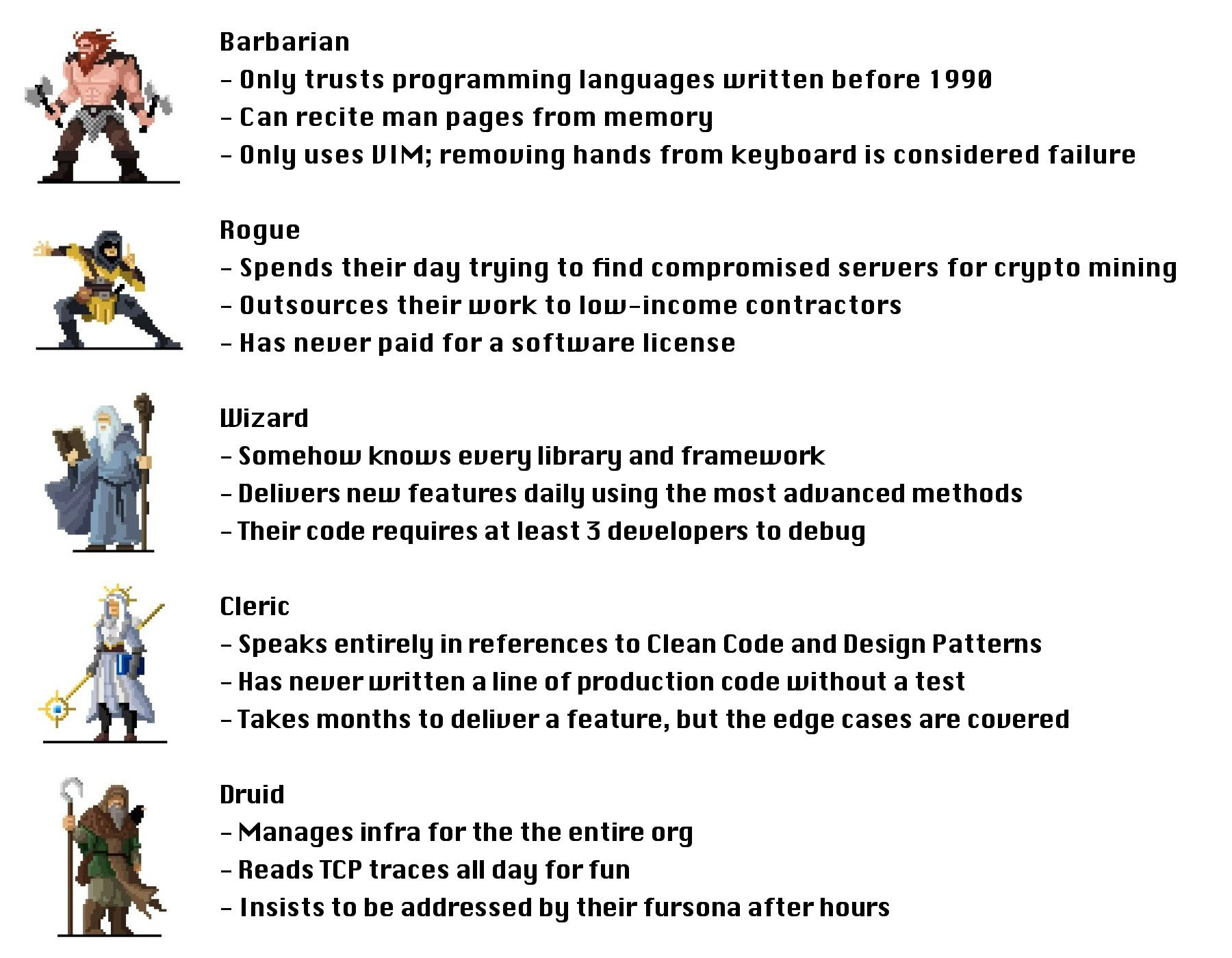
This meme assembles an adventuring party of developer archetypes, each exaggerating a real-life engineering persona in an RPG (role-playing game) style. Seasoned devs immediately recognize these five "classes" from countless incident calls and code-review battles. It's both hilarious and painfully relatable because we've all met a version of these characters in the wild of corporate engineering teams. The humor works on multiple levels: referencing classic Dungeons & Dragons-style classes while satirizing the extremes of tech CorporateCulture and DevCommunities.
The Barbarian is that grizzled old-school programmer who treats anything post-1990 as suspect. They wield legacy_language_fanatic cred: think of a coder who still swears by C from 1972 or even COBOL, claiming modern languages are for the weak. This warrior can quote Unix man pages like epic poetry (who needs Google when you memorized the manual?). Their battleaxe is the editor VIM – a modal text editor from the '90s known for its efficiency (and steep learning curve). For the Barbarian, removing hands from keyboard is a sign of defeat; every time someone reaches for the mouse, they cringe as if watching a comrade fall in battle. Seasoned engineers chuckle here because they've seen the "VI vs Emacs" holy wars – and the Barbarian has clearly planted their flag on vi/vim's side. In terms of DeveloperExperience_DX, working with a Barbarian can feel like time-travel: they'll insist on terminal commands and scoff at your fancy GUI IDE. The joke is affectionate though – their deep knowledge (they can fix a broken
Makefileat 3 AM without breaking a sweat) makes them formidable, if a bit feral in modern tooling.The Rogue plays the role of the morally flexible "growth hacker" or the resourceful engineer who might cut every corner. In the meme, they’re literally in a black-and-yellow hood like a stealthy thief. This is the colleague who spends days hunting for compromised servers for crypto mining – which sounds absurd until you recall real incidents of hackers infecting machines to mine cryptocurrency. Perhaps this dev isn't the one hacking others (one hopes!) but rather the one scanning the company’s servers for any sign someone else snuck a Bitcoin miner in. Still, the description reads as if our Rogue is up to no good themselves: maybe running side hustles on company hardware or at least fascinated by the dark arts of hacking. They outsource work to low-income contractors, an allusion to real stories where developers secretly hired freelancers (often overseas) to do their job. Senior engineers smirk because yes, a famous case involved a programmer who offloaded his tasks to a contractor for a fraction of his salary and spent the day watching cat videos – ultimate Rogue move! This archetype also never pays for software licenses, proudly pirating any tool they need. That line pokes fun at the kind of dev who has Photoshop, IntelliJ, or Windows activated with a sketchy crack, bragging about saving money while violating agreements. It's a jab at ethically gray behavior that many recognize in startup culture or among scrappier devs. The humor lands because experienced folks know that for every straight-laced engineer, there's a cunning Rogue who treats rules as optional. In CorporateCulture, this person both impresses and alarms: they deliver quick results (by any means necessary), but you’re never entirely sure if their code or methods will land the company in technical debt or legal trouble.
The Wizard in this lineup is the classic “10x engineer” stereotype dialed up to 11. This grey-bearded mage with a staff represents a developer of almost supernatural knowledge. Somehow knows every library and framework – we all know that genius who seems to have read all of Stack Overflow and GitHub. In meetings they conjure obscure new JavaScript frameworks or quote the inner workings of the Linux kernel from memory. They deliver new features daily using the most advanced methods, as if casting spells with cutting-edge tech: think of deploying a machine learning model on Monday, refactoring to a reactive microservices architecture on Tuesday, and writing a custom compiler on Wednesday. The Wizard embraces the latest and greatest tools from every category (truly a master of library_wizardry), making the rest of us feel like simple peasants scrambling to catch up. However, as the meme jokes, their code requires at least 3 developers to debug. 🧙♂️ In practice, that wizardly code can be an enigmatic spellbook – rich with clever one-liners, metaprogramming, and ultra-DRY abstractions that mortals struggle to understand. Senior devs laugh (and maybe groan) here because they've been those 3 bewildered developers tracing through recursive template meta-programming or deeply nested reactive pipelines that the "wizard" left behind. This highlights an industry truth: the dev who moves fast and dazzles with advanced solutions often leaves a maintainability challenge in their wake. It's TechHumor with an edge of caution – even magic has its price. Yet, teams often keep a Wizard around because their knowledge is invaluable; just pray they write comments as well as code.
The Cleric is depicted with a halo and silver armor, perfectly fitting the clean_code_evangelist and testing zealot. This is the developer who treats “Clean Code” and the Gang of Four design patterns as sacred scriptures. If the Barbarian is all muscle and gut instinct, the Cleric is faith and precision. They speak entirely in references to SOLID principles, 12-factor apps, and quote chapter and verse from Clean Code ("functions should do one thing, and do it well," you'll hear in design discussions). Seasoned folks know this character from code reviews: they will call out every magic number, every long function, every misnamed variable as if exorcising demons from the codebase. They’ve never written a line of production code without a test – indeed, they likely practice strict Test-Driven Development, writing exhaustive unit tests, integration tests, and acceptance tests for each change. In daily stand-up, their updates sound virtuous: “Refactored the repository layer to follow the Repository pattern and added 47 tests – all green.” 🙏 While managers appreciate quality, others joke that the Cleric takes months to deliver a feature, but the edge cases are covered. This pokes fun at agile vs perfectionism: the Cleric will handle every possible null input, every overflow scenario – things that do matter (especially in critical systems), but this thoroughness slows the pace. It's a lighthearted jab at the DeveloperExperience_DX trade-off: moving fast and breaking things vs moving carefully and never breaking anything. The DevCommunities of software craftsmanship and testing will see themselves in the Cleric – proudly perhaps – while others might recall times they rolled their eyes at a peer insisting on 100% test coverage for a one-line change. In CorporateCulture, Clerics are both essential and sometimes frustrating; they prevent future outages with their discipline, but product folks joke about feature requests vanishing into the monastery of unit tests, emerging only after long retreats.
The Druid rounds out the party as the mystical infrastructure sage. This person manages infra for the entire org – basically a one-person DevOps/SRE team who communes with servers and networks like a forest guardian. The meme’s druid is in earthy green robes with a staff, evoking someone attuned to nature — or in this case, the datacenter. They read TCP traces all day for fun, which is a brilliant nod to the deep-debugging network engineers who actually open Wireshark or
tcpdumpcaptures just to understand packet flows. To most developers, raw TCP stream analysis might as well be druidic runes; it’s arcane knowledge. The Druid is the colleague who can tell you exactly why the site is slow in one region by analyzing a pcap file and noticing a subtle TCP window size issue. This is hardcore RelatableDeveloperExperience if you've ever watched an ops wizard at work. And then, the kicker: they insist on being addressed by their fursona after hours. A fursona_alias is an anthropomorphic animal persona often used by members of the furry fandom; reading that, any seasoned techie might chuckle and nod, “Yup, I’ve met that admin.” Tech, especially in open source and ops circles, has a fair share of colorful personalities and niche hobbies. This line is an absurdly specific stereotype: an extremely competent infra engineer who also happens to be a furry, asking coworkers to call him "NightWolf" or "Foxfire" in informal contexts. It’s both oddly plausible and exaggerated, which makes it very funny. The Druid encapsulates the infra_druid archetype: deeply knowledgeable about systems, perhaps a bit reclusive or socially unique, and so vital to the company's uptime that everyone tolerates (even endears) their eccentricities. In CorporateCulture, these folks often operate outside the normal hierarchy – they’re in their own world keeping everything running. The RPG metaphor fits perfectly: the druid doesn’t wear a suit of corporate armor, they’re out in the woods (the server room or cloud console), talking to the spirits of the network.
Together, these five form an RPG-like “party” that any senior engineer would recognize from real life. The meme cleverly uses the fantasy class system to highlight how diverse and extreme developer DeveloperRoles can be. On a serious incident “dungeon raid,” you might indeed see: the legacy_language Barbarian furiously typing in Vim on a production server; the crypto_mining Rogue suggesting an unconventional quick fix (or quietly running a side script); the all-knowing Wizard conjuring a solution with an obscure library; the principled Cleric cautioning against any hack without proper testing; and the Infra Druid humming to themselves as they parse logs and packet traces, perhaps chiming in with a quiet “the load balancer’s SSL handshake is failing” (a mystical incantation to others). This TechSatire lands so well because effective software teams do benefit from a balance of these traits, but in the extreme, each is laughably distinctive. It’s an affectionate roast of common DeveloperArchetypes. Seasoned devs laugh not just at the joke, but at memories of meetings and war rooms where these archetypal behaviors were on full display. In the epic quest of software development, it really does feel like “Pick your party” – choose your mix of strong-willed veterans, cunning hackers, code sorcerers, purity-driven architects, and infrastructure shamans, then hope their combined strengths (and weaknesses) align to slay the dragon (or that nasty production bug).
Description
The image is laid out like an 8-bit RPG character select screen. Five small pixel-art sprites line the left margin: a bare-chested, axe-holding barbarian; a black-and-yellow hooded rogue; a blue-robed, long-bearded wizard with staff; a haloed cleric in silver mail; and a green-cloaked druid gripping a crook. To each sprite’s right, bold headers label the class and three bullet points describe a developer archetype in black text. Barbarian - Only trusts programming languages written before 1990 - Can recite man pages from memory - Only uses VIM; removing hands from keyboard is considered failure Rogue - Spends their day trying to find compromised servers for crypto mining - Outsources their work to low-income contractors - Has never paid for a software license Wizard - Somehow knows every library and framework - Delivers new features daily using the most advanced methods - Their code requires at least 3 developers to debug Cleric - Speaks entirely in references to Clean Code and Design Patterns - Has never written a line of production code without a test - Takes months to deliver a feature, but the edge cases are covered Druid - Manages infra for the entire org - Reads TCP traces all day for fun - Insists to be addressed by their fursona after hours The meme lampoons well-known senior-engineering stereotypes: the legacy-language zealot, the ethically flexible growth hacker, the framework polymath, the test-driven purity evangelist, and the infrastructure hermit. Seasoned engineers will recognize each “class” from real-world incident bridges and code-review dungeons, making the RPG metaphor both humorous and painfully relatable
Comments
37Comment deleted
If the sprint ever hits production chaos, just remember: the Wizard will ship a new framework before the Barbarian finishes his :wq, but the Druid already rolled advantage on tcpdump and silently patched the cluster
The real boss fight isn't in production - it's getting the Barbarian to approve a PR that uses async/await, the Wizard to write documentation anyone else can understand, and the Cleric to ship anything before achieving 100% mutation test coverage
The Barbarian still writes in C because 'if it was good enough for Kernighan and Ritchie, it's good enough for production,' while the Wizard's microservice architecture is so cutting-edge it requires a dedicated team just to understand the dependency graph - proving that sometimes the real dungeon isn't the legacy codebase, it's the 47-layer abstraction you built last sprint
Our ideal team mix is Barbarian (Vim), Rogue (license‑optional), Wizard (framework hoarder), Cleric (TDD zealot), and Druid (tcpdump whisperer) - which explains why retros need a Dungeon Master more than a Scrum Master
Wizard knows every library, but code needs five devs to debug - classic case of framework polyglot turning architecture into spaghetti
A balanced party ships daily: Barbarian writes it in C, Wizard wraps it in two frameworks, Cleric drapes it in tests, Druid keeps packets flowing - and the Rogue’s “observability agent” mysteriously exposes a hashrate metric
Only using your fursona name after hours? Must be a junior dev Comment deleted
Multiclassing, huh? Comment deleted
Ok, nevermind, I've just never paid for any software Comment deleted
why i should do if i did not match on any of these ? 😢 Comment deleted
It means you’re playing on a custom character which is a pretty good too ;) Comment deleted
that makes you an NPC Comment deleted
cruel Comment deleted
but true Comment deleted
I use outdated methods like ftp and scp to deliver code on production Features take weeks to be done, edge cases are not covered, because "cmon, you ain't big enough to hit 600r in any 5 second window API rate limit" Don't even know the libs and frameworks I work with, still manage to succeed with any languages and frameworks, cause they're all the same Debug code of three wizards simultaneously, never coming down to rewrite-from-scratch Maybe I'm just a low-income contractor after all Comment deleted
I learned a new word today. Comment deleted
Which is it? Comment deleted
Fursona 😄 Comment deleted
Sorcerer: - Copies the code from Stack Overflow or uses ChatGPT for fixing bugs - Learns new languages by watching tutorials on Youtube - "It just works" Comment deleted
I'm a humble corporate tetragrammaton cleric. I don't just deliver perfect new code - I also insist that the old code, along with its authors, should be burned. Comment deleted
Archer: - launched hundreds requests from postman every day - can shuffle json on the fly - have different microservice on any task in his quiver Comment deleted
warrior: - power in unity, power in monolith - SOLID discipline - trained OOP his entire life Comment deleted
me: use JavaFX WebView to run a Vue webpage and spend hundreds MBs memory to show a HelloWorld string on screen i am definately the king Comment deleted
Ninja: default GitHub avatar no social media no LinkedIn (or LinkedIn with Lucky Star/OniMai avi) makes $300,000 a year minimum for some company you’ve never heard of Cherry switches, 200+ WPM no clear job description signs in, fixes 5 lines of code, leaves Comment deleted
I know at least one person for each of these :3 all of them are fun to be around and work with; every programming style has its advantages and disadvantages ^^ Comment deleted
Warlock: workflow is half Copilot in Visual Studio, half obscure utils left over from Win95, to write .NET code deployed on an Azure server. Actually uses Cortana and Edge. Believes open-source is a sin. Comment deleted
Bard: writes Swift, uses emoji for variable names Comment deleted
Devil: Knows every malware inside-out Does some suspicious commits into prod, refuses to elaborate. Without it prod fails Any code he writes compiles on the first attemt Was never seen in person last 7 years Former colleagues afraid to talk about him Comment deleted
Post-Apocalypse Wanderer -Insists on writing everything from scratch -wants to have a team, but doesn't like being in someone's team -downloads offline version of docs, but never reads them Comment deleted
Nah, post-apocalypse coding is all about using old tech without understanding how it works: - Grabs modules and snippets from every dumpster on the internet - The uglier it looks, the better - Can't read docs because... well, can't read - Sometimes the code he crafts explodes and takes down the entire system Comment deleted
Just @ me next time Comment deleted
Please define: • Deity • Dementor • Dragonslayer • Dwarf • Heretic • Witcher Comment deleted
are these from a specific game or novel? Comment deleted
Everything you listed is not a class. Dragonslayer is job, heretic is sort of religion cultist, everything else is creature Comment deleted
But still: Deity - client, hard to satisfy, easy to angry Dementor - scrum master, drain your soul on each daily meeting Dragonslayer - guy, who rewrite legacy project Dwarf - guy, who laid the cables Heretic - functional programming enjoyer Witcher - same as dragonslayer Comment deleted
Witcher is full-stack dragonslayer - one IDE for the frontend, one for the backend. Comment deleted
Wizard/Cleric dual class - I've often been complimented on knowing a library/package/framework-feature for every solution - Though people tend to hold off reviewing my PRs... - I really hammer down Design Patterns and value Clean Code - I take far too long on some features to cover edge cases LMAO Comment deleted