
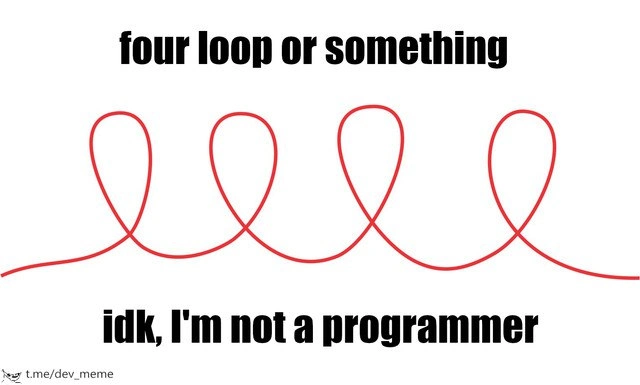
A Literal 'Four Loop' Interpretation
Description
This is a simple, minimalist meme on a white background. At the top, in bold black font, is the text 'four loop or something'. Below it is a continuous red line drawn into four distinct, evenly spaced loops, resembling a spring or coil. At the bottom, also in bold black font, is the caption 'idk, I'm not a programmer'. A small watermark for 't.me/dev_meme' is visible in the bottom-left corner. The humor is derived from a pun on the term 'for loop', a fundamental control flow statement used for iteration in most programming languages. The image literally visualizes 'four loops' instead of the programming construct. The 'idk, I'm not a programmer' caption is a popular meme format used to feign ignorance while making a literal or humorous observation, making the joke accessible even to non-programmers


Comments
7Comment deleted
I see you've implemented loop unrolling manually. Bold choice for O(4) complexity
Stakeholder: “Can’t you just throw in a quick four loop?” Me: “Sure - if you’re cool with turning it into O(n⁴) and a cloud bill sporting four commas.”
This is actually more accurate than most architecture diagrams I've seen - at least it admits the loops are infinite and doesn't pretend there's an exit condition
This perfectly captures the semantic gap between domain experts and outsiders - we've all been in architecture reviews where stakeholders hear 'event loop' and picture a literal circular queue, or 'service mesh' and imagine fishing nets. The real humor here is that after 20 years, you realize explaining 'for loop' to executives is harder than implementing a lock-free concurrent data structure, because at least the latter has formal semantics you can point to
PM whiteboard special: O(n^4) vagueness, zero termination condition
“Four loop”? Close - it’s a for loop around an idempotent write: four retries with backoff, then the circuit breaker opens and PagerDuty finishes the algorithm
Specs that say “do it four times” are why half the team writes i < n, the other half writes i <= n, and SRE writes the postmortem