When You Fail to Parse Your Friend's Support Vector
Why is this DevCommunities meme funny?
Level 1: Robot Language Confusion
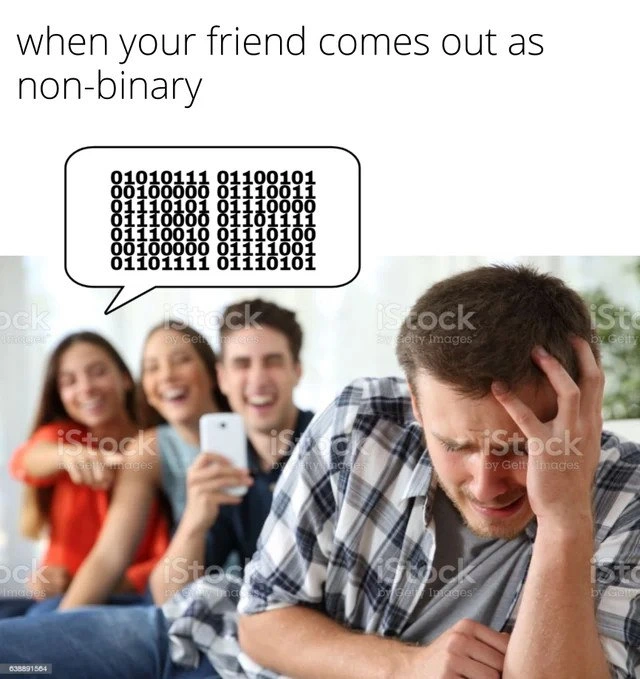
Imagine you tell your friend something really important about who you are – for example, you say you’re not just a boy or a girl, you feel like something different. Now, instead of your friend giving you a hug or saying “I support you,” they start talking like a robot, only using the numbers 0 and 1. 🤖📣 That would be pretty confusing, right? In this meme, that’s exactly what happens. One friend shares that they are non-binary (which means they don’t identify as only a boy or a girl). But their programmer friend hears the word “binary” and thinks about computer binary (the language of 0s and 1s). So the programmer friend literally replies in a bunch of zeros and ones, as if he’s a computer spitting out code!
For a simple comparison, it’s like if you said “I feel sad,” and your friend responded by reading off a bunch of phone numbers or random digits. You’d probably face-palm (cover your face in frustration) just like the person in the picture. The guy in front with the plaid shirt is doing a face-palm because his friend’s response is completely off-track. He wanted understanding, but got a string of mumbo-jumbo numbers instead. It’s funny because the programmer friend is treating a normal conversation like it’s a computer problem. He basically answered in a secret machine language that only computers understand (and maybe some humans with a special decoder). That’s why the other friends in the back are laughing at the phone – they see the ridiculousness of replying to a personal reveal with what looks like Matrix-style code.
So, the humor here is about a mix-up: one friend is talking about feelings and identity, and the other friend replies in “robot language” (binary code). The result is a silly situation where an important message got answered in the wrong way. Even if you don’t know how binary works, you can tell that a bunch of 0s and 1s is not a normal response to someone sharing something personal. It’s as if the programmer friend only knows how to talk to computers, not people. In the end, the meme makes us laugh because we see the frustrated friend thinking, “Ugh, my buddy is literally speaking gibberish when I needed a real answer.” It’s a lighthearted way to show how a computer-obsessed friend might accidentally act like a computer at the worst possible time, causing confusion but also a good giggle for everyone else.
Level 2: All Zeros and Ones
In this meme, a programmer-type friend literally speaks in binary code. Binary is the foundational language of computers – a system of only two digits: 0 and 1. Each 0 or 1 is called a bit (short for “binary digit”). In everyday programming and computer science fundamentals, we learn that everything on a computer – text, images, music, you name it – is ultimately represented in binary. For example, the letter 'A' is encoded as 01000001 in binary (that’s 8 bits in a row). Here, the developer replies with a bunch of those 0s and 1s, effectively sending a message in the same format that computers use internally. It’s as if the dev friend’s brain hears the word “binary” and automatically switches to ones-and-zeros mode.
Let’s break down what those weird 01010111 01101001 01010000 ... sequences mean. They’re grouped in sets of eight bits. Eight bits make one byte, and a byte can represent a wide range of values (0 to 255 in decimal). Often we use a standard like ASCII to map each byte value to a character (like a letter or punctuation). In ASCII encoding, for instance, 01010111 in binary corresponds to the decimal number 87, which is the character 'W'. Similarly, 01101001 is 105 in decimal, representing 'i', and 01010000 is 80 in decimal, which is 'P'. So if you take 01010111 01101001 01010000 and convert each chunk from binary to a letter, you get "WiP". The speech bubble in the meme contains eleven such byte-sized chunks. If we were to decode the entire bubble, we’d likely get an actual phrase or sentence the dev friend is “saying” in binary (perhaps something like "WiPe You..." – it looks like it started spelling out words). The key is: those zeros and ones aren’t random gibberish; they are the binary encoding of text. This detail makes the joke more specific to programmers, because we immediately recognize that pattern of 0/1 as code-like output. It’s the kind of thing you see in low-level programming examples or old-school hacker movies with green text raining down the screen (hello, Matrix!).
Now, why is this funny to anyone who’s dabbled in coding? Because it’s mixing up two meanings of “binary.” The friend who “comes out as non-binary” is talking about gender – meaning they don’t identify strictly as a man or a woman; that’s a personal and social identity term. But the dev friend hears the word "binary" and thinks of binary numbers or binary data. So instead of responding with, say, “Thanks for telling me, I’m here for you,” the developer responds as if the friend was referencing binary code itself! It’s like a knee-jerk programmer reaction: “Non-binary? Does not compute… maybe I should reboot into binary mode?” and proceeds to output a string of bits. For someone new to tech, picture the dev essentially talking in a secret computer language that only machines (or trained humans) understand. It’s a huge miscommunication.
To a junior developer or a student, this meme is also a quick puzzle: you might even be tempted to decode those binary numbers to see what the message is! That’s because early in learning programming, you often encounter exercises about binary and ASCII. For instance, you learn that you can convert text to binary and back. Here’s a tiny example in Python to illustrate how a word becomes binary:
text = "Hi"
binary_stream = ' '.join(format(ord(c), '08b') for c in text)
print(binary_stream) # prints: 01001000 01101001
In this code, we take each character in "Hi" and convert it to an 8-bit binary string. The output 01001000 01101001 is exactly how a computer might store the letters 'H' and 'i'. So in the meme, the dev friend did essentially this in reverse – taking some text they wanted to say and encoding it in binary to reply. It’s a playful nod to low-level programming where you might interact with data in its raw binary form. For a newbie, the joke also reinforces just how literally programmers sometimes take things: a friend mentions non-binary (which to most people has nothing to do with numbers) and our coder immediately starts crunching out binary digits as if that’s the appropriate response.
This scenario is amusing and a bit endearing: the programmer isn’t trying to be rude; they’re just so deep in the world of tech that they respond with zeros and ones. However, from the friend’s perspective (and probably any onlookers who aren’t fluent in binary), that response is pure nonsense. It would be like someone replying to a heartfelt statement with Morse code or Klingon – technically a form of communication, but totally missing the intended context! In sum, the meme uses computer science humor to highlight how a simple word like "binary" can lead a techie down a very different rabbit hole than what was meant, resulting in a well-meaning but comically inappropriate reply made of 0s and 1s.
Level 3: Bit of a Misunderstanding
At the heart of this meme is a classic geeky miscommunication. One friend says they are non-binary – referring to a gender identity outside the male/female binary – and the developer friend immediately thinks of binary code (the 0s and 1s at the core of computing). Instead of offering emotional support, the dev’s brain flips into low-level mode and replies with a string of ones and zeros in a speech bubble. This literal bit-level humor plays on the dual meaning of "binary": in everyday life it describes the gender spectrum, but in CS fundamentals it means base-2 numeric representation. The joke is that the dev friend hears "non-binary" and basically goes: "Binary, you say? Time to bust out the 01010110 and 01100001!" 🙃
From a seasoned coder’s perspective, the scenario is hilariously tone-deaf but relatable. Developers often joke about "thinking in binary" or dreaming in code – here it’s taken to an absurd extreme. The speech bubble in the image is filled with eight-bit sequences like 01010111 01101001 01010000, which are binary representations of text characters (likely ASCII codes). To an experienced eye, this looks like someone literally wrote a sentence in raw binary. (For instance, 01010111 in binary equals 0x57 in hex, which is 87 in decimal, representing 'W' in ASCII.) The dev friend is essentially speaking ASCII in binary form. This is low-level programming enthusiasm misplaced in a high-level social situation! The poor friend in the foreground (plaid shirt, facepalming) is presumably the one who just came out, now realizing their programmer pal has completely misunderstood the context. It’s the classic engineer’s literalism: hearing a personal revelation and responding with a binary encoding demonstration. Talk about crossing wires – it’s a human moment turned into a coding exercise.
This mix-up resonates with developer humor because it highlights how we sometimes see the world through a technical lens by default. The meme exaggerates it: rather than acknowledging the friend’s identity news, the dev fixates on the word “binary” and fires off a machine-level reply. It’s funny in the way that only nerdy miscommunication can be. We’ve all seen well-meaning techies who reply with code or jargon when the moment called for plain English. Here the dev took it up a notch, replying in the most fundamental computer language possible – just bits! It’s an inverse pun: the friend says “non-binary” (not referring to numbers at all), but the dev responds in actual binary digits. The humor also pokes at how deeply entrenched binary is in a programmer’s mind. After all, at a hardware level everything is 0 or 1, true or false – there’s no “maybe” or third option, no nuance. So when someone says “non-binary,” this code-brained pal ironically communicates using only binary values, as if doubling down on two-option logic. The resulting social blunder is cringe-worthy and comical, a kind of protocol mismatch between human relationship talk and computer talk.
To give a sense of the disparity, consider the perspectives side by side:
| Friend’s Intention (Human Context) | Dev’s Reaction (Technical Context) |
|---|---|
| “I’m non-binary.” (sharing a gender identity) | “Binary? Got it!” 01010111 01101001… (responds with literal binary code) |
| Expected: empathy or support (personal news) | Actual: displays CS fundamentals (treats it like a coding prompt) |
This contrast is what makes the meme too real in tech circles. It satirizes the tendency of some programmers to respond to human stories with a tech-centric answer. The developer friend isn’t trying to be mean – if anything, they might think this is a clever or supportive gesture (“Hey, I’ll speak your language... except they picked the wrong interpretation of language!”). The facepalm tells us the outcome: the humor comes from the friend’s exasperation that their important news was met with a wall of 0s and 1s. It’s a light-hearted reminder that not everything is a coding problem to solve, and sometimes our low-level mindset can hilariously miss the high-level point.
Description
This meme uses a stock photo of a distressed man in a plaid shirt holding his head, while in the background, his friends are pointing and laughing. The top text reads, 'when your friend comes out as non-binary'. A speech bubble points from the laughing friends, containing several lines of binary code. The visual gag suggests the man is upset by his friend's identity, but the technical punchline lies in the binary code itself, which translates from ASCII to the supportive message: 'We support you'. The joke is therefore on the man in the foreground; he isn't being cruel, he's simply frustrated because he cannot understand the binary message of support his friends are offering. His friends are laughing at his technical illiteracy, not their non-binary friend. For developers, this is a clever, wholesome subversion of expectations that turns a potentially offensive setup into an in-joke about fundamental computer science knowledge
Comments
21Comment deleted
That horrifying moment you realize your own internal parser for human interaction doesn't support the latest character sets
After two decades of stuffing life into booleans, I nearly started drafting an enum migration plan when my friend said they’re non-binary - then I realized the only refactor needed was my pronoun cache
Spent 20 years optimizing for binary operations, now I need to refactor my entire mental model to support ternary logic... and my brain's garbage collector just crashed
Peak engineer allyship: the support is sincere, but you still have to decode 112 bits to receive it
This meme perfectly captures the moment when your brain's parser throws a semantic exception: you've spent so many years thinking in base-2 that 'non-binary' triggers an immediate mental stack trace to data representation rather than identity. It's the engineering equivalent of hearing 'I'm going to fork the relationship' and immediately thinking about git branching strategies instead of relationship dynamics - a reminder that our professional context-switching isn't always as efficient as we'd like to believe
Non-binary? Cool - deprecate the bool, add an open-ended type, and watch 37 microservices discover their 0/1 assumptions in prod
Non-binary friend? Just another schema migration from BOOLEAN to ENUM('male','female','other') - deploy to prod and pray
Senior take: if your user table still has gender BOOLEAN, you don’t need a meme - you need a migration to an enum and a postmortem on your data model
Hah, decimal louser Comment deleted
why not balanced ternary? Comment deleted
Base53 Comment deleted
01010111 01100101 00100000 01110011 01110101 01110000 01110000 01101111 01110010 01110100 00100000 01111001 01101111 01110101 Comment deleted
57 65 20 73 75 70 70 6F 72 74 20 79 6F 75 Comment deleted
My bro, what is the app name? Comment deleted
first ddg link https://www.rapidtables.com/convert/number/binary-to-ascii.html Comment deleted
Thnks🖤 Comment deleted
ur welcome ^^ Comment deleted
btw ddg sucks since two days ago Comment deleted
What did they do? Comment deleted
They have started manipulating query results to "fight with disinformation about conflict in Ukraine" Comment deleted
Everyone manipulates Search Results. DDG is just being transparent about it, Putins War is a terrible crime and russian state sponsored misinformation should not be shown without context in search results. Comment deleted