The Four Fundamental Forces of Nature, Updated
Why is this Dependencies meme funny?
Level 1: The Bottomless Toy Box
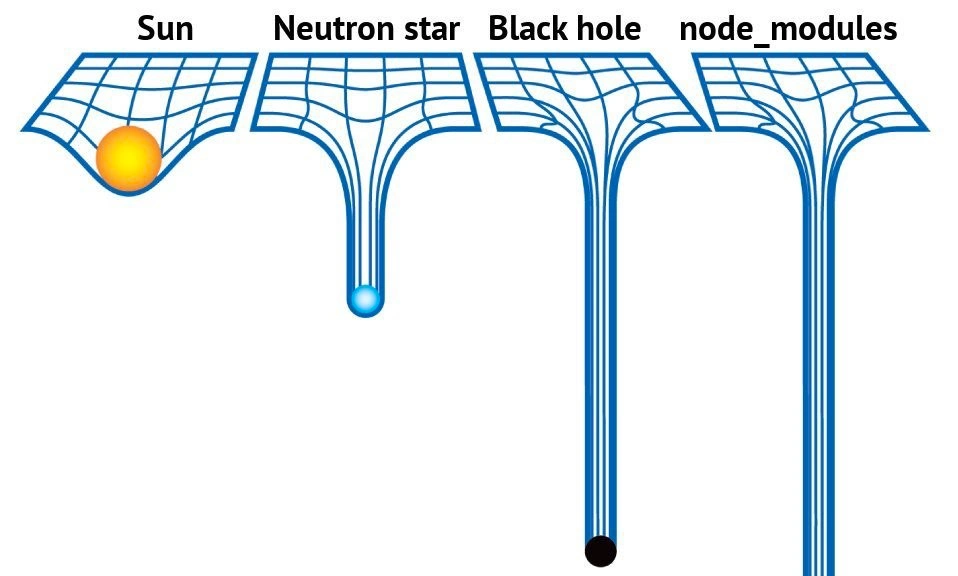
Imagine asking a friend to lend you one board game, and they show up with a moving truck — because the game needs dice, and the dice came in a set, and the set came with a shelf, and the shelf needed a whole room. This meme lines up the heaviest things in the universe — the Sun, a collapsed star, a black hole — and says the folder where programmers keep their borrowed code is heavier than all of them. It's funny because it's barely an exaggeration: ask for one small thing, receive an avalanche, and the avalanche never ends.
Level 2: What You're Actually Looking At
A quick glossary for the diagram's last panel:
node_modules— the folder where npm (Node.js's package manager) installs every library your project depends on, plus every library those libraries depend on, recursively. Runnpm installon a typical web project and watch it materialize 30,000+ files.- Dependency — code someone else wrote that your project uses. Declared in
package.json. The catch: dependencies have their own dependencies (transitive dependencies), and you get all of them. - The physics panels — in Einstein's general relativity, heavy objects bend spacetime like a bowling ball on a trampoline. Denser object → deeper well. A black hole is so dense the well becomes effectively bottomless.
The joke clicks the first time you try to copy a project folder to a USB stick and the file count makes the progress bar give up, or you run du -sh node_modules and it answers with a number bigger than the actual application by two orders of magnitude. Practical survival tips you'll learn early: never commit node_modules to git (that's what .gitignore is for), rm -rf node_modules && npm install is the developer's "turn it off and on again," and tools like pnpm exist specifically because people got tired of storing the same copy of lodash forty times.
Level 3: Heavier Than a Black Hole
The image hijacks the canonical physics-textbook illustration — four gravity wells labeled "Sun", "Neutron star", "Black hole", and "node_modules" — and the visual escalation does all the comedic work. The Sun makes a polite dimple. The neutron star digs deeper. The black hole's funnel plunges to a dot. And node_modules? Its funnel runs clean off the bottom edge of the image. No dot. No bottom. Not even a singularity, just more dependencies.
Senior engineers laugh because they've audited the crime scene. A fresh React or Next.js scaffold pulls in hundreds of megabytes and tens of thousands of files before you've written a single line of business logic. The JavaScript ecosystem's culture of micro-packages — is-odd, is-even (which depends on is-odd), left-pad — means your one direct dependency fans out into a transitive forest. Each maintainer made a locally reasonable choice: small modules are composable, reusable, testable. The emergent global result is dependency bloat that no individual decision caused and no individual decision can fix.
The deeper satire is about risk, not just disk. Every node in that invisible funnel is code you didn't write, didn't read, and implicitly trust with your build pipeline and often your production runtime. The 2016 left-pad unpublishing broke half the internet over eleven lines of padding logic; supply-chain attacks since then have weaponized exactly this depth. The funnel that swallows your disk space also swallows your security audit. And the standard mitigations — lockfiles, npm dedupe, pnpm's content-addressed store, Yarn PnP — are partial patches on an incentive structure where publishing a new package is free and depending on one is one line of JSON. The gravity is structural.
Level 4: The Mathematics of Infinite Density
The punchline rests on a real correspondence between two unrelated hard problems. In general relativity, the wireframe funnels depict how mass-energy curves spacetime — the deeper and narrower the well, the closer you are to a singularity where curvature becomes infinite and the equations stop giving meaningful answers. In package management, dependency resolution has its own singularity: resolving a dependency graph with version constraints is formally NP-complete, reducible to boolean satisfiability (SAT). Every package.json range like ^4.17.0 is a constraint clause, and the resolver must find an assignment of concrete versions satisfying all of them simultaneously.
npm's historical answer to this complexity was elegant and catastrophic: don't solve the constraint problem globally, just nest. If two packages need incompatible versions of lodash, each gets its own private copy inside its own node_modules. The graph becomes a tree by duplication. That trades an NP-complete search for exponential disk usage — before npm v3 flattened things, deeply nested trees could exceed Windows' 260-character MAX_PATH limit, a filesystem event horizon from which no Delete operation returned. The meme's bottomless funnel is therefore not just a gag; it's an accurate sketch of what happens when you resolve a hard combinatorial problem by physically materializing every branch of the search space onto your SSD.
Description
This is a four-panel diagram illustrating the concept of spacetime curvature, humorously adapted for a developer audience. On a white background, four blue grids represent the fabric of spacetime, each distorted by an object of increasing mass and density. The first panel, labeled 'Sun', shows a yellow sphere causing a gentle dip. The second, 'Neutron star', shows a small blue sphere creating a much deeper well. The third panel, 'Black hole', depicts a tiny black dot pulling the grid into an almost infinitely deep, narrow funnel. The fourth and final panel, hilariously labeled 'node_modules', shows a distortion far greater than the black hole, suggesting it is the most massive and dense object in the universe. The joke is a commentary on the notoriously large size of the 'node_modules' directory in JavaScript projects, which often contains an enormous number of dependency files and consumes a significant amount of disk space. For experienced developers, this is a universally understood pain point, making the astronomical exaggeration a perfect and relatable piece of humor
Comments
8Comment deleted
The universe is expanding, but my hard drive is shrinking, and I'm pretty sure the singularity responsible is located somewhere in my `node_modules` directory
Astrophysics has the Schwarzschild radius; we have the moment a microservice hits “npm install” - past that /node_modules event horizon, every Docker layer gains infinite mass and the build pipeline red-shifts deadlines to eternity
The only known phenomenon where rm -rf actually takes longer than the npm install that created it
Light can't escape a black hole; nothing escapes node_modules - not even `rm -rf` finishes before the heat death of the universe
The meme brilliantly captures every JavaScript developer's existential dread: you start a simple React project, run 'npm install' once, and suddenly your SSD is experiencing gravitational lensing. The node_modules folder doesn't just consume disk space - it warps the very fabric of your filesystem, creating an event horizon from which no 'rm -rf' command can escape. Senior engineers know the real reason we moved to microservices wasn't scalability - it was to distribute the gravitational mass of node_modules across multiple repositories so no single machine would collapse into a singularity
Black holes evaporate via Hawking radiation; node_modules accretes eternally via npm audit fix
General relativity says mass curves spacetime; JavaScript relativity says transitive deps curve your CI timeline - once npm ci crosses node_modules’ event horizon, only audit warnings escape
Node_modules: the only singularity where even du -sh and your CI budget can't escape - rm -rf briefly hits escape velocity, then npm install recreates the universe with new peer-dep warnings