AI Dev Tools Promise Innovation, Deliver Existential Crisis
Why is this IndustryTrends Hype meme funny?
Level 1: Too Many Magic Wands
Imagine you’re in a big toy store, and every aisle you turn down, there’s someone shouting, “Tell me any toy you want, and I’ll make it appear like magic!” The first time you hear it, you might get really excited – who wouldn’t want a magic toy-maker, right? But then you realize every person in the store is yelling the same thing: “What do you want to play with today? I can make anything!” It starts to sound a little silly and maybe too good to be true. You think, “If everyone here is claiming they can magically create any toy, is any of it real?” You might even try one: you say, “Okay, I want a rocket that can really fly!” Maybe the person quickly hands you something that looks like a rocket, but when you try it at home, it just falls over or breaks because, well, it wasn’t actually magic – it was just a quick trick. After a few times, you’d probably feel tired and a bit frustrated. You’d plop down on a chair, rubbing your temples, thinking, “Ugh, not another one of these guys… I just want a real toy that works.”
That’s basically what this meme is showing, but in the world of computer people. All the big words like “What do you want to build today?” are like those toy store magicians shouting promises. They’re saying you can have anything you dream of, super fast, with no effort. The cartoon boy sitting all slumped over in the middle – he’s like the kid (or in this case, the programmer) who’s been hearing this over and over and is just exhausted and done with it. It’s funny in a “I totally feel that way” kind of sense. The joke is that there are just too many “magic buttons” being advertised. Press this, and poof, your app is ready! It sounds like every infomercial or ad that promises unbelievable results. And just like a kid wise to a magic trick, developers have seen enough to roll their eyes a bit.
So, in super simple terms: the picture is joking that every new computer tool is yelling the same thing – we can do everything for you! – and the poor guy in the middle represents all of us feeling a bit worn out and skeptical. It’s funny because it’s true: when everyone shouts, “I’m the best! I’m the easiest! I’m the fastest!” all at once, it just becomes noise. Sometimes you just want to cover your ears (or bury your head like the cartoon) and say, “Enough! I’ll build it myself, thanks.” The meme exaggerates it to make you grin, because we’ve all been that tired kid in the chair at some point, surrounded by too many crazy promises and just wishing for something real and simple.
Level 2: No Code, Some Code
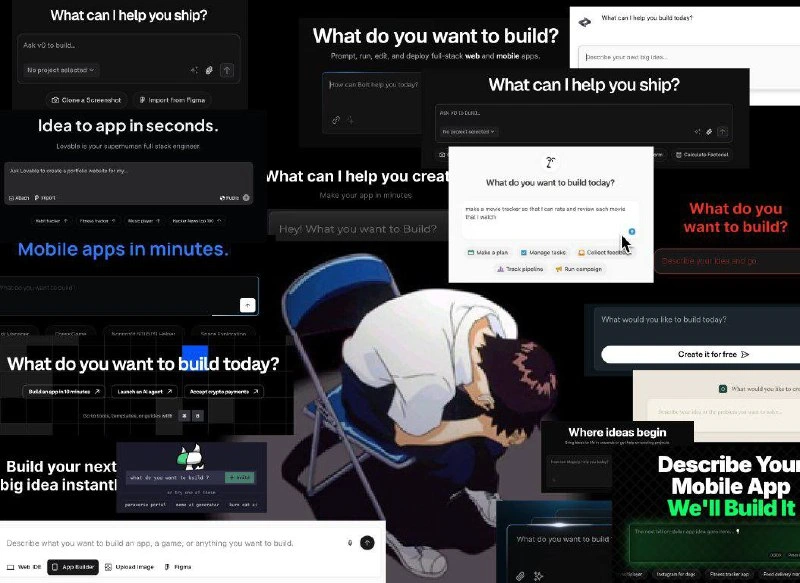
Let’s break down what’s going on here in everyday tech terms. The meme is a collage of screenshots from various AI and no-code tool websites. A no-code platform is basically a service or software that lets you create applications without writing traditional code. Instead, you might drag and drop components or, in the newest twist, just describe what you want in plain language. These platforms often advertise themselves with lines like “build an app in minutes” because they’re targeting people who have ideas but maybe not a lot of programming experience (or just developers who want to save time on boilerplate). The big bold phrases you see – “What can I help you ship?”, “What do you want to build today?”, “Describe your mobile app — We’ll build it.” – are all essentially saying: “Hey user, tell us your idea, and our AI will do the heavy lifting!” They’re trying to get you excited that literally any project is just one click or one prompt away from being finished.
Now, the reason this becomes funny (and not just inspiring) is because every one of these sites says almost the exact same thing. It’s like if a bunch of restaurants on the same street all had a neon sign saying, “Hungry? We’ll cook your dream meal in seconds!” At some point, you’d think, “Did they all hire the same marketing copywriter?” In tech, when a trend is hot – and generative AI for code is extremely hot right now – companies tend to mimic what’s currently working. That’s why you see this repetition: one successful tagline leads to a dozen copycats using that formula. IndustryTrends_Hype spreads fast. Those little rocket 🚀 icons or lightning bolts ⚡ on the pages? They’re visual shorthand for speed and innovation – launch your app fast, lightning speed execution! It’s part of a common design language now for these AI tools. Dark mode themes with vivid accent colors (white, blue, neon green text on black) are also trendy in developer tool websites, since dark mode is beloved by many programmers and it looks more high-tech.
So, picture a developer (maybe you, if you’ve been curious about these tools) browsing through tech news or a site like Product Hunt. You stumble on a new AI service promising to be your “superhuman full stack engineer.” The first time, you’re intrigued – cool, I just describe my app and it builds it? That could save time! But then you scroll a bit more and find another one: “Prompt, run, and deploy full-stack web and mobile apps. What do you want to build?” Hmm, that sounds familiar. Then another: “Idea to app in seconds. Your AI developer awaits.” By the third or fourth, it’s a pattern. Instead of feeling more excited, you start feeling suspicious and a bit overwhelmed. Are any of these legit? Why do they all sound the same? This feeling is what we call cognitive overload – too much information (or in this case, too many similar choices) and it becomes hard to decide or trust any of them. It’s like analysis paralysis but from marketing. In developer terms, it’s ToolingOverload: so many new tools that you don’t even know which one is worth trying.
Now, the center of the meme shows an anime character sitting slumped over a chair. That’s Shinji Ikari from Neon Genesis Evangelion, in what fans often call the “trauma chair” pose (or just the “get in the robot” meme pose). You don’t need to know Evangelion lore to get it – just look at his body language. He’s exhausted, maybe mentally done with all this. In the context of the meme, Shinji represents the developer who’s just fed up with all these grand promises. Imagine being a developer who’s tried one or two of these AI code tools. Perhaps you typed “Make a to-do list app with user login” and indeed it spat out some code. Great – but then you tried to actually run it or customize it, and you hit weird bugs or limitations. Then another tool promised the same and you thought, “maybe this one is better” – only to find it had its own issues. After a while, you’d be like Shinji, head in hands, thinking “I can’t keep doing this. They promised me the world, and I got hello-world.”
In straightforward terms: the meme pokes fun at the gap between AI hype and reality. All those slogans represent the hype – the idea that making software is as easy as typing a wish into a box. The tired anime guy represents reality – the feeling that, nope, it’s not that easy, and we’re a bit tired of being told it is. It’s categorized under AI_ML and IndustryTrends_Hype because it’s specifically about the current trend in AI tools and the marketing frenzy around them. And it touches on DeveloperExperience_DX because these tools claim to improve the developer experience (DX) by automating a lot of coding work. Ironically, for many devs, the experience of being bombarded by these claims is not entirely positive – it can feel like more noise to sift through.
For a junior developer or someone new to this theme: think of it this way. You know how you might see multiple tutorials or libraries for the same problem, and after a while you realize they all say “This is the easiest way!” but they can’t all be the easiest? It’s that, but with entire platforms and tools. The meme is basically a more visual way of saying, “There are countless AI tools right now, all bragging that they’ll make app-building instant and effortless. It’s a bit much, and developers are feeling overwhelmed by the repetition and skeptical of the claims.” No-code tools can be genuinely useful for simple projects, and AI code generators (like GitHub Copilot, for example) do help by suggesting code. But building a complete, polished application involves more than just generating code once – it requires design decisions, refinement, testing, and maintenance. Those are things you learn as you get more experience in development. And so, many devs chuckle at slogans that sweep those realities under the rug. The humor lives in that contrast: AIHype telling us it’s plug-and-play, and our experience reminding us it’s never that simple.
Level 3: Deja Vu as a Service
From a senior developer’s vantage point, the collage of identical slogans is painfully funny because it captures the AI hype bandwagon in full swing. At this level, it’s all about pattern recognition – not by an AI, but by us, the engineers who’ve been around the block. We’ve seen these trends before: every few years there’s a new silver-bullet tool that promises to revolutionize development. No-code platforms, visual programming, 4GLs, RAD tools – each wave came with its own catchphrases. Now in the era of generative AI, the buzzwords have changed, but the song remains the same. The meme shows a dozen dark-mode websites all effectively screaming the exact same line: “What do you want to build today?” accompanied by breathless sub-text like “full-stack web and mobile apps in minutes!”. The humor (and horror) is in the cookie-cutter MarketingVsReality vibe. It’s as if these startups all cribbed from the same SaaS Marketing 101 template: black hero section, big bold promise text, a friendly input box with a lightning bolt icon, and maybe a little AI assistant cartoon waiting to grant your wishes. By the fifth site asking that question, any developer’s eyebrow is climbing off their forehead in disbelief.
Why is this so relatable? Because DeveloperExperience_DX in the real world doesn’t line up with these rainbow-and-unicorn promises. We’ve all had that experience of a manager or non-tech stakeholder excitedly forwarding a link: “Hey, check out this AI builder! It says it can have our next project done in a day!” Meanwhile, the developers are collectively facepalming, channeling their inner anime protagonist in despair (hence Shinji from Evangelion slumped in the center – the poster child for “I just can’t deal with this”). It’s a snapshot of developer frustration with the hype: we’re drowning in tools claiming to reduce all complexity to a single prompt. Instead of feeling empowered, we feel a kind of fatigue. It’s overload – too many choices, too many inflated claims. ToolingOverload is real; when every week there’s a new “revolutionary” framework or AI assistant, you spend more time evaluating shaky demos than actually shipping code.
This meme’s collage format nails that sense of deja vu. It’s AIIndustryTrends satire: each snippet by itself might look impressive, but together they expose a lack of originality. It’s like going to a tech conference and every booth is shouting variations of “Our AI does everything, instantly!” The first time, you’re intrigued; the tenth time, you’re jaded. The veteran dev in us can’t help but laugh at how each of these startups believes their copy is unique, even as they all blur together. We recognize the pattern: a hype cycle at its peak, supported by marketing that’s essentially a tagline repeat meme in itself. Some of those lines – “Idea to app in seconds”, “Describe your mobile app – We’ll build it” – they sound almost parody-level because we know the AI assistants behind them have serious limitations. It’s humor grounded in truth: we laugh, then we sigh because we’ve debugged the aftermath of such promises.
Let’s decode a few of those slogans through a cynical senior lens:
| Landing Page Slogan | Developer’s Translation (Subtext) |
|---|---|
| “What do you want to build today?” | “Prepare to be underwhelmed by a generic demo.” |
| “Idea to app in seconds.” | “Sure, if ‘app’ means a half-baked prototype.” |
| “Build your next big idea instantly.” | “We’ll generate Hello World and call it revolutionary.” |
| “No code needed!” | “...until something breaks, then it’s 🧑💻 code o’clock.” |
| “Describe your app, we’ll build it.” | “We’ll guess what you meant and you’ll fix the rest.” |
Notice a pattern? Each bold promise has an unspoken asterisk. We’ve all learned that “automagic” solutions often involve a lot of manual cleanup. The table above is basically the AIHypeVsReality in caption form. It’s funny because it’s true: behind every “no-code” miracle tool, there’s a hidden layer of actual code (and often chaos) that someone eventually has to deal with. As senior devs, we’ve perhaps even built a few of these ourselves or integrated one, only to find that we spent more time fighting the tool’s quirks than if we’d coded it from scratch. So when confronted with a barrage of marketing tagline repeats, our reaction oscillates between dark laughter and a kind of war-weary flashback. This meme is essentially gallows humor for the dev community: we’re laughing at the absurdity of the hype even as we brace for the inevitable moment when management says, “I saw this thing on Product Hunt, can we use it to save time?” and we have to explain, yet again, why building software is not as simple as filling in a Mad Libs prompt and hitting deploy.
And let’s not ignore the art choice: Shinji from Neon Genesis Evangelion in that iconic defeated pose. That’s a whole meme in itself (often captioned “get in the robot, Shinji” in its original context). Here Shinji is every developer who’s been told for the Nth time that “This new AI will handle the boring parts, you just click a button!” The poor guy’s posture screams burnout and cognitive overload. Surrounded by all those loud promises, he’s representing the human side of the developer_overload_meme: the mental toll of keeping up with constant hype. In a darkly comic way, it’s reassuring – you’re not the only one exhausted by this. We’ve all been Shinji on that folding chair at some point, trying to tune out the noise of the latest fad. The meme gets a hearty chuckle from seasoned devs because it validates our shared experience: AIHype is everywhere, you can’t escape it, and sometimes the only sane reaction is to momentarily collapse into a chair and laugh at the absurdity before soldiering on.
Level 4: Algorithmic Alchemy
Deep beneath the glossy promises, these AI-powered “build anything” platforms hinge on complex machine learning magic that even seasoned engineers view with skepticism. At their core are massive Large Language Models (LLMs) trained on vast code repositories (think millions of GitHub files) to perform a kind of algorithmic alchemy: turning a plain English request into executable code. In theory, you describe what you want (“a mobile e-commerce app with user login, shopping cart, and AI chatbot support”), and the model conjures up how to build it. But anyone versed in program synthesis research or formal software engineering knows this is a holy grail-level challenge. Converting an idea into a correct, full-featured application isn’t a straightforward deterministic process – it’s more like searching for a needle in an exponentially large haystack of possibilities. In computational complexity terms, deriving a complete program from an abstract spec can be NP-hard (or worse), because the system must consider countless combinations of frameworks, libraries, and code patterns.
These AI code generators essentially skip exhaustive search and use pattern matching on steroids: a neural network with billions of parameters predicting likely code based on statistical correlation, not true understanding. It’s impressive, but also why the results can be brittle or just flat-out wrong. There’s no formal verification underneath saying “yes, this code meets the spec and won’t crash.” It’s a far cry from the rigorous methods of critical software (like avionics, where they use formal proofs) – here it’s all probability. As a result, the “Idea to app in seconds” pitch glosses over the reality that we’re balancing on the razor’s edge of AI limitations. The model might produce a plausible app blueprint quickly, but ensuring that app is secure, efficient, and handles all the edge cases? That’s the real work, often requiring human developers to wade in and fix things.
The meme’s central joke is that every new AI dev tool markets itself like it’s found the Philosopher’s Stone of coding – a universal transmutation engine for ideas into apps. But from a theoretical CS perspective, this is AI-complete territory: as hard as the hardest problems in AI. It’s akin to expecting an algorithm to solve the halting problem for arbitrary project specs, or believing that training on existing code can anticipate every novel scenario. We can’t magically bypass the fundamental ambiguity in human requirements; a one-sentence prompt can’t capture hundreds of decisions about data models, error handling, UI nuance, and so on. So when you see yet another landing page chirping “Describe your app, we’ll build it” with a little rocket icon, a seasoned architect knows to ask: have they truly cracked some software engineering impossibility, or are they just running a very fancy autocomplete that might spew out a to-do app and call it a day? In short, the grand irony at this deep level is that these services are wagering that emergent behavior from an LLM will paper over inherent complexity. Sometimes it does – often enough to wow folks in a demo. But other times the result is like early alchemical experiments: you end up with a weird mess, not gold, and a slightly singed eyebrow.
Description
This meme captures the feeling of being overwhelmed by the modern AI-driven development landscape. The central image features the character Shinji Ikari from the anime series Neon Genesis Evangelion, slumped over in a blue chair in his iconic pose of despair and emotional paralysis. He is surrounded by a chaotic collage of screenshots from numerous AI-powered app builders, low-code platforms, and startup landing pages. These screenshots, mostly in dark mode UI, relentlessly prompt the user with cheerful, ambitious questions like 'What do you want to build?', 'What can I help you ship?', 'Idea to app in seconds.', 'Mobile apps in minutes.', and 'Build your next big idea instantly!'. The stark juxtaposition between the crushing weight of expectation from these tools and Shinji's state of utter burnout creates the core humor. For experienced developers, it's a poignant commentary on creative fatigue, analysis paralysis, and the cynical weariness that comes from the relentless hype cycle of 'revolutionary' tools that promise to trivialize the complex art of software engineering

Comments
18Comment deleted
So the AI can generate a full-stack app from a prompt, but it still can't join the daily stand-up and explain why the feature that 'only takes five minutes' is actually a multi-sprint refactor of legacy code
Every AI landing page: “What do you want to build today?” Me, after 20 years of post-mortems: “A GDPR-and-PCI-compliant, zero-downtime migration off our 2004 Oracle schema - ping me when your ‘idea-to-app in seconds’ button supports that.”
After 20 years in the industry, I've learned that 'build apps in seconds' translates to 'spend months fighting platform limitations, then rewrite everything in code when the client wants that one feature that's slightly outside the happy path.'
When the AI promises 'idea to app in seconds' but you're still debugging the generated code three sprints later, wondering if you should have just written it yourself in the first place. The real product these tools ship is developer burnout, delivered with sub-millisecond latency
I’ve pasted the same prompt into six ‘What do you want to build?’ boxes and got twelve CRUD monoliths - still waiting for the one that generates contracts, tests, and a rollback plan
All those “build an app in minutes” popups really mean “pick your vendor lock‑in and CAB tickets now”; the LLM ships scaffolding, you inherit IAM, data lineage, and on‑call for life
No-code: 'Apps in seconds' for MVPs; just wait for the 'migration to real code' phase when CAP theorem bites
Полезай в ёбаный флюттер, Щинжи Comment deleted
Please, follow rules, we only use English there 🙏 Comment deleted
Sorry, my bad Comment deleted
А почему? Comment deleted
ChatGPT wrappers everywhere? Or did I misunderstood? Comment deleted
The initial idea have to come from human and human is sitting in the middle, empty and depressed Comment deleted
Ahhh Comment deleted
"AI will replace devs" people have no idea that they gonna become new developers instead Comment deleted
Yeah, right? And instead of talking with programmers or managers when ordering a software - they'll be talking with AI. Good luck with that. Comment deleted
Possible, but requires special knowledge on user behalf Comment deleted
The king is dead, all hail the new king Comment deleted