Skip to content
DevMeme
4263 of 7435
That Moment Your 'Shallow' Neural Network Looks Like a Human Silhouette
AI ML Post #4659, on Jul 7, 2022 in TG

That Moment Your 'Shallow' Neural Network Looks Like a Human Silhouette

Why is this AI ML meme funny?

Level 1: That’s Pretty Deep

Imagine your friend builds a really tall tower out of blocks – as tall as your teacher – but says, “Eh, my tower isn’t that tall.” You’d look at the tower, then at your friend, and probably giggle because the tower is literally as tall as a person! It’s obviously huge, so your friend saying it’s not tall is really silly. That’s what’s going on in this picture. The “tower” here is a drawing of a neural network (a kind of computer brain with lots of little parts). The person in the picture (a red silhouette of a man) is placed next to that network drawing to show they’re the same size. Someone said the network isn’t deep (not complicated), but the picture shows a network as big as a person – meaning it’s actually pretty deep! It’s funny for the same reason it’s funny when a kid with chocolate all over their face says, “I didn’t eat the cookie.” The words don’t match what you see. In simple terms, the joke is: they’re pretending something isn’t big or deep, but it clearly is, and that mismatch makes us laugh.

Level 2: Not So Shallow

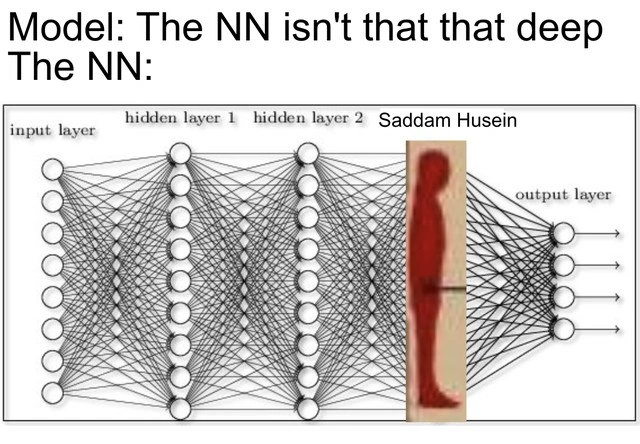
Let’s break down the meme’s elements in simpler terms. We have a picture of a neural network — basically a bunch of circles arranged in columns with lines connecting them. Those circles are the “neurons” or nodes (little computing units that take inputs, do a calculation, and pass output forward), and the lines are the connections (think of them as wires that carry numbers from one neuron to the next). On the far left, the column labeled “input layer” is where information enters the network. For example, if this network were trying to recognize a picture of a cat, the input layer might have one neuron for each pixel of the image, feeding in the pixel values.

On the far right, we see the “output layer” – those circles could represent the final results or predictions the network produces. In our cat example, the output layer might have two neurons: one outputs a value for “cat” and another for “not cat,” or if the network is classifying multiple animals, each neuron could correspond to a different animal. The output is the network’s answer after crunching through all the connections.

Now, the interesting part is in the middle: “hidden layer 1” and “hidden layer 2.” These are called hidden because you don’t directly see their values; they’re internal to the network’s computation. The first hidden layer takes the raw input (like the pixels) and applies a bunch of weights and functions to detect patterns – maybe simple ones like edges or colors in the image. The second hidden layer builds on that, maybe recognizing shapes or textures by looking at the patterns found by the first layer. Each hidden layer is essentially a step of feature extraction or transformation that brings the input data closer to something meaningful for the output layer to use. When you stack multiple hidden layers like this, that’s exactly what people mean by a deep neural networkdeep just means multiple layers of neurons between input and output. By contrast, a shallow network would have only one hidden layer (or none at all, in which case it’s just input straight to output).

The text at the top of the meme says: “Model: The NN isn’t that that deep” followed by “The NN:” and then the picture of the network. “NN” stands for neural network. So it reads like: the person (or code) describing the model is saying “The neural network isn’t that deep,” and then the meme shows us the actual network diagram, which clearly has two hidden layers. It’s a humorous way to call out that actually, by most standards in machine learning, two hidden layers counts as a deep model – it’s certainly beyond a trivial one-layer setup. It’s as if someone said “this cake isn’t very rich,” and then you see it’s a triple-chocolate fudge cake with caramel filling. The picture is contradicting the statement.

To illustrate, here’s a tiny pseudo-code of a neural network setup that matches the meme:

# Pseudo-code for a neural network with two hidden layers
model = NeuralNetwork([
    DenseLayer( neurons=8, activation='relu' ),   # hidden layer 1 with 8 neurons
    DenseLayer( neurons=8, activation='relu' ),   # hidden layer 2 with 8 neurons
    DenseLayer( neurons=4, activation='softmax')  # output layer with 4 neurons (for 4 output classes)
])

In this snippet, DenseLayer means a fully connected layer of a certain number of neurons. We created two hidden layers each with 8 neurons, and an output layer with 4 neurons (maybe this network classifies inputs into 4 categories). This layer_count (two hidden + one output) is definitely more complex than a single layer. So if someone told you “oh, it’s not a deep network, it just has a couple layers,” technically it is a deep network (since it has >1 hidden layer). That’s why the meme is funny: the developer’s description doesn’t match the network’s actual architecture shown. It’s playing on the idea that tech folks sometimes downplay how complicated something is.

Now, about that red figure overlaying the network – the vertical red silhouette that looks like a person, labeled “Saddam Husein.” This part is pure visual gag. They took an image of a person’s silhouette (for some reason, identified as Saddam Hussein – perhaps the meme maker found a silhouette named that, or it’s an old reference image) and stretched it to cover the whole height of the neural net diagram. This makes the network literally look as tall as a human body. The intention is to exaggerate the notion of “depth.” If you imagine standing a human figure next to something, and it’s the same height as the person, you’d call that thing pretty tall (or deep, if we’re talking vertical depth). So by showing the network alongside a human shape, the meme conveys, “See? The network is practically person-sized – that’s not small!” The use of Saddam Hussein’s name is likely just a random, absurd twist to make it more meme-worthy (there’s no special machine learning meaning to Saddam’s name here — it’s inserted for shock humor and randomness). In internet humor, mixing unrelated contexts (AI diagrams and a political figure’s silhouette) can make things oddly funny because it’s so unexpected. It’s the meme’s way of underlining the joke with a bright red marker — quite literally.

To sum up, at this level: The meme is highlighting the concept of network depth in a funny way. A “shallow” network usually means not many layers, but the one shown has two hidden layers, which in everyday ML talk is considered deep. The caption’s claim (“isn’t that deep”) and the reality (diagram showing a sizable network) are at odds. This is a nod to AI humor where we poke fun at ourselves as developers or data scientists for sometimes mischaracterizing our models. And the human silhouette overlay is just there to hammer home how silly that claim is, by giving a ridiculous visual comparison. It’s like the meme is saying, “You call that shallow? It’s as deep as a full-grown person!” Anyone who’s started learning about DeepLearning or built even a simple neural net can appreciate the joke: even your “basic” models can end up looking complex when you draw them out. Don’t worry if you’re new to this – even seasoned folks chuckle because it’s true that we sometimes pretend our creation isn’t over-complicated… until we actually diagram it and it looks like a plate of spaghetti wires! This meme laughs at that little developer fib in a lighthearted way.

Level 3: Deep Denial

This meme captures a scenario all too familiar in AI development: a slight case of developer denial about model complexity. The text sets up a classic two-part gag:

Model: “The NN isn’t that deep.”
The NN: (shows an obviously deep network diagram with multiple layers and a human silhouette)

In other words, the engineer claims their neural network is “no big deal, just a simple model,” and then we see the actual network looking like a spaghetti mess of neurons and connections – clearly not so simple after all. The humor comes from that stark contrast between what’s said and what’s shown. It’s like a chef casually saying, “Oh, this recipe is easy,” and then you look in the kitchen and every countertop is covered with bowls and ingredients. Here, “isn’t that deep” becomes an amusing understatement when the NeuralNetwork diagram reveals two sizable hidden layers loaded with neurons. For most of us, two hidden layers does qualify as a DeepLearning model (it’s literally the definition of a multi-layer perceptron). So we immediately recognize the joke: the model is deeper than the speaker is letting on.

Why would someone downplay layer count? In real developer culture, there’s an ongoing tongue-in-cheek dialogue about AI hype. On one hand, you have the hype-men bragging about ultra-deep models (“AIHype: Our network has 50 layers and will cure cancer!”). On the other hand, you have the pragmatic engineers who might say “Relax, it’s just a small two-layer network, nothing fancy.” This meme sides with the latter, but teases them: Sure, Jan, keep telling yourself it’s small 😏. Perhaps the developer built a surprisingly large architecture (maybe to ensure high accuracy or because they kept adding layers to improve performance) but still wants to portray it as a shallow network – maybe to not scare stakeholders or simply out of modesty. It’s a form of cognitive dissonance that seasoned ML folks find funny. We’ve all seen a teammate claim “It’s a simple fix” or “the service is lightweight” only for the reality to be an over-engineered beast. In software terms, this is like calling a codebase “just a script” when it’s actually a full MVC application with microservices – we chuckle because we’ve been there.

The network diagram itself is a dead giveaway that this model has too_many_hidden_layers (at least by the standards of someone expecting a trivial solution). There’s an input layer on the left (those circles likely represent input features), then not one but two hidden layers jam-packed with nodes, and finally an output layer on the right. Every node in one layer connects to all nodes in the next – that’s a fully-connected (dense) network, which quickly leads to a combinatorial explosion of weights. The tangle of lines is almost dizzying, a hallmark of a complex web of parameters. If you’ve ever visualized a neural network with even a couple of layers, it indeed looks like a thicket of interwoven connections. Seeing that mess, anyone who’s trained deep nets knows the implications: lots of neurons, lots of weights, likely a ton of training data needed, maybe a risk of overfitting if not handled carefully – in short, definitely not a toy model. That “shallow” model is arguably an overengineered_network for whatever the task might be (unless the task truly demands it). The meme is essentially shouting, “Who are you kidding? This thing is huge!” through the visual.

Now, the masterstroke of absurd humor: the vertically stretched red silhouette of a person labeled “Saddam Husein” pasted over the network. This random cameo is what takes the meme from mildly amusing to memorably ridiculous. The silhouette is roughly the height of the network diagram, making the network resemble a stick figure or human torso. On a literal level, it’s saying “your ‘not deep’ network is as tall as a full-grown man.” It exaggerates the network’s depth by giving it human scale. Why Saddam, of all people? There’s no direct link between a former dictator and neural nets — and that’s exactly why it’s funny in a tech meme. It’s meme_comparison by silliness: sometimes meme creators pick an outlandish, unexpected figure to invoke a spit-take reaction. In this case, naming the silhouette “Saddam Hussein” is so left-field it catches us off guard and makes us laugh out of sheer surprise. It might also be referencing a classic internet image of Saddam’s body outline – which is sometimes used in pranks or memes – purely for shock humor. The result is a bit of hidden_layer_humor: the hidden layers literally hide behind a human facade. It pokes fun at the idea that we sometimes anthropomorphize AI (“the network thinks like a human!”) by literally inserting a human shape into the network. And it underscores the original joke: the developer’s claim is as questionable as someone claiming a Saddam silhouette is just a random shape – we can clearly see what it is!

In essence, this level of the joke resonates with developers who have witnessed AI_hype and reality collide. We smirk because we know the type of colleague or boss who might minimize a project’s complexity until you see the architecture diagram. The meme cleverly combines technical satire (layer counts and architectural_depth being downplayed) with meme-y absurdity (Saddam’s ghost in the machine). It’s a reminder that in tech, when someone says “it’s not that complicated,” you might want to double-check the diagram – you never know what hidden complexity is lurking 😂.

Level 4: Depth Illusions

At the theoretical extreme, the humor touches on neural network depth as a concept in machine learning theory. A "shallow" neural network typically has just one hidden layer (or very few), whereas a "deep neural network" stacks multiple hidden layers to learn hierarchical features. Formally, there's even the Universal Approximation Theorem which states that a single hidden layer (if sufficiently wide) can approximate any continuous function on a given domain. This means, in theory, a "shallow" network with enough neurons can do almost anything a deep one can do – but how it does it (and how efficiently it learns) can differ dramatically.

In practice, depth provides a kind of model expressiveness that width alone struggles with. Each additional hidden layer allows the network to compose simpler functions into more complex ones, building up understanding in stages. For example, in image recognition, lower layers might detect edges, mid layers assemble edges into shapes, and deeper layers recognize objects. Two hidden layers (like in the diagram) let the network learn two levels of abstraction – which is already significant. By 2022, however, deep learning research had exploded with architectures dozens of layers deep (ResNets with 50+ layers, Transformers with hundreds). In that context, a model designer might genuinely think “It isn’t that deep” if it’s only a 2-hidden-layer feed-forward network. Compared to state-of-the-art DeepLearningModels with extreme layer counts, a mere two hidden layers could feel quaint!

But here’s the kicker: even a 2-layer network can pack a lot of complexity, especially if each layer has many neurons. The image’s dense web of connections hints at an over-parameterized network – likely thousands of weights. Modern theory on over-parameterization shows counterintuitive results: neural nets with far more parameters than training examples can still generalize well (thanks to phenomena like implicit regularization in gradient descent). So while the model’s creator insists it’s “not that deep,” the sheer number of connections suggests a model that could memorize the Encyclopedia if you let it. It’s the classic scenario of AIHypeVsReality with a twist: usually people over-hype depth, but here the engineer is understating it, knowingly or not.

And what about that bizarre Saddam Hussein silhouette plastered over the network diagram? This is absurdist seasoning on the joke. In a literal sense, the silhouette is roughly human-sized, implying the network’s depth is comically as tall as a person. There’s no technical link between Saddam Hussein and neural nets – that’s precisely why it’s funny. It’s an unexpected non sequitur that makes the exaggeration unforgettable. (One could stretch a metaphor: Saddam hid in a hole, so perhaps the “hidden” layers are hiding a “deep” secret – but that’s likely coincidence.) The main effect is visual shock value: by aligning a human figure with the network, the meme screams “Look how deep this goes – it’s person-sized!” in a way no plain description could. It’s a tongue-in-cheek way to highlight the architectural_depth of the network while poking fun at the developer’s claim. In sum, the meme wittily combines theoretical depth (layer count and network complexity) with an out-of-left-field visual metaphor, creating a layered joke that both ML insiders and casual observers can chuckle at – albeit on very different levels.

Description

The meme has a plain white background with bold black text at the top reading, "Model: The NN isn't that that deep" followed by a line break and "The NN:". Beneath the caption is a grayscale diagram of a densely - connected feed-forward neural network: an "input layer" of circles at the far left, two labeled columns "hidden layer 1" and "hidden layer 2" packed with nodes, and an "output layer" of circles at the right, all linked by a thicket of black lines. Super-imposed over the middle of the network is a vertically stretched red silhouette of a person with the label "Saddam Husein", visually exaggerating the network’s depth by equating it to a full-body profile. The juxtaposition pokes fun at engineers who downplay model complexity, using the classic deep-learning diagram to satirize conversations about whether a neural net is truly “deep” enough. Technically, it references hidden-layer counts, over-parameterized architectures, and the sometimes comical gap between model descriptions and their actual layer depth

Comments

6
Anonymous ★ Top Pick ML lead: “Relax, it’s only two hidden layers.” Me, counting nodes on a diagram thicker than our microservice call graph: “Cool - so ‘shallow’ now means a rack of A100s and a week of schedulers crying?”
  1. Anonymous ★ Top Pick

    ML lead: “Relax, it’s only two hidden layers.” Me, counting nodes on a diagram thicker than our microservice call graph: “Cool - so ‘shallow’ now means a rack of A100s and a week of schedulers crying?”

  2. Anonymous

    When you spend three weeks debugging why your model keeps predicting weapons of mass destruction in every dataset, only to discover someone's geopolitical bias got backpropagated into production

  3. Anonymous

    When your model's 'depth' comes from geopolitical history rather than gradient descent - turns out the real deep learning was the dictators we hid along the way. At least this architecture has better documentation than most production ML systems, even if the hyperparameters include 'spider hole coordinates' and 'rubble density.'

  4. Anonymous

    PM: “It’s only two hidden layers.” Me: “Exactly - fully connected O(n^2) weights, vanishing gradients, and a burn rate so deep finance needs gradient clipping.”

  5. Anonymous

    “Not that deep,” says the model card - two hidden layers; the deep part is the preprocessing DAG, feature store, Kafka, and canary routing, where we need a second model just to debug the first

  6. Anonymous

    When your NN claims it's shallow but gradient descent unearths a dictator in the latent space

Use J and K for navigation