Skip to content
DevMeme
6497 of 7435
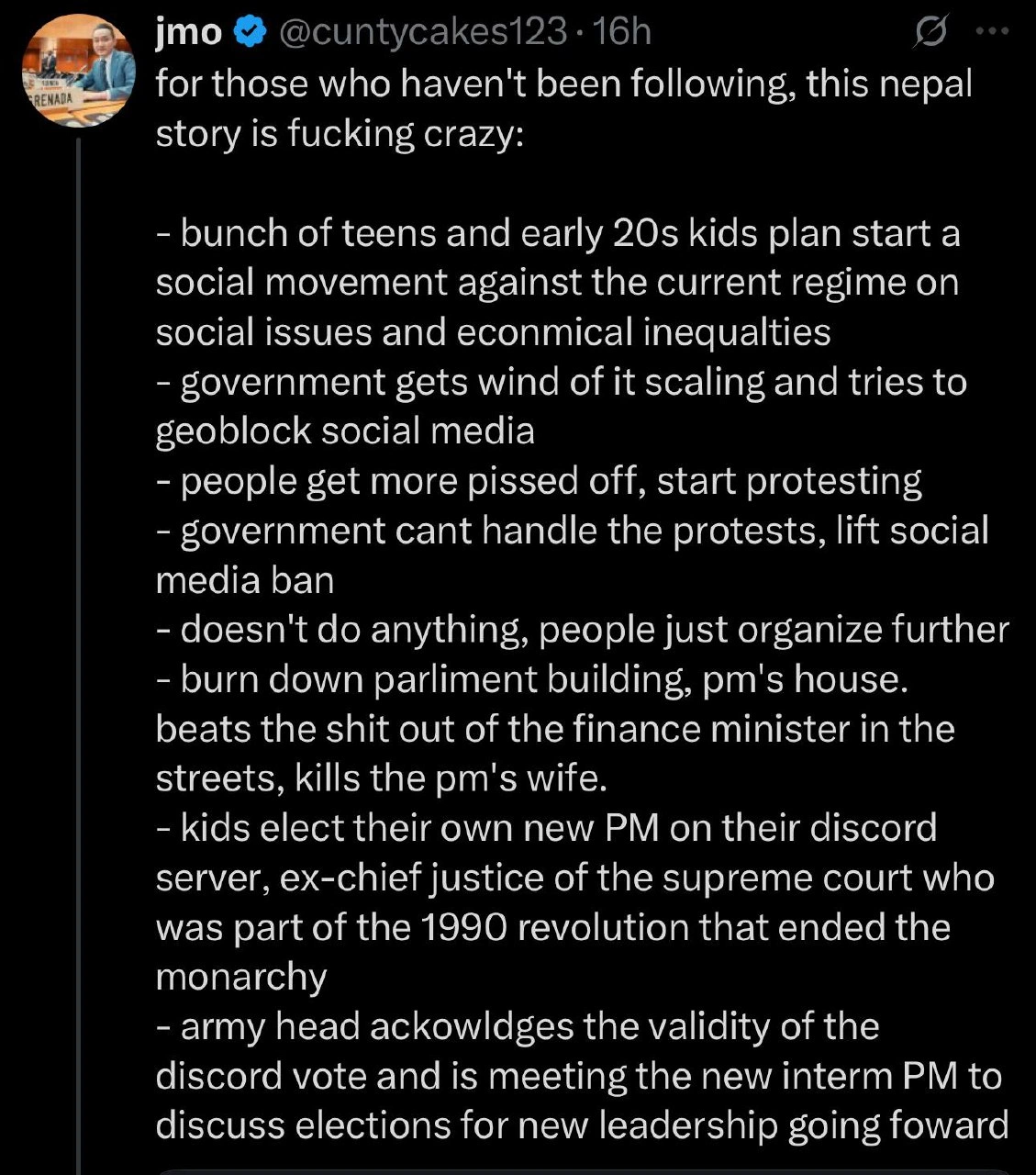
Nepal Gen-Z Overthrows Government, Elects PM Via Discord Vote
DevCommunities Post #7122, on Sep 12, 2025 in TG

Nepal Gen-Z Overthrows Government, Elects PM Via Discord Vote

Why is this DevCommunities meme funny?

Level 1: Thumbs-Up Government

Imagine your whole school has to pick a new class president, but instead of having a real vote or discussion, everyone is just texting in one giant group chat at the same time. The teacher says, “Hurry, we need to decide now!” and hundreds of students start reacting to that message with thumbs-up 👍, laughing faces 😂, angry faces 😡, and poop emojis 💩. It would be super confusing, right? Some people are trying to vote seriously (maybe 👍 for one person, 👎 for another), but others are just joking or venting with silly emojis. In the end, how do you even tell who “won” or what everyone agreed on? One person might count 50 thumbs-up as votes for Alice, while someone else sees 40 laughing faces and wonders, “Does that mean they don’t take Bob seriously?” It’s a big muddle.

This meme is funny because it shows a very important decision – choosing the leader of a whole country – being made in a really silly and chaotic way. Normally, picking a prime minister or president involves formal voting, ballots, and clear results. But here it’s like they just threw all of that out and said, “Eh, let’s do it in our group chat with emojis, we’ll figure it out 😅.” That’s as messy as trying to run a classroom by having everyone talk at once. The picture even has a flashy headline as if it’s big news: “Gen-Z overthrows government, does election on Discord.” It sounds crazy on purpose. The humor comes from that contrast: something as serious as a government turned into something as goofy as an emoji reaction game. It’s like if your parents decided family dinner plans by seeing who texted the most pizza emojis vs. sushi emojis – you’d probably laugh because that’s not how serious decisions are meant to be made! So the meme makes us laugh by showing how ridiculous it would be to run a “thumbs-up government” where important choices are literally based on who clicks what emoji in a chat.

Level 2: Group Chat Chaos

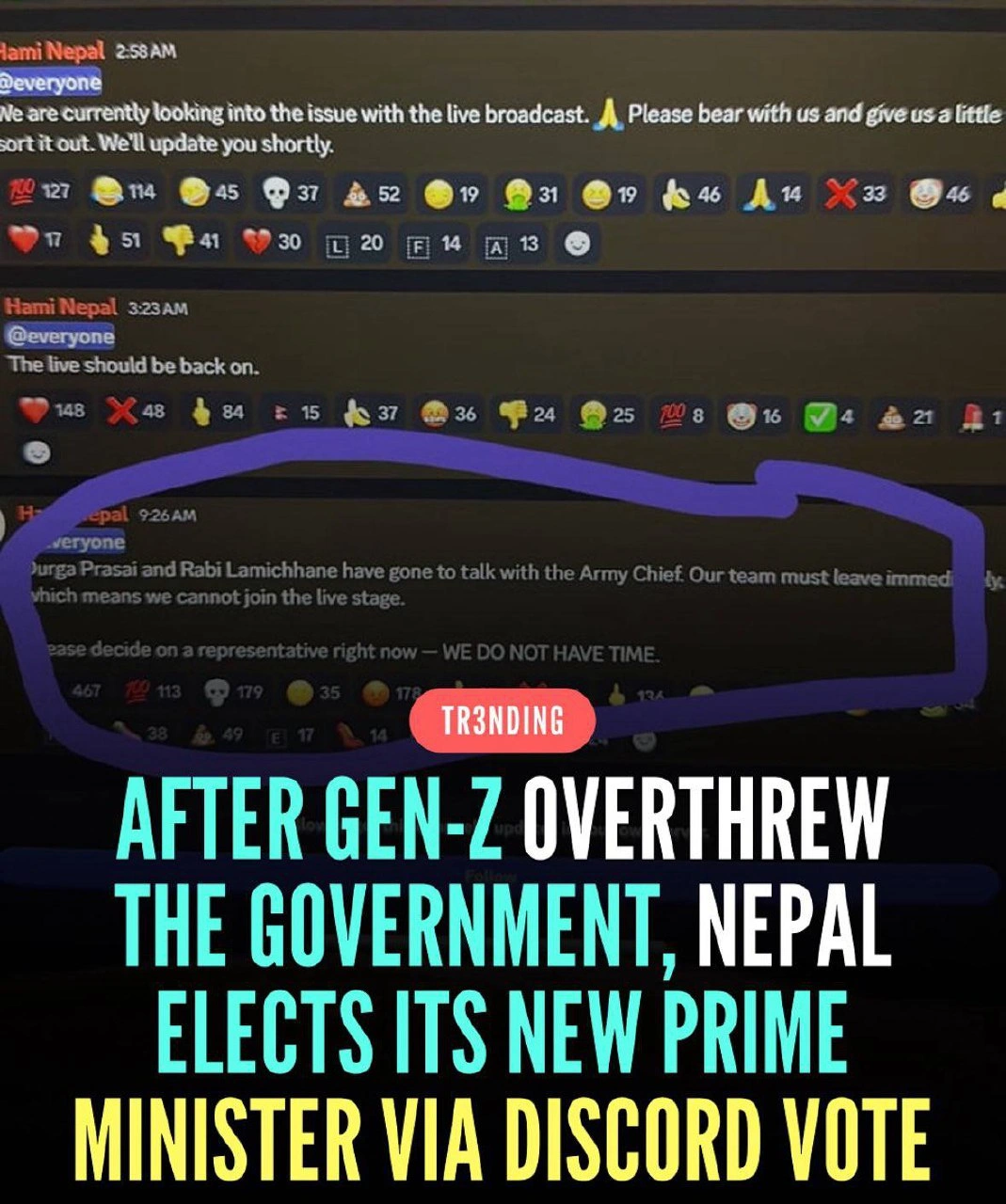
Imagine you’re part of a huge online group chat, like a Discord server (popular with gamers and dev communities) or a big Slack channel at work. Now picture that this chat is trying to do something absolutely crucial, like pick the leader of a country, in real time. Pretty wild, right? That’s exactly the crazy scenario this meme presents. It shows a screenshot from a Discord server named “Hami Nepal,” where everyone is frantically messaging and reacting. On Discord (and Slack too), you can mention @everyone to send a notification to all members of a channel – it’s a big red button used only for important announcements, because it will ping literally everybody. In the image, @everyone is used in three messages, which means the situation is super urgent. The times on the messages (2:58 AM, 3:23 AM, and 9:26 AM) tell us this conversation is happening through the wee hours of the night into the morning. This already feels like a firefight, like something is going really wrong and people are up all night dealing with it (sound familiar, devs?).

Let’s break down what’s happening in those messages:

  • 2:58 AM message: “We are currently looking into the issue with the live broadcast. 🙏 Please bear with us…” – This sounds like an official update from a moderator or leader of the Discord group. Something technical (a live broadcast, maybe a stream or online meeting) went down, and they’re asking everyone to be patient. The 🙏 emoji in the text is like saying please or sorry nicely. Under that message, we see a flood of reaction emojis: thumbs ups (👍), praying hands (🙏), red X marks, smiling faces 😂, even a poop emoji 💩. Those reactions have little numbers above them, meaning many people reacted with the same ones. For instance, “💯 112” means 112 people reacted with the 💯 emoji. In Discord, reacting is a way for a lot of people to quickly respond without typing a new message. A 👍 often means “Okay, got it” or “I agree,” a ❤️ might mean “We support you,” 😂 means people found something funny (maybe someone thinks this situation is ironically funny or absurd), and 💩 or 🤢 obviously show frustration or that this situation stinks (literally!). The mix of reactions shows that people in the chat have all sorts of feelings about this broadcast issue – supportive, annoyed, amused by the chaos. It’s not a clear signal at all, just noise.

  • 3:23 AM message: “The live should be back on.” Quick update – sounds like they fixed the broadcast (maybe the video stream is working again). Reactions here: 148 👍, a bunch of ✅ check marks, some ❤️ hearts, but also some ❌ and 🤡 (clown) faces. So even when things are fixed, people are reacting with clowns, perhaps mocking how messy this all is (“what a clown show!” someone might be implying). Still a lot of 👍 which presumably means “okay, good.” This is somewhat typical in big chats: even good news gets a flurry of random emoji responses. It’s like a reflex – everyone clicks an emoji to show they saw the update or to express their feelings.

  • 9:26 AM message: This is the kicker: “Durga Prasai and Rabi Lamichhane have gone to talk with the Army Chief… Our team must leave immediately which means we cannot join the live stage. Please decide on a representative right now — WE DO NOT HAVE TIME.” Whoa, suddenly this chat isn’t just about a broadcast, it’s about something very political. The message names two individuals (likely important figures in this story) who went to talk to the Army Chief (that sounds like real government crisis stuff). It implies those two were maybe candidates or leaders, and now they’re offline (having an in-person talk), and the rest of the group on Discord has to quickly choose someone else as a representative. It’s like an emergency vote because things are moving fast in the real world (“we do not have time” is in all caps!). Under this, the reactions are again all over: “💯 178” (178 people reacted with the 100% emoji, probably meaning “yes definitely”), “🙏 113”, “👍 37”, “😡 36” (angry face), “🤯 24” (mind-blown), “☠️ 23” (skull), “💩 21”, etc. This is chaos – people are just slapping emojis to register something: agreement, anger, confusion, you name it. There’s even a 🟢 green check and a 🔴 red circle among them—some might be trying to do yes (green) vs no (red) votes, while others are just reacting emotionally. In a normal election or decision, you’d have a clear yes/no or a list of options to choose from. Here it’s like everyone screaming their feelings in emoji form. It’s really hard to interpret what the “decision” is. Did they pick a representative? Are 👍 or 💯 votes for someone and 💩 votes against them? The meme intentionally makes it ambiguous and messy, to mimic how a serious decision becomes a circus in a free-for-all chat.

So, effectively, the meme is showing what happens when you try to use a group chat like Discord to do something that really needs structure – like voting or decision-making. In software teams, we often use Discord or Slack for quick communication, but usually for informal polls or getting a sense of the room. For example, a team might ask, “Lunch at 12:30 instead of 12? 👍 for yes, 👎 for no.” And that’s fine for little things. But imagine using Slack/Discord reactions to decide a major design change or a CEO hire – that would be nutty! Important decisions usually require a meeting, or a formal vote, or at least a poll with set choices. Here, the “Gen-Z” folks (the younger generation) in the meme skipped all that and just said “react to this message with emojis to effectively choose our Prime Minister.” It’s portrayed as something that trending news would headline because it’s so sensational and outlandish: the idea of digital democracy taken to the extreme.

Some terms and concepts to clarify from all this:

  • Discord server: An online community space on Discord, which has channels (like chat rooms). “Hami Nepal” is the server’s name here. Discord servers can have thousands of members. It’s like a big chat forum.
  • Stand-up meeting: In software teams (especially using Agile/Scrum methods), a daily short meeting where everyone “stands up” and tells what they did yesterday, what they’ll do today, and if they have blockers. It’s quick and meant to sync the team. The meme jokes that an entire country’s leadership election was done in a Discord stand-up style meeting – which is ironic because stand-ups are meant for quick status updates, not huge decisions.
  • Emoji voting: Using emoji reactions to vote or show preference. It’s common informally (like the lunch example above). But it’s not an official or foolproof way to vote – it’s just convenient and fun. In the meme, emoji voting is all they have, which is why it’s absurd.
  • Communication breakdown: This refers to a failure in communication where messages aren’t clear or get lost in the noise. You can see that happening: so many pings and reactions that the actual decision or message might not be clear to everyone.
  • Remote work culture and collaboration challenges: This scenario is exaggerated, but in real remote teamwork, people rely on tools like Discord/Slack to collaborate. When something urgent happens, remote teams can struggle because they’re not in the same room. Tons of messages fly around, and it can be confusing – exactly what’s shown here. It’s challenging to coordinate online during a crisis; you might have seen this even in a large group project or an online game raid gone wrong, where chat messages explode and it’s hard to follow the plan.

So, why is this meme funny to developers? Because it’s taking something we experience (Slack/Discord chaos in decision-making on a small scale) and blowing it up to a huge, ridiculous scale. It pokes fun at the idea that you could run something as serious as a government overthrow and an election with the same tools and methods you use to organize a college club or a software team’s daily tasks. The truth is, if you try to make big decisions in a free-for-all chat, you’ll likely get confusion and mixed signals – and here that reality is taken to comical extremes. Those of us who have been in messy Slack discussions look at this and chuckle: “Yep, that’s what it would look like if a whole country did things the way our chaotic team sometimes does!”

Level 3: ChatOps Coup d’État

For seasoned engineers, this image triggers PTSD from all-hands Slack channels and late-night outage “war rooms.” It’s a perfect storm of communication anti-patterns. We have an entire country’s leadership election supposedly happening in a Discord server, with the interface of a stand-up meeting crossed with a popularity poll. This absurdity tickles the same bone as remembering that time your team made a mission-critical decision in a Slack thread at 3 AM because production was on fire. The humor (and horror) comes from recognizing how easily important decisions can descend into 🎉 emoji reactions and @everyone shouts when there’s pressure and no structure.

Consider the @everyone barrage at odd hours (2:58 AM, 3:23 AM…). That’s the hallmark of an urgent ping culture: when something’s wrong, just blast a message to the whole group and hope someone responds. In the meme, a Discord admin is pinging literally the whole server in crisis (“we cannot join the live stage... decide on a representative NOW – WE DO NOT HAVE TIME”). Any engineer who’s lived through a high-severity incident can relate. It’s like when a site reliability engineer yells in Slack, “Production is down, I need all hands – database cluster failing – respond ASAP 👍👎❗”. The intention is to get urgency and consensus, but the effect is often chaos: dozens of people responding at once, multiple threads of conversation, and a flood of 🚑 fire-fighting emojis that do little to actually solve the problem. Here, instead of calmly convening a crisis meeting or following a runbook, the “team” (or rather, the country’s populace) is resorting to a quick emoji vote to choose a spokesperson in a national emergency. It’s a satire of ChatOps overreach – using a chat platform for something it absolutely isn’t designed to handle at this scale or importance.

The meme’s overlay headline — “AFTER GEN-Z OVERTHREW THE GOVERNMENT, NEPAL ELECTS ITS NEW PRIME MINISTER VIA DISCORD VOTE” — screams industry hype meets dystopian stand-up meeting. We’ve all seen those trending tech articles that breathlessly claim “X technology revolutionizes Y old process.” Here it’s poking fun at that trope: imagine a Hype Beast news alert claiming a country dumped traditional elections for a Discord server. It’s ridiculous, yet it resonates because in tech companies we do see decisions once made in boardrooms now happening on Slack or Discord. Online communities often hold quick polls or react with 👍 to gauge consensus on minor things – but scaling that up to a national election is an exaggerated mirror of scaling up startup culture to society. It tickles us because as devs we’ve sat through Slack polls on what the team t-shirt color should be… now imagine that trivial mechanism picking a Prime Minister. The decision-making by reaction counts is exactly what we do for lightweight choices (or lazy consensus: “no 👎 reactions, so we’ll proceed”), and the meme says “hey, what if Generation Z applied that same informal approach to toppling a government and picking the next leader?” It’s both hilarious and a tad plausible in a frightening way – the ultimate Communication Breakdown scenario.

There’s also a strong flavor of collaboration dysfunction here. The Discord messages show a team scrambling: first tech issues with a “live broadcast” (sounds like a live stream or online assembly failed – just like a Zoom outage during a critical all-hands meeting), then a frantic status “The live should be back on,” and finally chaos: key figures physically leave to negotiate offline (with the Army, no less), leaving the online masses leaderless. This is like if two principal engineers walked out of a heated Slack discussion to confer privately, and then everyone else in the channel is like “quick, we need a decision now, vote who’s in charge while they’re gone!” The urgent shortcut of a vote via emoji is both comical and painfully familiar. Many of us have seen a team choose a solution just because a majority reacted with 👍 on someone’s Slack message, even if half the team was asleep or the 👍 were just a knee-jerk. It gets the job “done,” but only in the sense that something was decided, not necessarily the right decision. The meme exaggerates this to a national scale for comedic effect.

And let’s talk emojis: the reactions under each message are all over the place. There are thumbs-ups (👍) and checkmarks for approval, thumbs-down (👎) and red X’s for dissent, but also tears of joy 😂, poop 💩, sick faces 🤢, clowns 🤡, hearts ❤️, and even a skull ☠️. It’s a tornado of emotional responses. To any developer used to Slack/Discord, this is peak clownery: when something crazy happens, people react not just seriously but with gallows humor and sarcasm. The presence of a 💩 or a 🤡 reaction in what should be a solemn vote is exactly the kind of dark humor devs deploy during absurd late-night incidents (“the server’s on fire, 👍 if you think it’s DNS, 💩 if you blame legacy code”). Here, those reactions under a message about electing a Prime Minister indicate utter chaos. Are people voting? Are they venting their feelings? Both? Neither? One can imagine a harried mod screaming “Guys, stop reacting with clown emoji, this is serious!” This is a textbook signal-to-noise problem – the useful signals (perhaps 👍 for candidate A, 👎 for not-A) are drowned in a sea of meme reactions. It’s funny because it’s true: we’ve seen technical discussions go off the rails with memes and emojis when things get stressful or absurd. Consensus gets disguised as a flurry of colorful icons, which is exactly how you misinterpret noise as agreement. Seeing 💯 and ☠️ on the same decision update is like seeing both “Ship it!” and “This is dead on arrival” at the same time – the team (or populace) clearly isn’t on the same page, despite the illusion of engagement.

From an organizational dynamics perspective, the meme mocks the idea of flat, leaderless decision-making taken to the extreme. Modern agile teams value being decentralized and democratic – great – but without a clear decision protocol, you get design by emoji committee. The line “Please decide on a representative right now — WE DO NOT HAVE TIME” reeks of desperation. It’s the kind of thing you’d see when a deadline looms (“Production deployment in 5 minutes – we need a go/no-go, everyone vote now!”). Senior devs know that feeling in their bones: the sinking realization that a critical call is being rushed and made by whoever yells loudest or reacts fastest, rather than through careful deliberation. If you’ve ever had upper management suddenly ask a scattered remote team for an immediate consensus (“drop what you’re doing and thumbs-up if you can support this hotfix going live”), you recognize the humor and horror here. Collaboration challenges in remote work often stem from lack of clear authority and process. This meme basically says: imagine those challenges, but with a country at stake. The result is as messy as you’d expect.

Historically, major decisions — be it in companies or governments — come with procedures: meetings, votes, discussions, Robert’s Rules of Order in board meetings, or at least a Google Doc RFC for the techies. The Gen-Z revolution depicted tossed all that out, apparently favoring the quickest tool they know: a Discord server poll with flashy reactions. It’s a satirical nod to how each new generation might over-index on the technologies they’re comfortable with. Gen-Z grew up with real-time online everything, so in the meme’s lore, they applied startup culture to statecraft: overthrow government on Monday, form a Discord on Tuesday, react with 👍😂💩 by Wednesday to decide the new Prime Minister. For a senior engineer who’s seen waves of Industry Trends & Hype, this pattern is recognizable. It’s akin to when a hot new tool or methodology is suddenly used for every problem, even ones it’s ill-suited for. (Remember when every project had to be microservices, including the ones that didn’t need it? Here it’s “we’ll run the government like a Discord community because that’s cool and modern.”) The meme exaggerates to make a point: just because a tool is great for casual or small-scale collaboration doesn’t mean you entrust it with literally running a country.

In essence, the senior-perspective joke is: Been there, done that, got the T-shirt (with a 👍 on it). We chuckle (or cringe) because we’ve experienced the mini-version of this in our professional lives. The stakes were smaller — maybe a production outage or a project decision — but the pattern was the same: unstructured chat “meetings” creating a facade of consensus amid actual chaos. It’s funny as a meme, but if you've lived through something similar, you laugh and then immediately think, “let’s never let that happen for real.”

Level 4: Consensus by Emoji

In a distributed system, reaching agreement on something as critical as a leader requires rigorous algorithms – think Paxos or Raft for leader election. These algorithms ensure all nodes either agree on the same leader or know the election failed, even if some nodes (or people) are offline or acting maliciously. Here, the meme parodies that idea by replacing formal consensus with raw Discord emoji reactions. In a real cluster, each server would send votes and acknowledgements in a coordinated fashion, ensuring quorum (a majority agreement) before declaring a new leader. There's logging, two-phase commits, maybe even handling of Byzantine faults (nodes that lie or send confusing data). By contrast, a Discord chat’s “algorithm” for decision-making is basically: whoever gets the most 👍 or 💯 wins, assuming everyone interprets those emojis the same way. It’s consensus in the same loose sense that a riot is consensus – not at all guaranteed or even well-defined.

Let’s draw a parallel in pseudo-code between a proper consensus approach and what’s happening in this Discord election:

# Proper distributed leader election (simplified pseudocode)
while not consensus_reached:
    votes = collect_votes_from_all_nodes()     # Gather votes from each participant (node)
    if majority_agrees(votes):                 # Check if more than half agree on one leader
        leader = agreed_candidate              # Consensus on a new leader achieved
        commit(leader)                         # Log and commit this decision so it's official
    else:
        propose_new_candidate()               # Try another round if no majority consensus

# "Consensus" via Discord emoji reactions
emojis = discord_message.reactions             # e.g., {"👍": 148, "💩": 8, "😂": 84, "👎": 15, ...}
leader_choice = max(emojis, key=emojis.get)    # Pick whatever emoji got spammed the most (👍 presumably)
announce(leader_choice)                        # Announce the "winner" based on raw reaction count

In a serious system, every vote is deliberate and identities are verified — you know which server/node cast which vote, akin to verifying voters in an election. In our Discord scenario, anyone on the server (including bots or random onlookers) can click any reaction emoji, possibly multiple times via alternate accounts. There’s no cryptographic guarantee here, no digital signature on each vote. It’s like trying to run a Byzantine Generals Problem solution but letting the generals vote with stickers on a bulletin board, hoping no one is a double agent or spamming false signals. The Byzantine Generals Problem in distributed computing describes how difficult it is for parties to agree on a concerted strategy (like “attack at dawn” or in this case “who should be PM”) when some participants might be traitors or when messages can be lost or forged. In a disciplined algorithm, we mitigate that with multiple rounds of voting, fault tolerance, and maybe requiring supermajorities. In this meme’s world, by contrast, a swarm of 😂 and 💩 reactions can muddy the waters of what “consensus” even means.

Furthermore, consider network partitions and timing. At 9:26 AM in the screenshot, key people have left the chat (“gone to talk with the Army Chief”), akin to part of a distributed network going offline. In distributed consensus theory, if some nodes are unavailable (partitioned), the system faces a choice: halt decisions until reconnected (to maintain consistency), or go on with a partial quorum (favor availability). Here, the Discord group chooses availability and speed (“Please decide… WE DO NOT HAVE TIME”) at the expense of consistency and full participation. This is reminiscent of the CAP theorem trade-offs: they sacrificed consistency (not everyone’s input is accounted for) to remain available (make some decision now). The result is a fast but loose decision – no guarantee that everyone will accept the outcome as legitimate later (which is exactly how forks and disputes happen in distributed databases when partitions heal). It’s a truly eventually consistent election: eventually everyone finds out who got the most emoji votes, but whether they all agree that person should be leader is another story.

Even the order of messages in a Discord chat isn’t guaranteed the way a sorted event log in a consensus protocol is. Two people might react at nearly the same time; Discord will display counts, but if messages were flying, the context can be lost. A robust system like a blockchain or Raft log would have an ordered record of “Proposal: Alice for PM – accepted by 8/10 nodes at time T.” In the meme, we get: “Proposal: Alice for PM – 148 👍, 84 😂, 15 🤬… etc. at God-knows-when.” There’s no mechanism to distinguish serious votes from joke reactions (is 😂 a vote for or just someone laughing at the absurdity?). The semantics are undefined. In computer science terms, the “state machine” of this election has ambiguous inputs: some reactions mean “yes,” some mean “no,” and some mean “lol this situation is insane.” The system can’t automatically interpret that reliably. It’s as if a database transaction included random emojis in place of commit/abort signals – the outcome is anyone’s guess.

This chaotic emoji voting is a far cry from a structured RFC process or a formal consensus protocol. An RFC (Request for Comments) in a tech-community or governance context would mean someone writes a detailed proposal, everyone reviews it over time, comments, and then an official vote is held with clear yes/no options. Similarly, a consensus protocol would ensure a single value is agreed upon out of the proposals. But here we have what one might call reaction-driven development of democracy: a flurry of instantaneous responses with no clear distinction between serious votes, emotional reactions, or plain spam. Fundamentally, the meme highlights an underlying truth from distributed systems theory: unstructured, asynchronous chatter doesn’t automatically produce coherent agreement. Without explicit rules or algorithms to follow, a “decision” from such a process is about as reliable as a coin flip – but hey, it’s the fastest finger first. In short, the meme’s scenario is like someone tried to implement a national voting system on top of a gaming chat app: it’s fun (in a dark way) to watch, but mathematically and logically, it’s a synchronization nightmare that would give Leslie Lamport (the father of Paxos) heartburn.

Description

A social media news post with the 'TR3NDING' watermark showing Discord chat screenshots from 'Hami Nepal' server. The messages show real-time coordination during what appears to be a political crisis in Nepal. Messages include '@everyone We are currently looking into the issue with the live broadcast', 'The live should be back on', and 'Durga Prasai and Rabi Lamichhane have gone to talk with the Army Chief. Our team must leave immediately, which means we cannot join the live stage. Please decide on a representative right now - WE DO NOT HAVE TIME.' The headline reads: 'AFTER GEN-Z OVERTHREW THE GOVERNMENT, NEPAL ELECTS ITS NEW PRIME MINISTER VIA DISCORD VOTE'
Comments

7
Anonymous ★ Top Pick Finally, a Discord server where '@everyone' actually means everyone in the country, and the 'admin' role comes with actual legislative power
  1. Anonymous ★ Top Pick

    Finally, a Discord server where '@everyone' actually means everyone in the country, and the 'admin' role comes with actual legislative power

  2. Anonymous

    Who needs Raft or Paxos when a wall of 💯 reactions counts as quorum?

  3. Anonymous

    When your country's democratic process runs on the same infrastructure as your gaming clan's raid coordination, at least you know the uptime will be better than most government websites - and the emoji reactions provide more nuanced feedback than traditional voting systems

  4. Anonymous

    When your infrastructure team says they're 'moving to Discord for better async communication' but you didn't realize they meant electing government officials with emoji reactions. This is what happens when you let the DevRel team handle your consensus algorithm - turns out Byzantine Fault Tolerance is just counting thumbs-up emojis and hoping the skull reactions are ironic. At least they're not using Slack threads; imagine trying to find the election results buried under 47 replies about lunch orders

  5. Anonymous

    Finally, a governance model our CAB will understand: quorum by reaction count - three 🔥 is SEV1, 100 ✅ promotes you to PM, and the audit trail is just the message link

  6. Anonymous

    Discord polls for PM: finally, a voting system with built-in rate limiting and zero hanging chads - just occasional outages during regime change

  7. Anonymous

    We’ve implemented Emoji‑Raft: leader election by reaction count - great availability, undefined consistency, and a runbook that starts with @everyone

Use J and K for navigation