Skip to content
DevMeme
6498 of 7435
Nepal Story: Gen-Z Revolution Summary From Social Media Ban to Discord PM
DevCommunities Post #7123, on Sep 12, 2025 in TG

Nepal Story: Gen-Z Revolution Summary From Social Media Ban to Discord PM

Why is this DevCommunities meme funny?

Level 1: Election by Group Chat

Imagine a bunch of kids at school are really unhappy with how the school is being run – say the rules are unfair and lunch is terrible. They start whispering and passing notes to organize a big protest to demand changes. The principal finds out and gets scared, so he tries to stop them from talking to each other. He bans all note-passing and even takes away their phones during school, hoping the kids can’t plan anything if they can’t communicate.

But guess what? That just makes the students even more upset. It’s like when you tell your friends they can’t talk about a secret, and suddenly they want to talk about it even more. The kids get so angry they start shouting in the hallways and planning to protest after school. The principal realizes his ban backfired (nobody’s calming down – they’re actually angrier), so he says, “Okay, fine, you can have your phones back, you can talk.” But by now it’s too late – the students are already united in rebellion.

That afternoon, chaos breaks out: the kids run around trashing the cafeteria and chasing out the strict teachers – basically turning the school upside down. With the principal hiding in his office and the school in disarray, the students decide to take matters into their own hands. They all jump into a big group chat (like a massive text messaging thread that everyone’s in – imagine a giant chatroom) and they vote for a new “principal” to be in charge. And they don’t pick just any kid; they pick an old, wise teacher who had helped reform the school many years ago and is respected by everyone. They’re like, “This teacher will be our acting principal now!” amazingly, the school security guard (who is kind of like the muscle of the school) hears about this and says, “You know what, if all you kids agreed on that in the chat, I’ll go talk to this new acting principal and figure out next steps.”

This sounds like a totally crazy school day, right? It’s funny and unbelievable because usually principals are chosen by the school board, not by kids on a group chat! The reason it’s humorous is that the principal’s attempt to control things by silencing the kids completely backfired. Instead of keeping control, he lost it entirely – the kids even picked a new leader using their phones and group messages. It’s like a modern twist on “the students took over the school” story, powered by a group chat vote. The core of the joke is that trying to stop people from communicating can just make them work around you in an even bigger way. In real simple words: if you try to shut people up, they might shout even louder somewhere else – maybe even loud enough to change who’s boss!

Level 2: Crowdsourced Prime Minister

Let’s unpack this story in simpler tech terms. A group of young people in Nepal used the internet to organize a movement against their government’s policies (social issues and economic inequalities were their grievances). They mainly coordinated over social media – think of platforms like Facebook, Twitter, or group chats that let lots of people communicate quickly. The government found out this was gaining momentum and tried a blunt-force approach: geoblocking social media, which means blocking access to those sites within the country. Essentially, they told internet service providers or used a firewall to prevent people in Nepal from using major social networks. This is like the government hitting a big OFF switch for Twitter/Facebook in that region.

Now, there’s something known online as the Streisand effect – named after singer Barbra Streisand – which is what happens when an attempt to hide or censor information ends up drawing more attention to it. (Streisand once tried to suppress photos of her house, and the attempt backfired, making those photos wildly famous.) In Nepal’s case, the crackdown on social media made people even angrier. Instead of quieting the protesters, it fired them up. Imagine a moderator in a forum suddenly deleting a thread that lots of people care about; usually it doesn’t silence folks – they just take the conversation elsewhere, even more passionately. That’s what happened here: protests exploded on the streets once the social media ban was in place. Cutting off the communication only convinced everyone that the government was really afraid of what they were saying, which motivated them further.

Overwhelmed by the growing protests, the government lifted the social media ban. But by then, people were already mobilized. Restoring Facebook and Twitter didn’t magically pacify anyone – in fact, now they could coordinate both online and offline. The movement snowballed: it went from peaceful organization to actual riots. The meme’s text lists extreme events: protesters burned down the parliament building and the Prime Minister’s house, beat up the finance minister, and even killed the PM’s wife. It’s very intense and quite shocking – basically the government completely lost control of the situation.

Now comes the tech-community twist: in the midst of this chaos, the young protesters elected a new Prime Minister on their Discord server! Discord is an online platform (originally popular among gamers) that lets you create servers for group voice and text chat. Think of it as a souped-up group chat app where each “server” hosts a community. Developers and hobbyist groups often use Discord servers to coordinate projects or just hang out. Here, the protesters’ Discord server became their command center. When the official Prime Minister was effectively out of power (hiding or incapacitated after the turmoil), these kids didn’t wait for formal procedures. They held a vote in Discord – basically using an online poll or counting votes posted in a chat – to pick someone they trust to act as the new interim PM.

And who did they choose? Not one of themselves, but an ex-Chief Justice of the Supreme Court who had been part of Nepal’s 1990 revolution that ended the monarchy. This detail is important because it shows the protesters picked a figure with credibility and experience in change – someone older who had stood up to power before. It’s like in an online community, if things go wrong, people might ask a well-respected veteran to step in as moderator. Here the “veteran” was literally a retired top judge known for reform. In a way, this was a crowdsourced leadership decision: no traditional ballots, no parliament votes – just an online community reaching consensus on who should lead temporarily.

Now, the truly surprising part: the head of Nepal’s army acknowledged this Discord vote as valid! The army chief basically said, “Okay, I see the people have chosen this person online, I’ll talk to them.” That’s pretty much unheard of – usually armies listen only to official governments. But the situation was so out of hand that the army recognized the reality on the ground (and online). This would be like if a company’s upper management publicly accepted a decision made by employees on a Slack channel because the CEO was away and the employees’ choice was the only thing keeping operations going. The army meeting with the new interim PM signaled that even the state’s force (the guys with the guns and tanks) agreed that the internet-organized decision had weight. They were essentially bowing to the community-driven process because the formal government had collapsed.

For a junior developer or someone new to these terms: this is a crash course in how powerful communication networks are. If you try to shut down communication (like the geoblock did), it often backfires (communicationGap becomes communication explosion). Online communities (whether on Discord, Reddit, or Twitter) have their own dynamics and can make big things happen in real life – that’s the InternetCulture aspect. We often see internet polls or campaigns that influence decisions (like fans voting to influence a TV show or a tech community deciding the name of a library), but influencing a government leadership change is next level. This story is basically an extreme example of community dynamics: a decentralized group using tech tools to outmaneuver a centralized authority.

In tech terms, you can also think of it like this: the government was an old centralized system (like a legacy monolithic app) that couldn’t handle the stress of too many user requests (the public dissent). The people formed a distributed network (lots of individuals connected via social platforms, akin to microservices communicating). When the government tried to cut the network (networking literal disconnect), the distributed system re-routed and kept going (they switched platforms, kept communicating). Ultimately the “clients” (citizens) even did a leader election – a concept from distributed computing where network nodes vote on a new master node if the current master fails. Here the citizens voted on a new “master” (Prime Minister) because the old leadership failed. They did it on Discord, which, amusingly, was their consensus mechanism (the way to agree on something as a group).

The takeaway in plain terms: trying to silence an online-savvy crowd can spectacularly fail. Instead of stopping the movement, Nepal’s social media ban supercharged it. People coordinated through any means available (Discord being a big one) and even made major political decisions through an online poll. It’s a vivid reminder of how online communities and communication platforms can influence real-world events. The meme narrates it in a shocking, slightly comedic way because the idea of a Discord server appointing a nation’s leader sounds absurd – yet it happened! For developers who use Discord to discuss coding or memes, seeing it used as a tool of revolution is both unbelievable and darkly funny. It underscores that in today’s connected world, a group of determined people online can act faster than traditional structures – whether that’s for writing open-source software or, apparently, overthrowing a government.

Level 3: Geoblock Cascade Failure

From a seasoned developer’s perspective, this Twitter meme reads like a dramatic postmortem of a system outage caused by a terribly executed hotfix. We have a classic case of the Streisand effect in action: attempt to censor or block something and watch it come back to bite you tenfold. The Nepal government heard about a bunch of young people coordinating a social movement (their “users” organizing in a way the authority didn’t like). In a panic move, they deployed a crude patch – geoblocking social media – thinking they could cut off the coordination channel. That’s akin to a sysadmin panicking and yanking the network cable out of a server to stop a bad process. Any senior engineer can tell you: such band-aid fixes often cause more damage. Here it indeed poured gasoline on the fire: people only got more angry and more determined when their communication was restricted (textbook Streisand effect). It’s the equivalent of trying to quiet a complaining userbase by shutting down the forum – you’ll just prompt an exodus to a new platform where the complaints multiply louder.

We can break down the “incident” timeline as if this were an outage in a tech system:

  • Early Warning: Signs of high load in the “social system” – youths organizing on social media about social injustice (like users spinning up a big feature the system wasn’t ready for).
  • Ill-Advised Hotfix: Government attempts a social media ban (deploying a firewall rule to drop traffic). This is like pushing a risky config change (sudo iptables -A DROP social_media) during peak load. No surprise, it leads to…
  • Cascade Failure Begins: The ban enrages the users. Protests erupt in the streets – think of this as a surge in write operations to an already strained database. The system load (public anger) spikes instead of dropping.
  • Rollback: Overwhelmed, the government lifts the ban (reverts the change) in hopes things will calm down. But rollback doesn’t restore normal operation; it’s too late. In outage terms, the database is already in inconsistent state and the clients (citizens) have lost trust in the service.
  • Catastrophic Crash: The situation goes nuclear – protesters literally burn down the parliament building and the PM’s residence. Key components of the old system are physically destroyed or removed. This is the production server catching fire, the data center meltdown moment. The regime’s “uptime SLA” just collapsed.
  • Unplanned Failover: In the chaos, the citizens initiate a leader election on Discord – basically spinning up a new cluster leader from outside the old system. They choose an ex-Supreme Court Chief Justice (someone with credibility, a stable node) via a quick poll on a Discord server. It’s a crowdsourced PM solution, akin to the engineering team promoting a respected senior dev to tech lead when all the managers quit.
  • Quorum Achieved: Now even the head of the army (a major stakeholder, previously part of the old system) acknowledges this Discord-elected interim Prime Minister. That’s like upper management begrudgingly accepting the tech team’s emergency decision because the official chain of command broke down. The army meeting the Discord-chosen leader is essentially hitting consensus – the final node agrees to the new state.
  • Aftermath: They plan to discuss proper elections going forward (a full re-architecture and system reboot in governance terms). The incident has triggered a complete refactor of how the country will run, just as a massive outage triggers rethinking the architecture of a service.

The humor (tinged with shock) for tech folks comes from how familiar this pattern is, despite the stakes being so high. We’ve all seen quick fixes that blow up: a seemingly small intervention unleashes chaos – a true cascade failure. The government’s social media ban is exactly the kind of knee-jerk action that a seasoned SRE would facepalm at, because communication networks don’t shut down gracefully under pressure; they reroute and often come back stronger. This is why the Streisand effect is legendary in internet culture: trying to silence people or hide information in the digital age just amplifies the signal. It’s like compressing a spring – when released (or even while pressed), it snaps back with force. Here the spring was the public’s pent-up frustration, and the geoblock compression led to an explosive release.

Another layer of tech-insider humor is the notion of electing a national leader via Discord poll. Discord, typically known for gaming communities and developer chat groups, suddenly became the medium for regime change. That’s as absurd (and darkly funny) as if a country’s fate was decided by a Strawpoll link or a Slack emoji reaction vote. In developer culture, we’re used to doing informal polls about lunch options or naming variables, but seeing a “DiscordServers” channel used to choose a Prime Minister is next-level InternetCulture. It’s a perfect example of how OnlineCommunities can organize with serious impact. The meme highlights how nowadays a group of motivated individuals on an online platform can coordinate faster than a slow-moving legacy hierarchy. It’s a bit like an open-source community fork: if the maintainers (government) are unresponsive or hostile, the users might fork the project (form a parallel movement) and even succeed in supplanting the original.

Seasoned devs also appreciate the irony of the legacy system (old government structure) failing to scale horizontally. The regime couldn’t handle a large-scale, distributed challenge. They tried the equivalent of scaling down (cutting off user communication) instead of scaling out or adapting – and it backfired spectacularly. In tech, when a monolithic application can’t handle load, you don’t just turn off user access (that’s a last resort); you’d consider adding more resources or a smarter strategy. The Nepali government’s approach was the non-technical manager’s brute-force “solution,” reminiscent of a higher-up saying “Just unplug the server, that will stop the bad activity” — sure, but at the cost of stopping everything good too. And once they plugged it back in, all hell had broken loose.

In essence, this meme had DevTwitter in awe because it distilled a complex socio-technical failure into a few bullet points that read like an engineering horror story. It’s hilarious in a jaw-dropping way: the failure of communication management led to an irrecoverable system crash (for the government). For those of us in tech, it’s a poignant reminder that communication is the backbone of any system, whether it’s microservices chatting or citizens planning a protest. And if you mishandle that communication — especially by trying to forcefully suppress it — you might just trigger the very outcome you wanted to avoid, but 100 times worse. As the context tags suggest, this was a digital_insurrection supercharged by the streisand_effect, a true “did that just happen?” moment where internet community dynamics took down a real-world power structure. It’s scary, it’s fascinating, and it’s an extreme case of the kind of CommunityDynamics that tech folks know well: empowered by unbridled communication, a motivated crowd can self-organize faster than any old-school command-and-control system can respond. In other words, don’t underestimate a bunch of organized teenagers on Discord – they just might reboot your entire system overnight.

Level 4: Consensus Under Partition

At the most theoretical level, this meme is a wild real-world enactment of distributed systems principles and failures. The government's attempt to geoblock social media essentially created a network partition – isolating nodes (citizens) from standard communication channels. In distributed computing terms, Nepal experienced a forced split-brain scenario: one partition with the regime trying to maintain control and another with outraged citizens seeking new ways to synchronize. The result? The classic trade-offs described by the CAP theorem came to life. By cutting off connectivity, the government sacrificed Availability of information in pursuit of control (a kind of misguided Consistency), but the system (society) found a way to remain Partition Tolerant: people quickly routed around the outage. This reflects John Gilmore’s famous axiom about the Internet: “The Net interprets censorship as damage and routes around it.” The blocked Facebook/Twitter traffic was treated as packet loss, and the community reestablished communication via other channels (enter Discord) to restore availability.

What’s breathtaking is how a consensus protocol emerged organically among the protesters. In computer science, a leader election algorithm (like Paxos or Raft) helps distributed nodes agree on a coordinator after failures. Here, a bunch of human "nodes" on a Discord server collectively elected a new Prime Minister – essentially performing a multi-agent leader election in real life. It’s as if the cluster of citizens detected the primary node (the Prime Minister) had failed catastrophically and initiated a failover. Discord acted as the consensus medium, similar to a raft of servers passing around ballots until a new leader was chosen by majority quorum. No formal Raft algorithm was implemented of course, but the voting on Discord mimicked the idea of reaching agreement despite communication faults. The military (Army head) acknowledging the Discord vote is like an authoritative node validating the new leader’s term in a distributed consensus – a real-world commit of the new leadership value.

This scenario even brushes up against the Byzantine Generals Problem. That’s the classic problem of achieving agreement in a distributed network where some actors are unreliable or malicious (a nod to Byzantine fault tolerance in algorithms and to the context tag byzantine_governance_failure). The protesters had to coordinate their “attack” (protest and political action) with the government actively acting as a malicious node—jamming communication (censorship) and spreading fear. Despite these Byzantine faults, the system of youth achieved consistency on a single course of action (overthrow and new elections) by using a trustworthy intermediary (the ex-Chief Justice chosen as new PM, a figure with established credibility, akin to a reliable node). In essence, they achieved a form of Byzantine fault-tolerant consensus: enough participants agreed on the new leader and path forward, and even the previously adversarial node (the army, part of the state apparatus) accepted this consensus, at least temporarily. It’s remarkable – like a chaotic test of distributed governance protocols, where the Streisand effect acted as an amplifier for consensus-building.

Speaking of the Streisand effect, from an information-theory perspective it’s a feedback loop where an attempt to decrease signal (hide information) actually increases the signal-to-noise ratio dramatically (everyone focuses on the very thing suppressed). The geoblock introduced a high-pressure state in the information network, forcing information propagation into new channels. In control systems terms, the government applied a hard clamp on output (free expression), but that led to oscillation and eventual uncontrolled surge – a bit like trying to dam a river and instead causing it to overflow catastrophically. This resonates with how an overflow or backpressure can cause a system crash. Here the “system crash” was the literal collapse of governmental authority.

In summary, the meme’s story provides a mini PhD seminar in distributed coordination: network partitions and recoveries, consensus under adversarial conditions, and emergent order from chaos. It takes lofty concepts like distributed leader election, consensus algorithms, and network resilience out of the whiteboard domain and drops them, dramatically, into the real world. An entire country’s political reset happened via an online community vote — a kind of ad-hoc Paxos in a DiscordServers channel with very high stakes. It’s both terrifying and darkly fascinating to systems engineers: a flawed legacy governance architecture failing to handle the load of modern, horizontally-scaled social connectivity. In pure theory, we learned that if one communication channel is geoblocked, information will seek eventual consistency through other paths, and consensus will emerge somewhere in the network, expected or not. Nepal’s Discord revolution is basically the Byzantine consensus algorithm no one intended to run, executed live on the world stage.

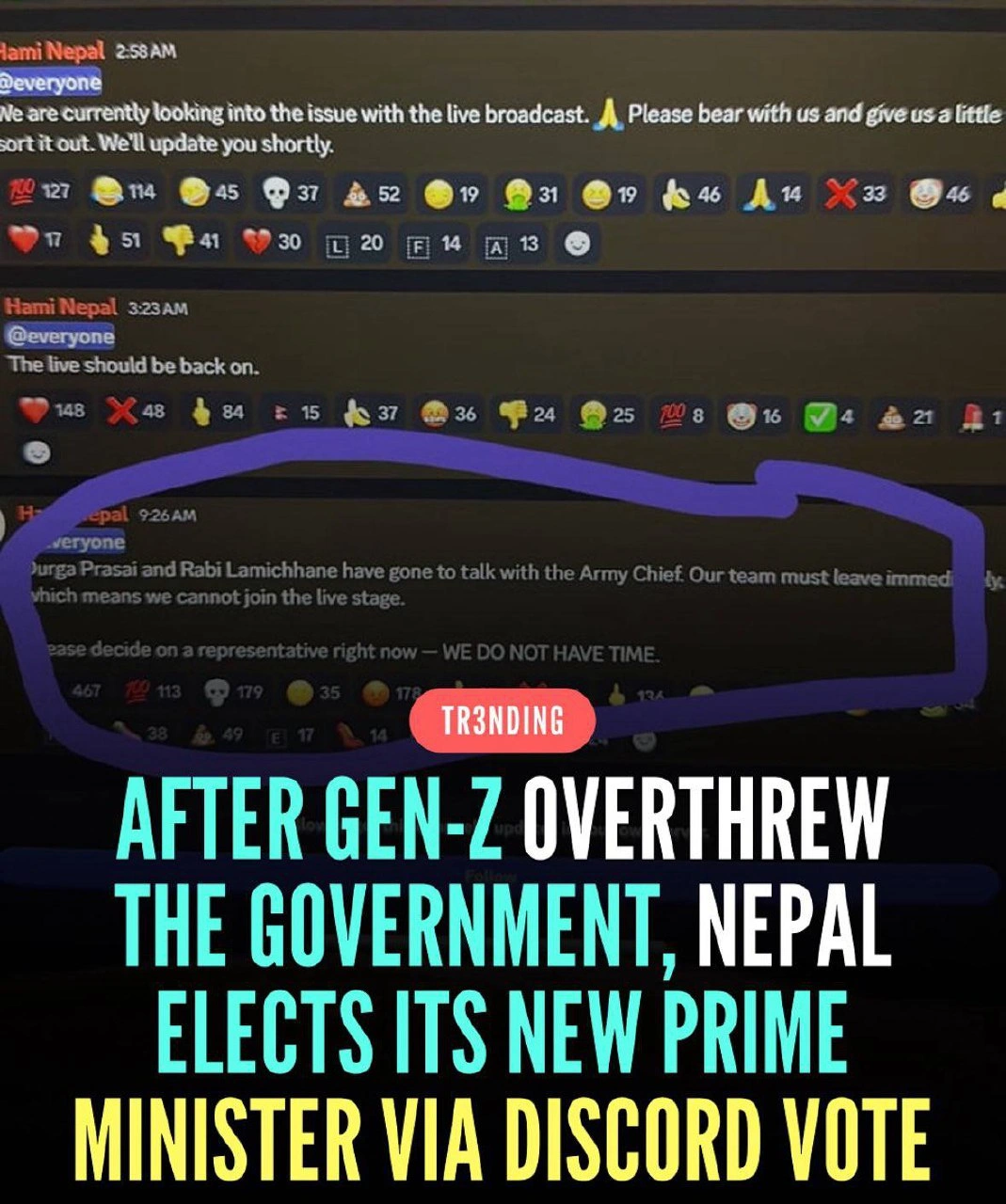
Description

A tweet/X post by jmo (@cuntycakes123) providing a detailed summary of the Nepal political crisis: 'for those who haven't been following, this nepal story is fucking crazy:' followed by a timeline: teens and early 20s start social movement against current regime on social issues and economic inequalities; government tries to geoblock social media; people get more angry and protest; government lifts social media ban; people organize further; burn down parliament building and PM's house; beat finance minister in streets; kids elect their own new PM on their Discord server (ex-chief justice from 1990 revolution); army head acknowledges the validity of the Discord vote and meets the new interim PM
Comments

7
Anonymous ★ Top Pick Government: 'Block all social media!' Gen-Z: 'We'll just overthrow you on Discord and elect a PM in the #general channel. Also the vote passed with 148 heart reacts.'
  1. Anonymous ★ Top Pick

    Government: 'Block all social media!' Gen-Z: 'We'll just overthrow you on Discord and elect a PM in the #general channel. Also the vote passed with 148 heart reacts.'

  2. Anonymous

    When your parliamentary quorum can’t reach consensus, just spin up a Discord server - turns out emoji reactions implement RAFT faster than any legacy government API

  3. Anonymous

    When your production environment is so stable that Discord has better uptime than your government, and the kids running the Minecraft server have more experience with consensus algorithms than parliament

  4. Anonymous

    When your Discord server's governance model accidentally becomes more legitimate than your country's actual government, you know we've reached peak 'move fast and break things' - except this time they broke parliament. Literally. I guess 'Discord Nitro' now includes constitutional authority, and the real question is: did they use a bot for the election, or was it just a really heated poll in #general? Either way, this is what happens when your infrastructure is more reliable than your democracy - at least Discord's uptime SLA is better than most governments' accountability metrics

  5. Anonymous

    Geoblock deploy with the ultimate blast radius: scaling alert to regime change in one rollback fail

  6. Anonymous

    The regime induced a network partition with geoblocking; the citizen cluster just ran Raft on Discord - choose P and CAP quietly deprecates your leadership

  7. Anonymous

    Democracy via Discord is ChatOps for constitutional change - quorum by emoji, rollout in threads, and the general’s checkmark serves as CAB approval, still faster than our enterprise release cycle

Use J and K for navigation