
The MVP Staircase to Nowhere
Description
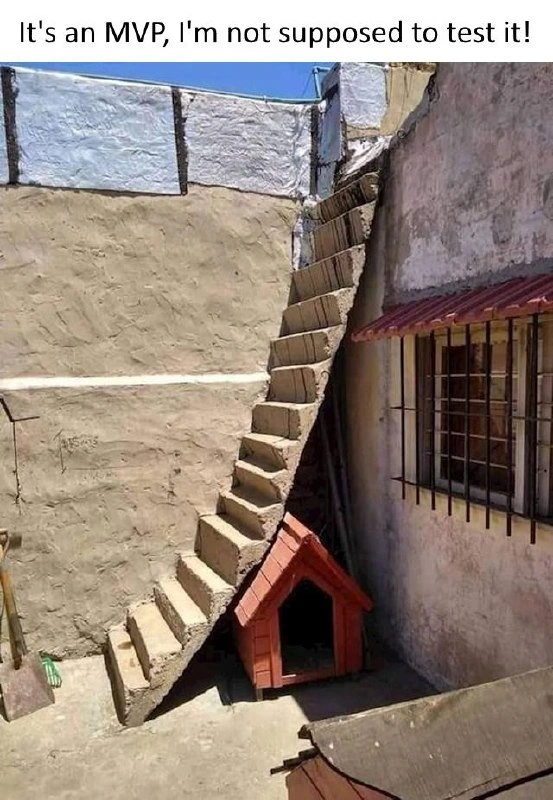
The image displays a poorly constructed, steep concrete staircase built against a rough, unfinished exterior wall. The steps are uneven and appear hazardous. At the bottom of the stairs, a small red wooden doghouse is wedged directly underneath, completely blocking the last few steps and rendering the entire staircase unusable. The overall scene suggests a comically dysfunctional and dangerous piece of construction. Above this image, a caption reads: 'It's an MVP, I'm not supposed to test it!'. The meme draws a parallel between this absurdly flawed construction and a Minimum Viable Product (MVP) in software development. It satirizes the tech industry mindset where the 'MVP' label is sometimes used as an excuse to rush out a product that is not just minimal in features but is fundamentally broken, untested, and fails to perform its core function. The image serves as a potent visual metaphor for shipping code without any quality assurance, leading to a useless end product

Comments
12Comment deleted
This MVP successfully validates the core hypothesis: users can't report bugs on a feature if it's physically impossible to access it in the first place. Ship it
Product calls it an MVP staircase, QA calls it a post-mortem, and SRE calls it an unbounded retry loop with gravity as the exponential back-off
This is the same MVP that somehow passed the architecture review because the senior engineer who would've flagged it was in another "alignment meeting" about why we need to align on alignment
This is what happens when product management interprets 'ship early, iterate later' as 'structural integrity is a post-launch feature.' Sure, it technically gets users from point A to point B, but the blast radius of failure includes both the engineering team's reputation and anyone brave enough to actually use it. At least when this MVP collapses, it won't take down the entire production environment - just your career and possibly several load-bearing walls
Calling it an MVP doesn’t eliminate testing - it just outsources the integration test to production, with gravity as the test runner
PM calls it an MVP; SRE calls it a canary. SLO: fewer than one gravity exception per sprint, and the handrail’s scheduled for v2 after the postmortem
MVP: Minimum Viable Product, or 'Miraculously Vertical, Postponed Testing' - until users climb it
"if it works - do not touch" (c) Comment deleted
Most Valueble Pstaircase 😤 Comment deleted
when finished testing server on localhost and ready to go live release Comment deleted
looks almost exponential Comment deleted
It actually depends on how much of each step is incorporated into the wall. (Let's be honest, most probably none at all.) Comment deleted