Skip to content
DevMeme
5960 of 7435
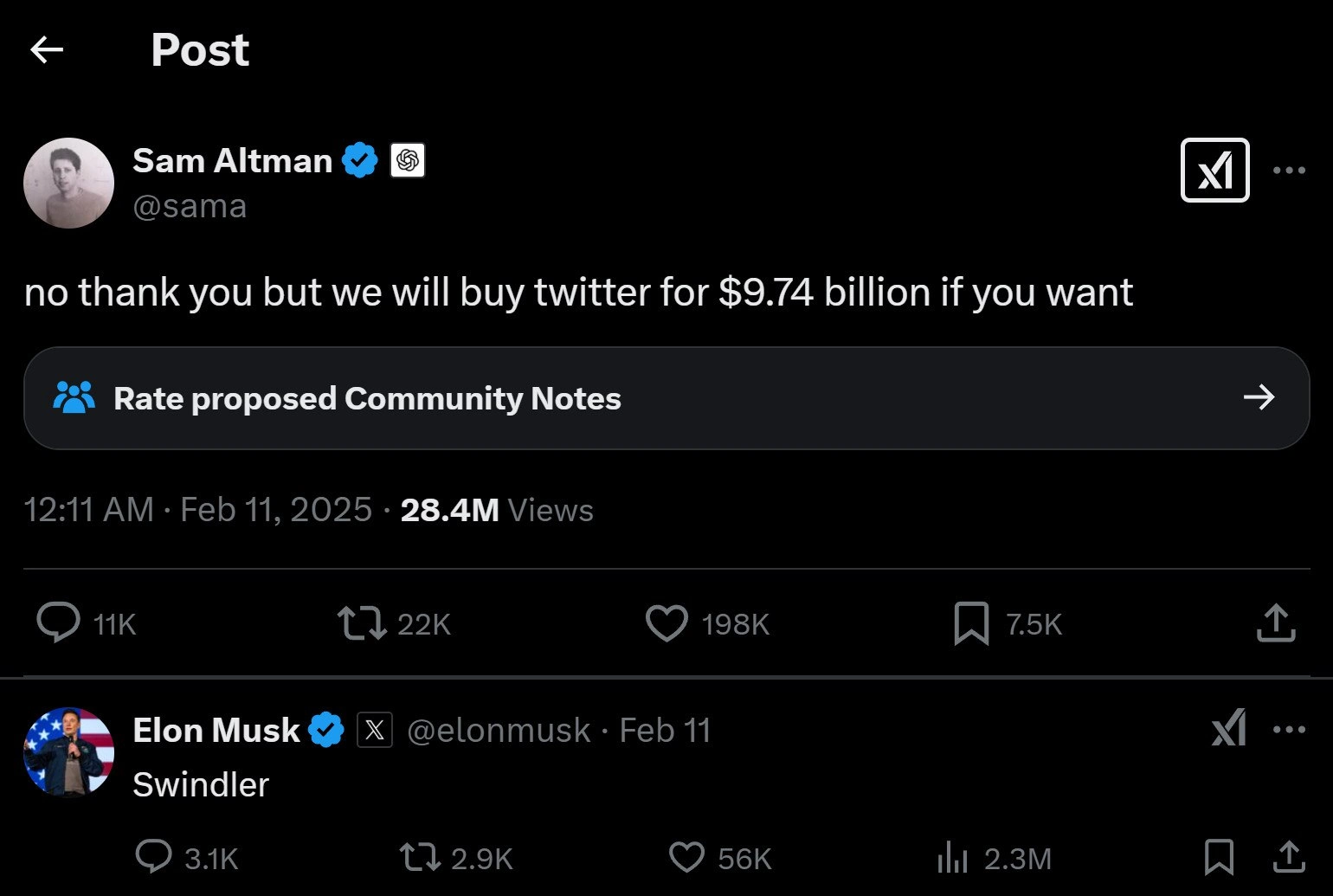
Musk-led consortium proposes $97.4B takeover of OpenAI, shaking the AI landscape
AI ML Post #6527, on Feb 12, 2025 in TG

Musk-led consortium proposes $97.4B takeover of OpenAI, shaking the AI landscape

Why is this AI ML meme funny?

Level 1: Playground Power Play

Imagine you and your friends have been working on a really cool sandcastle together, meant for everyone to enjoy. It’s the best sandcastle anyone has ever seen – with secret tunnels and tall towers. You all agreed it should be for everyone to play with, not just one kid. Now picture one of the older kids, who helped start the sandcastle idea long ago, coming back with a gigantic bag of candy (we’re talking almost 100 billion pieces of candy!). He slams it down and says, “I want to be in charge of this sandcastle now. Here’s a ton of candy for all of you if you let me take over.” It’s so much candy that it doesn’t even seem real – like cartoonish, pile-to-the-sky amounts.

All the kids freeze and stare. On one hand, wow, that’s an unbelievable amount of candy – it shows how important and special the sandcastle has become. On the other hand, everyone senses that if one person becomes the boss of the sandcastle, things will change. Maybe the rules of who can play with it will be different, or the original idea of “sharing with everyone” might get lost. It’s a bit funny because it’s such an over-the-top offer (who shows up with that much candy just to control a toy we all built together?). It’s also a bit worrying – what if the new boss doesn’t let everyone play nicely anymore?

In simple terms, this scenario is amusing like a story you’d hear on a playground: a super rich kid tries to buy the coolest toy outright. Everyone laughs a little because it’s so extreme, but they’re also not sure what will happen next. Will the sandcastle get even bigger and cooler with all that candy (resources)? Or will it stop being the friendly project it used to be? The heart of the joke is that something meant to be shared equally might become someone’s prized possession – all because of a huge, wild offer that nobody saw coming. It’s surprising, a bit silly, and that’s why it makes people grin and gossip, just like kids on a playground when something unbelievable happens.

Level 2: OpenAI 101 – Big Lab, Bigger Moves

OpenAI is basically a very important research lab and company that created famous AI models like GPT (the brain behind ChatGPT). Think of OpenAI as a place where super-smart folks teach computers how to understand language and solve problems. It started with a mission to be “open” and share research for the good of everyone. In reality, as its AI models became more powerful (and expensive to create), OpenAI had to partner with big investors (like Microsoft) and became a sort-of-business. This means it’s not just about research; there’s money and products involved now.

Now enter Elon Musk – yes, the same guy behind Tesla (electric cars) and SpaceX (rockets). He was one of the original founders of OpenAI back in 2015. Musk has always been loud about AI safety – basically making sure AI doesn’t turn into some rogue robot overlord. He left OpenAI a few years later, partly because of disagreements (rumor has it he wanted OpenAI to stay non-profit and maybe under his guidance, but others had different plans). Fast forward to the headline: a “Musk-led group” means Elon has teamed up with other investors to try and buy OpenAI. A $97.4 billion bid is an offer to pay that staggering amount to take control of the company. For context, that number is insanely high – even in tech land – showing just how hyped AI has become. It’s like saying “AI is so crucial, we’ll pay almost 100 billion dollars for the keys to the kingdom.”

For junior devs or those new to the industry, seeing such a headline might cause a double-take. Is this for real? It reads like a tech plot twist. Big acquisitions happen (remember when Microsoft bought GitHub, or Facebook bought Instagram?), but this one is off-the-charts huge. It raises a lot of questions:

  • What happens to OpenAI’s projects? Often when a company is bought, the new owner can change the direction. If Musk’s group took over, they might push OpenAI to do different things – maybe focus more on certain research, or open-source more (or less!), or integrate with Musk’s other plans (Mars AI, anyone?).
  • Why would Musk do this? Possibly because he’s concerned about who controls AI. Musk has voiced that AI should be developed carefully and transparently. He might feel OpenAI is too closed or too influenced by corporate interests already (hello, Microsoft). By taking control, he perhaps thinks he can steer it toward safer or more “for humanity” directions. Of course, others see it as him just wanting the hottest tech under his belt – it’s a debate of altruism vs ego/hype.
  • AI governance is a term you’ll hear – it means how decisions about AI development are made, and who gets to make them. This headline suggests one group wants to govern a huge chunk of AI by owning OpenAI.
  • Industry consolidation is another concept here: that’s when fewer people or companies end up owning more of the industry. It often happens when an industry matures – big fish swallow the little fish. If Musk’s consortium succeeded, one arguably very influential person (with friends) would have a huge say over AI research and products used by millions.

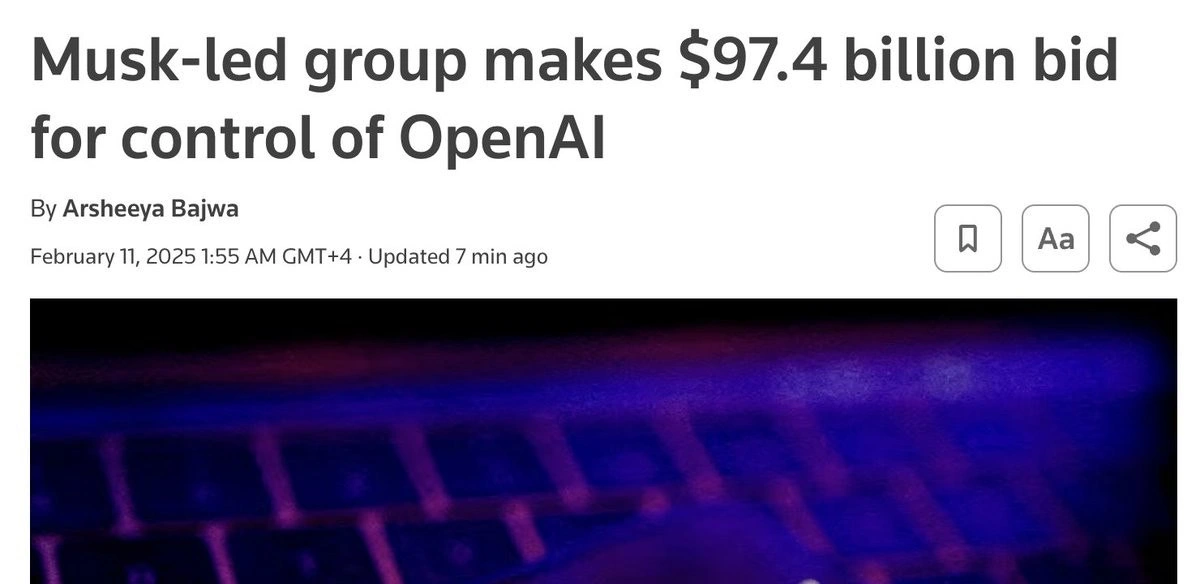
The meme aspect for developers also lies in the timing and style of the headline. We’ve got that serious news look: bold headline, reporter name, timestamp at some odd hour (1:55 AM, updated 7 min ago – real breaking news style). It feels like a Reuters or Bloomberg blurb. Developers often wake up to sensational headlines like this and immediately hit up Slack or Twitter: “Did you see this?! Is it real? What does it mean for us?” There’s excitement (“this could shake things up!”) and worry (“what if they start charging more for the API or change the usage terms?”). The neon keyboard image is just a generic tech illustration – something you eventually notice every time AI news breaks, the article has some circuit board or glowing keyboard that doesn’t tell you anything new, but sets a “futuristic” vibe. It’s almost a running joke: AI news must be accompanied by either a Terminator-looking robot or a neon keyboard – this time it’s the keyboard’s turn.

All these elements connect to common experiences:

  • If you’re new in tech, think of a time when a tool or platform you liked got acquired by a big company. Developers joke about it because often the first fear is “Will it still be free or awesome?” For example, when GitHub was bought by Microsoft, junior devs worried Microsoft might ruin it – but Microsoft actually handled it pretty well. Still, the anxiety is real every time.
  • OpenAI’s tools (like ChatGPT or GPT APIs) are things many devs use daily now. A takeover might mean changes to those tools. Imagine if the library you use for work or a game you love suddenly is owned by someone new – will they make it better, or will it become something you don’t recognize?
  • There’s also a bit of AI humor in here: OpenAI was supposed to be “open” and neutral, and the headline implies it might become someone’s property. It’s like a nerdy joke about the name: “OpenAI might get closed under new management, ha!” It’s a play on the ideals vs. the reality.

So, for a junior dev or an AI enthusiast just getting started, this meme is a crash course in how wild and fast the tech industry can move. One minute, research labs are publishing papers and open-source code; next minute, they’re at the center of a bidding war. It’s both exciting and a little scary – and that mix is exactly why people are sharing and chuckling at this image.

Level 3: Consolidation Crescendo

At the peak of the AI hype cycle, nothing screams tech industry déjà vu like a billionaire swooping in with a $97.4 billion bid. This bold number isn’t just random; it’s a signal that OpenAI – once a scrappy, idealistic research lab – has become a crown jewel of the AI world. Industry veterans see the irony: Elon Musk helped found OpenAI to ensure AI benefits all of humanity, then parted ways when it veered from his vision. Now, a Musk-led consortium aiming to grab control feels like the empire striking back. It’s as if the open in OpenAI might come full circle to closed, under one very influential (and unpredictable) figure. The humor here is laced with anxiety – developers joke about it, but they’re keenly aware this reflects a real power tussle in AI.

Behind that straightforward headline lies a juicy mix of AI governance drama and industry consolidation. We’ve seen this pattern before: a breakthrough tech (from operating systems to social networks) hits a fever pitch, valuations soar, and then a few giant players (Big Tech or big egos) start gobbling up control. It’s the Great AI Land-Grab. OpenAI’s board and researchers are likely in a frenzy: one day you’re fine-tuning GPT models, the next you’re the prize in a corporate tug-of-war. And for developers using OpenAI’s APIs, it raises the question: Will our trusty AI tools remain accessible and unbiased, or will a new owner remodel them to fit a personal agenda?

The screenshot’s format screams serious news, complete with a byline and timestamp at 1:55 AM (because earth-shaking tech news loves to drop in the dead of night). The obligatory neon-lit keyboard stock photo – awash in purple and blue – is the cherry on top. Seasoned devs chuckle at that: nothing says “cutting-edge AI takeover” like an artsy shot of a glowing keyboard that has zero to do with the story. It’s a visual trope in tech journalism, as routine as an “it’s always DNS” joke in ops. The presence of bookmark and share icons hints this article expects to go viral – fitting, since a nearly $100B bid on an AI lab by Musk is prime hype cycle fodder.

Why is this all funny in a knowing way? Because it’s absurd yet believable. Musk has a flair for the dramatic (launching a car to space, dragging us through X Æ A-12 name puzzles, and oh – casually buying Twitter). Betting nearly a hundred billion on AI supremacy? It’s the kind of over-the-top plot twist that feels ripped from satire, except it could really happen. Devs who weathered the AIIndustryTrends of the past decade recall how OpenAI transformed from a non-profit research collective into a semi-commercial juggernaut fueled by Microsoft’s billions. That journey involved idealism colliding with reality: massive compute costs, closed-source models, and the creeping realization that the one with the deepest pockets often charts the course. Musk’s proposed takeover satirizes that truth – it’s like saying, “Throw enough money and hype, and you can rewrite the AI story.” It touches a nerve: AI safety concerns mixed with corporate power plays. After all, Musk often warns about AI doom; putting him at OpenAI’s helm blurs the line between saving the world and owning the spotlight.

In real-world terms, this scenario underscores how AI research is no longer an academic sandbox but a high-stakes arena. The bid’s sheer size ($97.4B!) has engineers jesting that maybe they’re valuing each parameter of GPT-4 in gold. Yet behind the jest is acknowledgment of a serious trend: AI labs like OpenAI hold immense influence (from setting ethical norms to dominating the AI talent pool). A change of control could pivot the entire industry’s direction. It’s funny to meme about Musk’s takeover because it’s easier to laugh than to wrestle with how one consortium could dictate AI’s future. The situation captures that classic AIHypeVsReality tension: wild headlines and boardroom maneuvers vs. the everyday grind of making models actually work without crashing or spewing nonsense. In short, this meme packs a lot of “oh boy, here we go” energy – a mix of excitement, skepticism, and the coping humor developers use when the tech world gets fundamentally shaken (again).

Description

Screenshot of a news article headline in bold black text that reads, “Musk-led group makes $97.4 billion bid for control of OpenAI.” The byline underneath says, “By Arsheeya Bajwa,” followed by the timestamp, “February 11, 2025 1:55 AM GMT+4 · Updated 7 min ago.” To the right of the byline area are three small icons for bookmark, font-size, and share. Below the headline a blurred, neon-lit close-up of a keyboard in purple and blue hues serves as a generic tech image. For developers, the headline implies a massive corporate move that could reshape the governance, research priorities, and open-source stance of one of the most influential AI labs, prompting discussions about concentration of power, AI safety, and industry hype cycles
Comments

6
Anonymous ★ Top Pick Can’t wait for the post-acquisition MLOps: weights delivered over Starlink, feature flags toggled by 3 AM tweetstorms, and CI only goes green if Dogecoin’s above $0.10
  1. Anonymous ★ Top Pick

    Can’t wait for the post-acquisition MLOps: weights delivered over Starlink, feature flags toggled by 3 AM tweetstorms, and CI only goes green if Dogecoin’s above $0.10

  2. Anonymous

    Watching someone spend $97.4 billion to acquire the nonprofit they co-founded is like watching yourself debug production at 3am because the microservice architecture you championed five years ago finally achieved its ultimate form: distributed failure

  3. Anonymous

    When your ex-cofounder shows up with $97.4B trying to buy back into the company you left in 2018, it's giving 'git revert --hard' energy but with venture capital instead of version control. At least this merge conflict comes with a price tag that makes AWS bills look reasonable

  4. Anonymous

    Elon's $97B OpenAI bid: the priciest 'git revert' after forking xAI

  5. Anonymous

    Apparently Raft leader election can be implemented with a tender offer - $97.4B is a very persuasive heartbeat

  6. Anonymous

    Buy vs build at AI scale: apparently the workaround for OpenAI rate limits and vendor lock‑in is $97.4B - just acquire the API and set the global temperature to 0

Use J and K for navigation