Skip to content
DevMeme
7221 of 7435
Movie Computers Have a Designed Error State for 'Containment Breached'
UX UI Post #7919, on Apr 13, 2026 in TG

Movie Computers Have a Designed Error State for 'Containment Breached'

Why is this UX UI meme funny?

Level 1: The Sign on the Wall

Imagine touring a zoo and seeing a big, beautifully printed sign that says "IN CASE THE LIONS ESCAPE, FOLLOW THE GREEN ARROWS." You'd stop and think: wait — they made a sign for that? With arrows? That means someone sat down, decided lion escapes were likely enough to plan for, picked the font, and bolted it to the wall... instead of, you know, making the cage stronger. That's the joke: when a movie computer calmly announces a disaster with its own special screen, it accidentally tells you the people who built it always knew this would happen — and apparently their big preparation was making the announcement look nice.

Level 2: Error States, Flows, and Other Words From Standup

  • UX (user experience): the discipline of designing how software looks, behaves, and communicates. UX people think in flows — step-by-step journeys a user takes, like "sign up" or, apparently, "experience containment breach."
  • Error state: the specific screen or message an app shows when something fails. Designers deliberately create these: a "no internet" screen, a "payment declined" screen. Each takes real work — layout, wording, testing — so each one is proof the team saw that failure coming.
  • Edge case: a rare or extreme situation a system might face. Teams triage which edge cases deserve handling; the rest get punted. A gorgeous edge-case screen means that edge case won the triage meeting.
  • Hollywood UI: the genre of fictional movie interfaces — giant red text, beeping progress bars, screens that say ACCESS DENIED in 72-point font. They're designed for audience legibility, not realism, which is exactly the seam this post pries open by taking them literally.

The junior takeaway is a real habit worth stealing: when you join a codebase, read its error messages like a historian. // this should never happen followed by 40 lines of recovery logic tells you it absolutely happened, more than once, probably on a weekend.

Level 3: Somebody Closed That Ticket

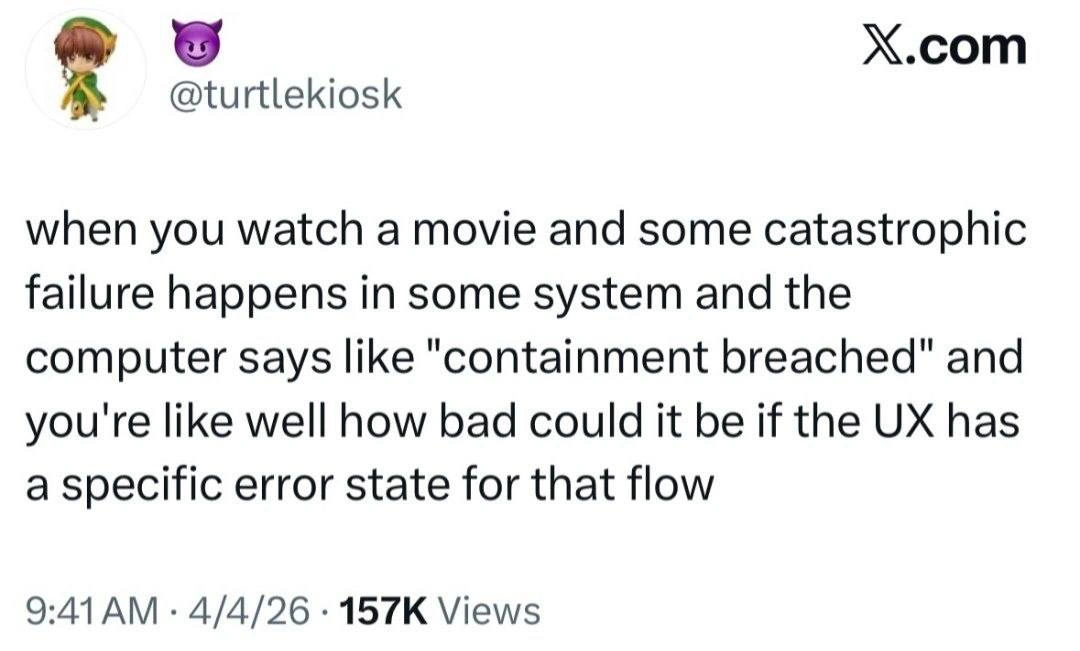
"well how bad could it be if the UX has a specific error state for that flow"

The post from @turtlekiosk lands because it applies real product-development forensics to Hollywood UI and arrives at a genuinely unsettling inference: software artifacts encode organizational expectations. If the movie computer displays a dedicated, art-directed CONTAINMENT BREACHED screen, then somewhere upstream of the catastrophe there was a full designed failure flow: a PM wrote acceptance criteria, a designer produced mockups (probably in three states — warning, critical, breached), a copywriter A/B-debated "breached" versus "compromised," an engineer wired the trigger condition, and QA signed off on the breach experience. The disaster isn't an anomaly; it's a ticketed user journey. The lab didn't merely fail to prevent the apocalypse — they sprint-planned it.

This is funnier the longer you've worked in software, because it's how practitioners actually read systems. Error states are archaeological evidence: every specific, well-worded error message marks a place where someone anticipated that exact failure. The genuinely novel disaster never gets a bespoke screen — it gets a raw stack trace, undefined is not a function, a kernel panic, or the dreaded generic Something went wrong :(. Polish is inversely correlated with surprise. So when fiction shows a crisp, purpose-built breach UI, an engineer's instinct says: this failure was in the threat model, ranked high enough to fund design work, and — the darkest part — not ranked high enough to fund actually preventing it. That's a brutally accurate satire of real-world risk management, where organizations routinely find budget for the error page but not for the fix, because the error page closes the ticket.

There's a legitimate counterweight that makes the joke richer rather than wrong: in safety-critical domains, designing the catastrophe path is exactly correct practice. Nuclear plants, avionics, and SCADA systems deliberately specify alarm hierarchies and human-factors-tested failure displays, precisely because operators under stress need pre-built clarity. The engineering truth the meme dances around is that good systems have detailed error states for things that should never happen — defense in depth demands it. The comedy lives in the gap between the two readings: is that breach screen evidence of mature edge-case handling, or evidence that "containment breach" sat in the backlog labeled known issue — happens sometimes? In the movies, given that the monster is already loose, we can guess which.

Description

A light-mode X (Twitter) post by @turtlekiosk (avatar of a chibi anime character, devil emoji as display name, 'X.com' top right), timestamped 9:41 AM · 4/4/26 with 157K views. Text: 'when you watch a movie and some catastrophic failure happens in some system and the computer says like "containment breached" and you're like well how bad could it be if the UX has a specific error state for that flow'. The observation skewers Hollywood UIs through a product-design lens: if designers spec'd, wrote copy for, and shipped a dedicated screen for the catastrophic failure, then the failure was an anticipated, ticketed, presumably QA-tested user journey - which says everything about the system's reliability expectations

Comments

2
Anonymous ★ Top Pick If there's a polished 'CONTAINMENT BREACHED' screen, somewhere there's a closed Jira ticket reading 'breach UX - happy path done, edge cases punted to v2'
  1. Anonymous ★ Top Pick

    If there's a polished 'CONTAINMENT BREACHED' screen, somewhere there's a closed Jira ticket reading 'breach UX - happy path done, edge cases punted to v2'

  2. @blue_bonsai 2mo

    When you release an SCP?

Use J and K for navigation