The True Mark of a Programming Psychopath
Why is this DeveloperExperience DX meme funny?
Level 1: Wrong Tool for the Job
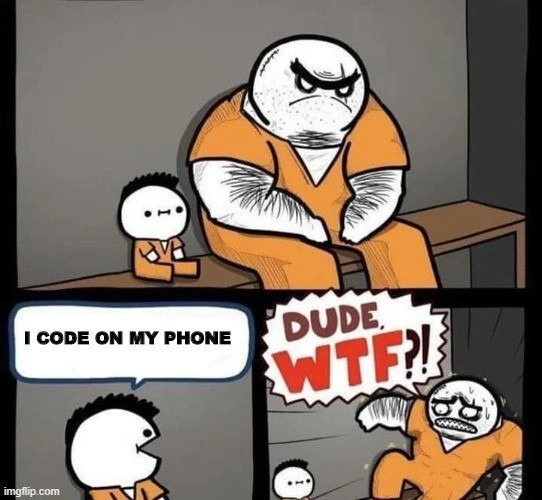
Imagine you’re trying to do something important with a gadget that’s too small and clumsy for the task, and everyone around you knows it. It’s like telling a group of construction workers that you plan to build a house using only a tiny toy hammer. They would all stop and stare, and probably shout, “Are you crazy?!” In this meme, the little person says he writes computer programs on his phone, which is the tiny toy tool in this situation. The big guy’s over-the-top shock — “DUDE, WTF?!” — is just a funny way of showing how wild and absurd that idea sounds. Essentially, the meme is joking that using a phone instead of a proper computer to do a programmer’s job is so outrageous that even a tough prisoner can’t believe it.
Level 2: Touchscreen Taboos
At first glance, this meme is a three-panel cartoon of two prisoners in a jail cell. The smaller prisoner nervously admits, “I code on my phone,” and the larger prisoner leaps up in alarm, shouting “DUDE, WTF?!” The joke compares doing software development on a smartphone to committing a shocking crime. It’s set in a prison to amplify how forbidden or outrageous this idea feels among developers. This format (often called the prison meme format) is popular for humor: one character says something unexpected, and the other reacts with over-the-top surprise or anger. Here, the unexpected statement is about a very unusual way to write code.
Why is coding on a phone such a big deal? In real life, almost all programmers write code on a computer (desktop or laptop), not on their phones. There are good reasons for that. A computer provides a comfortable environment for development: a large screen to see many lines of code, a physical keyboard to type quickly, and the computing power to run heavy development tools. These tools often include an IDE (Integrated Development Environment) or advanced text editors, which are applications like Visual Studio Code, IntelliJ, or Android Studio. An IDE is software that helps programmers write and manage code more easily – it has features like syntax highlighting (colorful code), auto-completion of code, debugging tools, and so on. On a phone, you typically can’t run these big IDE applications. The phone’s operating system (like Android or iOS) and its hardware are not designed for running large programming suites.
Coding on a phone usually means you’d be using a very minimal text editor app or maybe a special mobile code editor which has far fewer features. You’d have to rely on a touchscreen keyboard to type. Imagine trying to type out symbols like {, ;, or < on a small screen – it’s much slower and more error-prone than using a full keyboard. Touchscreens are great for tapping icons or writing quick messages, but for coding (which requires a lot of precise typing and using many unusual characters), it’s painfully awkward. There’s also autocorrect on phones that might turn technical code words into common words (a phone might mistakenly change sudo apt update into some unrelated phrase, for example). All of this makes the phone a suboptimal dev setup – meaning it’s not an ideal or efficient arrangement for coding work.
Let’s break down some differences to see why developers find the idea so absurd:
| Standard Coding Setup (PC) | Phone Coding Setup |
|---|---|
| Big screen – You can open multiple files or windows side by side, and see lots of code at once. | Tiny screen – Very limited view of code. You might see 10-20 lines at a time, making it hard to navigate or understand big programs. |
Physical keyboard – Full layout with all keys, easy to type symbols like { } [] <>, and touch-typing without looking. |
Touchscreen keyboard – No tactile feedback, slower typing, and often you must switch keyboard modes to find { or ;. It’s easy to make mistakes. |
| Powerful hardware – Desktops/laptops have faster processors, more memory, and can run compilers, databases, or even virtual machines for coding. | Limited hardware – Phones have less processing power and memory. Complex tasks (like compiling a big project or running heavy development servers) can be very slow or impossible. |
| Full OS with dev tools – You can install programming languages, compilers, Docker, git, etc. Tools are made for PC operating systems (Windows, macOS, Linux). | Mobile OS limitations – Mobile apps are sandboxed and there are fewer developer tools available. While there are apps to write code or a terminal (like Termux on Android), you’re working against the grain. |
| Comfort and ergonomics – You can use a mouse, multiple monitors, and sit at a desk. It’s designed for long work sessions. | Portability over comfort – A phone lets you code on the move, but it’s not comfortable for long periods. Your hands, eyes, and neck can get strained quickly trying to do serious work on such a small device. |
Looking at this comparison, it makes sense why developers react strongly. The meme’s big prisoner yelling “WTF?!” is basically expressing, “Why would you do such serious work on such a limited device?” It’s as if someone said they prefer to run a marathon in flip-flops – technically you could, but it’s going to be unnecessarily difficult and everyone will advise against it.
There’s also a bit of developer culture and stereotypes embedded here. Developers often have a kind of pride in using proper tools. Some even joke about how many screens they have or how fancy their mechanical keyboard is. There’s a stereotype of the serious programmer with multiple monitors filled with code, a powerful custom-built PC, and all the latest gadgets to make coding efficient. Against that backdrop, coding on a phone isn’t just inefficient – it’s almost unthinkable. It breaks the norm so much that it invites judgment or mockery.
Additionally, when we talk about MobileDevelopment, we usually mean writing software for mobile phones, like apps and games, but we still do that coding on a regular computer. The finished app then runs on your phone. Almost nobody writes the app’s source code on the phone itself. So if someone says “I develop on my phone,” it sounds upside-down to other devs. They’d wonder, why not use a proper laptop/desktop and then put the result on the phone? The idea of using only a phone for the whole process feels like a huge self-imposed handicap.
The prison setting in the meme is a dramatic metaphor. In a typical prison-themed joke, prisoners might share what landed them in jail. Here the small guy’s crime is “coding on my phone,” which is absurdly mild in a literal sense, but among developers it’s portrayed as if it were shockingly illicit. It humorously implies that in the society of programmers, using a phone to code is nearly a criminal offense. The big prisoner’s wild-eyed, fists-up reaction exaggerates just how unacceptable or crazy that idea sounds to an experienced programmer. It’s a way of saying “Every developer in the room would flip out if they heard this.”
So, if you’re new to programming, the takeaway is: developers really value using the right tools for the job. A smartphone, while incredibly handy for many tasks, is considered the wrong tool for serious coding, much like using a spoon to dig a foundation for a house. It’s technically possible, but it’s going to make your life much harder, and people might give you very strange looks (or in this case, comic fury) if you insist on doing it that way.
Level 3: Coding Contraband
In the dev world, coding on a phone is treated like a flagrant violation of the unwritten rules – practically contraband for serious programmers. This meme exaggerates that sentiment with a prison scene: a small inmate meekly confesses “I code on my phone,” and a hulking cellmate explodes in outrage: “DUDE, WTF?!” The humor lands because even a hardened prisoner – a comic stand-in for an ultra-tough senior developer – is utterly scandalized by this innocent admission. It’s a vivid way to poke fun at how shocking a suboptimal dev setup can be to devout techies. In a place where you'd expect confessions of actual crimes, the real heresy is apparently using a smartphone as your primary coding rig.
Why is this so outrageous to developers? It boils down to developer ergonomics and culture. Professional coding typically assumes a powerful workstation or at least a decent laptop: big monitors, a real keyboard (often the beloved clack of a mechanical one), precise mouse or trackpad, and an environment optimized for writing and running code. A phone offers the polar opposite – a tiny touchscreen keyboard, limited screen real estate, and operating systems (iOS, Android) that aren’t designed for heavy software development tasks. It’s like showing up to a hackathon with your hands literally tied; the constraints are that severe. The meme plays on this contrast: in a community obsessed with efficient tooling and high-performance setups, saying you willingly choose a phone – a device built for swipes and selfies, not serious coding – is beyond baffling. It violates the shared norms of Developer Experience (DX) so badly that it provokes a comically disproportionate reaction.
This cartoon also satirizes developer judgment and stereotypes. Software engineers can form almost tribal identities around their tools and workflows. Editors and environments spark fierce loyalty – there are legendary feuds like Vim vs Emacs or tabs vs spaces that can turn a calm discussion into a heated debate. Here, the mere mention of a smartphone IDE crosses a red line. It’s beyond preferences; it’s viewed as an affront to good practice. The big inmate’s furious “WTF?!” is basically the collective gasp of seasoned devs picturing the pain: no proper IDE support, no convenient debugging, likely using some minimal code editor app or an SSH terminal on a 5-inch screen. They’re thinking of all the things that could go wrong. Autocorrect turning your code into nonsense, trying to select text or move a cursor precisely with fat fingers, the lack of key developer tools (good luck running Docker or a heavy compiler on your phone without melting it). It’s an instant nightmare scenario for anyone who’s struggled even with a cramped laptop.
Yet, beneath the exaggeration lies a kernel of truth (the kind that makes tech humor funny). On rare occasions, a developer might actually attempt coding on a phone – typically out of desperation. Picture a 3 AM production outage and you’re on-call with only your smartphone at hand: you SSH into a server or open a GitHub web editor to patch a hotfix. It’s doable, but every second of it hurts. The meme taps into that shared trauma: we know how painful it is to type { or [ on a phone’s on-screen keyboard when panic adrenaline is already high. Choosing to do that by preference? That’s lunacy! Hence the inmate’s extreme reaction – even battle-hardened devs who have seen every weird bug and terrible legacy system are horrified by the thought of willingly using a phone as a coding device. It’s the ultimate “Why would you do that to yourself?!” moment. This collective stance is comically dramatized by equating it with the kind of outrage you’d see if someone broke a sacred rule of prison. It’s developer culture shock memed into a prison yard confrontation.
Interestingly, the tags like MobileDevelopment and IDEs_Editors hint at another layer of irony: mobile development usually means writing apps for phones, but always using a PC or Mac to do so. No serious mobile app engineer writes their Swift or Kotlin code on the phone itself – they use Xcode or Android Studio on a desktop. There’s a well-established toolchain and workflow. By flipping this around – using the phone as the development machine – the meme highlights how absurd that reversal feels. Yes, modern smartphones are powerful, and there are apps and workflows (like using vim in a terminal app, or cloud IDEs in a mobile browser) that make phone coding possible. But “possible” isn’t “pleasant” or “professional.” It’s more of a party trick or emergency fallback. The DeveloperExperience is so degraded that it’s almost a joke in itself. This cartoon leans into that joke heavily: the environment is a literal jail cell, implying the coder has sentenced themselves to needless hardship. And the senior dev avatar – the big inmate – is not impressed. In the realm of TechHumor, equating a questionable tech choice to an unforgivable crime is a great recipe for laughs. After all, to a die-hard coder who lives and breathes proper tooling, voluntarily coding on a phone might as well be a felony. The meme says what every shocked developer is thinking: “Dude, WTF?!”
Description
A two-panel comic strip depicting a prison scene. In the first panel, a small, calm inmate sits next to a large, intimidating, and angry-looking inmate on a bench inside a cell. Both are wearing orange prison jumpsuits. In the second panel, the small inmate says, "I CODE ON MY PHONE" in a speech bubble. The large, tough inmate recoils in absolute terror, sweating and shouting "DUDE, WTF?!". The humor comes from the extreme reaction to a practice that professional developers would consider masochistic and highly impractical. It satirizes the perceived absurdity and difficulty of writing code on a mobile device, suggesting it's an offense more shocking than whatever landed the tough guy in jail. The watermark "imgflip.com" is visible in the bottom left corner
Comments
7Comment deleted
Some people use Vim, others use VS Code. Then there are the ones who write production code on a 4-inch screen with autocomplete from a keyboard that thinks 'refactor' is a typo for 'refrigerator'. Those people don't need a prison, they need an intervention
Told the staff architect the critical hotfix was written, unit-tested, and kubectl-apply’d end-to-end from my phone on the commute - he stared like I’d just proposed running two-phase commit over Slack
Even someone doing 25-to-life for production database drops thinks coding on a 6-inch screen with autocorrect is cruel and unusual punishment - and they've seen what happens when you forget WHERE clauses
Coding on a phone isn't just a workflow choice - it's a confession that you've either achieved enlightenment through masochism or you're debugging production at 2 AM from a rideshare. Either way, your coworkers will judge you harder than any code review, because if you can navigate a 6-inch screen to refactor a monolith, you're either a wizard or someone who's given up on proper tooling entirely. The real crime isn't the mobile IDE - it's that you probably have better uptime than our Kubernetes cluster
I’ve mosh’d into prod from Termux at 3am, but if your daily IDE is your thumbs, your system’s critical path is autocorrect
I code on my phone = I deploy to prod over hotel Wi‑Fi while autocorrect pair‑programs our Kubernetes cluster names
Coding on a phone? That's not mobile dev, it's masochistic refactoring - where every hot reload risks thumb-induced production outage