Skip to content
DevMeme
485 of 7435
Machine Learning Cycle: Expectation vs. Reality
AI ML Post #556, on Aug 14, 2019 in TG

Machine Learning Cycle: Expectation vs. Reality

Why is this AI ML meme funny?

Level 1: When All Else Fails, Meme

Imagine you’re trying to do something new and exciting, like baking a cake for the first time. You have a great idea: you want it to be a chocolate cake with cool decorations. You gather ingredients and follow a recipe (that’s like writing the code for your idea). Then you put the cake in the oven to experiment – basically to see how it turns out. Now, in a perfect story, the cake comes out delicious and you learn how to make it even better next time. But what if it doesn’t go well? Let’s say the cake comes out flat and burnt. Uh-oh! That’s a big disappointment – you feel sad because your idea didn’t work out. In a normal situation, you might scrape it and try baking again to fix what went wrong. But you’re so frustrated and upset that instead you do something else: you decide to make a joke about it. You take a funny photo of the deflated burnt cake and draw a goofy face on it, or caption it with “My cake’s future: charcoal!” and show it to your friends. Everyone laughs, including you, and suddenly you feel a bit better.

This meme is just like that, but for someone building an AI model instead of baking a cake. They had an idea, tried it out, it failed, and they were so let down that they made a funny picture on the internet (a meme) about how it failed. It’s funny because it’s true: when we work hard on something and it doesn’t succeed, sometimes the best thing to do is laugh about it. Just like turning a ruined cake into a silly joke, this person turned their failed machine learning experiment into a silly meme. The emotion at the heart of it is something everyone understands – you try, you fail, you feel bad, so you find a way to giggle and carry on. After all, sharing a laugh can make even a big disappointment feel a little less heavy!

Level 2: Iteration Frustration

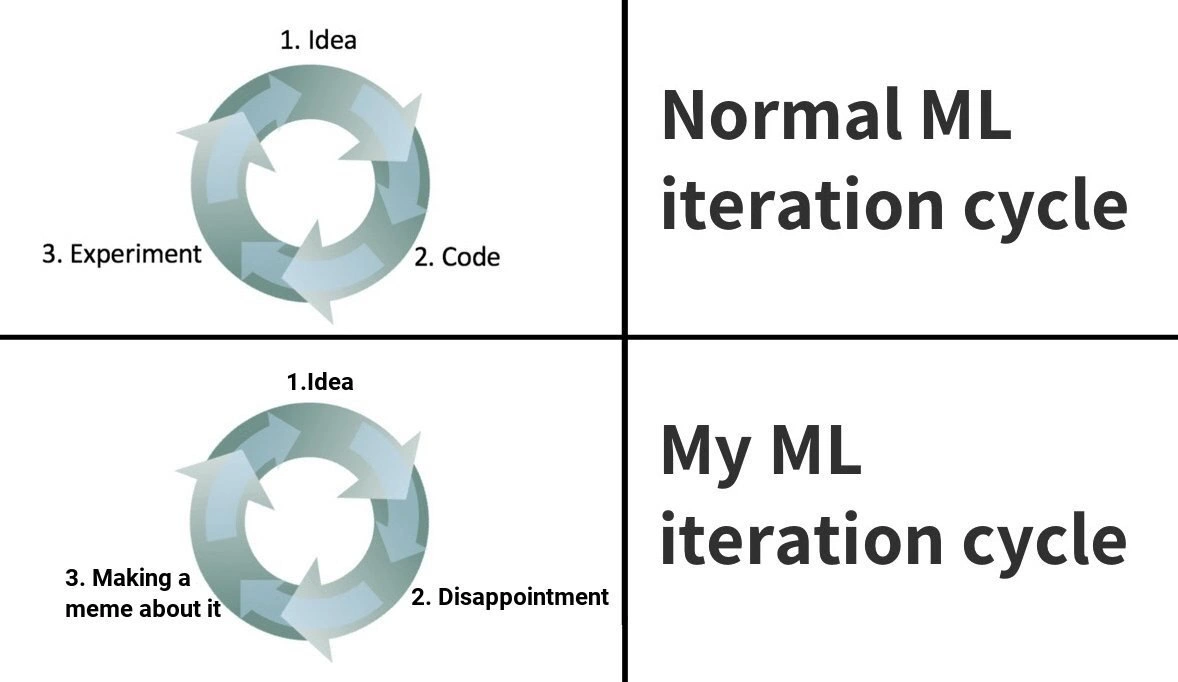
Let’s break down what’s happening in this meme in simpler terms. In Machine Learning (ML) – a field of computer science where programs learn from data – there's a common development process: you have an idea for a model or improvement, you write the code to implement that idea, and then you run an experiment to see how well it works. This process is a loop, meaning you do it over and over, improving the model each time. It’s like a cycle: try something (idea), test it (experiment), learn from it, and repeat. That’s what the top half of the image calls the "Normal ML iteration cycle." Iteration just means doing things repeatedly, and a cycle means it goes in a circle (step 1 → 2 → 3 → back to 1, and so on). Ideally, each loop makes your ML model a bit better. For example, you might think, "Hey, what if I add another layer to my neural network?" (that's the idea), then you implement that change in code, then train the updated model on your dataset to see if your accuracy went up (that’s the experiment). In a perfect world, the experiment gives you useful results – maybe it works, maybe it doesn’t, but either way you gain insights and move to the next idea.

However, the meme jokes that in real life the cycle often doesn’t go as planned. The bottom half, labeled "My ML iteration cycle," replaces the steps after Idea with Disappointment and then Making a meme about it. This is a humorous way to say: "I had an idea, I tried to code and experiment on it, but the result was so bad or frustrating that I just ended up disappointed and joking about it." In other words, instead of a productive experiment that leads to a new idea, the process stops at feeling discouraged. The disappointment here usually means the experiment failed or the results were poor. For instance, maybe you hoped your new model would classify images correctly, but it turned out no better than random guessing. That’s really disappointing when you’ve put effort into coding and training. Imagine spending days cleaning your data and tuning your model, and then seeing no improvement in the model’s performance – you’d feel pretty let down. This meme suggests that when that happens, the person doesn’t immediately come up with a new idea. Instead, step 3 becomes "make a meme about it."

Now, what does making a meme mean in this context? A meme is a funny image or joke, often shared online, that people in a community find relatable. In developer and DataScienceHumor circles, folks often create memes to poke fun at their own struggles. So, when the meme says "3. Making a meme about it," it implies the ML practitioner gave up on serious experimentation (at least for the moment) and decided to create a humorous image (like this very meme) to express their frustration. It’s basically saying: “Well, that experiment was a flop... might as well get a laugh out of this failure!” This is quite common in the AI/ML community – when something goes wrong, engineers often joke about it to feel better. They might post a meme on Twitter or a developer forum showing their mood. It’s a coping mechanism and a way to bond with others who’ve been through the same thing.

Let’s connect each part of the meme to real life in simpler terms:

  • "1. Idea" – This is the starting point. In ML, an idea could be anything from using a new algorithm you read about, to tweaking your model’s parameters, or trying a different approach with your data. For example, a data scientist might think, "What if I use a decision tree instead of a linear model for this problem?" That’s the idea phase – it’s the creative spark where you think of a potential solution.

  • "2. Code" (in the normal cycle) – This means implementing the idea. After you have an idea, you actually write the code to test it out. In ML, that could mean writing Python scripts, using libraries like scikit-learn or TensorFlow, and setting up your experiment. Essentially, it’s building the model or the experiment in code form so you can run it. If your idea was to try a new algorithm, coding means writing the necessary program or using the library to apply that algorithm to your data. For many ML engineers, this step is exciting because you get hands-on with the idea and bring it to life.

  • "3. Experiment" (in the normal cycle) – This is the testing phase. You run your newly coded model on some data to see how it performs. For example, you train your model on a training dataset and then evaluate it on a test set to get metrics like accuracy or error rate. The experiment phase tells you if your idea actually worked. Maybe your new approach improved the accuracy from 85% to 90% – great! Or maybe it stayed the same, or even got worse – not so great. The key of the normal cycle is that after the experiment, you’d normally loop back: use the results to brainstorm a better idea (back to step 1) and then do it all again. That’s why it’s a cycle – ML involves a lot of these trial-and-error loops, gradually hopefully making progress.

  • "2. Disappointment" (in my cycle) – Here’s where things diverge in the meme’s version of reality. Instead of “Code” as step 2, it directly jumps to Disappointment. This implies that as soon as the person tried the idea, the outcome was disappointing. It could be that the coding itself was fraught with bugs or that the experiment’s result was bad. By labeling it Disappointment, the meme humorously compresses all the hard work (coding, training, etc.) into one emotional result: it didn’t meet expectations. Maybe the model’s accuracy actually dropped or nothing improved, leading the experimenter to feel frustrated. This is a feeling every beginner (and expert!) in ML knows: you put in a lot of work and hope, and sometimes the model just doesn’t perform. It’s like studying hard for a test and then getting a low grade – you feel upset and wonder what went wrong. The meme exaggerates by implying this happens immediately after the idea, like going straight from hope to despair. It skips showing the coding step explicitly, probably because the outcome overshadows it.

  • "3. Making a meme about it" (in my cycle) – Instead of analyzing the experiment and trying again, the person jumps to humor. Making a meme means creating a joke image or message that captures what happened. In our context, the person likely made exactly the meme we are looking at! This final step suggests that the only thing produced by the whole effort was a funny meme to share with friends or colleagues. It’s a lighthearted way to admit defeat. Rather than a new model or a success story, the “project” resulted in a relatable joke. In real life, this might be like when a programmer’s code doesn’t work after many tries, so they tweet a funny screenshot or a GIF about giving up. For an ML newbie, it could be going on a forum and posting “Tried to train a model all night, got worse results than before 😫. At least I learned how not to do it!” along with a meme image.

The Normal vs My cycle comparison is the core of the joke. The left side of each (the circular arrow image) visually looks the same, but the text labels change. This is to emphasize that from the outside, the process might look identical (you go through some steps in a loop), but the content of those steps is very different between ideal and reality. The top says you should be experimenting and learning; the bottom says you ended up dejected and on social media making jokes. It’s a humorous admission that “my process isn’t so scientific or fruitful as it probably should be.”

For a junior developer or data science student, this meme is funny because it’s a shortcut to a truth you discover quickly: not every project or idea succeeds, and you have to be ready for failure. The use of humor here is actually encouraging in a way – it tells you that you’re not alone when you fail. Everyone in the ML field has felt that iteration frustration. In fact, there’s a whole subculture of AI humor and DataScience humor built on these shared struggles. If your experiment bombs, you might feel like you did something wrong. But seeing a meme like this from someone else tells you “hey, this happens to all of us, don’t worry!” Sometimes, after a particularly bad result, people really do take a break and make jokes. They might say, “Well, my neural network can’t even beat random guessing... time to start making memes instead of models!” That’s exactly what this meme conveys in a fun, simplified way.

In conclusion (for this level of detail): The meme uses a simple cycle diagram to contrast what beginners are told (or imagine) the ML process is – a steady loop of improvement – with what actually often happens – a loop that ends in disappointment and internet humor. It’s highlighting a relatable developer experience: you begin a machine learning project bright-eyed with an idea, you end up disappointed by the results, and then you comfort yourself by creating or sharing a meme about how machine learning can be so frustrating. This is a common rite of passage in the ML journey, and that’s why anyone who has trained a model or two is likely to chuckle and nod knowingly at this meme.

Level 3: Backpropagation Blues

At first glance, this meme contrasts the idealized vs actual Machine Learning workflow in a tongue-in-cheek way. The top half – labeled "Normal ML iteration cycle" – shows a tidy loop: 1. Idea → 2. Code → 3. Experiment. This is the textbook ml_iteration_cycle every data scientist aspires to follow. You come up with a clever idea for an AI model or improvement, you implement it in code (perhaps writing some Python with TensorFlow or PyTorch), and then you run an experiment to test it on your data. In theory, the results of step 3 feed back into refining your idea, creating a continuous idea–code–experiment loop driving progress. It’s the classic virtuous cycle of DataScience: brainstorm a model, train it, evaluate it, then use what you learned to brainstorm the next improvement.

But the bottom half – labeled "My ML iteration cycle" – hilariously replaces those steps with 1. Idea → 2. Disappointment → 3. Making a meme about it. This subverts the expected outcome. Instead of a successful experiment yielding new insights, the only thing yielded is frustration and an inevitable joke. Essentially, the punchline is: “I had a great idea for my ML project, I tried it... it flopped spectacularly, and now I’m consoling myself by creating a meme.” The identical circular diagram in both halves drives the joke home: it’s a cycle diagram humor trick. We see the same arrows looping around, but in the real cycle the loop doesn’t lead back into productive iteration – it leads straight to meme creation as the final product. The meme itself becomes the output of the failed experiment. This format plays on the familiar "expectation vs reality" trope in DeveloperHumor. The top diagram is the polished expectation (a smooth research process), while the bottom is the relatable reality (getting stuck and coping with comedy).

Why is this so funny (and a bit painful) for those in AI_ML and research? Because it’s extremely relatable. In real machine learning work, most ideas don’t pan out. Maybe your new neural network architecture slightly underfits and your accuracy actually drops. Perhaps your experiment runs for 12 hours only to achieve no better results than a dumb baseline. It’s common in MachineLearning that after days of coding and training, the model’s performance can be disappointingly low – cue the disappointment stage. Every experienced ML engineer or data scientist has been there: your fancy idea that was supposed to increase the metric by 10% actually made it worse, or broke the training run entirely (“NaN error at epoch 3, again?!”). The meme captures this universal ml_experiment_failure feeling. We laugh (ruefully) because we’ve all felt the sting of a model that stubbornly refuses to improve.

Now, the twist: instead of persevering in the loop, the author jumps to “Making a meme about it.” This is poking fun at our own coping mechanism. In the real world, when an experiment flops and you’re out of ideas or just drained, often the best therapy is humor. ML communities (on Slack, Twitter, Reddit) are filled with AIHumor memes exactly like this – people turning their frustration into jokes that only other ML folks will fully appreciate. It’s a form of commiseration. By making a meme, you at least get some laughs (and internet points) out of your failed idea. The irony is rich: instead of optimizing an algorithm, we end up optimizing our meme-making skills. 😅

From a seasoned perspective, this meme also hints at the hidden reality behind every “success story” in ML. Published papers and impressive demos don’t usually show the dozens of failed iterations that came first. But in private, senior data scientists know that for every one model that works, there are many that face-planted. The “Normal” cycle implies a smooth, iterative improvement, but the “My” cycle tells the truth: it’s often one quick loop from hope to despair. In practice, of course, you shouldn’t give up after one failed experiment – but the joke exaggerates how it feels internally. Sometimes after the nth failed try, you throw your hands up and slack off by making a sarcastic meme to share with colleagues. It’s a gentle jab at ourselves and a stress release. As a community, Data Scientists find solidarity in such humor: “Yep, I’ve done the meme-step plenty of times!”

Technically speaking, there’s even some dark DataScienceHumor logic here. We often talk about “failing fast” in agile development – well, this meme takes that to the extreme: fail fast, then immediately pivot to meme production! It acknowledges the emotional cycle: idea (excitement)experiment (reality check)meme (catharsis). The term “iteration” is almost mocked: you are iterating, but iterating through emotions (hope → disappointment → humor) rather than through improving model parameters. In a way, making a meme is like logging the result of the experiment in a fun public post-mortem. The next step after meme might actually be trying again with a new idea once morale is restored – but the meme doesn’t show that, which is part of the joke. The loop in the bottom diagram looks closed (Idea → Disappointment → Meme → back to Idea?), implying perhaps that the meme itself gets you back to having another idea after a good laugh.

To a senior ML engineer, there’s another wink here: the inevitability of disappointment. It hints at the No Free Lunch principle of ML – not every idea can magically work on a given problem. You might have a brilliant concept in theory, but the data or the model might not cooperate. Training a model involves so many factors (data quality, hyperparameters, random initialization) that oftentimes the result is essentially random disappointment. Even the process of hyperparameter tuning can feel like pulling a lever on a slot machine; more often than not, you lose. The meme steps could easily be renamed “1. Idea, 2. Code, 3. Code doesn’t run, 4. Debug for a week, 5. Experiment, 6. Disappointment, 7. Meme”, but that wouldn’t fit in a neat circle! So the meme cuts to the chase – it skips all interim agony and labels the entire outcome as “Disappointment.” That exaggeration is what makes it funny. We compress the real painful process into a single word, which every engineer fills in with their own war stories (whether it was a memory leak in training, a model blowing up to infinity, or just embarrassingly poor accuracy).

Let’s not forget the meta aspect: by creating this very meme, the author is demonstrating step 3 of their cycle. The meme about ML is itself the product of disappointment. It’s a little self-referential gem. My experiment failed, so I made a meme about failing experiments. And here we are analyzing it – proof that at least the meme succeeded in resonating with the community! In the end, this is a good reminder that in machine learning – as in all of programming – a healthy sense of humor is essential. When your neural network refuses to learn or your carefully coded algorithm yields nonsense, sometimes the only sane response is to laugh, share a joke, and then get back to the drawing board. The “Backpropagation Blues” (that melancholy when your backpropagation training doesn’t converge to anything useful) can hit hard, but turning those blues into a funny meme is how developers turn frustration into camaraderie. After all, if you can’t make your model learn, you can at least learn to laugh at yourself!

# Pseudo-code of the ideal ML loop vs the reality
for attempt in range(max_attempts):
    idea = brainstorm_new_approach()
    model = implement(idea)
    metrics = run_experiment(model)
    if metrics.is_promising():
        idea = refine(idea, metrics.insights())   # Normal loop: refine and continue
    else:
        create_meme("Model failed with metrics: {}".format(metrics))  # Reality: make a meme
        break  # exit loop early due to existential dread

In summary, the meme’s humor lives at the intersection of technical process and emotional truth. Veterans in AI/ML smile (or groan) because they recognize that supposedly simple loop of Idea → Code → Experiment is, in practice, riddled with false starts and flops. And when confronted with that inevitable disillusionment, we do what any sane engineer does: analyze the failure rigorously make a joke on the internet. This shared cycle of idea, disappointment, meme is the modern ML experience for many, making the meme both very funny and very real.

Description

A two-panel meme contrasting an idealized machine learning workflow with a more cynical, relatable one. The top panel, labeled 'Normal ML iteration cycle', displays a circular diagram with three steps: '1. Idea', '2. Code', and '3. Experiment'. The bottom panel, labeled 'My ML iteration cycle', shows a similar diagram, but the steps are altered to '1. Idea', '2. Disappointment', and '3. Making a meme about it'. The humor stems from the frustrating reality of machine learning development, where projects often fail to meet expectations, and the developer's final output is not a working model but a meme shared with the community as a coping mechanism. It's a commentary on the trial-and-error nature of AI/ML work and the emotional investment required

Comments

7
Anonymous ★ Top Pick My ML pipeline is idempotent: no matter how many times I re-run the experiment, the final output is always disappointment and a new meme for the team's Slack channel
  1. Anonymous ★ Top Pick

    My ML pipeline is idempotent: no matter how many times I re-run the experiment, the final output is always disappointment and a new meme for the team's Slack channel

  2. Anonymous

    Official ML loop: Idea → Code → Experiment. Senior reality loop: Idea → 3 days of hyper-param roulette → realise the prod pipeline serialises a different feature set → turn the post-mortem into a meme

  3. Anonymous

    The real ML pipeline: spending three weeks optimizing a model to beat the baseline by 0.2%, then realizing a regex from 2003 still outperforms your transformer

  4. Anonymous

    The real ML iteration cycle: Idea → Train model → Watch validation loss plateau → Adjust learning rate → Still plateaus → Try different architecture → Overfits → Add regularization → Underfits → Question career choices → Make meme → Repeat. At least the meme generation pipeline has 100% reproducibility and zero hyperparameters to tune

  5. Anonymous

    After 40 W&B runs and a hyperparameter sweep, the only metric that beat the logistic baseline was my meme throughput - apparently the loss function is optimizing for GPU spend

  6. Anonymous

    My ML lifecycle: idea → three weeks duct-taping data pipelines → ten minutes of training → realize the dumb baseline wins → ship the only artifact that reliably generalizes - this meme

  7. Anonymous

    The 'Make about it' step is ML's favorite abstraction: skip validation, embrace the NaN-induced enlightenment

Use J and K for navigation