Microsoft Misinterprets User Needs with Android Malware Feature
Why is this Microsoft meme funny?
Level 1: Butterfly or Bee?
Imagine a little kid asks for a pet butterfly because butterflies are pretty and harmless. Now picture a confused grown-up who catches a wasp (which can sting you) and says, “Oh, this is what the kid wanted, right?” 😕 The kid would be like, “No way, that’s not a butterfly at all!” In this meme, Microsoft is like that confused grown-up, and the Android malware is the wasp. Microsoft is mistakenly thinking a dangerous thing (malware, like a bad app that can hurt your computer or phone) is the nice butterfly that users actually want. Of course, users don’t want a dangerous thing on their devices, just like no kid wants to be stung by a wasp when they asked for a butterfly. The joke is funny because it’s so silly: it shows someone totally misunderstanding what people really want, in a way that could be harmful – and everyone except the confused character can see how wrong it is. It’s a simple reminder that giving people something safe and good (a butterfly) is not the same as accidentally giving them something unsafe (a wasp) and thinking you did a great job.
Level 2: Feature or Malware?
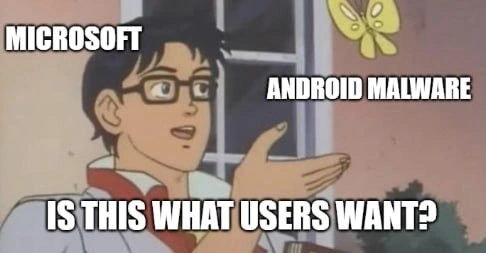
Let’s break down what’s happening here in simpler terms. In the image, Microsoft is labeled on a character who is looking at a butterfly labeled “Android malware.” The character is asking, “Is this what users want?” This is using the famous “Is this a pigeon?” meme format, where someone mistakes one thing for another. In the original meme image, a character confusingly identifies a butterfly as a pigeon. In our context, Microsoft is (jokingly) confusing Android malware for something users actually desire – essentially calling a malicious Android app a feature.
So, what is Android malware? “Malware” means malicious software – programs designed to harm your device, steal data, or otherwise do bad things without your consent. On Android, which is Google’s mobile operating system, malware often comes in the form of sketchy apps. For example, a game or utility might look legitimate but secretly steal your personal info or install a virus. Android allows users (and app stores) to install apps pretty freely, which is great for openness, but it also means android_security_risks are a constant concern. Google’s official Play Store scans for malware, but some sneaky apps slip through, and if you install apps from outside the official store (sideloading), the risk is even higher.
Now, why would Microsoft have anything to do with Android apps? In 2021, Microsoft announced a feature for Windows 11 called the Windows Subsystem for Android (WSA). This basically lets Windows users run Android apps on their PC. The aim was to make Windows more versatile – imagine being able to use your favorite phone apps on your desktop. Cool idea for MobileDev folks and users who want cross-platform convenience. However, it raised concerns about security. Microsoft would be effectively bringing another ecosystem’s software into Windows. Typically, Windows apps come through Microsoft’s own store or are at least checked by antivirus software. But Android apps? If users start installing random Android APKs (app packages) on Windows, could those be malware?
The meme humorously suggests that Microsoft might unintentionally distribute or legitimize some bad Android apps because they’re so eager to have this Android-on-Windows feature. The text “IS THIS WHAT USERS WANT?” implies that Microsoft is asking if users want Android malware, which is absurd. Of course users don’t want malware! What they want are useful apps – without viruses. This taps into a common tech joke: sometimes companies mistakenly give users what they didn’t ask for. It’s like when a platform adds a feature nobody asked for (and perhaps nobody likes), or when a security program flags a legitimate app as a virus – except here it’s flipped, joking that Microsoft would flag a virus as a legit app!
In real life, Microsoft has a responsibility to keep users safe on Windows. They have tools like Windows Defender (built-in antivirus) and vet apps on their Microsoft Store. If they’re allowing Android apps, they’d need to vet those too or use a trusted store (in Windows 11’s case, they partnered with Amazon’s Appstore to provide the Android apps). The developer community was quick to joke about worst-case scenarios. Imagine a blatantly malicious Android app somehow sneaks through and Microsoft treats it like a feature addition to Windows. It’s an exaggerated scenario to highlight the importance of good security practices when implementing new features. Developers – especially those in security or who’ve seen malware problems – find it funny because it’s a head-smacking “obviously not” moment. No, users don’t want malware, and any implication otherwise shows a complete misunderstanding of user needs!
To a junior developer or someone new to these concepts, the meme is saying: Be careful that in your quest to add new capabilities, you’re not introducing new problems. It’s a lighthearted warning. Microsoft here is a stand-in for any company that might be so excited about adding something (like support for Android apps) that they might overlook the risks (like malware). The humor comes from how clearly wrong that is – like mixing up a harmful thing for a helpful one. The context tags like questionable_app_distribution and misaligned_product_strategy are fancy ways of saying “pushing out apps or features that haven’t been thought through in terms of user safety or actual desire.” It’s a lesson in making sure that what you deliver is truly what users want – and definitely not something that could harm them!
Level 3: Embrace and Infect
At the senior engineer level, this meme hits on a painfully familiar pattern: a big tech player chasing features at the expense of security. Here we see Microsoft personified (anime guy with glasses) pointing at “Android malware” (the butterfly) and essentially asking “Is this what users want?” This image riffs on Microsoft’s push to bring Android apps to Windows (via the Windows Subsystem for Android). Experienced devs immediately smirk because they recognize the irony: Microsoft spent decades battling Windows viruses and malware, and now it might inadvertently welcome a whole new class of mobile malware onto its platform as a “feature.” It’s the classic “It’s not a bug, it’s a feature” joke taken to the extreme – literally mistaking malicious software for a selling point.
Why is this funny to a seasoned developer? Because it rings true of corporate missteps we’ve seen before. There’s a long history of tech companies misreading what users actually want or need. Security professionals especially have war stories of well-intentioned features that opened up scary vulnerabilities. In the late 90s and 2000s, Microsoft itself had an “embrace and extend” strategy – sometimes that felt like “embrace and extend…and accidentally infect”. Think of ActiveX controls in Internet Explorer: they extended web functionality but were also a malware nightmare. Fast forward to 2021, and Microsoft announces Windows 11 can run Android apps. Cool feature on paper (more apps for Windows!), but senior devs immediately thought: does this broaden our attack surface? The meme exaggerates this concern by joking that Microsoft can’t tell a butterfly from a pigeon, or in this case, a piece of Android malware from a legitimate app.
The caption “IS THIS WHAT USERS WANT?” drips with sarcasm. It implies Microsoft might justify distributing even shady apps under the belief that it’s giving users what they asked for (more apps, more features). We’ve all seen product managers cheer for higher app counts or flashy integrations, while engineers mutter under their breath about the incoming security patches and on-call alerts. It’s gallows humor: the idea that a corporation might accidentally endorse a malicious app and only later realize users weren’t clamoring for a virus on their phones or PCs. Seasoned developers find this hilarious because it satirizes real tensions between product strategy and platform security.
There’s also an element of shared trauma here. Anyone who’s dealt with android_security_risks or cleaned up a malware infestation knows how much users don’t want malware. A senior dev recalls nights debugging mysterious data leaks or CPU spikes on a server, only to find some “helpful” third-party addition was essentially acting like malware. So when Microsoft in the meme proudly presents “Android malware” as if it’s a new killer feature, it hits close to home. It’s a spicy jab at misaligned priorities: as if a company is so fixated on catching up with competitors (like supporting mobile apps on desktop) that it momentarily forgets the basic mandate of keeping users safe. In reality, Microsoft has a whole security division and Windows Defender to fight malware – so the notion of them serving malware by design is absurd. And that absurdity is exactly what fuels the humor. It’s an inside joke that winks at all the questionable_app_distribution decisions in tech history (bundled bloatware, anyone?).
In summary, at this level we laugh (perhaps a bit cynically) because the meme nails a truth: tech giants sometimes pursue features or integrations without fully thinking through “is this actually good for the user, or are we just checking a marketing box?” The misaligned_product_strategy of confusing a bug for a feature, or in this case malware for a must-have add-on, is all too recognizable. A grizzled dev might chuckle and say, “Yep, that looks like a C-suite decision. Next up: Clippy recommending virus downloads.” It’s dark, it’s funny, and it’s a clever use of a classic meme template to poke fun at how security can be an afterthought when shiny features flutter by like that butterfly.
Description
This image uses the popular 'Is this a pigeon?' anime meme format. In this version, a young man with glasses, labeled 'MICROSOFT,' is looking at a yellow butterfly, which is labeled 'ANDROID MALWARE.' The subtitle at the bottom reads, 'IS THIS WHAT USERS WANT?'. The meme satirizes the perception that large tech companies, in this case Microsoft, often misunderstand or ignore the actual needs and desires of their user base. It humorously suggests that Microsoft is presenting a flawed or undesirable feature (symbolized by 'Android Malware') as something valuable or requested by users. This could be a commentary on the introduction of Android app compatibility in Windows, implying it might bring more problems, like security risks, than benefits, or that it was a feature nobody was asking for
Comments
33Comment deleted
The product manager said, 'Users want a seamless cross-platform experience.' The engineering team heard, 'Let's import the entire Google Play Store threat model directly into the kernel.'
“Windows Subsystem for Android” release criteria: 1) APK sideloads without whining ✅ 2) Calls home to a random IP range ✅ 3) Fits the slide that says “access to millions of Android apps” ✅ Cool - security can file a post-GA RFC
After spending billions on Nokia and watching Windows Phone die, Microsoft finally figured out how to get their software on Android devices - they just had to rebrand it as 'security features' instead of 'telemetry services'
Microsoft's relationship with Android security is the enterprise equivalent of your ex offering to fix your new partner's car - technically helpful, but everyone knows there's 20 years of Windows Mobile baggage in that toolbox. The real irony? Their Defender for Endpoint actually does decent Android threat detection now, but the trust issues run deeper than any APK's permission manifest
When MAU KPIs beat threat models, Android malware gets rebranded as a feature request and Defender is told to stop blocking the roadmap
Microsoft Defender on Android: Ships the bloatware, then heroically detects it
Microsoft evaluating Android malware: “HKCU Run key, scheduled tasks, silent updates - great engagement pattern; pin it by default.”
😏😏😏😏😏 Comment deleted
sounds oddly specific, what is this about? Comment deleted
windows 11 will run android stuff natively Comment deleted
Ahhahahahahwhywqhag lmao "natively" Comment deleted
don't ask me, I didn't read into that info Comment deleted
Its just emulator bruh Comment deleted
no Comment deleted
well; possibly. But a much smarter implementation would be implementing the whole android API Comment deleted
which has already been done in open source land Comment deleted
Proprietary soft moment Comment deleted
Anbox, do you know of any other? Comment deleted
wsl + smth over it Comment deleted
wsl is extremely fast rn Comment deleted
There will be a new android application format by Google instead of .apk, so I believe win11 will only run newer ones, but if I would be happy to be mistaken Comment deleted
It isn't new Comment deleted
where is that copying apple? Comment deleted
I believe that concept has existed on linux for quite some time as well Comment deleted
soon you'll witness the ARM revolution Comment deleted
you can run mobile applications on Linux since 2016, so it not copying apple Comment deleted
it is copying linux not apple Comment deleted
Well yes, but actually no Comment deleted
They will contain only system-specific data packages, unlike .apk, and all will require google certification, so there are a lot of differences between formats. Unfortunately, android piracy got hit really hard there Comment deleted
dont worry, like android devices, windows 11 compatible computers will make it very hard to run other operating systems so you wont have to worry about security problems Comment deleted
same, but I have no proof nor motivation to research it Comment deleted
do you remember Windows CE / HPC / PocketPC which had supported subset of WinAPI or that it had .NET Framework? I am sure it was like two decades before Apple. Comment deleted
well Comment deleted