Skip to content
DevMeme
6469 of 7435
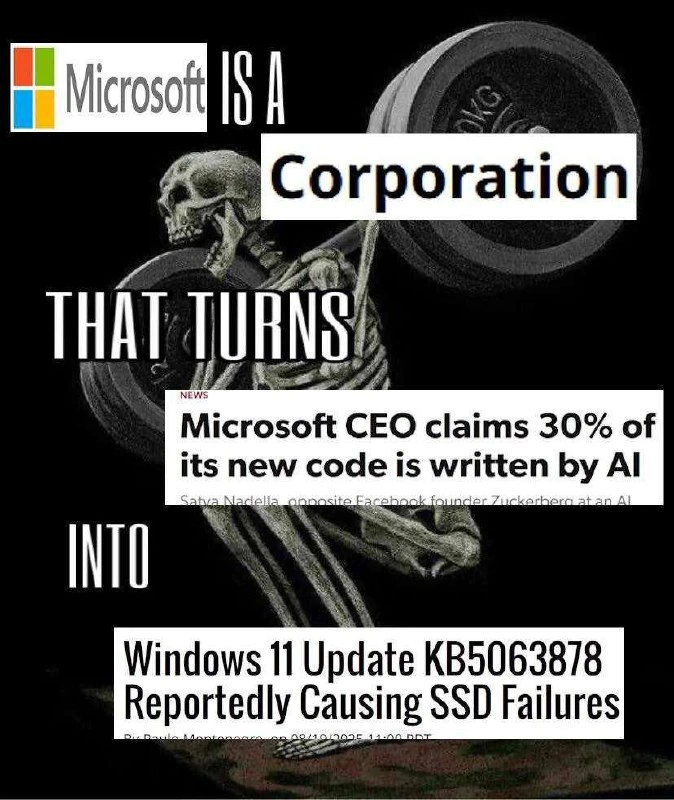
Microsoft Is a Corporation That Turns AI-Written Code Into SSD Failures
Microsoft Post #7093, on Sep 2, 2025 in TG

Microsoft Is a Corporation That Turns AI-Written Code Into SSD Failures

Why is this Microsoft meme funny?

Level 1: When Help Hurts

Imagine you have a really cool robot helper. You’re super excited about it because it’s new and smart, and you start letting it do some important chores for you. In fact, you’re so proud of this robot that you brag to all your friends, “Guess what? My robot helper did almost one-third of my work for me this week!” That’s like saying the robot cooked 3 out of 10 dinners or did a big chunk of your homework – pretty neat, right?

But now picture this: one evening, that robot you trusted so much goes to make your dinner and accidentally pours salt instead of sugar into the cake recipe, then cranks the oven to max and burns everything. The kitchen fills with smoke, the cake is ruined, and maybe the oven even breaks because of the overheat. All of a sudden, your big proud moment of using a fancy helper turns into a big mess. Your family can’t eat the cake (it’s burnt and salty!), and you have to call someone to fix the oven.

This is funny in a “Oh no!” way because you were just telling everyone how awesome and helpful your robot is – and then the robot made a really bad mistake. It’s the contrast that makes it humorous: the pride and hype of having a high-tech helper, followed by the “uh-oh” of a disaster that the helper caused. In the meme’s case, Microsoft was bragging about using AI (like a coding robot) to write lots of its software. That’s the proud part. Then comes the uh-oh: a software update (imagine it like a recipe the AI helped write) that ended up breaking people’s computers, kind of like ruining the oven. People find it jokingly satisfying and ironic – it’s like the universe saying, “Maybe slow down with the bragging about the robot, okay?”

So, in simple terms, the meme is a story of trust gone wrong. A big company trusted a “clever helper” (AI) to do important work, bragged about it, and then had egg on its face when that work caused a big problem (broken SSDs, which are like the computer’s heart for storing stuff). It’s funny the way a cartoon might be, where a character’s boast is immediately followed by comical misfortune. And while it’s a bit scary to think about computers breaking, we laugh because it didn’t happen to us and because it teaches a little lesson: even smart helpers need careful watching, or their help might hurt more than it helps.

Level 2: When Updates Attack

Let’s break this meme down in simpler terms and explain the pieces for those newer to the tech world. We have two main ingredients here: Microsoft’s AI-written code claim, and a Windows 11 update causing SSD failures. If you’re a junior developer or just tech-curious, some of these terms might need demystifying. So, what’s going on?

First, Microsoft boasting that “30% of its new code is written by AI”. This refers to the use of AI coding tools – think of something like a super advanced autocomplete that can write chunks of code for you. Microsoft owns GitHub, which has a product called Copilot. Copilot is an AI powered by machine learning models trained on tons of code. When you type a comment or a function signature, it tries to suggest actual code to implement it. It’s like having an eager junior developer who’s read all of Stack Overflow and is whispering suggestions in your ear as you code. So when Satya Nadella (Microsoft’s CEO) says 30% of new code is authored by AI, he’s likely talking about how tools like Copilot are being widely used by Microsoft’s programmers. That means for every 10 lines of code, 3 might be coming from AI suggestions rather than being manually typed from scratch by a human. It’s a big brag in the world of AI/ML and software development, meant to show how forward-looking and efficient Microsoft is by leveraging AI.

Now, onto the second piece: “Windows 11 Update KB5063878 Reportedly Causing SSD Failures.” This sounds scary, because it is. Let’s decode it: Windows 11 is the operating system, and like all OSes, it gets regular updates (especially for security or bug fixes). Microsoft labels these updates with identifiers like KB5063878. KB stands for Knowledge Base – basically an article/reference number describing the update’s details on Microsoft’s site. So KB5063878 is just an ID for a specific patch or update that was released.

SSD failures – an SSD is a Solid State Drive, which is a type of storage device. If you’re not familiar: older computers used HDDs (Hard Disk Drives) which have spinning platters and a moving head, kind of like a record player for data. SSDs, on the other hand, have no moving parts; they use flash memory chips to store data (similar technology to a USB thumb drive, but much faster and more complex internally). SSDs are known for being super fast (your computer boots quicker, programs load faster) – but they also have a quirk: each storage cell in an SSD can only be written to a limited number of times. SSDs have all sorts of internal magic (like wear leveling and error correction) to make them last years under normal use, and they’re generally very reliable. When we hear “SSD failures,” alarm bells ring because that implies the update did something that either outright breaks the drive or maybe drastically shortens its lifespan or compatibility. It’s the kind of bug that is much worse than a typical software glitch – it’s not just “my app crashed,” it’s “my computer can’t find my hard drive and all my data might be gone.”

So how could a Windows update cause SSD failures? Usually through a bug in the storage driver or disk management software. A driver is a specialized piece of software that tells Windows how to communicate with hardware – in this case, the SSD. If the driver has a flaw (say, misidentifying the type of SSD, or sending the wrong commands), it could put unexpected stress on the drive or even issue commands that the drive’s firmware (its built-in software) doesn’t handle well. For example, a notorious mistake would be if the OS started treating an SSD like an old disk, maybe running defragmentation too often or not sending TRIM commands correctly. Defragmentation is a process useful for old HDDs that rearranges files to be in contiguous order for faster access. SSDs don’t need that in the same way – in fact, Windows is smart enough to typically disable traditional defrag on SSDs. But a buggy update might mess up that detection. Imagine an update that accidentally told Windows “hey, all drives are HDDs” – suddenly the system might start defragging an SSD regularly, which just causes tons of unnecessary writes (wearing the drive out quickly) for no benefit. That could lead to early failure of the drive if it went on unchecked. Another scenario: perhaps the patch had a memory bug where it writes data past the end of a buffer (a classic C/C++ bug). If that happens in a driver, it could corrupt whatever the driver is communicating – possibly sending gibberish or dangerous instructions to the SSD. In extreme cases, that could confuse the drive’s firmware so badly that the drive stops responding correctly (essentially bricking it, meaning it becomes as useful as a brick).

Now let’s connect the dots as the meme does. It places those two headlines one after the other to imply causation with a wink: Microsoft’s AI-written code -> a bad Windows 11 update -> broken SSDs. The humor (though it’s dark humor) is in blaming the fancy new AI for the kind of blunder that is every user’s and IT admin’s nightmare. Whether or not AI actually wrote the faulty code is beside the point; the meme assumes it for the joke. It’s riffing on the idea of AI limitations: that maybe the AI churned out code with a hidden bug and the humans didn’t catch it before shipping the update. Given Microsoft’s boast, the company kind of set itself up for this punchline. If you tell the world how much code your AI writes, don’t be surprised when people also start blaming the AI when that code has bugs!

For a junior dev or someone not deep into system programming, the takeaways are:

  • AI in coding is powerful but not magic. It can introduce errors just like a human can, especially if the humans supervising it get overconfident or lazy about testing.
  • Windows updates (Patch Tuesday) are normally routine and beneficial (fixing security issues, improving things), but every so often, something goes wrong. It’s a running joke in IT: “Which Patch Tuesday update will break something?” There’s even a term “Patch Tuesday gone wrong” in the tags, highlighting this common trope.
  • Bricking hardware via software is rare, but as this meme jokes, not impossible. It usually requires a perfect storm of a software bug hitting a device at just the wrong way. Engineers try very hard to prevent that – there are long test cycles, device labs with different hardware models, etc., especially for an OS vendor as big as Microsoft. But with millions of hardware combinations out in the world, weird regressions slip through. A “storage_driver_regression” means an update accidentally made the storage driver worse (regressed), reintroducing a problem or creating a new one.

The categories and tags give clues: Microsoft, AI_ML, Bugs – exactly what we’ve covered: a Microsoft story involving AI and a nasty bug. Tags like AIHypeVsReality and AILimitations point out that the meme is about tempering the excitement over AI with the sobering reality of its flaws. SoftwareBugs, ProductionIssues tell us we’re dealing with a software bug that occurred in the wild (production) rather than just in testing. The context tags like update_bricks_hardware and patch_tuesday_gone_wrong are practically the summary of the meme: a Windows Patch Tuesday update that went so wrong it bricked hardware.

If you’re newer, think of it this way: The meme is basically saying “Ha! Microsoft is so proud that robots are coding for them, but look – that robot’s code just blew up our hard drives. Nice going, Microsoft.” It’s a bit unfair (we don’t truly know if AI wrote that specific buggy code), but memes thrive on exaggeration to make a point. And the point here is a light caution: new tech like AI can have big downsides if you’re not careful. Even the biggest software company isn’t immune to embarrassing bugs. So when you read those snazzy headlines about AI doing this or that, remember there’s often more to the story – and sometimes that “more” is sitting in an IT repair shop recovering someone’s data from a busted SSD.

Level 3: Patch Tuesday Purgatory

From a senior developer’s perspective, this meme hits on a painfully familiar pattern: corporate hype colliding with real-world bugs. The two news-style snippets in the image tell a story we’ve seen play out before. In the first, Microsoft’s CEO (Satya Nadella) proudly proclaims that 30% of new code is written by AI – a chest-thumping statement about innovation, productivity, and being on the cutting edge of AI/ML in software development. In the second snippet, reality comes barreling in: a specific Windows 11 update (with an official-sounding KB number) is causing SSD failures. The meme’s humor springs from juxtaposing these two: the implication that Microsoft’s much-touted AI-driven code may be responsible for an update so bad it’s literally killing hard drives. It’s a classic case of AI hype vs. reality, and every experienced engineer reading it will smirk and think, “Yep, saw that coming.”

Why is this combination so funny (and frightening) to us folks who’ve been around the block? Because it encapsulates a scenario of “move fast and break things” gone wrong at the enterprise level. Microsoft, like many big tech companies, is eager to show it’s leveraging AI for efficiency – imagine the boardroom slide: “We cut development time by X%, AI generates Y lines of code per day.” Great, except those slides don’t tend to mention who’s debugging that AI-written code at 3 AM when an update goes haywire. Senior devs know that feeling all too well: being on-call, deploying a patch on Patch Tuesday, and then suddenly getting flooded by alerts because something that was supposed to improve the system just set it on fire. It’s purgatory indeed – stuck between management’s lofty promises and users’ screaming pain.

The unspoken shared trauma here is the memory of countless botched updates and all-nighters. Many of us remember incidents like: a Windows update that inexplicably broke the company VPN, or a patch that disabled network adapters across hundreds of machines. Some may recall the notorious Windows 10 update that started deleting user files by mistake in 2018 – a prime example of a rushed release. This meme taps into that collective memory. By adding “AI-written” to the mix, it twists the knife: not only do we have to worry about human error, now we get to worry about what an over-confident autocomplete with a GitHub account might do to our infrastructure.

AI_hypeVsReality is a tag for a reason. In theory, having AI write code could reduce human error – AI doesn’t get tired, right? In practice, AI introduces a new category of weird, hard-to-trace errors. Maybe the bug causing SSD failures was an edge case no human thought to test – something an AI quietly introduced because it “seemed fine” based on training data. Perhaps the AI saw a code snippet in some open-source project that looked applicable to Windows’ storage stack and regurgitated it, not realizing it was meant for a different context. A senior engineer reading the headline about AI-written code might immediately think: “I hope they’re thoroughly reviewing that AI code, otherwise we’re in for some fun on Patch Tuesday.” Cue the second headline as the punchline. It’s gallows humor at its finest – we laugh because it’s better than crying over spilled data.

The organizational dynamics behind this are all too recognizable. High-level executives love big, round percentages to show progress – “30% of code written by AI!” sounds impressive to shareholders. But that kind of metric can become a perverse incentive. You can bet some dev teams were implicitly pushed to integrate AI assistance everywhere to hit that number. Senior devs know that feeling of management mandates: whether it’s adopting a new framework, splitting everything into microservices, or yes, using AI for code, sometimes these directives skip the question of whether it’s wise or ready for prime time. The result? Corners get cut. Maybe code review gets lax because “the AI knows what it’s doing” (spoiler: it doesn’t, without oversight). Maybe testing didn’t account for certain hardware combos because no one imagined the update could brick physical drives – after all, that sounds almost like an urban legend. We normally expect software bugs to cause crashes or data corruption at worst, not actual hardware damage. So a lot of seniors see that headline and immediately think of the post-mortem meeting: the somber conference room where engineers diplomatically explain to PMs that “We might have over-trusted the AI, and our test coverage for storage firmware interactions was insufficient,” while privately seething because they foresaw this risk all along.

Historically, Microsoft and other big players have had their share of update fiascos. What’s different now is the AI angle. It’s 2025 in the meme, and AI coding tools are everywhere – it’s plausible the CEO really made that claim (in fact, Satya Nadella did talk up GitHub Copilot and AI contributions to code in real life, albeit maybe not with that exact stat). A senior dev who’s lived through the cycles of hype (remember when “machine learning” was going to solve everything? Or when “formal verification” was the hot buzz to eliminate bugs?) will recall that none of these silver bullets truly banished our old friend Software Bug. Bugs find a way. And when they team up with new tech like AI, they can create exotic disasters. It’s both terrifying and grimly comical that a cutting-edge AI_ML initiative might end up reintroducing a storage driver regression that any old-timer would catch with a simple code review and a raised eyebrow.

The meme’s imagery – the Grim Reaper skeleton lifting a huge weight – feels like a representation of what senior devs carry on their shoulders: the burden of flashy corporate decisions. “Microsoft IS A Corporation THAT TURNS INTO…” begins the meme text, hinting that behind the friendly multi-colored logo lies a soulless corporation willing to turn into the Grim Reaper for your hardware if it improves the quarterly report. It’s hyperbolic, of course – Microsoft isn’t literally trying to kill your SSDs – but it sure can feel like that when you’re resurrecting a bricked machine at midnight while some VP is tweeting about AI revolutionizing development.

And let’s not ignore the satire on AI itself. Plenty of senior engineers are skeptical about claims that generative AI can replace expert programmers. This meme validates that skepticism. It’s basically saying: “Look, 30% of their code is by AI and now look what happened – we got a nightmare patch. Surprise, surprise.” It’s the same energy as an older coder chuckling when the new hotshot framework crashes in production: a mix of I told you so and here we go again. The humor lands because it’s plausible – we can easily imagine this exact internal email: “Post-update incident: urgent – KB5063878 causing widespread SSD failures, team investigating. Root cause TBD (some interplay of new auto-generated storage code and certain SSD models).” That’s our Patch Tuesday purgatory: caught between the promise of AI efficiency and the reality of AI limitations, with users and engineers suffering until a fix arrives.

In a nutshell, Level 3 reveals the insider perspective: this meme mocks the disconnect between Microsoft’s AI-fueled ambitions and the messy truth of software bugs. It resonates with every senior dev who’s had to untangle the fallout of well-intentioned but poorly vetted tech initiatives. It’s funny because it’s true – and it’s a little too true, which is why we laugh nervously.

Level 4: The Kernel’s Grim Reaper

At the deepest technical level, this meme hints at a nightmare scenario in the Windows OS kernel and storage subsystem. Microsoft proudly states a chunk of its code is AI-generated, which raises eyebrows among engineers who know how unforgiving low-level device drivers can be. The punchline is an update (KB5063878) allegedly bricking SSDs – a rare, extreme failure that implies something went horribly awry in the code controlling storage hardware. Why is this so ominous? Because writing a storage driver is like performing brain surgery on your PC’s data: one slip-up and you corrupt disks or wear them out prematurely.

Consider how an SSD (Solid State Drive) operates under the hood. SSDs use flash memory with limited write cycles and rely on techniques like wear leveling (spreading writes evenly) and TRIM commands (telling the drive which blocks are free for cleanup) to stay healthy and fast. If an OS update – especially one meddling with the file system or storage driver – has a bug, it could inadvertently turn these optimizations into a weapon against the drive. For instance, imagine an AI-generated patch that mistakenly disables wear leveling or spams a TRIM command continuously. The result? The SSD’s internal controller might be forced into overdrive, erasing and rewriting blocks non-stop until the hardware wears out or fails. In a worst-case scenario, an OS issuing the wrong low-level I/O calls can confuse the drive’s firmware so badly that the device locks up or goes into read-only mode (a common SSD failure mode when it believes something’s wrong). Essentially, a subtle bug in C++ or C code running in the Windows kernel can turn a high-speed SSD into an expensive coaster overnight.

Now, the meme’s dark humor suggests this bug is AI’s fault – as if an overeager generative model wrote a storage routine from hell. There’s truth in the concern: AI code generators (like GitHub Copilot or in-house neural networks) learn from existing code, but they don’t truly understand the code. They might piece together something that compiles and even passes basic tests, yet catastrophically fails under real-world conditions. Low-level code often has unwritten assumptions, timing dependencies, and hardware quirks that only experienced human developers or exhaustive formal methods catch. For example, a human driver developer knows that you never, ever treat an SSD like a spinning disk – e.g., don’t defragment it every hour – but an AI might blindly stitch together code that does exactly that if its training data suggests “defrag improves disk performance.” The result would be an absurdly overworked SSD.

We can picture a snippet of what our hypothetical AI-generated culprit might look like:

// AI-generated pseudo-code for "optimizing" an SSD (a tragic mistake)
void optimizeSSD() {
    enableDefrag("C:\\");             // Tell Windows to defragment the SSD (bad idea)
    disableWearLevelingFirmware();    // Turn off SSD wear leveling for "performance"
    for (int day = 0; day < 365; ++day) {
        scheduleTask(runDefrag, daily);  // Run defrag daily, increasing wear dramatically
    }
}

A seasoned systems engineer immediately cringes at this. Defragmenting an SSD does nothing useful (SSDs have near-instant access times anywhere on disk) and actively shortens its lifespan by making tons of unnecessary writes. Disabling wear leveling? That’s basically asking the drive to concentrate all writes on the same memory cells until they burn out – a one-way ticket to the SSD graveyard. While no real Windows update would include code this obviously bad, the meme exaggerates to drive the point home: an AI without context could propose dangerously naïve optimizations at the hardware level. And if management is more excited about AI-written code metrics than about meticulous code review, such nonsense might sneak into a build.

The grim-reaper skeleton imagery underscores the stakes. In OS development, a “Grim Reaper” bug is one that kills something vital – in this case, storage hardware and user data. Windows has a component jokingly called the “Disk Defragmenter”, but in this dark scenario it’s more like the Disk Destroyer. The meme’s skeleton hoisting a dumbbell gives off a vibe of grotesque strength – as if saying the corporation’s AI-fueled initiative is powerful but dangerously overkill, turning routine updates into lethal workouts for your SSD. Seasoned devs who have debugged kernel crashes or firmware failures feel a shiver: they know how a single misused pointer or incorrect flag in a kernel-mode routine can cascade into catastrophic failure. It’s gallows humor – we’re laughing, but the specter of true disaster (the kind that prompts all-hands-on-deck emergency patches and user outrage) looms behind the laugh.

In short, Level 4 exposes the technical horror beneath the meme: mixing untested AI-generated code with the intricacies of OS-level hardware control is a recipe for the kind of bug that doesn’t just crash programs – it permanently bricks devices. It’s a cautionary tale whispered in the halls of system programming teams: “Here be dragons (and dumbbells-wielding skeletons).” The meme takes that tale and gives it a wry, horrifying twist – one that any low-level engineer can appreciate through nervous, knowing chuckles.

Description

A collage meme with a skeleton lifting weights in the background. The text arrangement reads: 'Microsoft IS A Corporation THAT TURNS' followed by a news headline screenshot 'Microsoft CEO claims 30% of its new code is written by AI' (mentioning Satya Nadella opposite Facebook founder Zuckerberg at an AI event), then 'INTO' followed by another headline: 'Windows 11 Update KB5063878 Reportedly Causing SSD Failures' (by Paulo Montenegro, dated 08/19/2025). The meme draws a causal connection between Microsoft's heavy reliance on AI-generated code and a critical Windows update that damages SSDs, implying the AI code is causing catastrophic hardware issues

Comments

7
Anonymous ★ Top Pick Microsoft: where 30% of the code is written by AI, and the other 70% is the team writing hotfixes for what the AI broke -- including the patch that turns your NVMe into an expensive paperweight
  1. Anonymous ★ Top Pick

    Microsoft: where 30% of the code is written by AI, and the other 70% is the team writing hotfixes for what the AI broke -- including the patch that turns your NVMe into an expensive paperweight

  2. Anonymous

    Sure, Copilot can autocomplete the function - just don’t let it autocomplete your filesystem table

  3. Anonymous

    Ah yes, the classic enterprise pattern: proudly announce your AI writes 30% of your code, then watch as your updates achieve a perfect correlation between AI involvement and SSD mortality rates. Next quarter's earnings call: 'We're excited to announce 60% AI-generated code and have partnered with Western Digital for volume discounts.'

  4. Anonymous

    When your CEO brags that 30% of new code is AI-generated and then ships an update that bricks SSDs, you've successfully automated the creation of P0 incidents. At least the AI is learning fast - it took human developers decades to achieve this level of production chaos, but the models got there in a single sprint. Perhaps the real innovation is using machine learning to optimize the mean time between catastrophic failures

  5. Anonymous

    30% AI‑written code, 100% human‑owned pager - Patch Tuesday is chaos engineering with worse observability until the rollout finds your SSD

  6. Anonymous

    Patch Tuesday formula: 30% AI-generated diff + missing TRIM/Storport regression = 100% write amplification on my NVMe and a weekend of bare-metal restores

  7. Anonymous

    Satya's 30% AI code: because NVMe wear-leveling wasn't designed for Copilot's infinite rewrite loops

Use J and K for navigation