Haskell Compiler Bug Where Disabling Warnings Breaks Instance Resolution
Why is this Compilers meme funny?
Level 1: The Mute Button Mishap
Imagine you have a fire alarm in your kitchen that occasionally gives off little warning chirps – not because there’s a real fire, but maybe because it’s a bit too sensitive or the battery is low. It’s annoying, so you decide to mute all the alarms in your house for a while to get some peace. You think, well, nothing’s really on fire, I’m just tired of the noise. But then, weirdly, as soon as you do that, your stove refuses to turn on. Suddenly you can’t cook anything, and an error message on the stove says, “No heat instance found!” You’re standing there like, “What on earth does muting my alarms have to do with my stove not working?!” You spend an hour checking the stove, the gas, the electricity – everything seems fine. Finally, you discover that muting the alarms (which was only supposed to stop the noise) accidentally triggered a bug in your smart home system that made the stove think it can’t heat up.
In this little story, muting the alarms is like turning off compiler warnings, and the stove refusing to work is like the compiler error that shouldn’t have happened. The meme is joking that as programmers, when we try to silence the little warning messages from our tools (because we find them annoying or think we don’t need them), the technology might mischievously bite back with a much bigger problem. It’s saying, in a playful way, “maybe we had it coming.” Like if you tell your friend to stop nagging you about wearing a seatbelt, and then the car refuses to start because it knows you won’t wear a seatbelt – you’d think the car is punishing you! The phrase “divine punishment for making the rock think” is a fancy way of personifying the computer (the "rock" that we made “think” with our programming). It’s as if the computer is a grumpy deity that got back at the programmer for messing with it.
So, in simplest terms: the meme is funny because the programmer did something that should have been harmless (turning off warning messages), but it caused a silly, baffling breakdown (the code stopped working for a crazy reason). It points out how technology can sometimes behave illogically, and we can only throw up our hands and laugh, saying “Well, I guess I asked for it!”
Level 2: The Missing Instance Mystery
Let’s break down what happened in simpler terms. We’re looking at a Haskell program and a weird compiler error. Haskell is a functional programming language known for being very strict about types – which means the compiler usually catches any mistake in how data is used. In Haskell, when you see something like Just () == Nothing, the compiler needs to know that it’s okay to compare those two values for equality. Just () and Nothing are values of type Maybe () (think of Maybe like an "optional" type that can either be Nothing meaning no value, or Just x meaning there is a value x). To check equality with ==, Haskell relies on something called a typeclass named Eq. A typeclass in Haskell is like an interface or a contract that says "types that belong to this class know how to compare for equality" (in case of Eq). When a type belongs to a typeclass, we say there's an instance of that typeclass for the specific type. For example, the type Int has an Eq instance (since we know how to check if two integers are equal), and Maybe Int also has an Eq instance (basically, it knows to compare the inside values if both are Just, and that Just is never equal to Nothing). In fact, Haskell’s standard library automatically provides an Eq instance for Maybe a as long as a itself can be compared for equality. So, logically, Maybe () should have an Eq instance because () (the unit type, a single trivial value) can be compared with itself.
Now, normally if you write:
main = print ( Just () == Nothing )
the program compiles and runs fine, printing False (since Just () is not equal to Nothing). But in the meme’s scenario, the developer added a special line at the top: {-# OPTIONS_GHC -Wno-all #-}. This is a GHC pragma (an instruction to the compiler) telling it to turn off all warnings. GHC (the Glasgow Haskell Compiler) has lots of warning options. Warnings are those messages that aren’t fatal – the code can still compile and run, but the compiler is letting you know “hey, this might be a problem or a bad practice.” Sometimes projects enable a bunch of extra warnings (with a flag like -Wall, meaning "enable all warnings") to keep code quality high. Here, -Wno-all explicitly says "disable all warnings" (essentially the opposite of -Wall). It’s a bit unusual – if you hadn’t enabled warnings, there’s nothing to disable, but it’s like an explicit confirmation: no nagging, please.
What happened next is the mystery: with that warning flag in place, the compiler suddenly threw an error about no instance for Eq (Maybe ()). In plain terms, the compiler error is claiming “I don’t know how to compare Maybe () values with ==.” This is bizarre, because as we established, it should know how – the capability (instance) is built-in. This error [GHC-39999] is not something a beginner would ever expect to see; even many experienced Haskell developers did a double-take. It’s as if you asked the calculator to add 2 + 2, and it responded “Error: no addition instance for 2 and 2.” You’d be puzzled, right? You’d probably assume you did something wrong, not the calculator. That’s exactly what the developer in the meme went through: an hour of checking everything, thinking “What could possibly be wrong here? Is my code cursed?” They eventually discovered it wasn’t their fault at all – it was a compiler bug. In the GitHub issue screenshot (actually from GHC’s issue tracker), the title literally says “Disabling warnings breaks instance resolution.” Instance resolution is a fancy term for "figuring out which instance to use" – in this case, figuring out that Maybe () has an Eq instance. And indeed, that process "broke" when warnings were disabled.
To put it simply: a compiler bug means the compiler itself has a flaw. We usually treat the compiler as the ultimate judge of what’s correct in our code. It’s very rare (and scary) when the compiler is the one doing something wrong. It’s like finding out your spell-checker is intentionally misspelling words, or your calculator gives wrong answers only when you wear a blue shirt. Here, turning off warnings (something that should just make the compiler less chatty) ended up making it forget or ignore that Maybe () is comparable. That’s not normal at all – warnings should never affect actual code logic. So this meme is pointing out this absurd situation and laughing (painfully) at it.
The lines in the meme text – “Programmers do deserve this. It’s divine punishment for making the rock think.” – are a tongue-in-cheek expression of despair. The author is basically saying: this is so ridiculously cruel that it feels like cosmic karma. We, as programmers, took a rock (silicon from sand makes computer chips) and taught it to “think” (perform computations). Haskell, being a high-level language, is like black magic that turns logic into a running program. So when something inexplicably goes wrong at the compiler level, it almost feels like the universe smacking us on the head for our arrogance. "We deserve this" is pure sarcasm born from frustration: obviously no programmer truly wants or deserves a bug that wastes their time, but when you’re defeated by such a weird problem, humor is a coping mechanism. It’s easier to jokingly say “haha, I guess I had that coming” than to just scream in rage.
In summary, for a junior developer or someone new to Haskell, what you need to know is: this meme is about a weird Haskell compiler bug. The developer turned off all the compiler’s warning messages and, in doing so, triggered an error that shouldn’t happen. The code that compares a Just () to Nothing stopped compiling because the compiler wrongly thought it didn’t know how to compare them. This led to a lot of confusion. The humor (yes, developers have a strange sense of humor) comes from the sheer ridiculousness of the situation. It’s like a detective story where the culprit was the last thing you’d suspect – in this case, the compiler’s own warning system. And the punchline is delivered with a bit of self-deprecation and nerdy drama: implying that perhaps the gods of computing are punishing programmers for their hubris. Don’t worry – in day-to-day coding you won’t run into this kind of bug often. But when you do hit an inexplicable problem, this meme is a reminder that sometimes it’s not your fault; sometimes the tools themselves have gremlins. And all you can do is shake your head and laugh (after you finally figure it out).
Level 3: No Warn, All Harm
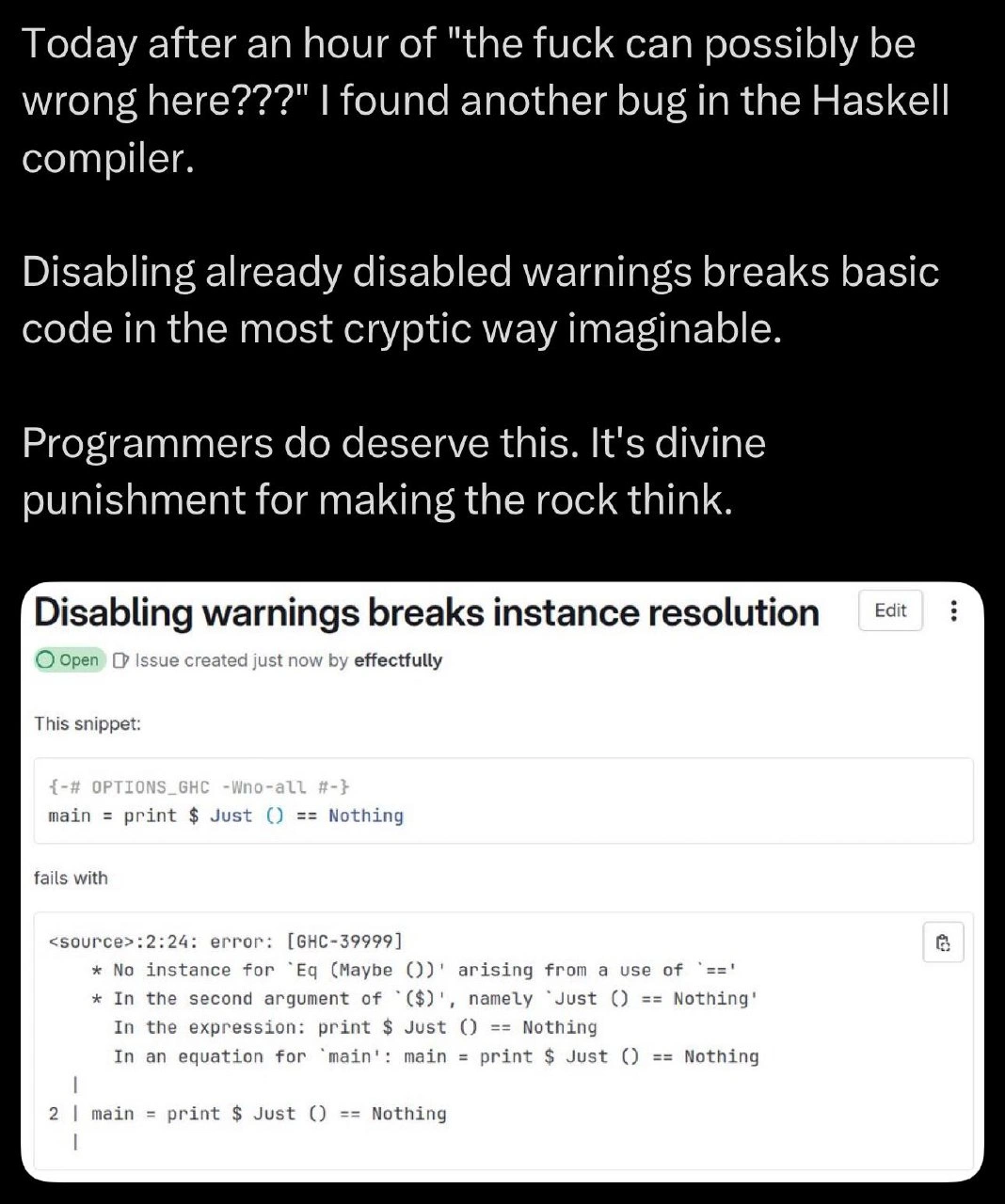
For the seasoned Haskell developers and compiler veterans, this meme hits a very specific nerve. It encapsulates that moment when you're debugging a trivial piece of code, absolutely convinced “this should work”, and yet the compiler spits out an error from an alternate reality. Here we have a classic case of a haskell_compiler_bug that only surfaces under a bizarre condition: using the GHC option -Wno-all to disable warnings. The snippet in question is as simple as it gets:
{-# OPTIONS_GHC -Wno-all #-}
main = print $ Just () == Nothing
One would expect this code to compile without fuss – after all, comparing Just () to Nothing is totally legit. Haskell’s standard library defines an Eq instance for Maybe (as long as the contained type is Eq, and () is certainly Eq). Under normal circumstances, Just () == Nothing should evaluate to False and print that out. But with the wno_all_flag engaged, GHC surprises us with an error:
<source>:2:24: error: [GHC-39999]
* No instance for ‘Eq (Maybe ())’ arising from a use of ‘==’
* In the second argument of ‘($)’, namely ‘Just () == Nothing’
In the expression: print $ Just () == Nothing
In an equation for ‘main’: main = print $ Just () == Nothing
This is the cryptic instance error the meme refers to. GHC is acting as if it has suddenly forgotten that Maybe () can be checked for equality. Seasoned devs will recognize the absurdity immediately: "No instance for Eq (Maybe ())" is not a message you expect unless you truly screwed up imports or instances – certainly not for Maybe which is part of the Prelude. The meme's author describes an hour of "what the f**k can possibly be wrong here???" – a relatable debugging frustration where you question your sanity, your code, and ultimately reality itself. It's that sinking feeling when a fundamental guarantee (typeclass_instance_resolution of a built-in type) appears broken.
Why is this funny (in a dark way) to experienced devs? Because it highlights a perverse twist: a warning flag side effect. Normally, compiler warnings are advisory; they point out potential issues but do not change program behavior. Turning warnings off (especially ones that were never on to begin with, since -Wno-all suggests "disable all warnings", presumably undoing -Wall or similar) should, in theory, just silence nagging messages. It certainly shouldn’t alter compilation logic. And yet here we are – toggling a warning flag breaks basic code. This is the kind of deep bug that gives you existential dread as a developer. You start asking: if even the compiler can randomly lie to me, what is true? The meme captures this existential comedy: "Programmers do deserve this. It's divine punishment for making the rock think." That line drips with cynical humor. The "rock" refers to the computer at the most fundamental level (silicon chip = refined sand/rock). We dared to "make the rock think" by writing highly abstract code in Haskell, and the universe (or the computing gods) punished our hubris with an unfathomable bug. This is a modern tech twist on Greek mythology – Prometheus stole fire from the gods, and was punished; here a programmer harnessed compute power (making sand think), and is punished with a brain-melting compiler bug. It’s funny because it feels earned in a twisted way: Haskell is notoriously proud of its type system and purity, and many Haskellers (lovingly) tout how the compiler is smarter than us. Well, this time the compiler wasn’t just smart – it was downright malicious.
For veteran devs, there's also a sense of "Of course it’s GHC". Compilers are some of the most complex pieces of software out there, and GHC, supporting myriad ghc_options, extensions, and optimizations, has a long history of both genius and quirk. We remember tales of language quirks and obscure bugs: like how certain combinations of flags or exotic types can trigger a GHC panic (the compiler’s equivalent of a runtime crash, often with the infamous message "the compiler panicked: this should not happen"). This issue – "Disabling warnings breaks instance resolution" – now joins the annals of legendary oddball bugs. It even has a tracking number that we can almost laugh at: #26374, as if Haskell’s bug tracker is telling us how many cuts this death by a thousand paper cuts has reached. The humor thrives on hyperbole and commiseration: Programmers deserve this?, the author jests. On one hand, no one truly deserves losing hours to a nonsense bug. On the other, seasoned devs often joke that our pain is self-inflicted – we build these ridiculously complex systems (like a language with a powerful typeclass mechanism and countless compiler flags), so when it collapses under its own complexity, well, maybe we had it coming.
This meme resonates because it’s a perfect storm of CompilerErrors and LanguageQuirks. It’s the kind of story you immediately share with colleagues on Slack: “Check this out – I disabled warnings in GHC and it broke equality. Yes, seriously.” It lampoons the reality that even in a very high-level, theoretically robust language like Haskell, you can still stumble on a bug so low-level and absurd that all you can do is laugh (and cry a little). And if you’ve ever maintained legacy code or wrestled with bugs in software late into the night, you know this feeling: sometimes the tools that are supposed to save us (like a compiler catching our mistakes) become the source of the mistakes. It’s a shared industry joke that “it’s always something stupid like a missing semicolon or a config flag,” except here the stakes were higher – it was the compiler’s fault, not even the code’s. In sum, the meme humorously portrays a senior dev’s WTF moment turned life lesson: don’t blindly trust anything, not even your compiler’s innocence, and maybe don’t turn off warnings unless you really mean it. The divine punishment angle is just the extra salt, effectively saying: We thought we were gods crafting logic out of lifeless mineral... but clearly, we are mere mortals at the mercy of the machines we created.
Level 4: Typeclass Twilight Zone
At the deepest technical level, this meme highlights an arcane corner of the Glasgow Haskell Compiler's internals – a place where a seemingly harmless flag warps compiler behavior in inexplicable ways. We’re dealing with typeclass instance resolution, which in Haskell is normally a deterministic search for a matching instance (like a proof that Maybe () supports equality). Under the hood, GHC turns typeclass constraints into dictionary passing: the compiler carries around evidence (dictionaries) that a type implements a typeclass. Typically, the instance for Eq (Maybe a) exists (provided a has an Eq instance), and GHC’s constraint solver can always resolve Eq (Maybe ()) because () (unit type) trivially has an Eq instance. However, enabling {-# OPTIONS_GHC -Wno-all #-} – a flag intended to suppress all warnings – unexpectedly sabotages this process. It’s as if a low-level flag state is messing with the compiler’s constraint solver algorithm – likely an unforeseen coupling in GHC’s code. The result is a phantom instance error: GHC reports no Eq instance for Maybe () even though one exists. This is a true "ghost in the machine" scenario, reminiscent of a Heisenbug where the act of toggling a compiler setting changes the outcome of compilation in a non-linear way. The error code [GHC-39999] hints at how deep and specific this glitch is – GHC's error numbering has ventured into the high 30k range for this oddity, suggesting a freshly uncovered edge case. Under the hood, something in the warning flag handling likely interferes with module imports or instance scope: possibly the flag erroneously prunes the import of the Eq instance or short-circuits some typeclass lookup phase. It's a compiler bug of the purest sort – not a misunderstanding of Haskell’s lofty type system or monads, but a dirty wart in the plumbing of the compiler itself. This kind of bug is where functional programming meets fallible implementation: the theoretically sound typeclass mechanism is undermined by a practical coding mistake in GHC’s codebase. In academic terms, one could draw parallels to an incompleteness in the logic resolution algorithm triggered by a non-logical flag, akin to a solver that fails under certain global conditions, violating the principle of referential transparency at the compiler meta-level (since a warning flag, which shouldn't change semantics, ironically does). It’s both terrifying and fascinating: a peek into how even a language known for mathematical rigor can stumble due to the messy reality of compiler engineering. At this level, the humor in the meme is cosmic irony: we built a sophisticated, theoretically beautiful system (Haskell’s typeclasses and GHC’s advanced compiler) only to find a butterfly-effect bug where disabling warnings – purely an aesthetic choice – causes a logical breakdown. It's as if the compiler's logic has a hidden backdoor, and by uttering the magic incantation -Wno-all, we've summoned a demon that devours typeclass instances. In essence, this is an absurd intersection of compiler theory and Murphy's Law: anything that can break, will break – even the guarantees of your beloved type system, given the right (or wrong) compiler flag.
Description
A screenshot with white text on dark background describing a Haskell compiler bug discovery. The text reads: 'Today after an hour of "the fuck can possibly be wrong here???" I found another bug in the Haskell compiler. Disabling already disabled warnings breaks basic code in the most cryptic way imaginable. Programmers do deserve this. It's divine punishment for making the rock think.' Below is a GitHub issue titled 'Disabling warnings breaks instance resolution' (Open, created by effectfully). The issue shows a Haskell code snippet: '{-# OPTIONS_GHC -Wno-all #-}' followed by 'main = print $ Just () == Nothing' which fails with error '[GHC-39999]: No instance for `Eq (Maybe ())` arising from a use of `==`'. The bug demonstrates that adding -Wno-all pragma somehow breaks type class instance resolution for basic Eq comparisons
Comments
12Comment deleted
'Programmers deserve this. It's divine punishment for making the rock think.' -- and Haskell programmers deserve it doubly, because they made the rock think about types, monads, and category theory until even the compiler lost track
Turns out `-Wno-all` quietly promotes every warning to a full-blown existential crisis - proving that in Haskell even the compiler practices lazy error disclosure
After 20 years in the industry, you realize the real bug is that we convinced silicon to have opinions about type equality, and now it's getting revenge by making instance resolution dependent on whether you asked it to shut up about other problems
Ah yes, the classic Haskell experience: spend an hour debugging your perfectly valid code, only to discover the compiler itself is having an existential crisis about whether warnings should affect type inference. It's like the GHC team decided that '-Wno-all' should mean 'no, all your instances too.' At least when you're fighting the borrow checker in Rust, you know it's *your* fault - but in Haskell, even the compiler can gaslight you into questioning whether Maybe really does have an Eq instance. This is what happens when you give a sufficiently advanced type system enough rope: it doesn't hang itself, it just silently breaks instance resolution and watches you suffer
Apparently -Wno-all means “no warnings and no typeclass dictionaries” - silence the linter, and Eq quietly rage-quits; peak compiler-as-feature-flag energy
Haskell's type checker: 'You disabled my warnings? Fine, now explain why Nothing won't show itself.'
Only in GHC can -Wno-all erase Eq (Maybe ()): when diagnostics mutate semantics, you didn’t disable warnings - you enabled quantum compilation
i mean their fault for using haskell Comment deleted
How's that type safety, asshole? Comment deleted
Found the c dev Comment deleted
Go, actually Comment deleted
Maybe just need to use assembler?😁 Comment deleted