Warcraft for Workgroups: The Lost Microsoft x Blizzard Collab
Why is this Microsoft meme funny?
Level 1: All Work and Warcraft
Imagine you go to turn on a computer that’s supposed to be for serious work – like doing homework or office tasks – and instead of showing the normal welcome screen, it shows the title of a video game. 😃 That’s what’s happening here, and it’s funny because it’s so unexpected. It’s like walking into a classroom expecting math class, but the blackboard says the name of your favorite game or cartoon instead of the lesson. The meme takes something boring or serious (a work computer startup screen) and suddenly makes it fun (by changing it to a game screen). The emotional core is the surprise and delight of mixing work and play. People who see this picture remember how computers used to look long ago (that gives a warm, nostalgic feeling) and then they see a game’s name where it doesn’t belong (that gives a silly, rebellious feeling). It’s basically saying, “Wouldn’t it be cool if your office PC was actually secretly a game machine?” That playful twist – turning a dull office moment into a fantasy battle – is what makes it amusing to anyone who’s ever wanted to have a little fun during work time.
Level 2: Retro OS meets RTS
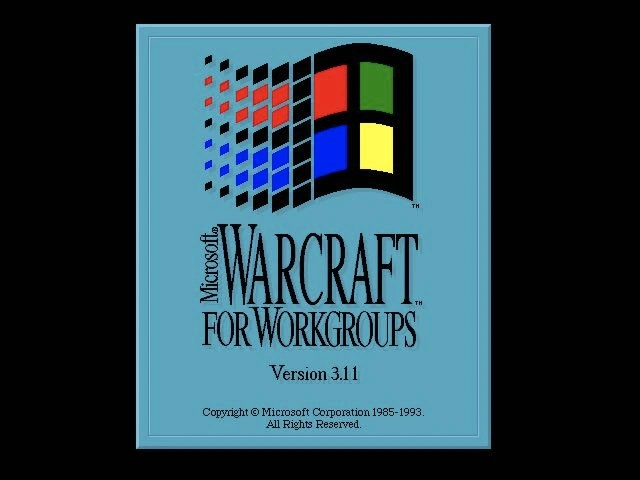
Let’s break down the joke for those who aren’t familiar with the references. Windows for Workgroups 3.11 was an old version of Microsoft’s operating system, released around 1993, before Windows 95. The term “for Workgroups” meant it was specifically geared towards connecting a small group of computers together in an office or lab – basically early networking for sharing files and printers among co-workers. When you turned on a PC with Windows 3.11, you’d see a startup splash screen: a teal-blue background with the classic old Windows logo (a wavy window made of red, green, blue, and yellow tiles) and text saying “Microsoft Windows for Workgroups 3.11.” It looked very 90s, very pixelated, and it gave off a serious “welcome to work” vibe. This was a time of RetroComputing aesthetics – low-resolution graphics and simple UI – which many find charming today.
Now, Warcraft in this context refers to a popular computer game series by Blizzard Entertainment. The first game, Warcraft: Orcs & Humans, came out in 1994. It’s what we call a Real-Time Strategy (RTS) game. In an RTS, you build a base, gather resources, and command an army (like orcs or humans in a fantasy setting) against opponents, all in real-time. Warcraft was a big deal in gaming culture and was the ancestor of other Blizzard hits like Warcraft II, Warcraft III, and eventually the famous online game World of Warcraft. In the mid-90s, playing Warcraft or similar games with your friends usually meant connecting computers on a LAN (Local Area Network) because the internet was not yet widely available or fast enough for gaming. A LAN is basically a direct network connecting computers in close range – like in the same office or room – often using either cables or special network protocols of the time.
So what’s “Warcraft for Workgroups” then? It’s a playful mashup of those two worlds. The meme image replaces the word "Windows" with "Warcraft" on that old Windows 3.11 startup screen. It also keeps “Version 3.11” in there. Essentially, it’s joking that the operating system itself is dedicated to running Warcraft in a workgroup setting. Imagine turning on your PC at work and instead of booting into Windows (for spreadsheets and email), it boots into Warcraft (for launching catapults and casting spells!). The Microsoft Windows logo is still there, but now it’s as if Microsoft officially endorsed using your office network for a fantasy war game.
For a newcomer, here’s why that’s funny to those in tech: Windows for Workgroups was supposed to be all about office productivity and networking for work. But many techies who used it at the time also discovered they could use the exact same network connections to play games like Doom or Warcraft with their colleagues. It was like a secret dual-purpose: by day your PC was a serious work machine, by night (or lunch break) it transformed into a game console, often without your boss knowing. So “Warcraft for Workgroups” is basically saying “this computer network is officially for playing Warcraft.” It flips the script.
Also, the nostalgia factor is huge. Both “Windows 3.11” and the original Warcraft game are relics of the 90s. Seeing the two combined is instantly recognizable to those who know them. It’s as if someone took two old favorite things and merged them into one image. It taps into gaming culture and tech history at the same time. The visual style – that old-school splash screen – signals something from decades ago, and the text swap to a game name is unexpected. It’s a bit of tech humor that relies on knowing the context: that Windows 3.11 was one of the first OS versions to support LAN networking, and that Warcraft was one of the classic games people would play over those LANs.
To put it simply: the meme is funny to developers because it reminds them, “Hey, remember when we used to set up our clunky old PCs at work to play Warcraft together? What if Microsoft had just admitted that and shipped an OS just for that purpose?” It’s a crossover joke. If you didn’t know these specific things, think of it like combining a famous old tool with a famous old toy – the surprise is seeing them in one place. Once you know Windows 3.11 was real (and very work-focused) and Warcraft is a game (very play-focused), the idea of Microsoft releasing “Warcraft for Workgroups” becomes a delightful absurdity. It’s a prime example of meme culture among techies, where mixing references yields a chuckle.
Level 3: Nostalgic LAN Warfare
This meme hits home for any developer who remembers the days of tech nostalgia when offices and computer labs doubled as covert gaming arenas. The image looks exactly like the old Windows 3.11 startup splash: the teal blue background, the pixelated four-color Microsoft window logo trailing off into digital confetti, and the formal “Version 3.11” caption. For those of us who grew up booting into that screen, it’s an instant time machine to ~1993. But then comes the twist: instead of Windows for Workgroups, it reads “Microsoft Warcraft for Workgroups.” This mashup is hilarious because it fuses two very different memories from that era: the stodgy business-minded Windows OS and the fantastical world of Blizzard’s Warcraft game. It’s like discovering your office’s serious mission statement has been replaced with a guild charter for battling orcs.
The humor plays on the juxtaposition of work and play. Windows for Workgroups was all about office productivity and networking efficiency — it let colleagues share files, printers, and maybe send the occasional early email across a LAN. Meanwhile, Warcraft is a classic fantasy RTS game where humans and orcs duke it out with swords and sorcery. By cheekily rebranding the OS as “Warcraft for Workgroups,” the meme suggests that instead of sharing printers, these office PCs are sharing catapults and spellbooks. It’s poking fun at how corporate networks in the 90s often ended up being used for impromptu gaming sessions. Many senior engineers have fond (and borderline mischievous) memories of staying after hours or coming in during lunch to host a quick LAN party in the office, turning the boardroom into a battleground. The phrase “for Workgroups” itself hints at small-group collaboration – and nothing builds team spirit like a 2v2 game of Warcraft over the company network, right? :wink:
There’s also a layer of GamingCulture and insider nostalgia here. In the early-to-mid ‘90s, PC gaming was just starting to flourish. Games like Doom and Warcraft II were often passed around on floppies and installed on office machines under the guise of “testing the network.” Warcraft for Workgroups feels like a shout-out to that era when tech-savvy employees tested the limits of what their work PCs could do. The meme resonates because it’s exactly the kind of thing an IT department might joke about: “Our network is so robust, we could run Warcraft on it!” Engineers who lived through those times recall editing network settings or running IPX/SPX protocols not just to map a network drive, but to get multiplayer games working. Seeing the Microsoft Windows boot screen – usually a promise of spreadsheets and databases – morphed into a banner for a fantasy war game is a fun reminder of how we often turned tools meant “for work” into instruments of play.
The version number “3.11” is the cherry on top. It firmly plants the joke in a specific timeline – Warcraft: Orcs & Humans (the first Warcraft) was released in 1994, shortly after Windows 3.11 in 1993. So the meme imagines if these two had launched together as a hybrid product. Of course, in reality, Windows 3.11 never shipped with any epic games (though it did have Minesweeper and Solitaire—the original “sanctioned” office time-killers!). That contrast is golden: Minesweeper is about the most sedate “game” you’d find in a ‘90s office, whereas Warcraft involves frenzied clicking and battle cries. The meme essentially says, “What if Microsoft had a sense of humor and bundled a full-blown fantasy war simulator with its office network OS?” It’s an absurd scenario that makes tech folks smirk. It also subtly satirizes how even today, corporate machines often come locked down for work use only, yet people find ways to sneak in a bit of fun.
On a TechHistory note, the combination of Microsoft and Warcraft is ironic and apt. Microsoft was the giant of operating systems; Blizzard (the maker of Warcraft) was becoming a giant of PC gaming. In the decades since, these worlds have collided in reality (consider Microsoft’s ventures into gaming with DirectX, Windows gaming, Xbox, etc.), but back then they were distinct realms. This meme imagines a crossover that never actually happened but feels like it could have been a cheeky Easter egg in an alternate timeline. It tickles the brain of anyone who remembers configuring Windows 3.x and also playing early Blizzard games. It’s a gentle ribbing at how we partitioned “work software” and “game software” as if they were oil and water, even though they ran on the same beige computers.
To break down the contrast and the shared joke, consider the roles of each in the 90s:
| Windows 3.11 For Workgroups 🖥️ | “Warcraft for Workgroups” (Parody) 🕹️ |
|---|---|
| Meant for office productivity and file sharing among colleagues. | Meant for office “productive” skirmishes and file-saving throws (game saves) among colleagues. |
| Boot-up splash shows Microsoft’s logo, implying serious business. | Boot-up splash shows a Warcraft twist, implying serious mayhem. |
| Users connect PCs to share printers and maybe schedule meetings. | Users connect PCs to share alliances and schedule orc raids. |
| Comes with Notepad, Excel, and boring databases. | Comes with footmen, orcs, and building bases. |
| The biggest built-in distraction was Solitaire or Minesweeper. | The biggest built-in distraction would be an entire Warcraft campaign! |
(Yes, we’re effectively envisioning an IT-approved LAN party simulator.)
Ultimately, the meme’s hilarity is that it perfectly dresses up a gaming reference in an official Microsoft wrapper. It’s the kind of TechHumor that blends MemeCulture with real historical tech. Anyone who’s ever felt the thrill of clicking “Multiplayer” on an office network, or who nostalgically remembers the retro computing look of early Windows, will get a kick out of it. “Microsoft Warcraft for Workgroups” is basically saying: remember when our biggest network concern was whether we could get WarCraft running at the office? It’s a wink to veterans who’ve been there and a quirky history lesson to those who haven’t.
Level 4: 16-Bit Battleground
In the early 1990s, Windows for Workgroups 3.11 was a 16-bit multitasking battleground of its own, straddling the line between old-school MS-DOS and the future of graphical operating systems. It ran on top of DOS in protected mode but had to cooperate with DOS’s real-mode roots. That meant segmented memory and the infamous 640 KB conventional memory limit were very real constraints. Under the hood, Windows 3.11 used cooperative multitasking for 16-bit applications – programs had to play nice and yield control, or else the whole system could stall. Launching a heavy DOS game like Warcraft: Orcs & Humans inside such an environment was asking for trouble: the game’s main loop would happily hog the CPU, and since Windows 3.11 didn’t have true preemptive scheduling for those 16-bit tasks, running an RTS could turn your multitasking OS into a single-minded war room. Essentially, once Warcraft took over, your workgroup PC became a dedicated battle station until you quit the game – a quirk of the OS’s design that veteran engineers remember all too well.
Moreover, Windows for Workgroups was notable for introducing built-in network support (hence the “for Workgroups” moniker). It bundled network drivers for protocols like NetBEUI and could work with IPX/SPX to connect PCs in a local LAN – critical for both office resource sharing and early multiplayer gaming. Back then, Warcraft (especially Warcraft II in 1995) and other games often relied on IPX networks for direct PC-to-PC play, since TCP/IP wasn’t yet the default on Windows 3.11 (you usually had to install a 3rd-party Winsock stack for internet TCP/IP). This meme riffs on the technical reality that the same low-level network plumbing meant to share printers and files could also be leveraged to wage * after-hours * fantasy battles across cubicles. Operating system nostalgia kicks in when you recall configuring IRQ jumpers on network cards and editing AUTOEXEC.BAT to load network drivers so that a “work” PC could see other machines – whether for a file share or a quick round of Orcs vs. Humans. The Microsoft Windows logo in the splash image is rendered in the classic 16-color pixelated style, invoking that entire era of computing limitations: low-resolution graphics, dithering, and direct VGA memory access. Under those constraints, even drawing the Windows logo during boot was an achievement of careful memory management and mode switching. The Warcraft logo supplanting it suggests an alternate reality where the OS’s boot sequence might initialize a game engine – a humorous impossibility given the era’s hardware. After all, early ‘90s PCs typically had only a few megabytes of RAM, and a real-time strategy game like Warcraft needed to manage resources tightly (units, pathfinding, graphics) often by directly accessing the hardware through DOS. Merging that with a GUI OS’s overhead would be a nightmare of memory contention and CPU thrashing. In short, seeing “Microsoft Warcraft for Workgroups” is a tongue-in-cheek technical absurdity: it conflates system software with application software in a way that defies the architectural separation we usually maintain. For seasoned developers, it’s a reminder of how far OS design has come – from an era where just getting a soundblaster card’s DMA working in Windows was a mini-boss fight, to today’s systems where operating systems and games run together smoothly thanks to protected memory, preemptive multitasking, and standardized networking. The meme cleverly operates on this fundamental incongruity: taking a retro computing platform known for strict technical limits and imagining it repurposed as a conduit for epic fantasy warfare, highlighting both the progress since then and the endearing clunkiness of that bygone tech battlefield.
Description
This image is a retro-themed parody, styled as a software splash screen from the early 1990s. It features a teal-blue background, characteristic of early Microsoft Windows operating systems. At the top is the classic, wavy Windows 3.x flag logo. The main text reads 'Microsoft WARCRAFT FOR WORKGROUPS', with 'Microsoft' oriented vertically on the left. Below the title, it says 'Version 3.11', followed by a copyright notice: 'Copyright © Microsoft Corporation 1985-1993. All Rights Reserved.' The meme is a clever mashup of Blizzard's 'Warcraft' and 'Microsoft Windows for Workgroups 3.11'. Created in response to the news of Microsoft's acquisition of Activision Blizzard, it humorously imagines what Warcraft might have looked like if it were a Microsoft product in the early 90s. For veteran technologists, the joke is layered: it evokes strong nostalgia for the Windows 3.11 era and highlights the absurdity of running a complex, networked game like Warcraft on the primitive peer-to-peer networking technology of 'Workgroups,' which was notoriously clunky even for simple file sharing
Comments
8Comment deleted
The original networking for 'Warcraft for Workgroups' was just a series of broadcast packets shouting 'FOR THE HORDE' across the LAN, with a 50% chance of causing a blue screen of death instead of finding a match
Warcraft for Workgroups 3.11: because after three hours juggling NE2000 IRQs and IPX/SPX bindings, storming an orc stronghold felt like the quick win in the sprint
Finally, a version of Warcraft where the real boss fight is getting NetBEUI to recognize all the workstations and the endgame raid requires everyone to have matching IRQ settings
Warcraft for Workgroups: finally an MMO with native NetBEUI support and a 40-man raid capped by the 16-bit cooperative scheduler
Back when 'distributed systems' meant convincing your entire accounting department to join your Warcraft LAN game during lunch, and 'high availability' was making sure nobody picked up the phone line while you were mid-raid. Windows for Workgroups 3.11 gave us IPX/SPX networking so we could finally answer the age-old question: can a T1 backbone handle both quarterly reports AND a 4v4 Orcs vs Humans match?
Warcraft for Workgroups 3.11: the original distributed system - IPX + NetBEUI, LMHOSTS as service discovery, and one General Protection Fault wipes the whole cluster
Back then SMB meant Server Message Block - until Friday, when over NetBEUI it clearly meant “send more barracks,” same packet storm, different SLA
Peer-to-peer Orc raids via NetBEUI - scalable until the first 640K RAM overflow crashes your workgroup