Skip to content
DevMeme
3780 of 7435
Microsoft's Acquisition of Azeroth: The New Login Screen
Microsoft Post #4121, on Jan 28, 2022 in TG

Microsoft's Acquisition of Azeroth: The New Login Screen

Why is this Microsoft meme funny?

Level 1: Magic Portal Requires a Key

Imagine you have a magical video game door that takes you to a fantasy land of warriors and wizards. You’re all set to enter this awesome world, but suddenly a security guard pops up in front of the door and says, “Hold on! Please show me your ID badge before you go in.” Sounds silly, right? You’re thinking, “Why do I need my work ID to enter a make-believe kingdom?” That’s exactly the silly scenario this picture is joking about. The game world (Azeroth, like a big magical kingdom) usually just needs a game password to get in, kind of like a secret club password. But here, it’s acting like your office building – asking for your Microsoft work login, which is something you’d use to unlock your office computer or work email.

It’s funny because it mixes work and play in a way that doesn’t fit – like having to fill out office paperwork to go play with your friends. Developers (the people who make and use a lot of software) joke that they have to sign in so often at work that it feels like they can’t escape it. Even when they try to relax and play a game, boom, the same “Please sign in” box jumps in front of them. It’s like if your boss showed up at the playground with a clipboard every time you tried to have fun, saying “Just need you to sign this first!” The humor comes from that feeling of “No matter where you go, someone’s asking for credentials (ID and password)”. Even a mystical realm with dragons and magic swords isn’t safe from the dreaded login prompt!

Level 2: SSO Pop-Up in Azeroth

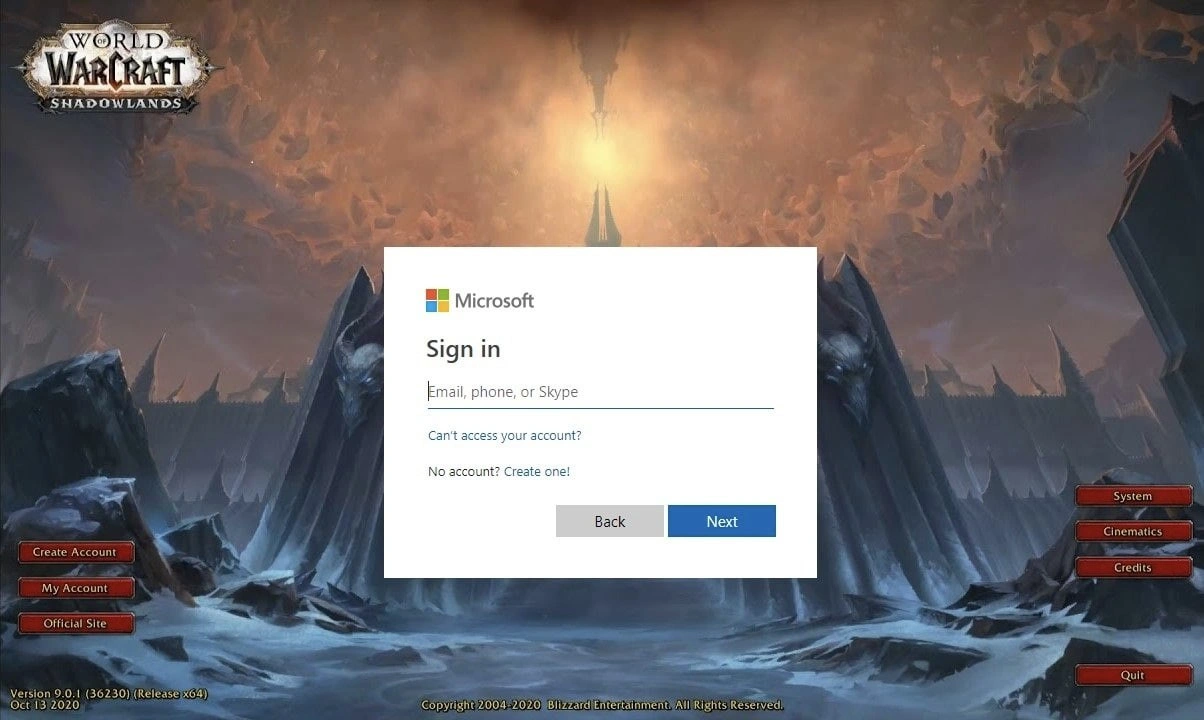
For a newer developer or someone just familiar with basic tech concepts, let’s break down what’s happening. World of Warcraft (WoW) is a popular online game set in a fantasy world called Azeroth. Normally, when you launch WoW, you see a login screen where you enter your Blizzard account details (Blizzard Entertainment is the company behind WoW). It’s a self-contained game login – you use a username/email and password that you created for the game. The background of the login screen in the meme is from the Shadowlands expansion (an update to the game) featuring a spooky, icy landscape. All the usual game menu options (“Create Account”, “My Account”, etc.) are there, implying this is the game’s start menu.

Now, front and center, there’s a Microsoft “Sign in” window pasted over that game screen. It’s the kind of dialog you normally get when logging into Microsoft services at work or school – for example, when you sign into Outlook email or Microsoft Teams, or anything using your Microsoft 365 account. It asks for “Email, phone, or Skype” and has the Microsoft logo. This is a generic Single Sign-On (SSO) prompt. Single Sign-On means one account (often your corporate or school account) can log you into many different applications without needing separate usernames and passwords for each. Companies love it because it centralizes security – you sign in once with your main credentials, and then you get access to all the authorized apps. The trade-off is you often see pop-ups like this when an app needs you to prove who you are via that central system.

In the meme, the joke is that World of Warcraft is asking you to sign in with your Microsoft corporate credentials. This is unusual – WoW has nothing to do with Microsoft logins in real life. Blizzard games have their own accounts and login system. Microsoft accounts are used for things like Windows, Office, Xbox, or Azure services, not for logging into WoW. So the image is intentionally ridiculous: it’s as if your workplace’s login system has hijacked the game. The phrase “even Azeroth needs Microsoft credentials” exaggerates that everywhere you go, you need to sign in with Microsoft’s system.

This plays on a developer’s everyday experience: at work, anything you open – be it an internal website, a code repository, or even a company Wi-Fi portal – might throw an SSO login at you. You get used to seeing that Microsoft sign-in box (or maybe one from Okta or Google, depending on your company). It becomes a running gag that you can’t do anything on a computer without entering your credentials. By putting that very corporate-looking login box into a game’s fantasy setting, the meme is saying “Ha! You thought you could relax and play? Nope, enter your work email first!”

To someone new: Microsoft credentials usually mean the username/password you use for Microsoft services. For a corporate user, that’s often their company email and password, managed by their employer’s IT via Azure Active Directory (Microsoft’s user directory in the cloud). It might also enforce extra steps like an authentication app or text message code – that’s called Multi-Factor Authentication (MFA), a security step to verify it’s really you. The meme doesn’t explicitly show MFA, but anyone who deals with SSO knows it often comes next! The link “Can’t access your account?” is a typical corporate password reset/help link, and “No account? Create one!” is what you’d see if you somehow didn’t have a Microsoft account yet. All these elements are totally normal in a business app context, but utterly out-of-place in a medieval fantasy game login.

The tags like “single_sign_on_invasion” and “game_login_screen” sum it up: it’s the invasion of SSO into a game’s login. Even if you’re not deeply technical, you know games usually don’t ask for your work email. That’s why this image is funny. It’s poking fun at how often we’re asked to log in, to the point where even a dragon-slaying game might as well require your work ID. Developers who also play games find it extra amusing (or cringe-worthy) because they use SSO at work all day; seeing it cross into their hobby is a comical nightmare. In short, the meme is saying: modern tech life = always logging in, no matter if you’re in the office or in an online fantasy world.

Level 3: One Login to Rule Them All

At a senior engineer’s level, the humor comes from recognition of SSO overreach and the ubiquity of corporate authentication in daily life. In the modern enterprise environment, everything from your code repository to the office coffee machine’s app requires you to go through some SSO flow. Many developers have that muscle memory of the Microsoft login popping up: entering your email, password, maybe approving a push on your phone. It’s practically Pavlovian. This meme takes that everyday corporate nuisance and shoves it into a sacred leisure space – the World of Warcraft login screen. Azeroth is where you slay dragons, not fill out your Microsoft credentials. The absurdity of seeing a sterile Microsoft “Sign in” modal in a fantastical game UI triggers a laugh and perhaps a groan of empathy. It’s the ultimate “work invading personal life” scenario.

There’s also a nod to vendor lock-in and how large tech companies permeate everything. Microsoft’s identity system (whether it’s an Office 365 account or an Azure Active Directory login) is a common gatekeeper for enterprise apps. The joke implies that Microsoft’s tentacles are now so far-reaching that even Blizzard’s game can’t escape. It resonates with developers who joke that “soon you’ll need to log in with Azure just to open your fridge.” Here, even the gate to the Shadowlands expansion is guarded by Microsoft’s IdP. It’s funny because it echoes reality: big companies do try to unify accounts across services (for “convenience”) – think of logging into games with your Google or Facebook account, or how a Microsoft Account ties together Xbox, Skype, Windows, etc. The meme cranks this tendency to eleven, suggesting even unrelated products get assimilated.

Gaming culture and office culture typically live in different universes for developers. By merging them, the meme creates a culture clash. A WoW player expects maybe a Blizzard authenticator prompt at most – not a corporate SSO modal usually seen when accessing Outlook or Jira. The scene also parodies the annoyance of constant sign-ins: engineers are tired of being prompted for credentials everywhere (“authentication prompt fatigue” is real). Seeing that same prompt over a beloved game is like, of course, it’s everywhere now. Some devs might quip, “Great, can’t even escape SSO on my day off.” It’s an exaggeration that points to a truth: as more apps and games go online, and as more devices are managed by corporate policies, these login dialogs are omnipresent. If you’ve ever accidentally tried to do something fun on your locked-down work laptop, you likely encountered a barrage of security pop-ups. This meme captures that exact frustration in a single image.

There’s a bit of timely subtext too. Around early 2022, news of Microsoft expanding into gaming (the talk of acquiring Activision Blizzard, the publisher of WoW) was circulating. Engineers savvy about industry moves saw humor in the idea that Azeroth might literally fall under Microsoft’s domain. This image basically says: “Welcome to World of Warcraft, brought to you by Microsoft – please log in with your Office 365 account before raiding.” It’s a playful jab at how corporate takeovers could lead to surreal integrations – the fantasy of the game world colliding with the corporate reality of its new owners. Even without that context, the meme works on the evergreen joke that no matter where you go, you’re not safe from a login box. The wording “even Azeroth needs Microsoft credentials” nails it – it personifies Azeroth (the mythical world) as if it’s just another service under the empire of Microsoft.

For seasoned developers and IT folks, there’s additional ironic nuance: SSO is supposed to make life easier (log in once, access all systems), but in practice it can be a double-edged sword. Yes, one password for everything – but also, one password for everything! When it breaks or expires, you’re locked out of multiple systems at once. The meme hints at that pain: imagine being ready to enjoy your game night and your login token has expired or your password needs changing because some policy kicked in. Suddenly your fantasy escapism has a very real-world blocker. It’s funny in the way that shared pain is funny – every dev remembers a ridiculous login issue or an intrusive security prompt at the worst time. By placing that annoyance into an epic WoW backdrop, the meme elicits a knowing chuckle: “Been there, pal. Not in Azeroth, but close enough.” In summary, at this level, the meme is a satirical commentary on the omnipresence of corporate SSO and how it follows us even into places it absolutely doesn’t belong, highlighting our love-hate relationship with these security conveniences.

Level 4: Cross-Realm Authentication

At the most technical level, this meme highlights an intersection of enterprise identity protocols with a completely unrelated domain (a fantasy game world). It's a tongue-in-cheek collision of two authentication realms. In enterprise systems, Single Sign-On (SSO) works via federated identity – a trust relationship between a Service Provider (the app or game) and an Identity Provider (IdP) (here humorously depicted as Microsoft’s corporate login). Under the hood, protocols like OAuth 2.0 with OpenID Connect (OIDC) or even old-school SAML 2.0 govern these flows. They allow one trusted authority (e.g. your company’s Azure Active Directory) to assert “Yes, this user is who they claim to be” to the application. The Microsoft login dialog we see is essentially an OAuth authorization endpoint – normally you’d see it when logging into Office 365, Azure, or any app that uses Microsoft’s IdP for authentication.

In a serious context, if World of Warcraft were to integrate with corporate SSO, the game’s client would perform an authorization code flow: the game would redirect or pop open Microsoft’s Sign-In page, you’d enter your corporate credentials (email/phone/Skype as listed), and upon success, the IdP issues a token (often a signed JWT – JSON Web Token). This token confirms your identity and possibly carries claims (attributes like your user ID or roles). The game client would then use that token to log you in to Azeroth’s servers as if you were just another enterprise app user. It’s a bizarre concept because MMO games use their own account systems (Blizzard’s Battle.net), but the meme imagines a world where even entering a mythical realm requires a certificate of authentication from Microsoft.

From a security standpoint, corporate SSO brings serious authentication muscle – things like Multi-Factor Authentication (MFA) via an authenticator app, and strict password policies. It’s amusing to imagine these applied to a video game login. (Picture the Lich King being prompted to check his phone for a 6-digit code or update his password because it expired!) The meme exploits the contrast between closed, proprietary game login processes and open standard enterprise SSO flows. On a theoretical level, it also pokes fun at vendor lock-in and the scope of Microsoft’s identity network. Azure AD’s reach is so broad that, in this joke, it’s issuing “permission to enter” a fantasy universe. There’s an implicit jab at the relentless spread of corporate technology – even the fabric of a game world isn’t safe from enterprise intrusion if you take federation to an absurd extreme.

It’s worth noting that realm is an amusingly apt term here. In Kerberos (an authentication protocol underpinning many SSO systems and Microsoft domains), a “realm” is a domain of trust. World of Warcraft’s servers are literally called “realms” by players, and they trust Blizzard’s login. By slapping a Microsoft Sign-In on the WoW screen, the meme conjures an image of cross-realm trust gone haywire: as if Azeroth’s realm trusts Microsoft’s realm to verify heroes. It’s a perfect storm of technical references: identity federation transplanted into a video game context. The humor lands because, deep down, we know the machinery of corporate logins is complex, pervasive, and often feels out of place – and here it is wildly out of place, served with a side of icy Shadowlands scenery.

Description

The image displays the login screen for the popular online game 'World of Warcraft: Shadowlands.' The background is a dramatic, fantasy-themed illustration of a dark, ethereal realm with towering spires under a glowing sky, characteristic of the game's aesthetic. The 'World of Warcraft: Shadowlands' logo is visible in the top left corner. However, superimposed directly in the center of the screen is a starkly contrasting, standard white Microsoft 'Sign in' dialog box. This pop-up, with the four-colored Microsoft logo, prompts the user for an 'Email, phone, or Skype,' effectively replacing the game's native login interface. This meme is a satirical commentary on Microsoft's acquisition of Activision Blizzard, which was announced in January 2022, shortly before this meme's creation date. The joke is in the jarring juxtaposition of an immersive fantasy world with mundane corporate IT infrastructure. For developers and tech professionals, it humorously predicts the inevitable integration of Microsoft's ecosystem into Blizzard's products, symbolizing a potential loss of identity for the beloved gaming franchise and the often-clunky reality of corporate single-sign-on (SSO) systems taking over specialized platforms
Comments

8
Anonymous ★ Top Pick The final boss of the new expansion isn't a dragon, it's the Azure AD conditional access policy that requires MFA, a TPM 2.0 chip, and a blood sample before you can log in to raid
  1. Anonymous ★ Top Pick

    The final boss of the new expansion isn't a dragon, it's the Azure AD conditional access policy that requires MFA, a TPM 2.0 chip, and a blood sample before you can log in to raid

  2. Anonymous

    Forget mythic raids - Azeroth’s hardest boss is now Azure AD conditional access; the wipe happens every time the SAML clock skew drifts by five seconds

  3. Anonymous

    The real boss fight isn't in the Shadowlands - it's getting through the seventeen authentication layers, three 2FA prompts, and inevitable "unusual activity detected" email that stands between you and your own game launcher

  4. Anonymous

    The real raid boss is now the OAuth redirect loop - and it has a soft enrage timer called 'session expired.'

  5. Anonymous

    When your game launcher needs to authenticate with a third-party SSO provider before you can even see the 'Play' button - because apparently defeating the Lich King wasn't enough of a boss fight. Nothing says 'immersive fantasy experience' quite like a Microsoft OAuth flow interrupting your journey to the Shadowlands. At least the error handling is consistent: whether you're dealing with a raid wipe or a failed token refresh, you're equally locked out of the content you paid for

  6. Anonymous

    Identity consolidation went too far: my Saturday raid is now waiting on an OAuth authorization code flow - Conditional Access says Icecrown isn’t a trusted location, so I need a JWT with role=tank and an Intune‑compliant sword

  7. Anonymous

    Acquisition complete: Shadowlands authenticates with Azure AD - MFA to resurrect, Conditional Access blocks necromancy on non‑Intune souls, and the Lich King is now Global Admin

  8. Anonymous

    Blizzard's merger refactor: Battle.net auth now a hard dependency on Entra ID, with no semver for rollback

Use J and K for navigation