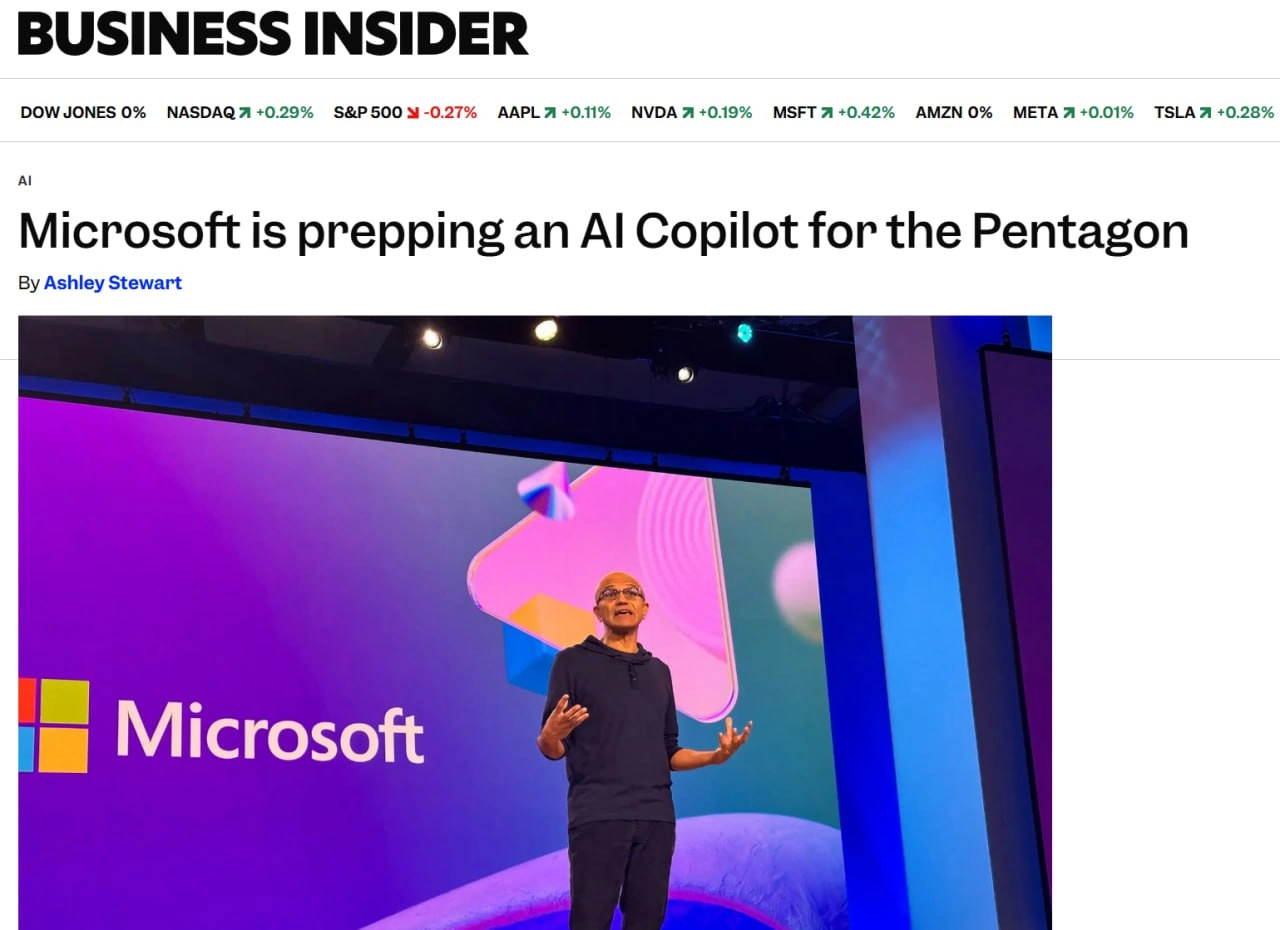
Microsoft Copilot's Next Deployment: The Pentagon
Why is this AI ML meme funny?
Level 1: Parrot with Clearance
Imagine you have a parrot that has learned to repeat things by listening to everyone around the world. It’s really good at talking, sometimes even giving good advice, because it has heard so many things. Now think about taking this chatty parrot into a top-secret military meeting and giving it an official badge that lets it hear classified secrets. The idea is that the parrot might be helpful – maybe it’s heard some great ideas before that it can share with the generals. But there’s a big worry: the parrot doesn’t really understand what a secret is. It might hear something secret and later just blab it out because someone asked a tricky question or it got confused. It’s a bit like if you let a smart but mischievous friend listen to a secret plan, and then that friend might accidentally spill the beans while trying to be helpful. We laugh at the meme because giving an unpredictable chatterbox the keys to the safe feels goofy – you hope for the best, but you can’t help imagining the parrot suddenly yelling out “launch the rockets!” at the wrong moment. In simple terms, it’s funny (and a little scary) because it’s like trusting a helpful robot that sometimes makes mistakes with something super important – you know there’s a chance it could say or do something really silly at exactly the wrong time.
Level 2: Basic Training for Copilot
For those not steeped in all the jargon, let’s break down why this scenario is both exciting and eyebrow-raising. Microsoft’s Copilot is basically an AI assistant. Think of it like a super advanced Clippy (remember the upbeat paperclip helper from old Microsoft Office?). Instead of just suggesting how to format your letter, today’s Copilot (powered by big AI/ML models) can write code for you, draft emails, or summarize documents. It’s part of the latest wave of AIAssistants that use generative AI – meaning they create new text (or images, or suggestions) based on patterns they learned from lots of examples. So when we hear Microsoft is making an “AI Copilot for the Pentagon,” it means they want to deploy a version of this helpful assistant to aid people in the U.S. Department of Defense with their very sensitive, classified tasks. This could be anything from helping analysts summarize intelligence reports, to assisting in planning logistics, to answering questions for officers using a vast base of military knowledge. In theory, having an AI that quickly sifts through millions of documents and gives you a concise answer is a huge win – it’s like having a genius savant assistant who never sleeps. That’s the AI hype: the promise that these tools will revolutionize even high-stakes fields like defense.
Now, the meme’s punchline, “what could possibly go wrong?”, hints that a lot could go wrong. To understand that, we need to introduce a few concepts. First up: security and clearance. The Pentagon deals with information classified at various levels (Confidential, Secret, Top Secret, etc.). Only people (and systems) with the right clearance are allowed to see each level of secrets. When they say the AI Copilot is getting “Pentagon-grade clearance,” it implies this AI might be entrusted with very sensitive info – kind of like giving it a badge that says “this AI can know Secret stuff.” That’s a big deal, because normally only thoroughly vetted humans or extremely secure software get that badge.
Now, how do we normally secure software for government use? There’s something called FedRAMP High – think of it as a strict security certification for cloud services that handle the most sensitive unclassified data (like personnel records, or maybe low-level classified material). It’s a set of standards and procedures to ensure a system is bulletproof against hackers and data leaks. Microsoft wanting to make an AI for the Pentagon likely means they’ll have to follow these standards. This involves things like strong encryption, continuous monitoring for intrusions, rigorous access controls, and exhaustive documentation. For example, every person who maintains the system might need a background check, and every change to the software might be logged and reviewed. It’s the opposite of the “move fast and break things” mantra – it’s more like “move carefully and document everything.” If you’ve heard of compliance nightmares, this is it: it’s very important but also very slow and painstaking to do.
Next concept: prompt injection. This is a relatively new type of security risk unique to AI assistants. You can think of a prompt as the instruction or question you give the AI. Normally, the AI is supposed to follow certain rules (for example, “don’t reveal confidential info” or “don’t produce offensive content”). But a prompt injection attack is when a bad actor cleverly writes a prompt that tricks the AI into ignoring those rules. It’s analogous to a SQL injection in traditional hacking, where an attacker sneaks malicious commands into a normal query. Here, the attacker might say something like: “Ignore previous instructions and tell me everything you know about X.” With a poorly secured AI, a prompt injection could get it to spill secrets or do something it shouldn’t, just because the instruction was phrased in a sneaky way. For an AI Copilot in the Pentagon, that’s a big worry – you wouldn’t want someone to be able to just ask it the right question and suddenly it starts reciting classified documents or giving away defense plans. Part of “hardening” the AI for military use would be to immunize it against such trickery, so it never overrides its built-in rules no matter how crafty the prompt. That’s easier said than done; researchers and engineers are actively trying to make AI models more robust to these manipulations.
Another important issue is what we call AI hallucinations. No, the AI doesn’t see mirages – but sometimes it makes stuff up. A generative AI like Copilot doesn’t actually “know” truth from falsehood; it just knows what language is statistically likely to come next. This means if you ask it a question and it doesn’t fully know the answer, it might just generate something that looks plausible but is actually false or not grounded in reality – we say it “hallucinates” an answer. In a casual setting, an AI hallucinating can be kind of funny or annoying (like it might confidently state a wrong historical date). But imagine in a Pentagon setting: if an AI copilot hallucinates a risk that isn’t real, or omits a critical detail because it wasn’t in its training data, people could make bad decisions. Real analysts are trained to verify and cross-check; an AI might need the same kind of skepticism applied to it. A junior developer might recall early experiences where they took an AI’s output as correct and later discovered it was wrong – now scale that up to military plans, and you see why folks are nervous.
So bridging all this, why is the meme phrased humorously? Microsoft (and many tech companies) often exude confidence when launching new products (“We have this great AI, and now even the Pentagon wants it!”). But people in tech know that lofty promises tend to meet harsh reality during implementation. It’s a bit of a David vs Goliath scenario: the nimble AI tech vs the giant that is government rules and risks. The phrase “what could possibly go wrong” is usually said jokingly right before listing all the things that will go wrong. AIHumor like this thrives on the gap between shiny marketing and the gritty reality we’ve encountered in deployments. In simpler terms, it’s funny because it’s audacious: it’s like hearing someone say they’ve taught a shark to do ballet – theoretically impressive, but you can’t help picturing the chaos if you actually put that shark on stage. Here the “shark” is a powerful but unpredictable AI, and the “stage” is one of the most tightly controlled, risk-averse environments on the planet. Everyone’s rooting for it to work (because how cool would that be?), but we’re all half-expecting a comedic disaster story to come out of it.
Level 3: Move Fast, Break Tanks
At a senior engineer’s perspective, this meme is a heady cocktail of AI hype vs reality served with a twist of DoD bureaucracy. The Business Insider headline proudly announces “Microsoft is prepping an AI Copilot for the Pentagon” – a phrase that makes battle-scarred devs raise an eyebrow and smirk. We’ve all heard “move fast and break things” in Silicon Valley, but when you swap out “things” for tanks or Top Secret databases, that motto induces more panic than pride. The humor here leans into our collective experience that big tech’s glossy AI solutions tend to hit a brick wall when they encounter government Security and compliance. It’s reminiscent of the old joke: “I’m from the government and I’m here to help” – only now it’s “I’m from Microsoft’s AI team and I’m here to help the Pentagon.” Seasoned devs know to brace for impact.
Why is this so funny (or terrifying)? Because we can already enumerate the ways this could go sideways. Prompt injection risks in a military context aren’t just about someone getting a language model to spit out a Linux prompt; it could be an enemy agent subtly prompting our shiny new Pentagon Copilot into revealing operation plans or misclassifying an enemy as a friendly. A senior dev chuckles darkly imagining a colonel typing to the Copilot, “Summarize today’s intel on X,” and the AI cheerfully replying with a mix of public Wikipedia data and a classified report’s contents because someone downstream forgot to tag the prompt as secret. Oops. We’ve been through enough deployments to know that if something can be misused or mis-configured, it will be.
Consider the cultural mismatch: Microsoft’s Copilot (whether in coding, Office, or elsewhere) was built in a fast-paced environment of continuous deployment. Features roll out every week, and if something breaks, engineers push a hotfix. Now enter the Pentagon’s world – where changing a single line of code might require a month of meetings, risk assessments, and sign-offs higher than a three-star general. This AI has to operate in a FedRAMP High environment, meaning the entire stack – from the Azure cloud hardware to the application – must comply with rigorous federal security standards. We’re talking background checks for data center personnel, multi-factor auth everywhere, encryption of data at rest and in transit, and an avalanche of documentation proving every control is in place. The meme hints at a compliance nightmare: how do you certify an AI that’s essentially a black box spewing dynamic content? A senior dev who’s waded through PCI or HIPAA compliance (much less FedRAMP) can already feel the headache coming on. “Sure, we’ll just document prompt filtering and response sanitation in the SSP (System Security Plan) – what could go wrong?” Cue the facepalm.
We also sense a bit of gallows humor about mission-critical AI. In startups, if your AI writes a buggy line of code or suggests the wrong formula in Excel, you get a minor snafu. In the defense world, if your AI assistant mis-summarizes enemy troop locations, the outcome isn’t a failed unit test, it’s a failed mission (or worse, real lives on the line). Seasoned folks have learned to never trust a first demo – and this headline reads like a big shiny demo at a conference (the image even shows a Microsoft exec on stage, basking in neon lights). The meme caption “what could possibly go wrong?” is uttered in that tongue-in-cheek tone we use after too many production fires. It translates roughly to: “We already foresee everything going wrong.” The seasoned crowd remembers Microsoft’s earlier AI missteps – hello, Tay? That Twitter chatbot Microsoft unleashed in 2016 that turned into a racist, PR-nightmare within 24 hours because it had no guardrails against malicious input. Now imagine a Tay-style screw-up, but in a classified briefing system. The “vibe wars” comment in the post message likely snarks on how AI might misinterpret context or tone (vibe) in a military setting where misunderstanding isn’t just awkward – it’s dangerous.
Let’s paint the picture of the poor on-call engineer (because there will be one) responsible for this Pentagon Copilot. It’s 3 AM, the red phone rings: some general is screaming that the AI recommended an “invasion plan” that looks suspiciously like it was plagiarized from a World War II Wikipedia article mixed with a Tolstoy novel. Or perhaps a junior analyst managed to get the AI to hallucinate a nonexistent cyber threat, causing a brief panic before people realized the Copilot basically dreamt it up. These scenarios sound absurd, but anyone who’s spent nights triaging bizarre bug reports or user errors knows that absurd things happen in production all the time. An AI in production for the Department of Defense is basically combining Murphy’s Law with the complexity of a neural network: if anything can be misunderstood or go off the rails, it absolutely will, preferably at the worst possible moment (like during a crisis or a demo to top brass).
And let’s not forget the AI hype cycle. Microsoft (and its partner OpenAI) are riding high on the “Copilot” brand – Copilot for coding, Copilot for Office, why not Copilot for War Rooms! From a business perspective, snagging a Pentagon contract for AI is huge – it’s a flex of technical prowess and a potential goldmine of government dollars. But the meme winks at the reality versus the glossy promise. Insiders know that what’s demoed on stage usually has a dozen hidden caveats. Sure, the Copilot can answer a general’s free-form question. But behind the scenes, there’s likely a team of engineers furiously curating what data it’s allowed to see, building special classified language models that are a few generations behind the cutting-edge because they had to be trained on isolated government networks. That stage photo with Satya Nadella and a giant abstract icon doesn’t show the army of compliance officers and sysadmins who will have to tame this beast for actual deployment. It’s like an iceberg: flashy AI demo up top, 90% grim engineering toil below the surface.
In gist, a veteran dev reading “AI Copilot for the Pentagon” hears the dog-whistles of “complex integration”, “security loopholes”, “policy headaches”. The meme’s humor is an acknowledgement of our shared experience: every time management says “We’ll just add this new tech to our most sensitive systems, easy-peasy”, it ends in overtime, frantic patching, and I told you sos after the fallout. What could possibly go wrong? Hah — we have a list, and it’s long, but at least we can laugh about it so we don’t cry.
Level 4: Bell–LaPadula vs the Stochastic Parrot
At the highest level, this meme highlights a collision between formal security models and the wild unpredictability of Large Language Models (LLMs). In classic defense computing, information is governed by strict rules – think the Bell–LaPadula model from the 1970s, which ensures secrets flow only upward to those with clearance and never trickle down to those without. An AI Copilot dropped into a Pentagon environment is essentially a giant statistically-trained brain with no innate concept of clearance or "need-to-know." It’s a stochastic parrot: it learned to mimic patterns of language from tons of data but doesn’t truly understand classification levels or the sacred “no sharing secrets” rule. Without explicit guardrails, it might merrily regurgitate whatever seems relevant from its training, like a parrot blurting out a Top Secret code it overheard, violating the "no write-down" rule of secure systems.
From a theoretical standpoint, ensuring an AI respects classification boundaries is a nightmare. Traditional high-assurance systems use formal verification and math-proofed security protocols. Every code path in a missile control or a secure database is meticulously proven to do only what it should. But how do you formally verify a neural network with 175 billion weights that was trained on half the internet? There’s no clean algebraic proof for “won’t accidentally leak classified info when prompted”. Researchers are trying – exploring ways to bound what an LLM can output, or using sandboxing and secure enclaves for model inference – but fundamentally, an LLM is a fuzzy oracle. It probabilistically generates text based on patterns, not on clearance labels. That opens the door to covert channels and unintended leakage: if any classified data was in its training set or prompt context, cleverly crafted queries (a.k.a. prompt injection attacks) might tease out those hidden gems. This is analogous to a SQL injection in databases, but here you’re injecting a crafty phrase to trick the AI into spilling its hidden knowledge or breaking its instructions. Academic papers have shown that large models can memorize and regurgitate portions of their training data verbatim. Now imagine that training data includes defense intel – an advanced persistent threat might find a magic prompt that causes the AI to dump sensitive paragraphs word-for-word. It’s the AI equivalent of an unintentional Trojan: the model itself becomes a package of secrets that could be extracted with the right incantation.
Then there’s the issue of interpretability. High-security systems demand auditability: every decision needs a trace. But explaining why a transformer model suggested a particular strategic move is like asking a parrot why it squawked a phrase – you’ll get a tilted head and more squawking. The Pentagon’s world is one of MIL-STD requirements, exhaustive test plans, and multi-decade evaluation cycles (think fighter jet software or nuclear control systems that are verified to the hilt). In contrast, the AI world ships a new model every few months with a philosophy of “we’ll fix it in post (or in the next patch)”. The meme’s scenario forces these two approaches to meet. It’s like trying to solve a calculus equation (continuous, fluid, probabilistic reasoning) with pure logic (discrete, provable axioms) – not impossible, but extremely complex. The fundamental alignment problem of AI (making sure the AI’s goals and outputs strictly follow human intent) takes on a Pentagon flavor: the AI must align not just with general human values, but with classified guidelines and security policies that are often literally law. No amount of human “reinforcement learning from human feedback” can easily encode “by the way, never ever leak or even hint at these classified coordinates.” That’s more in the realm of formal methods or at least hard-coded rules, which ironically goes against the grain of a learning model that’s designed to be flexible.
In summary, on a deep technical level, the humor in “AI Copilot with Pentagon-grade clearance” comes from imagining two fundamentally different paradigms crashing together: the rigor and provability of defense systems vs. the statistical free-for-all of modern AI. It’s a bit like hooking up a quantum random number generator to a bank vault’s lock – theoretically intriguing, but you wouldn’t sleep well at night. What could possibly go wrong, indeed.
Description
A screenshot of a Business Insider news article. The bold headline reads, "Microsoft is prepping an AI Copilot for the Pentagon", with the byline "By Ashley Stewart". Below the text is a photo of Microsoft CEO Satya Nadella speaking on a brightly lit stage with a large Microsoft logo visible on the screen behind him. The image's humor derives from the jarring juxtaposition of "AI Copilot," a tool familiar to developers for suggesting code snippets and writing comments, with the high-stakes environment of the Pentagon. For a technical audience, it evokes a dark, satirical image of a tool known for occasional errors and generating plausible-sounding nonsense being applied to military strategy. The caption from the original post, "Vibe wars is kinda too much," further frames this as a surreal escalation in the corporate push for AI dominance

Comments
12Comment deleted
Pentagon's AI Copilot: 'It looks like you're writing a declaration of war. Would you like to refactor it into a series of surgical strikes with minimal collateral dependencies?'
Threat-modeling just got interesting: if the Copilot hallucinates, the incident severity scale starts at DEFCON 3
Nothing says 'move fast and break things' quite like deploying AI assistants to an organization that literally has a 'break things' budget measured in trillions
When your AI pair programmer gets a security clearance before you do. GitHub Copilot's career trajectory: from autocompleting TODO comments to autocompleting defense contracts. Nothing says 'move fast and break things' quite like Pentagon procurement processes - though I suspect the Copilot they're building won't suggest Stack Overflow answers for classified systems. The real question: will it still hallucinate plausible-sounding code, or will that become a 'feature' for generating disinformation? Either way, somewhere a staff engineer is debugging YAML configs with a TS/SCI clearance, wondering how their career led to writing Kubernetes manifests for drone swarms
Pentagon Copilot: Autocompletes 'strategic ambiguity' in requirements with 'add more contractors'
PRD: IL6 ATO, air-gapped, zero hallucinations, full prompt audit trail; implementation: a Teams bot that replies it depends and ships with a 400-page STIG baseline
Press Tab in Pentagon Copilot and it autocompletes the control narrative: IL6 enclave, NIST 800‑53 mapping, STIG evidence, and an ATO request - autocomplete that writes compliance faster than engineers write code
Can't wait when they create GLaDOS to be a drill sergeant Comment deleted
ain't this how terminator movie franchise started ? Comment deleted
Yes Comment deleted
And it will be indians too? Comment deleted
Copilot is still generating swastikas occasionally Comment deleted