Skip to content
DevMeme
6421 of 7435
Meta Poaching OpenAI Talent via Face Detection on Livestreams
AI ML Post #7042, on Aug 15, 2025 in TG

Meta Poaching OpenAI Talent via Face Detection on Livestreams

Why is this AI ML meme funny?

Level 1: Talent Tug-of-War

Imagine you’re watching a school talent show live online, and one team has this super smart kid showing off a cool science project. Now picture the rich kid from a rival school also watching that live video. The moment he sees that genius kid on screen, he grabs a megaphone and yells, “I’ll give you a mountain of candy and a new bike if you join my team right now!” He even has his dad (who’s the school’s principal) personally call the kid with the offer.

This meme is just like that, but in the grown-up world of tech. One company (Meta, run by “Zuck”) is so eager to snag smart people from another company (OpenAI) that it jokes about using a special camera program to spot a brilliant person’s face on a live video – and then instantly sending them a jaw-dropping job offer (like a crazy huge pile of money). It’s a funny way to show how two big teams are playing tug-of-war over the really smart players. Everyone finds it silly because it’s like using a high-tech magic eye just to say “Hey, come to our side, we’ll pay you tons!” It’s a playground fight for the best teammate, blown up to billionaire levels.

Level 2: Face Detection Pipeline for Poaching

Let’s break this meme down in simpler terms. It’s referencing a scenario in the tech world where Meta (Facebook’s parent company) is aggressively hiring away people from OpenAI (the company behind ChatGPT). The meme jokes that Meta has a high-tech system watching every OpenAI livestream (live video broadcast) to spot any Asian face on screen, because apparently if someone on OpenAI’s team looks Asian, Meta assumes they’re a top AI genius and immediately sends them a job offer worth hundreds of millions of dollars. It’s a wild joke mixing AI technology with cutthroat hiring practices for a laugh.

Some key points and terms:

  • Face Detection: This is an AI/ML technology where a computer can look at a picture or video and find human faces. It draws boxes around faces or returns coordinates – essentially saying “there’s a face here.” It doesn’t identify who the person is (that’s face recognition), it just knows something is a face. In the meme, Meta is running a face detector on “every frame” of OpenAI’s video stream. A frame is like a single image in the video; checking every frame means constantly watching in real-time. So Meta’s system is basically scanning the video feed for any people. Doing this continuously is quite technical – it means Meta possibly set up an automated program to screen-scrape the livestream (capture the video) and then apply computer vision models to it. This hints at how far tech companies might go using tech on each other – here it’s depicted in a humorous, sneaky way.

  • “If it spots an Asian…”: This part is playing on industry stereotypes and the specific situation. Many notable AI researchers are of Asian heritage. Recently, a few Asian-American researchers who worked at OpenAI (and often appeared in OpenAI’s public events) left to join Meta. The meme cheekily suggests that Meta’s detection system is literally using “Asian-ness” as a signal to trigger a recruiting action. In non-joking terms, Meta likely noticed those particular individuals (who happened to be Asian) because of their expertise and visibility, not just their ethnicity. But the joke simplifies it in a tongue-in-cheek way: camera sees an Asian face at OpenAI → immediately send that person a giant offer. It’s hyperbolic humor about talent poaching (stealing hires from a rival). To be clear, real companies don’t explicitly hire people just for looking a certain way – they care about skills and achievements. The meme is exaggerating to be funny and also referencing the specific real people involved (who are Asian). It’s a form of hiring humor highlighting how tech firms sometimes chase certain profiles of candidates very eagerly.

  • 9-figure offer: In salary slang, “figures” refer to digits. A 9-figure sum is a number with nine digits. That means at least $100,000,000 (one hundred million dollars). 😮 This is an astronomical amount of money for an individual job offer. Virtually nobody gets a true nine-figure salary – even CEOs typically don’t get that in straight salary (though sometimes in stock or company sale deals it can happen). Here, “9-figure offer” is an absurd exaggeration to emphasize how coveted these AI experts are. It implies Meta is willing to pay whatever it takes, even hundreds of millions, to lure someone from OpenAI. So it’s basically saying “the offer is insanely high, way beyond normal”. For context, a “6-figure” salary (like $100k) is common for engineers at big tech; a “7-figure” (million+) is rare air for maybe senior or executive roles; “8-figure” (tens of millions) would be like a top executive or someone with shares; “9-figure” is almost cartoonish – basically treating an engineer like a superstar athlete contract. Using 9 figures in the joke just underlines how crazy the AI talent race has become in the public’s eyes.

  • Zuck’s personal email: “Zuck” is the nickname for Mark Zuckerberg, the CEO of Meta. Saying the offer comes from Zuck’s personal email (like him directly emailing the candidate) emphasizes how high-priority this hire is. Normally, initial contact in recruiting comes from a recruiter or a hiring manager, not the CEO! If Mark Zuckerberg himself emails you “Hey, join my team, I’ll pay you $X,” you must be a very important catch. In the meme, this detail adds to the absurdity and humor. It paints a picture that Meta has a system so automated and urgent that the moment it detects a potential star (especially an Asian researcher on OpenAI’s stream), Mark himself (or his account) shoots out an email with an offer. It’s hyperbole – obviously Zuck wouldn’t literally be sitting there sending emails frame-by-frame – but it’s funny to imagine. This detail pokes fun at Meta’s corporate culture of top-down involvement in major hires and also how personal the talent war can get. It’s like saying, “poaching you is so important, the boss will personally handle it.”

  • OpenAI livestream & recent hires: The context here is that OpenAI (famous for AI models like GPT-4) has done public livestreams where their team members demo new AI features or discuss research. Some of those team members – in particular, a few brilliant young researchers – were visible to the public. In a twist, a couple of those folks actually left OpenAI to join Meta’s new AI research lab (“Meta Superintelligence Labs”). The meme references a real tweet where Meta’s team welcomes Hyung Won Chung, Jason Wei, and Edward Sun aboard – these are real people who had been at OpenAI. The phrase “some may recognize them from various recent livestreams” basically confirms they were the ones appearing in OpenAI’s videos not long ago. To someone newer in tech, it might be surprising: aren’t these companies working on similar cutting-edge AI? Yes, and that’s why they fight over the same talent. Poaching is the term for when Company B hires someone away from Company A, especially a competitor. It often involves offering a lot more money or a bigger role. This meme is elaborating that scenario in a comedic way. Instead of the usual discreet phone calls or LinkedIn messages to woo someone, it imagines an actual AI system doing the job instantaneously.

  • AI talent war reality: The joke underscores a real trend in AI/ML fields: there’s a limited supply of experts who can build advanced AI like GPT or similar. Companies like OpenAI, Meta, Google, etc., are in a fierce competition to recruit these experts. Sometimes it leads to crazy salary offers, huge bonuses, or other aggressive tactics. For example, a company might fast-track hiring or even acquire an entire startup (called an acqui-hire) just to get the talent. The meme’s scenario is obviously exaggerated – Meta probably isn’t literally running face scans on YouTube live videos – but it symbolizes how aggressive and somewhat sneaky recruiting can feel. There have been anecdotes of recruiters watching conference talks or reading academic papers and then immediately contacting the presenter/author to offer jobs. This is just the next level: doing it live, with AI, automated. It’s funny because it’s almost believable in today’s hype climate.

  • Why specifically “Asian face”?: It’s worth noting for clarity: the meme does not mean that being Asian is a requirement for getting an offer. It’s riffing off the coincidence that the recently poached OpenAI researchers were of Asian descent (as are many renowned AI researchers globally). So, in the joke, Meta’s system uses a crude proxy – spotting an Asian face – to identify an AI expert. This plays on a stereotype in a jokey way. It’s a bit edgy, but the intention is to humorously point out how over-simplified an automated approach can be (like a bad AI model picking the wrong feature to focus on). It also implicitly flatters that group (suggesting “Asians in AI are so sought-after that just seeing one on a rival’s team means grab them”). In reality, Meta wants any top talent from OpenAI, regardless of ethnicity. The joke just uses this detail to make the scenario more punchy and memetic. It’s one of those cases where tech humor intersects with cultural reference – because many viewers of the meme might recognize the pattern of top AI labs having lots of Asian researchers, the joke lands with that audience.

  • Meta Superintelligence Labs & OpenAI: These names might be new if you’re a junior dev. OpenAI is the company that created ChatGPT, and it grew very fast with high-profile research. Meta (formerly Facebook) has several AI research divisions (FAIR, Reality Labs, etc.), and “Meta Superintelligence Labs” is evidently a new initiative (the tweet implies Meta’s starting a fresh high-end AI lab focusing on long-term AI research). When a new lab like this is set up, they need top people. Instead of training newbies, often they hire proven experts from elsewhere – even if it means pulling them from rivals. The tweet by Hyung Won Chung basically says he and two colleagues had a great time at OpenAI but recently joined Meta’s new lab and are excited by the compute resources and long-term focus. This gives context: Meta likely offered them a chance to build something new (and, presumably, great compensation and resources). Those factors are very tempting. From a Career/HR angle, this shows how a career move can happen: employees might leave for better opportunities or because a competitor is investing heavily in something they’re passionate about. The meme exaggerates how that hiring happened (with instant detection and emailing), but the end result is true – they switched teams. For someone early in their career, it’s a peek into how dynamic the tech job market at the top can be.

  • Humor and reality check: The meme is funny, but it also subtly highlights issues:

    • Automation gone wild: Using AI to hire AI people – it’s like a snake eating its tail. It’s amusing to imagine some script or AI agent doing a recruiter’s job automatically. It’s a bit of AI humor about how far we might trust algorithms (would you trust a face detector to pick your next hire? Probably not, but Meta trusts AI in many areas, so it’s a playful jab).
    • Extreme corporate competition: It illustrates CorporateCulture extremes – basically saying Meta will stop at nothing (not even spying on streams) to one-up OpenAI. Companies do watch each other, but this cartoonish depiction makes it laughable rather than scary.
    • Bias in AI: For those learning about AI, it’s a reminder that AI systems are only as good as their design. A system that sends offers based on something like appearance or ethnicity would be terribly biased and unethical in reality. It’s obviously not serious here, but it hints at the idea of algorithmic bias (where an AI could pick up on race or other attributes in hiring if we’re not careful). The fact we recognize this as wrong is part of why it’s funny – it’s so wrong it’s absurd.

In summary, to a less experienced developer or someone new to this context, this meme is saying: “Big tech companies are so desperate to hire the best AI people that we joke they might literally use AI to watch each other’s video streams and instantly throw huge money at any smart-looking person (in this case, an Asian researcher) they spot.” It’s a mix of AI industry trends and hiring humor. The image being a screenshot of a Twitter thread gives it a feeling of immediacy – like we’re seeing live evidence of this happening. The blurred faces in the photo likely are the actual guys who moved to Meta (blurred perhaps by the meme-maker for privacy or comedic effect).

For someone learning from this:

  • Poaching is a real term: it means hiring someone away from a competitor, akin to how one might illegally poach animals – it’s grabbing prized “game” from someone else’s territory (not illegal in hiring, of course, just metaphorical).
  • AI talent frenzy: This is a big theme in tech now. AI experts, especially those who’ve proven themselves by building famous models or papers, are in crazy demand. Companies sometimes offer them huge salaries, bonuses, or roles like leading a new lab.
  • Tech rivalry: OpenAI and Meta are both trying to be leaders in AI. This kind of joking reflects that rivalry. Others in this space include Google’s DeepMind, Microsoft (which partners with OpenAI), etc. So it’s a bit like sports teams trading star players, except it’s done via offering jobs.

Importantly, this meme’s tone is light-hearted. It’s poking fun at the absurdity of it all. Even if you don’t catch every reference, the image of an AI algorithm literally hiring people by face is cartoonish enough to be funny. Yet, it’s grounded in truth – that’s where the best tech humor lies, in that overlap between reality and the ridiculous.

Level 3: Automated HeadHunting

At the core of this meme is a razor-sharp satire of the AI talent poaching wars between big tech companies, particularly the rivalry of OpenAI vs Meta. The tweet thread suggests Meta built an automated recruiting pipeline that uses computer vision on OpenAI’s livestream to identify desirable engineers. It jokes: if Meta’s system detects a face (especially an Asian face) on Sam Altman’s livestream, it immediately triggers a nine-figure job offer from Mark “Zuck” Zuckerberg himself. This absurd scenario lands because it exaggerates real industry behavior – AIIndustryTrends where companies fiercely compete for a small pool of top AI researchers, sometimes in borderline ridiculous ways.

Let’s unpack why this hits home for senior engineers:

  • Face Detection for Hiring: In tech, face detection is a well-known AI/ML capability – using neural networks to find human faces in images or video. Normally it’s used for things like photo tagging or phone unlocking, but here it’s repurposed as a HR tool. The idea of Meta running a face detector on “every frame” of a competitor’s livestream is both hilarious and plausible enough to sting. It implies Meta is so hungry for talent they’d literally screen-scrape a video feed from OpenAI (their competitor) just to spot new face-shaped leads. This is AIHumor at its finest: a cutting-edge AI tool being used for something as petty (and brilliant) as corporate headhunting. It’s a perfect blend of HiringHumor and TechIndustryHumor – envisioning an algorithm that treats faces as résumés.

  • “If it spots an Asian…”: The meme specifically calls out Asian faces. This is an edgy punchline playing on the demographic reality in AI research (AIHypeVsReality). A significant number of prominent AI researchers and engineers happen to be of Asian descent, and the meme riffs on the stereotype that if a talented AI expert appears on camera, chances are they look Asian. So Meta’s “talent detector” uses ethnicity as a feature – a tongue-in-cheek nod to how biased or simplistic an automated hiring algorithm could be. It’s as if Meta reduced its scouting model to: “Spot an Asian face at OpenAI → must be a genius → trigger mega offer.” This is a joke about salary_as_classifier – using a single visual signal to decide an astronomical salary class. Of course, in reality any serious recruiting wouldn’t (and shouldn’t) be this shallow. But the humor lies in how corporate culture often chases patterns: if many star engineers fit a profile, a lazy algorithm (or a lazy exec) might just target that profile. It’s a satirical take on both AI bias and the real pattern of aggressive recruitment of Asian engineers in Silicon Valley. Senior folks see the double irony: we spend years removing bias from ML models, yet here a mega-corp might intentionally bake one in because it thinks it found a hack for finding talent.

  • Nine-Figure Offers & Zuck’s Personal Email: A nine-figure offer means at least $100,000,000 – an eye-popping amount as a salary or bonus. This number is obviously hyperbole for comedic effect, but it’s only funny because it’s just barely outside reality. In the current AI gold rush, top-tier AI researchers and engineers do command staggering compensation (though usually in the single-digit millions, not hundreds of millions – 9 figures is cartoonish). The joke suggests Meta is so desperate to assemble an “Avengers” of AI that even a 100 million dollar bait is on the table. Tying it to Zuck’s personal email cranks the humor up further. In normal circumstances, even high-level hires go through HR or recruiting staff; a CEO personally emailing a candidate is rare and denotes extreme priority. The meme implies that Mark Zuckerberg is personally on the lookout, ready to fire off offer letters the instant his AI system pings. This lampoons the CorporateCulture of competitive overdrive – like a battlefield where generals (CEOs) personally swoop in to capture prized “assets” (talent). For seasoned developers, this conjures real anecdotes: e.g., famous stories of Google’s CEO or Facebook’s CTO directly courting AI luminaries, or companies offering outrageous stock grants after a competitor’s breakthrough. It’s both ridiculous and reminiscent of actual Career/HR dramas during tech boom eras.

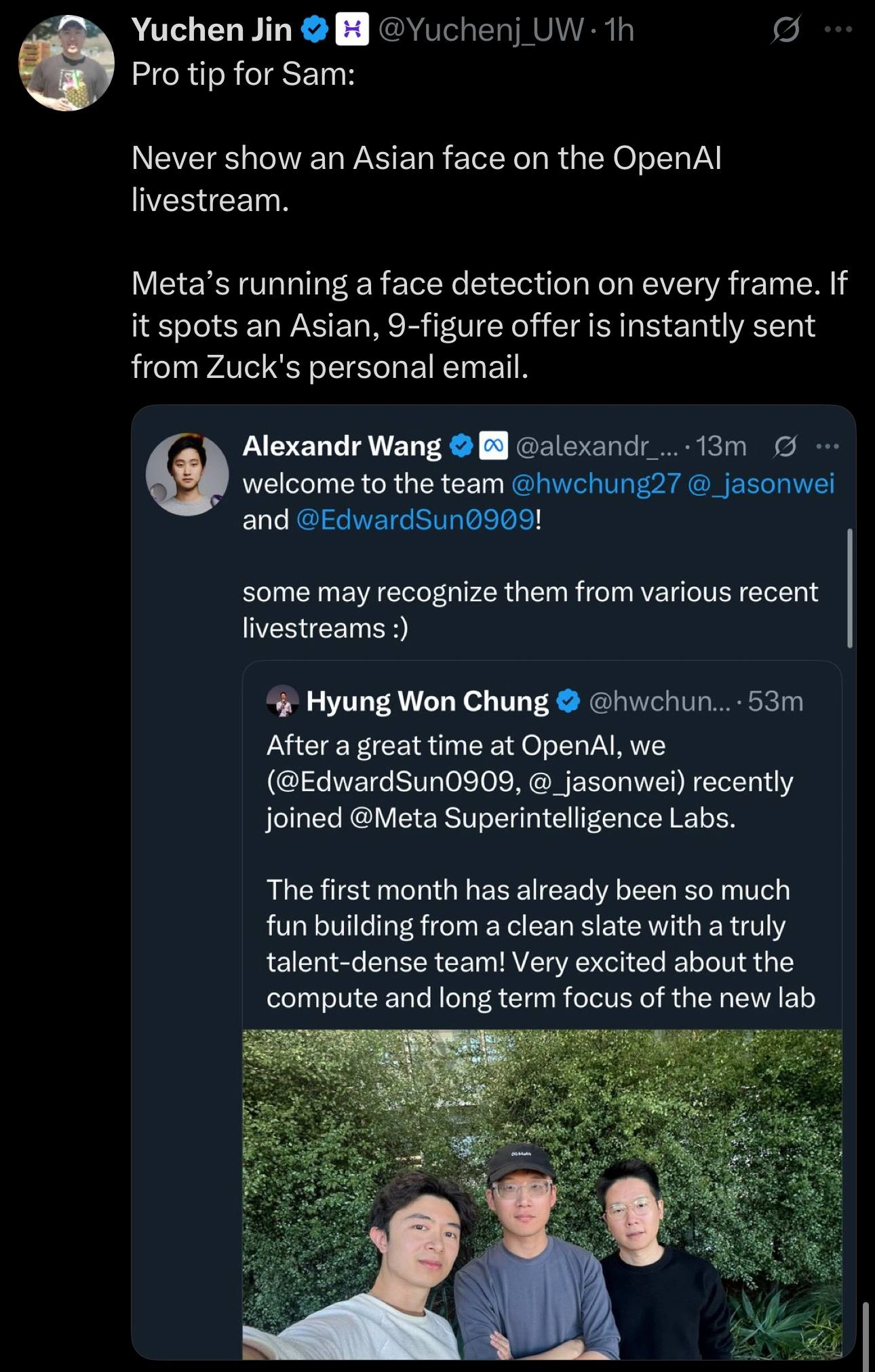
  • The Embedded Tweets – Proof in Jest: The screenshot shows a nested X (Twitter) thread confirming that Meta did hire people from OpenAI. Alexandr Wang’s tweet welcomes @hwchung27, @_jasonwei, @EdwardSun0909 to Meta’s “Superintelligence Lab”, and Hyung Won Chung (one of those hires) announces leaving OpenAI to join Meta. The line “some may recognize them from various recent livestreams :)” winks at the fact that these guys were literally seen on OpenAI’s public streams before. To a senior techie, this is deliciously on the nose: it’s as if the meme’s “pro tip” came true. OpenAI unwittingly showcased their talent on video, Meta noticed (“recognized them”), and promptly poached them. This scenario epitomizes ai_talent_poaching. In real life, companies absolutely monitor each other’s research publications, demos, and yes, even webinars or streams. If an impressive engineer or scientist becomes visible (say they give a talk or demo), it’s not unheard of for recruiters or rival managers to reach out soon after. The meme exaggerates it into an instant automated response, but every senior dev knows that feeling when a teammate presents at a conference and suddenly gets LinkedIn messages from FAANG recruiters. It’s too real and thus hysterical.

  • System Architecture of the Joke: From a technical standpoint, one can imagine Meta’s devious livestream_screen_scraping system:

    1. Capture Frames: It taps into OpenAI’s live video feed, grabbing frames in real time.
    2. Face Detection Model: Each frame is fed to a state-of-the-art face detection algorithm (Meta happens to be a leader in computer vision, so they could deploy something like a custom CNN or use DeepFace tech). This model scans for any human face in the image.
    3. Identification/Classification: If a face is found, another model or step assesses it. The meme assumes classification by ethnicity (since it specifically flags "Asian face"). More realistically, Meta might run face recognition to check if the person matches a database of known AI experts. (They could have a list of top researchers, with headshots scraped from papers or LinkedIn – essentially an AI-powered headhunter’s Rolodex!). The idea of salary_as_classifier comes in here: the output isn’t a category like “cat” or “dog”, but rather the size of the offer to send. It’s as if the classifier has two classes: “regular hire” (maybe send a standard recruiter email) and “must-have unicorn” (send a $100M offer from the CEO).
    4. Automated Outreach: Finally, an automated action triggers: generating an email from [email protected] straight to the target. Picture a script interfacing with Meta’s email server or maybe an internal tool that can fire off offer letters duly signed by Zuck. The notion of such an email arriving out of the blue is outrageous and hilarious — “Hi, it’s Mark. Saw you on that stream. How about $120M to join Meta?”.

Let’s humorously illustrate this “face_detection_recruiting pipeline” in pseudocode:

# Pseudocode for Meta's secret talent-sniffing tool
for frame in OpenAI_livestream:
    faces = face_detector.find_faces(frame)
    for face in faces:
        attributes = face_analyzer.analyze(face)
        person_id = face_recognizer.identify(face)
        # Check if the face belongs to a known OpenAI talent or matches desired profile
        if attributes.ethnicity == 'Asian' or person_id in openai_top_engineers:
            offer_amount = 1e8  # 9 figures = 100,000,000 (going big!)
            send_email(from="[email protected]",
                       to=person_id.email if person_id else "talent@unknown",
                       subject="Join Meta?", 
                       body=f"Hi, we liked your OpenAI livestream appearance. How does ${offer_amount} sound?")
            break  # send one offer and stop, no need to spam every frame

// The above is tongue-in-cheek – real code would be more complex (and ethical considerations ignored here are enormous!).

For seasoned developers, this code snippet is comedic because it’s an absurdly simplified pipeline: it blatantly uses ethnicity == 'Asian' as a trigger and assumes an email can be found – clearly not a serious or fair hiring practice. It lampoons the idea of “salary as a service” or automated headhunting. The salary_as_classifier concept shows up as we treat offer_amount as the “predicted label” for the input face.

  • Industry Commentary: The meme highlights an AIIndustryTrend where companies form new AI research labs (like Meta’s “Superintelligence Labs”) and stock them with as much talent as possible, sometimes by draining competitors. It’s reminiscent of an arms race, where talent is the weapon. In the AI era, people joke that talent > algorithms > compute in importance; whoever has the most brilliant minds can leap ahead. That’s why a scenario like Meta instantly sniping OpenAI’s experts resonates. There’s also a jab at the AI hype vs reality: While companies hype up their mission to benefit humanity through AI, behind the scenes they’re engaged in mercenary tactics, trying to out-hire each other with huge sums. It’s a reality-check wrapped in humor – the lofty talk of cooperation often gives way to CorporateCulture competition for individual rock stars.

  • Shared Trauma and Laughter: Anyone who’s been in tech for a while has seen or heard of colleagues getting lured by competitors with big offers, or entire teams “acqui-hired” for insane valuations. It can be disruptive, even farcical at times. This meme triggers a knowing laugh (tinged with a bit of anxiety) – it’s funny because it’s barely exaggerated. As a community, developers cope with these hyper-competitive dynamics by joking that “it’s so extreme, might as well have an AI do the recruiting.” We also recognize the subtext about diversity and bias – using “Asian face” as a proxy is wrong, but here it’s used satirically to poke fun at simplistic thinking. In short, the meme lands so well with experienced devs because it bundles up poaching paranoia, technology misuse, and the absurd money in AI into one darkly comic package.

Description

A Twitter/X screenshot of a post by Yuchen Jin (@Yuchenj_UW) with a joke aimed at Sam Altman: 'Pro tip for Sam: Never show an Asian face on the OpenAI livestream. Meta's running a face detection on every frame. If it spots an Asian, 9-figure offer is instantly sent from Zuck's personal email.' The post quote-tweets Alexandr Wang (@alexandr_) from Scale AI welcoming Hyung Won Chung, @_jasonwei, and @EdwardSun0909 to the team, noting 'some may recognize them from various recent livestreams :)'. Hyung Won Chung's embedded post announces that after a great time at OpenAI, they recently joined @Meta Superintelligence Labs. A group photo shows three people standing together outdoors

Comments

14
Anonymous ★ Top Pick Meta's recruitment pipeline: OpenAI livestream -> face detection model -> Zuck's personal Gmail -> 9-figure offer. Latency: 3ms. The only AI product at Meta that actually ships on time
  1. Anonymous ★ Top Pick

    Meta's recruitment pipeline: OpenAI livestream -> face detection model -> Zuck's personal Gmail -> 9-figure offer. Latency: 3ms. The only AI product at Meta that actually ships on time

  2. Anonymous

    Meta's new face detection model has a single classification layer: `is_poachable_openai_researcher`. It's the only model they have that's deployed straight to Zuck's outbox without a single PR review

  3. Anonymous

    Proof that Meta’s computer-vision pipeline has only two classes: background noise and ‘worth a blank-check offer.’

  4. Anonymous

    The real reason Meta pivoted to open-source AI wasn't philosophical - it was just cheaper than their previous strategy of buying every engineer who appeared in an OpenAI demo for more than their Series B valuation

  5. Anonymous

    The joke brilliantly captures the absurdist reality of AI talent wars where companies deploy the very technology they're building - real-time computer vision and automated decision systems - to poach each other's researchers. It's a meta-commentary on how the tools of AI research (face detection, automated triggers, instant notifications) could theoretically be weaponized for recruitment at scale. The '9-figure offer from Zuck's personal email' hyperbolically references both the astronomical compensation packages in AI research and the direct CEO involvement in recruiting top talent, a practice that's become standard at the executive level when competing for researchers who can advance AGI timelines. The underlying truth: in 2024's AI landscape, showing your team publicly is essentially painting targets on their backs for competitors running sophisticated talent intelligence operations

  6. Anonymous

    Kafka -> face-embedder -> Lambda(OfferService, amount=1e9): event‑driven recruiting with an SLO tighter than your stream’s P99 inference latency

  7. Anonymous

    OpenAI's face detector: superhuman accuracy from overfitting to the ICML best paper author distribution

  8. Anonymous

    Somewhere in PeopleOps: Kafka(openai.livestream.frames) -> CLIP embeddings -> ANN search against 'known_wizards' -> if similarity > 0.98 then OfferService.send(9_figures); finally, an HR system with a lower latency SLO than production

  9. @volkov_s 11mo

    I won't believe any AI can distinguish asian faces

    1. @deadgnom32 11mo

      why not?

    2. @deadgnom32 11mo

      machine learning did it very well long before any GPTs came out. don't see a reason why they wouldn't now

    3. dev_meme 11mo

      Yeah, Chinese also confused how similar all people of your race look like 🌚

    4. dev_meme 11mo

      In 2018 solo face recognition was working perfectly (99%+ success) with only parts of face being visible That made protest in HK in 2020, where people used mask, especially absurd since they all were easily identifiable as long as eyes and oval of face is visible (which is always a case during daylight)

      1. @Box_of_the_Fox 10mo

        You have some link where I could read more about it?

Use J and K for navigation