Skip to content
DevMeme
3752 of 7435
Medical Advice For Night Owls
MentalHealth Post #4092, on Jan 25, 2022 in TG

Medical Advice For Night Owls

Why is this MentalHealth meme funny?

Level 1: The Lazy Answer

Imagine telling someone, "My shoes hurt when I walk to school," and they answer, "Then don't walk to school," then charge a lot of money. The answer sounds clever for one second, but it does not really help. The funny part is that the doctor solves the problem in the laziest possible way and still sends a huge bill.

Level 2: Obvious Is Not Easy

The meme connects to sleep deprivation and developer fatigue because many programmers have irregular schedules. Late-night coding can feel productive in the moment: fewer meetings, fewer messages, more quiet time. The cost often arrives later as bad sleep, stiff posture, slower thinking, and a morning that feels personally hostile.

The doctor's advice is funny because it is both simple and silly. If mornings hurt, avoid mornings. That is like telling a developer, "If production breaks when you deploy, stop deploying." It removes the immediate trigger without understanding the real problem.

In software work, this happens when people offer advice that ignores context. "Write better code" is not a plan. "Fix technical debt" is not a schedule. "Have work-life balance" is not useful if the team is understaffed, on call, and rewarded for heroics. A good solution needs constraints: time, money, responsibility, risk, and what the person can actually change.

The bill marked $3000 makes the advice feel absurdly overpriced. That is why the AI-doctor caption fits: a very short answer can still be presented as expert output if the system around it looks official enough.

Level 3: Closed As Lifestyle

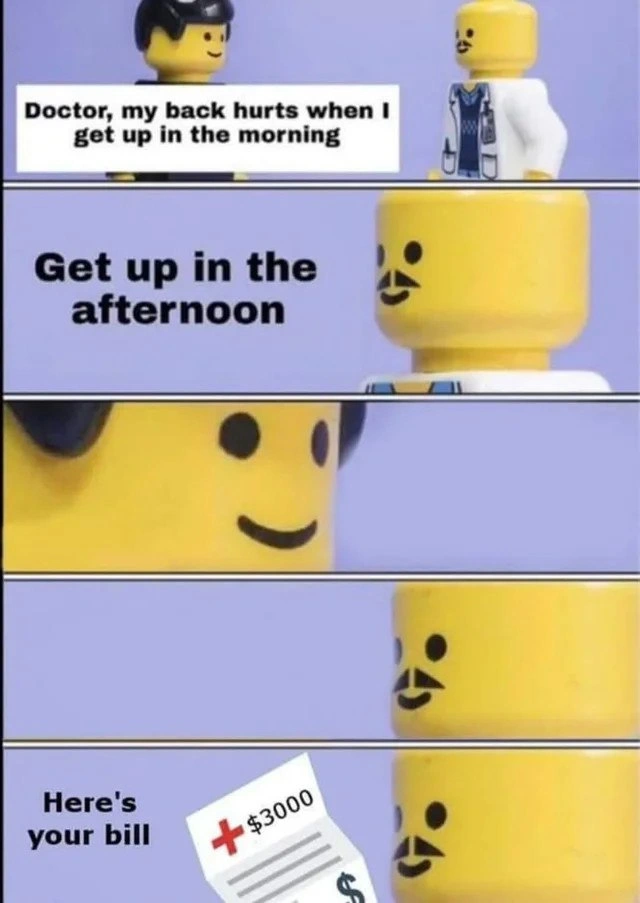
The comic starts with a patient saying:

Doctor, my back hurts when I get up in the morning

The doctor replies:

Get up in the afternoon

Then, after a few silent reaction panels, the doctor presents:

Here's your bill

next to a paper showing $3000. The joke is the oldest consulting pattern in miniature: redefine the problem so the solution is trivial, then invoice as if wisdom has just descended from the mountain.

For developer culture, the mapping is painfully easy. A programmer says, "I feel terrible when I start work after staying up until 3 AM debugging." The system replies, "Stop staying up until 3 AM." Technically correct, operationally useless. This is the same flavor of advice as "just rewrite it," "just add tests," "just use Kubernetes," or "just don't deploy on Fridays." The recommendation may contain truth, but it ignores constraints, incentives, history, and the fact that everyone involved is already tired.

The original post frames this as an AI-doctor money machine, which adds a second layer: shallow pattern matching can sound authoritative when delivered through the right interface. If an automated system sees symptom A and outputs lifestyle change B, the answer might be obvious, incomplete, or missing risk context. The meme is not making a precise claim about medicine; it is mocking the business model where a short, generic answer can be packaged as expert diagnosis and priced like a production incident retrospective.

The developer productivity angle is that many workplace problems really are lifestyle and process problems wearing technical masks. Back pain, sleep deprivation, burnout, attention fragmentation, and late-night coding are not separate from engineering output. They change judgment, patience, review quality, incident response, and the willingness to read documentation longer than a warning label.

The cynical punchline is the bill. The doctor does not solve the patient's life; he supplies a workaround and monetizes the encounter. In engineering terms, he closes the ticket with "works as designed" after changing the reproduction steps. Somewhere, a dashboard turns green.

Description

A five-panel LEGO-style doctor comic shows a patient telling a doctor, "Doctor, my back hurts when I get up in the morning." The doctor replies, "Get up in the afternoon," followed by a silent close-up reaction from the patient and doctor. The final panel shows the doctor saying, "Here's your bill," next to a paper marked with a red cross and "$3000." The image has no explicit code or tooling reference, but it maps loosely to developer culture around late-night schedules, sleep debt, and treating lifestyle bugs as trivial one-line fixes.

Comments

3
Anonymous ★ Top Pick Classic root cause analysis: classify the back pain as a scheduling bug and invoice like the fix shipped to production.
  1. Anonymous ★ Top Pick

    Classic root cause analysis: classify the back pain as a scheduling bug and invoice like the fix shipped to production.

  2. @ZgGPuo8dZef58K6hxxGVj3Z2 4y

    Lmao

  3. @SamsonovAnton 4y

    What's the joke, though?

Use J and K for navigation